
BIOC-200 · Lesson 1 of 12 · 26 min
Biochemistry: the chemistry of living things
▶ Video coming soon A video version of this lesson is on the way.
Biochemistry is the study of life at the level of molecules. It asks what living things are made of, how those molecules are built and shaped, and how the chemical reactions inside a cell are organized so that the cell can grow, move, sense its surroundings and copy itself. A muscle contracting, a seed sprouting, a bacterium dividing every twenty minutes and a neuron firing are all, at bottom, chemical events. They obey the same laws of bonding, equilibrium and energy that govern a reaction in a flask. What makes them remarkable is their scale and coordination: thousands of different reactions running side by side in a space a few micrometers across, each catalyzed by its own enzyme and each switched on or off as the cell's needs change.
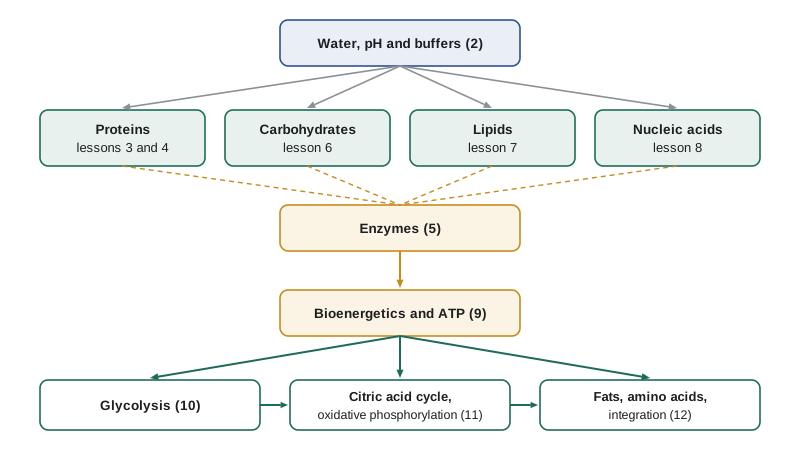
This course introduces the four great classes of biological molecules (proteins, carbohydrates, lipids and nucleic acids), the water in which they work, the enzymes that make their reactions fast, and the energy currency that pays for it all. It ends with an overview of metabolism, the network of reactions that breaks food down to release energy and builds the cell's own molecules back up. The later biochemistry courses take each of these topics further: BIOC-310 covers protein structure and function in depth, BIOC-320 enzymology, BIOC-330 and BIOC-331 metabolism, and BIOC-340 nucleic acids and gene expression. Here the aim is to see the whole picture and to learn the chemical reasoning that ties it together.
The elements of life
Living matter is built from a surprisingly short list of elements. Four of them, hydrogen, oxygen, carbon and nitrogen, make up about 96% of the mass of the human body. Add phosphorus and sulfur and you have the six elements that form almost every biological molecule; biochemists sometimes remember them as CHNOPS. A second group of elements is present as ions: sodium, potassium, calcium, magnesium and chloride carry electric charge across membranes, stabilize structures and act as signals. A third group, the trace elements, is needed only in tiny amounts but cannot be done without: iron in hemoglobin, zinc in many enzymes, copper in the enzymes of respiration, iodine in thyroid hormone, selenium in a few antioxidant enzymes, and cobalt at the heart of vitamin B12.
Why carbon? A carbon atom forms four strong covalent bonds, to other carbon atoms and to hydrogen, oxygen, nitrogen and sulfur. Carbon–carbon bonds are stable enough to last but not so stable that enzymes cannot rearrange them. Carbon can form chains, branches and rings, single and double bonds, and it can bear a tetrahedral arrangement of four different groups, which makes biological molecules chiral. No other element combines these features; silicon, the obvious alternative, forms weaker bonds to itself and much stronger, almost inert bonds to oxygen.
Hydrogen, oxygen and nitrogen matter just as much. Oxygen and nitrogen are more electronegative than carbon and hydrogen, so bonds such as O–H and N–H are polar. Polar groups make molecules soluble in water and allow them to form hydrogen bonds, the weak but numerous attractions that hold the two strands of DNA together, shape proteins and give water its unusual properties. Phosphorus, as phosphate, links the units of DNA and RNA and forms the high-energy bonds of ATP. Sulfur appears in two amino acids, cysteine and methionine, and in the disulfide bridges that stabilize many proteins outside the cell.
Functional groups: the vocabulary of biochemistry
Biological molecules can look intimidating, but most of their chemistry is the chemistry of a dozen functional groups. A hydroxyl group (–OH) makes sugars and alcohols polar and soluble. A carbonyl group (C=O) appears as an aldehyde at the end of a chain or a ketone in the middle; sugars are aldehydes or ketones carrying several hydroxyl groups. A carboxyl group (–COOH) is acidic and, at the pH of a cell, has lost its proton to become a negatively charged carboxylate (–COO⁻). An amino group (–NH₂) is basic and is usually protonated to –NH₃⁺. A phosphate group carries negative charges and can link two molecules as a phosphodiester. A thiol (–SH) can be oxidized to form a disulfide (–S–S–) with another thiol.
When two functional groups react, they form the linkages that join small molecules into large ones. A carboxyl and an amino group condense to form an amide; in proteins this is called a peptide bond. A carboxyl and a hydroxyl group form an ester, the linkage of fats and of many membrane lipids. Two hydroxyl groups on sugars form an ether-like glycosidic bond. A phosphate links to two hydroxyl groups as a phosphodiester in nucleic acids. In every one of these reactions a molecule of water is removed, which is why they are called condensation or dehydration reactions. The reverse reactions, which add water to break the linkage, are hydrolyzes. Digestion is largely a series of hydrolysis reactions catalyzed by enzymes.
Monomers and polymers
The large molecules of life are polymers built from a small set of building blocks. Proteins are chains of amino acids, of which twenty kinds are coded by the genes. Nucleic acids are chains of nucleotides: four kinds in DNA and four in RNA. Polysaccharides such as starch, glycogen and cellulose are chains of sugars, often just glucose joined in different ways. Lipids are the exception: they are not polymers, but they assemble in water into large structures such as membranes and fat droplets, held together by the hydrophobic effect rather than by covalent bonds.
This modular design is economical. A cell needs to make and recognize only a few dozen kinds of building block, yet by stringing them together in different orders it can make an almost unlimited variety of products. A protein of 300 amino acids could in principle have any of 20 to the power 300 sequences, a number vastly larger than the number of atoms in the observable universe. Only a tiny fraction of those sequences fold into useful shapes, and evolution has found and refined them over billions of years. The order of building blocks is information: in DNA it is the genetic code itself, and in a protein it determines the shape into which the chain folds and therefore what the protein does.
Each class of molecule has its own building block, linkage and jobs in the cell, summarized in the table below.
| Class | Building block | Linkage formed by condensation | Main roles |
|---|---|---|---|
| Proteins | Amino acids (20 kinds) | Peptide (amide) bond | Catalysis, structure, transport, «signaling||signaling», movement |
| Nucleic acids | Nucleotides (4 kinds in DNA, 4 in RNA) | Phosphodiester bond | Storing and expressing genetic information |
| Polysaccharides | Monosaccharides such as glucose | Glycosidic bond | Energy storage, structure, cell recognition |
| Lipids | Fatty acids, glycerol, sterols (not a polymer) | Ester bonds within each lipid | Membranes, energy storage, hormones |
Weak interactions hold life together
Covalent bonds fix the order of atoms in a molecule, but the shapes of biological molecules and the ways they recognize one another depend on much weaker, non-covalent interactions. A covalent C–C bond takes about 350 kJ/mol to break. The non-covalent interactions are tens to hundreds of times weaker, typically a few kJ/mol to about 20 kJ/mol each. Because they are weak, they can form and break at body temperature, which is exactly what is needed for an enzyme to bind its substrate and release its product, for a hormone to bind its receptor and let go, or for the two strands of DNA to be pulled apart for copying. Because there are so many of them, their combined effect can be large enough to hold a protein in a precise shape.
Four kinds of non-covalent interaction recur throughout the course. Ionic interactions, sometimes called salt bridges, attract opposite charges, such as a carboxylate and an ammonium group; in water they are weakened because water molecules surround and shield the ions. Hydrogen bonds form when a hydrogen atom bonded to an electronegative atom (O or N) is attracted to a lone pair on another electronegative atom; they are directional and give DNA base pairing its specificity. Van der Waals interactions are the weak, short-range attractions between all atoms that come into close contact; individually tiny, they add up when two surfaces fit snugly together. The hydrophobic effect is not really an attraction at all but a consequence of water's structure: nonpolar groups cluster together because that frees the water molecules around them, increasing the entropy of the water. It drives the folding of proteins and the formation of membranes, and lesson 2 explains it in more detail.
Levels of organization
Biochemistry links chemistry to biology through a hierarchy of structure. Atoms form small molecules such as amino acids, sugars and nucleotides, with molecular masses of a few hundred daltons (one dalton is one atomic mass unit, about the mass of a hydrogen atom). These join into macromolecules: proteins of tens of thousands of daltons and DNA molecules of billions. Macromolecules assemble into complexes such as ribosomes, which are made of RNA and about eighty proteins, and into structures such as membranes and the cytoskeleton. These in turn form organelles: the nucleus, mitochondria, chloroplasts, the endoplasmic reticulum. Organelles together make a cell, the smallest unit that is alive.
There are two basic kinds of cell. Prokaryotes, the bacteria and archaea, have no nucleus; their DNA lies in the cytoplasm, and a typical bacterium such as Escherichia coli is about 2 micrometers long. Eukaryotes, which include animals, plants, fungi and protists, keep their DNA in a nucleus and divide their interiors into membrane-bound compartments. A typical animal cell is 10 to 30 micrometers across. Compartments matter for biochemistry because they let a cell run opposing processes in different places: in an animal cell, fatty acids are made in the cytosol but broken down in mitochondria, so the two pathways do not simply undo each other.
Inside a cell, the molecules are crowded. Proteins alone make up roughly 20 to 30% of the mass of the cytoplasm, so the interior of a cell is more like a thick gel than a dilute solution. Water is still the largest single component, around 70% of the mass of most cells, and the rest is divided among proteins, nucleic acids, lipids, polysaccharides, small metabolites and ions. The program below takes a simplified composition of a bacterial cell and works out what the numbers mean in molecules.
A short history
Biochemistry began when chemists dared to treat living matter as chemistry. In 1828 Friedrich Wöhler made urea, a compound found in urine, by heating ammonium cyanate, weakening the old belief that the substances of life could only be made by living things. Through the nineteenth century, chemists such as Justus von Liebig analyzed foods and tissues, and Louis Pasteur showed that fermentation was carried out by living yeast. The decisive step came in 1897, when Eduard Buchner showed that a juice squeezed from yeast cells, with no living cells left in it, could still ferment sugar to alcohol. The active agents, soon called enzymes, were chemicals that could be studied in a test tube. James Sumner crystallized the enzyme urease in 1926 and showed that it was a protein.
The twentieth century filled in the details. Hans Krebs and others worked out the main metabolic pathways in the 1930s, and Fritz Lipmann recognized the central role of ATP in 1941. Frederick Sanger determined the first protein sequence, that of insulin, in the early 1950s, and in 1953 James Watson and Francis Crick proposed the double helix of DNA, using X-ray data from Rosalind Franklin and Maurice Wilkins. Max Perutz and John Kendrew solved the first three-dimensional protein structures, of hemoglobin and myoglobin, around 1960. Since then the tools have grown enormously: DNA sequencing, recombinant DNA, mass spectrometry, cryo-electron microscopy, and most recently machine-learning methods that predict protein structures from sequences, recognized by the 2024 Nobel Prize in Chemistry.
Biochemistry obeys chemistry
Two ideas from general chemistry will be used constantly. The first is that every reaction has a direction set by its change in Gibbs energy. A reaction proceeds on its own only if ΔG is negative, and the cell gets unfavorable reactions to go by coupling them to favorable ones, usually the hydrolysis of ATP. Lesson 9 develops this idea, which CHEM-271 treats in full. The second idea is that thermodynamics says nothing about speed. Many reactions with a large negative ΔG are extremely slow without a catalyst; glucose can sit in air for years without burning, although its oxidation releases about 2,870 kJ per mole. Enzymes provide the speed, and because each reaction has its own enzyme, controlling the enzymes controls the whole network. Lesson 5 shows how.
A worked example: counting molecules
Worked problem
From mass to molecules
A human red blood cell has a volume of about 90 femtoliters (9.0 × 10⁻¹⁴ L) and contains hemoglobin at about 330 g/L. Hemoglobin has a molar mass of 64,500 g/mol. Estimate the number of hemoglobin molecules in one red cell.
Show solution
- Mass of hemoglobin in one cell = 330 g/L × 9.0 × 10⁻¹⁴ L = 2.97 × 10⁻¹¹ g.
- Moles of hemoglobin = 2.97 × 10⁻¹¹ g ÷ 64,500 g/mol = 4.6 × 10⁻¹⁶ mol.
- Molecules = 4.6 × 10⁻¹⁶ mol × 6.022 × 10²³ per mol = 2.8 × 10⁸.
- Each hemoglobin carries four oxygen molecules, so one red cell can carry about 1.1 × 10⁹ O₂ molecules.
Answer: About 280 million hemoglobin molecules per red blood cell, enough to carry about a billion oxygen molecules.
A program: what a cell is made of
The program uses a simplified composition of an E. coli cell (by mass) and the typical size of each kind of molecule to estimate how many molecules of each class the cell contains. The cell is taken to weigh 1.0 picogram, about 70% of which is water. The numbers are rounded textbook values, but they give a feel for the scale of a cell's chemistry.
# Approximate composition of one E. coli cell by mass (fractions of the total)
N_A = 6.022e23
cell_mass_g = 1.0e-12          # about 1 picogram
parts = [
    # name, mass fraction, typical molar mass of one molecule (g/mol)
    ("water",              0.70,     18.0),
    ("protein",            0.15,  40000.0),
    ("RNA",                0.06, 300000.0),   # average over ribosomal, transfer and messenger RNA
    ("DNA",                0.01, 3.0e9),      # one chromosome of about 4.6 million base pairs
    ("lipids",             0.02,    750.0),
    ("polysaccharides",    0.02, 100000.0),
    ("small molecules",    0.03,    150.0),
    ("inorganic ions",     0.01,     40.0),
]
total = sum(f for _, f, _ in parts)
print(f"mass fractions add up to {total:.2f}")
print(f"{'component':18s} {'mass (fg)':>10s} {'molecules':>12s}")
for name, frac, mm in parts:
    mass = frac * cell_mass_g
    count = mass / mm * N_A
    print(f"{name:18s} {mass * 1e15:10.1f} {count:12.3g}")
dry = 1 - parts[0][1]
print(f"dry mass is {dry * 100:.0f} out of every 100 parts; protein is {parts[1][1] / dry:.0%} of the dry mass")mass fractions add up to 1.00 component mass (fg) molecules water 700.0 2.34e+10 protein 150.0 2.26e+06 RNA 60.0 1.2e+05 DNA 10.0 2.01 lipids 20.0 1.61e+07 polysaccharides 20.0 1.2e+05 small molecules 30.0 1.2e+08 inorganic ions 10.0 1.51e+08 dry mass is 30 out of every 100 parts; protein is 50% of the dry mass
Even this rough calculation is revealing. A single bacterium contains more than 20 billion water molecules, a couple of million protein molecules and only one or two copies of its chromosome. Protein is about half of the dry mass, which is why proteins, and the enzymes among them, take up so much of this course. The small molecules and inorganic ions, though they make up only a few hundredths of the mass, are the most numerous after water. The small molecules are the sugars, amino acids, nucleotides and other metabolites that flow through the cell's pathways.
Thinking like a biochemist
Throughout the course, try to connect each structure to its function and each function to its chemistry. When you meet a molecule, ask which functional groups it has, which of them are charged at pH 7, which can form hydrogen bonds and which are hydrophobic. When you meet a reaction, ask what kind of reaction it is (hydrolysis, condensation, oxidation, reduction, isomerization, group transfer), whether it is favorable, and how the cell makes it fast and controls it. These questions turn a long list of molecules and pathways into a small number of principles applied over and over again.
Common mistakes
MistakeBiological molecules follow special rules that ordinary chemistry does not.
InsteadThey obey the same laws of bonding, equilibrium and thermodynamics as any other molecules; what is special is their complexity and organization.
MistakeLipids are polymers like proteins and nucleic acids.
InsteadLipids are not built by linking many identical units; they assemble into membranes and droplets through non-covalent forces.
MistakeNon-covalent interactions are too weak to matter.
InsteadEach is weak, but large numbers of them together fix the shapes of proteins and DNA and make molecular recognition specific.
MistakeA reaction with a large negative ΔG must be fast.
InsteadΔG sets direction, not speed; glucose oxidation is strongly favorable but needs enzymes to happen at a useful rate.
MistakeCondensation and hydrolysis are unrelated reactions.
InsteadThey are the reverse of each other: condensation removes water to form a linkage and hydrolysis adds water to break it.
MistakeCells are mostly protein.
InsteadWater is about 70% of a typical cell's mass; protein is about half of the dry mass.
Summary and key terms
- Biochemistry explains life as chemistry: the structures of biological molecules and the reactions that build and break them.
- Six elements (C, H, N, O, P, S) form nearly all biological molecules, with ions and trace elements playing essential supporting roles.
- Proteins, nucleic acids and polysaccharides are polymers formed by condensation; lipids assemble without covalent polymerization.
- Non-covalent interactions (ionic, hydrogen bonds, van der Waals, hydrophobic effect) are weak individually but decisive together.
- Life is organized from molecules to macromolecules, complexes, organelles and cells; compartments separate opposing pathways.
- Thermodynamics decides the direction of reactions and enzymes decide their speed; ATP couples unfavorable reactions to favorable ones.
- Biomolecule
- A molecule made by living organisms, such as a protein, nucleic acid, carbohydrate or lipid.
- Condensation reaction
- A reaction that joins two molecules with the loss of water.
- Hydrolysis
- A reaction that breaks a bond by adding water; the reverse of condensation.
- Functional group
- A group of atoms with characteristic chemistry, such as hydroxyl, carboxyl, amino or phosphate.
- Hydrophobic effect
- The tendency of nonpolar groups to cluster in water, driven mainly by the entropy of the surrounding water.
- Dalton
- A unit of molecular mass equal to one atomic mass unit; proteins are often described in kilodaltons.
- Eukaryote
- An organism whose cells keep their DNA in a nucleus and contain membrane-bound organelles.
Practice problems
Work each problem on paper first, then reveal the answer to check.
Name the linkage formed when (a) two amino acids, (b) two glucose molecules and (c) a fatty acid and glycerol condense.
Show answer
(a) Peptide (amide) bond. (b) Glycosidic bond. (c) Ester bond.
Which of these groups is charged at pH 7: hydroxyl, carboxyl, amino, methyl?
Show answer
Carboxyl (negative, as carboxylate) and amino (positive, as ammonium).
A protein has a molar mass of 50 kDa. Roughly how many amino acids does it contain, if the average residue is 110 Da?
Show answer
50,000 ÷ 110 ≈ 450 amino acids.
Why are non-covalent interactions better than covalent bonds for holding an enzyme to its substrate?
Show answer
They are weak enough to break at body temperature, so the enzyme can release its product and work again; covalent binding would be essentially permanent.
Give one reason carbon, rather than silicon, is the backbone of biological molecules.
Show answer
Carbon forms stable bonds to itself and to H, O and N that enzymes can still rearrange; silicon's bonds to itself are weak and its bonds to oxygen are very strong and inert.
Using the program's numbers, estimate the number of protein molecules in 10 E. coli cells.
Show answer
About 2.3 × 10⁶ per cell, so about 2.3 × 10⁷ in ten cells.
Lesson quiz · 5 questions
Score 60% or more to complete this lesson.
Create a free account to save your progress, take quizzes and earn a certificate.