
BAS-230 · Lesson 4 of 12 · 25 min
Supply air temperature and static pressure reset
▶ Video coming soon A video version of this lesson is on the way.
On Wednesday evening, November 4, Sophie brought the draft of the sequence Quillon was writing for Ninefield Tower's retro-commissioning in the spring of 2027. Two paragraphs were marked in yellow: the supply air temperature reset and the duct static pressure reset for the four central air handlers. "The old sequence holds both setpoints fixed all year," she said. "Thirteen degrees off the coil and a fixed static pressure, summer and winter, full and empty. That's simple, and it's expensive. Resetting them is where most of the savings in this project are." BAS-130 had shown Callie how reset schedules and trim and respond work as control ideas. This evening was about how a sequence specifies them.
Why reset setpoints at all
An air handler sized for the hottest afternoon of the year runs most of its hours at part load. A fixed supply air temperature low enough for that afternoon means that on a mild day the VAV boxes throttle down and many of them reheat the cold air to keep their zones comfortable, which is cooling followed by heating. A fixed duct static pressure high enough for full flow means that at part load the boxes throttle hard against pressure the fan did not need to make. Resetting both setpoints to what the zones actually need saves fan energy, cooling energy and reheat energy at once.
The two resets pull against each other. Raising the supply air temperature reduces reheat and lets the economizer do more, but warmer air means each box needs more airflow for the same cooling, so the fan works harder. Lowering the static pressure saves fan energy, but only as far as the zones can still get their airflow. Good sequences reset both from the zones' real demands, so that each moves only as far as the zones allow.
Supply air temperature reset
The oldest form of supply air temperature reset is a schedule against outdoor air temperature: cold supply air in hot weather, warmer supply air in cool weather. It is simple and needs no information from the zones, but it cannot tell a crowded room from an empty one. Modern sequences, including those in ASHRAE Guideline 36, reset the supply air setpoint by trim and respond from zone cooling requests, within limits that themselves depend on outdoor air temperature. The outdoor air schedule sets how warm the supply air is allowed to go; the zone requests decide how far within that range it actually goes.
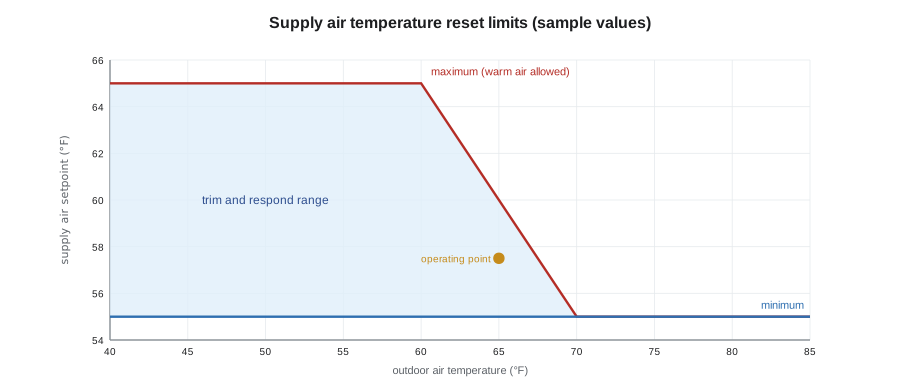
| Setting | Sample value | Purpose |
|---|---|---|
| Minimum supply air setpoint | 55 °F | Coldest air, for full cooling and dehumidification |
| Maximum supply air setpoint | 65 °F | Warmest air, used when zones need little cooling |
| Outdoor air at which the maximum applies | 60 °F or below | Cool weather, when warmer air saves the most |
| Outdoor air at which only the minimum applies | 70 °F or above | Warm, humid weather, when cold air is needed for moisture removal |
Worked problem
Finding the warmest allowed supply air
Using the sample limits above, the outdoor air is 65 °F. What is the highest supply air setpoint the reset may choose?
Show solution
- The maximum falls from 65 °F at 60 °F outdoor to 55 °F at 70 °F outdoor.
- Fraction of the way along: (65 − 60) ÷ (70 − 60) = 5 ÷ 10 = 0.5.
- Allowed maximum: 65 − 0.5 × (65 − 55) = 65 − 5 = 60 °F.
Answer: At 65 °F outdoors the supply air setpoint may go no higher than 60 °F. Within that limit, trim and respond from the zones decides the actual setpoint.
Humidity is the main reason for the upper outdoor air limit. In warm, humid weather the coil must cool the air below its dew point to remove moisture, and supply air that is too warm leaves the building damp even if the temperature is comfortable. Some sequences add a dehumidification override that forces the supply air to its minimum when the return humidity is high, and BAS-220's alarm review included a return humidity alarm for exactly this case.
Duct static pressure reset
A VAV air handler's supply fan is controlled to hold a static pressure measured somewhere in the supply duct. The pressure must be high enough that the box furthest from the fan, or the one with the hardest job, can still get its maximum airflow. At part load most boxes are partly closed, and the pressure needed is much lower than the design value. A static pressure reset lowers the setpoint until at least one box is close to fully open, and raises it when boxes start running out of pressure.
Trim and respond is the usual method. Every few minutes the setpoint is trimmed down by a small amount. Each zone that needs more pressure, usually one whose damper is nearly fully open and still below its airflow setpoint, sends a request. If there are more requests than the number to be ignored, the setpoint is raised by an amount for each request beyond that number, up to a maximum step. The ignored requests stop one rogue box, such as one with a failed sensor or a damper stuck open, from holding the whole system at high pressure.
| Trim and respond setting | Sample value | Meaning |
|---|---|---|
| Initial setpoint | 1.0 in. w.c. | Value used when the fan starts |
| Minimum and maximum | 0.15 to 1.5 in. w.c. | Limits on the reset |
| Time step | 2 minutes | How often trim and respond run |
| Ignored requests | 2 | Requests ignored each time step |
| Trim | −0.04 in. w.c. | Change every time step |
| Respond | +0.06 in. w.c. per request | Raise per request beyond the ignored number |
| Maximum respond | +0.15 in. w.c. | Largest raise in one step |
Worked problem
One trim and respond step
In one time step at Ninefield, 5 boxes send static pressure requests. Using the sample settings, how does the setpoint change? What if only 2 boxes send requests?
Show solution
- Requests beyond the ignored number: 5 − 2 = 3.
- Respond: 3 × 0.06 = 0.18 in. w.c., limited to the maximum of 0.15 in. w.c.
- Net change: trim −0.04 + respond +0.15 = +0.11 in. w.c.
- With 2 requests: 2 − 2 = 0 beyond the ignored number, so the net change is the trim alone, −0.04 in. w.c.
Answer: With 5 requests the setpoint rises by 0.11 in. w.c. in this step; with 2 it falls by 0.04 in. w.c. Over many steps the setpoint settles where a couple of boxes are just asking for more, which is the lowest pressure that still serves every zone.
Where zone requests come from
Trim and respond only works if the zones send honest requests. A request is a software signal from each zone controller to the air handler, generated from the zone's own loops. A cooling request might be sent when a zone's cooling loop output has been above a high value for some minutes, and a stronger request, counted twice or three times, when the zone is several degrees above setpoint. A pressure request might be sent when the box damper is nearly fully open and the airflow is still below its setpoint. High-performance sequences define these thresholds precisely, and lesson 11 shows how Guideline 36 does it.
Two things make requests unreliable. The first is a zone that requests all the time because of a fault, such as a failed sensor or a box serving a room that is simply too large for it. Ignored requests deal with one or two of those, and good sequences also let the operator set a zone's importance multiplier to zero so that a known rogue zone is removed from the count. The second is a zone whose box was never balanced, so that its airflow setpoints are wrong. BAS-120's VAV flow checks at Tilden, with a box programmed with the wrong K-factor, were the kind of problem that makes requests meaningless.
How the two resets work together
When supply air temperature and static pressure are both reset from zone requests, the sequence must avoid the two resets fighting. A common approach gives supply air temperature priority in cool weather, when warmer air saves reheat and lets the economizer work, and lets the static pressure reset follow what the boxes then need. In hot weather, the supply air is already near its minimum and the static pressure reset does most of the work. Because both are slow, step-by-step resets with modest time steps, they rarely interact badly in practice, but Sophie's draft still set the supply air time step longer than the static pressure step so that the pressure reset could settle between temperature changes.
Sophie's draft for Ninefield also included a fixed fallback. If the zone requests are unavailable, for example because the network to a floor fails, the reset holds its last value for a few minutes and then returns to a safe fixed setpoint: the design static pressure and a supply air setpoint from the outdoor air schedule alone. "A reset that depends on the network needs a plan for when the network isn't there," she said.
What the savings look like
Fan power depends on airflow and pressure together. At a given airflow, the power a fan needs is roughly proportional to the total pressure it develops, so lowering the duct static setpoint reduces the fan's pressure and its power. The real savings depend on the fan curve and the duct system, but a rough estimate helps when explaining a reset to an owner.
Worked problem
A rough estimate of fan savings
One of Ninefield's air handlers runs at 70 in 100 of design airflow most of the day. Its fan develops a total pressure of 3.6 in. w.c., of which 1.2 in. w.c. is the duct static setpoint. If static pressure reset lowers the setpoint to 0.6 in. w.c. and the rest of the system pressure is unchanged, by roughly how much does the fan's pressure, and so its power at that airflow, fall?
Show solution
- New total pressure: 3.6 − 1.2 + 0.6 = 3.0 in. w.c.
- Ratio: 3.0 ÷ 3.6 = 0.83.
- Reduction: 1 − 0.83 = 0.17, or about 17 in 100.
Answer: About 17 in 100 less fan power at that airflow, before any savings from reduced reheat or cooling. The estimate is rough because the fan's efficiency also changes with its operating point, but it shows why a fixed high static setpoint is expensive.
Checking resets in the trends
A reset sequence is easy to switch on and hard to judge by looking at the graphics on a single afternoon. The setpoint moves every few minutes, and whether it is doing its job only shows up over days. The useful trends are the setpoint itself, the number of requests at each time step, the fan speed and the supply air temperature. A healthy static pressure reset spends most of the day well below its maximum and climbs only when the zones really need it. A reset that sits at its maximum all day is almost always being held there by one or two zones.
| What the trend shows | Likely cause |
|---|---|
| Setpoint pinned at its maximum | A rogue zone sending requests all day |
| Setpoint pinned at its minimum | Requests not reaching the air handler, or set too hard to trigger |
| Setpoint swinging up and down every few steps | Respond amount too large, or time step too short |
| Zones too warm while the setpoint falls | Request threshold set too loose, or zone sensors misread |
The fix for a rogue zone is to find out why it calls: a stuck damper, an undersized box, a sensor beside a copier, or a room that simply has more load than its design. Until it is fixed, the zone's requests can be ignored or given a lower importance, as lesson 11 describes, but that change should be logged and reversed once the zone is repaired. Hiding a rogue zone permanently only moves the complaint from the trend log to the occupants.
Common mistakes
MistakeResetting supply air from outdoor air alone in a building with varied zones.
InsteadUse zone requests to choose the setpoint within outdoor-air-based limits.
MistakeLetting one faulty zone hold the system at high pressure.
InsteadIgnore a small number of requests and allow rogue zones to be removed from the count.
MistakeRaising supply air temperature in humid weather.
InsteadLimit the reset in warm, humid weather so the coil still removes moisture.
MistakeBuilding a reset that fails badly when the network does.
InsteadHold the last value briefly, then fall back to safe fixed setpoints.
MistakeTrusting requests from boxes that were never balanced.
InsteadCheck box airflow setpoints and K-factors before relying on their requests.
Summary and key terms
- Fixed supply air and static setpoints waste fan, cooling and reheat energy at part load.
- Supply air temperature reset raises the setpoint when zones need little cooling, within limits set by outdoor air and humidity.
- Static pressure reset lowers the setpoint until a few boxes are just asking for more.
- Trim and respond trims every step and responds to requests beyond an ignored number, up to a maximum step.
- Requests come from zone loops; faulty or unbalanced zones make them unreliable.
- The two resets are coordinated by priority and time step, with a fixed fallback when requests are lost.
- Fan power at a given airflow falls roughly with total pressure, so lower static setpoints save fan energy.
- Supply air temperature reset
- Changing the supply air setpoint according to outdoor air or zone demand.
- Static pressure reset
- Lowering or raising the duct static setpoint according to how much pressure the boxes need.
- Trim and respond
- A reset method that trims a setpoint each step and responds to zone requests.
- Zone request
- A signal from a zone to its air handler or plant asking for more cooling, heating or pressure.
- Ignored requests
- The number of requests that do not cause a response, to stop one zone controlling the system.
- Importance multiplier
- A factor that weights or removes a zone's requests.
- Dehumidification override
- Logic that holds the supply air cold when humidity is high.
- Fallback setpoint
- A fixed value used when the information a reset needs is lost.
Practice problems
Work each problem on paper first, then reveal the answer to check.
Trim −0.04 in. w.c., respond +0.06 per request, 2 ignored, maximum +0.15. With 4 requests, what is the net change?
Show answer
(4 − 2) × 0.06 = 0.12 respond; net −0.04 + 0.12 = +0.08 in. w.c.
Same settings, 8 requests. What is the net change?
Show answer
(8 − 2) × 0.06 = 0.36, limited to 0.15; net −0.04 + 0.15 = +0.11 in. w.c.
Why is the supply air reset limited in warm, humid weather?
Show answer
The coil must make cold air to remove moisture.
Fan total pressure 3.2 in. w.c. including a 1.2 in. w.c. static setpoint. The setpoint is reset to 0.8. Rough fraction of fan power saved at that airflow?
Show answer
New pressure 2.8; 2.8 ÷ 3.2 = 0.875; about 12.5 in 100 saved.
What should a reset do if it loses its zone requests?
Show answer
Hold its last value briefly, then fall back to a safe fixed setpoint.
Lesson quiz · 5 questions
Score 60% or more to complete this lesson.
Create a free account to save your progress, take quizzes and earn a certificate.