
BAS-230 · Lesson 1 of 12 · 24 min
Reading a sequence of operation
▶ Video coming soon A video version of this lesson is on the way.
On Wednesday evening, September 9, after her second day in the field, Callie stayed on at Quillon's office for the first of Sophie Aubertin's Wednesday sequence evenings. Sophie ran them for anyone who wanted to come: an hour and a half with a pot of tea, a stack of printed sequences and a whiteboard. "Programs, wiring and loops are all ways of carrying out a sequence," she said. "The sequence is the promise. If you can read one properly, you know what the building is supposed to do, and every complaint becomes a question: is it doing what the sequence says, and is the sequence right?" The first document on the table was the sequence of operation for Tilden Hall's AHU-1, written in 1988 and revised when the pneumatic controls were converted to DDC in 2009.
What a sequence of operation is
A sequence of operation is a written description of how a piece of equipment or a system is to be controlled: when it starts and stops, which setpoints it maintains, how each output responds, what happens in each mode, which safeties protect it and which conditions raise alarms. It is written by the design engineer, usually as part of the controls section of the specification, and it is the document the controls contractor programs from. On a new building it is a contract document: the owner is paying for equipment that behaves as the sequence describes. On an old building it is the best record of what someone once intended, and it may or may not match what the program does today.
Sequences are written for people, not controllers. They use words such as "modulate", "enable", "index" and "prove", and they leave many details to the programmer. A good sequence is specific about the things that matter, such as setpoints, limits, delays and safeties, and silent about the things that do not, such as which block type to use. A weak sequence says "maintain comfortable conditions" and leaves every decision to the programmer, which is how two identical air handlers on the same campus end up controlled in two different ways.
The parts of a sequence document
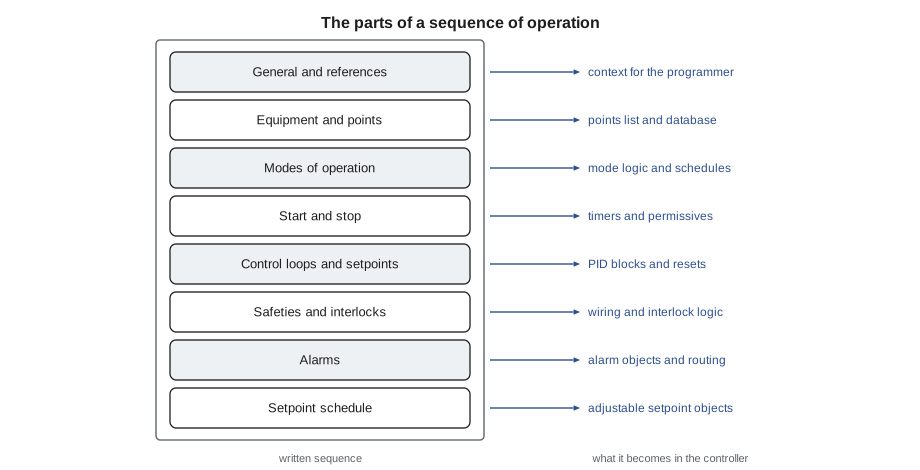
Most sequences follow a recognizable structure, although the headings vary between engineers. Sophie laid the AHU-1 sequence on the table and marked its sections with sticky notes. The 2009 revision ran to six pages, and almost every page fell into one of the sections in the table below.
| Section | What it contains | What it becomes |
|---|---|---|
| General | Scope, references to standards, the systems covered | Context for the programmer |
| Equipment and points | What is controlled and which devices are provided | The points list and the database |
| Modes of operation | Occupied, unoccupied, warm-up, cool-down, setback and so on | Mode logic and schedules |
| Start and stop | Order of starting, proving and enabling | Start logic, timers and permissives |
| Control loops | Each controlled variable, its setpoint and the device that controls it | PID blocks, resets and sequencing |
| Safeties and interlocks | Hardwired and software protections | Wiring and interlock logic |
| Alarms | Conditions, delays and priorities | Alarm objects and routing |
| Setpoint schedule | A table of setpoints, limits and delays | Adjustable values in the program |
Two of these sections deserve a closer look. The points list tells the programmer which physical inputs and outputs exist, and BAS-120 and BAS-210 showed how it becomes the controller's database. The setpoint schedule, when the engineer provides one, gathers every number in one table so that the operator can find and change them later. Many older sequences, including Tilden's 1988 original, scatter their numbers through the text, which makes them easy to miss and hard to change consistently.
Modes of operation
A mode is a state the system can be in, with its own rules. Most air handler sequences define at least an occupied mode and an unoccupied mode, and better ones add warm-up, cool-down, setback, setup, and sometimes purge, smoke control and freeze protection. Each mode has an entry condition, a set of behaviors and an exit condition. Reading a sequence well means listing the modes first, because every other paragraph applies in one mode or another.
Tilden's AHU-1 sequence had four modes. In occupied mode the fan ran continuously, the outdoor air damper held at least its minimum, and the supply air temperature loop was active. In unoccupied mode the fan was off and the outdoor air damper closed, unless a zone fell below its night setback, in which case the unit ran in night heating with the outdoor air damper still closed. In morning warm-up, used for the hour or so before occupancy on cold days, the unit ran with outdoor air closed and the heating coil carrying the load until the return air reached setpoint. The fourth mode, freeze protection, could take over from any of the others.
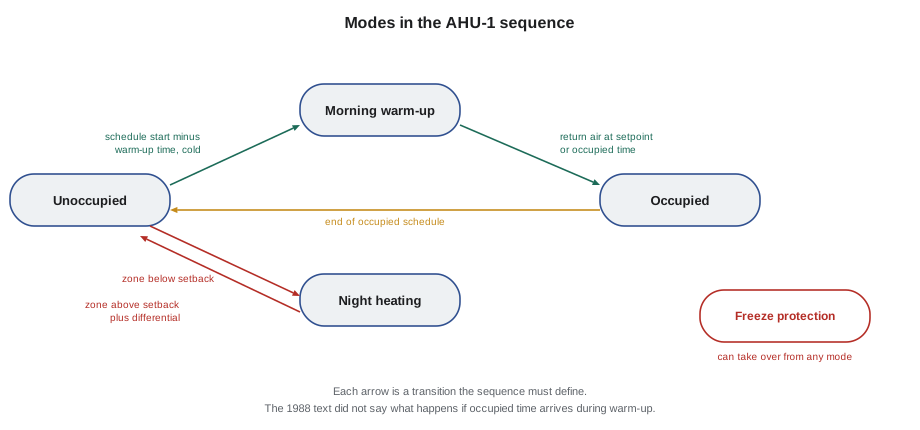
A state diagram like this one is worth drawing for any sequence with more than two modes. The arrows are where most problems hide. Sophie asked Callie what happened if the schedule's occupancy time arrived while the unit was still in warm-up and the return air was still cold. The 1988 text did not say. The 2009 program went straight to occupied mode at the scheduled time, opening the outdoor air damper to minimum while the building was still cold. That was a reasonable choice, but it was the programmer's choice, not the engineer's.
Reading the language
Sequences use a small vocabulary that is worth learning exactly. The table below lists the words Sophie underlined most often, with what they normally mean in a sequence and what they normally become in a program.
| Word or phrase | Usual meaning | In the program |
|---|---|---|
| Enable | Allow something to run if its own conditions call for it | A permissive that feeds a start or a loop enable |
| Start, stop | Command equipment on or off | A binary output |
| Prove | Confirm by a separate input that equipment is running | A status input compared with the command after a delay |
| Modulate | Vary an output continuously | An analog output driven by a loop |
| Maintain | Hold a variable at a setpoint | A closed loop |
| Reset | Change a setpoint according to another variable | A reset schedule or trim and respond |
| Index | Move to a defined position or mode | A fixed output value or a mode change |
| Sequence | Operate outputs one after another as demand rises | Split-range or staging logic |
| Lead, lag | The first and second units to operate | Lead-lag rotation and staging |
| (Adj.) | The value is to be adjustable by the operator | A setpoint object, not a constant in the code |
The abbreviation "(adj.)" matters more than its size suggests. When an engineer writes "maintain duct static pressure at 1.0 in. w.c. (adj.)", the programmer must put that number in an adjustable setpoint that an operator can see and change, not bury it in a block as a constant. BAS-220 showed how buried constants, or magic numbers, make programs hard to maintain. A sequence that marks its adjustable values clearly makes that mistake less likely.
Sequences and points lists
A sequence and its points list must agree. If the sequence says the outdoor air damper modulates to maintain a mixed air temperature, the points list needs a mixed air temperature sensor and an analog output to the damper. If the sequence says the fan is proven by a current switch, there must be a status input. Comparing the two is one of the first jobs on any project, and it often finds missing points before anything is ordered.
Callie and Sophie compared AHU-1's sequence with its 2009 points list line by line. The comparison found three things. The sequence called for a return air humidity alarm, but there was no humidity sensor on the points list. The points list included a low limit thermostat on the mixed air plenum with no matching paragraph in the sequence. And the sequence described a supply fan VFD alarm input that had been listed but never wired. None of these was serious, but each was the kind of gap that turns into a site visit later.
Worked problem
Checking a sequence against its points list
AHU-1's sequence mentions 14 physical devices that need a point: supply and return fans (command and status for each), outdoor, return and relief dampers (one output each, with the outdoor damper having its own actuator), heating valve, cooling valve, and sensors for supply, mixed, return and outdoor air temperature and duct static pressure. The 2009 points list has 15 physical points. Which way does the difference point, and what should be checked?
Show solution
- Count the sequence's devices by type: fans 2 × 2 = 4 points; dampers 3 outputs; valves 2 outputs; sensors 5 inputs.
- Total from the sequence: 4 + 3 + 2 + 5 = 14.
- The points list has 15, one more than the sequence needs.
- The extra point is the low limit thermostat input, which the sequence never mentions.
Answer: The points list has one point the sequence does not use. Either the sequence is missing a paragraph, or the point is spare. Here it was the mixed air low limit, so the sequence was missing its description, which Sophie added to the findings list.
Reading the numbers
Every number in a sequence should have a unit, a source and a reason. "Minimum outdoor air 3,180 cfm" has all three if the mechanical schedule shows the same figure and the ventilation calculation supports it. "Supply air temperature 55 °F" needs the context of the coil and the zones it serves. Numbers that disagree with the mechanical drawings are common in old sequences, because the drawings were updated during construction and the sequence was not.
Worked problem
Turning a minimum outdoor airflow into a fraction
AHU-1 supplies 10,600 cfm at design and its scheduled minimum outdoor airflow is 3,180 cfm. What fraction of the supply air is outdoor air at design flow? What happens to that fraction if the supply airflow falls to 7,420 cfm while the outdoor airflow is still held at 3,180 cfm?
Show solution
- At design: 3,180 ÷ 10,600 = 0.30, or 30 in 100.
- At reduced flow: 3,180 ÷ 7,420 = 0.43, or 43 in 100.
Answer: Holding a constant outdoor airflow means the outdoor air fraction rises as the supply airflow falls. A sequence that fixes a damper position instead of an airflow lets the outdoor airflow fall with the fan speed, which is why modern sequences measure or calculate outdoor airflow rather than trusting a minimum position. Lesson 3 returns to this.
Questions to ask of every sequence
By the end of the evening Sophie had written a short checklist on the whiteboard, and Callie copied it into the notebook she used for the program. Sophie said she asked the same questions of every sequence she programmed, whether it came from a famous engineering firm or from a page of handwriting in a plant room.
- What are the modes, and what moves the system from each one to the others?
- For each output, which loop or logic drives it in each mode, and what does it do when that loop is disabled?
- What starts the equipment, what proves it is running, and what happens if the proof does not arrive?
- Which safeties are hardwired, which are in software, and what does each one do when it trips?
- Which values are adjustable, and where is each one listed?
- What does the equipment do when the controller loses power, and when power returns?
- Which alarms are required, with what delays, and who receives them?
- Does every device in the text have a point, and does every point have a purpose in the text?
The answers to these questions are not all in the sequence. Some are in the specification's general controls section, some are on the drawings, and some are decisions the controls contractor must make and then document. Sophie's rule was that a decision made by the programmer should be written into Quillon's as-built sequence, so that the next reader does not have to rediscover it from the code.
When the sequence and the building disagree
On an existing building, the sequence, the program and the equipment can drift apart over the years. Equipment is replaced with something slightly different, programs are edited during service calls, and setpoints are changed to solve a complaint. Reading the sequence is therefore only the first step of understanding an existing system. The second is comparing it with the program, as BAS-220 described, and the third is comparing both with what the trends show the equipment actually doing.
AHU-1 had all three kinds of drift. Its 1988 sequence described inlet guide vanes on the supply fan, which had been replaced by a VFD in 2009. The 2009 revision described a static pressure setpoint of 1.5 in. w.c., but the program held 1.2 in. w.c., changed at some point by someone who did not record why. And the trends showed the heating valve opening briefly every morning in summer, which neither document explained. Each difference went onto a findings list for Gus Thibodeaux, Harcastle's facilities manager, with a recommendation: confirm, correct or document.
Common mistakes
MistakeStarting to program before reading the whole sequence.
InsteadRead it end to end, list the modes and draw the transitions before writing any logic.
MistakeTreating an adjustable value as a constant.
InsteadPut every value marked adjustable in a setpoint object listed in the setpoint schedule.
MistakeAssuming the sequence matches the building.
InsteadCompare the sequence with the program and the trends, and list the differences.
MistakeMaking a programming decision and not recording it.
InsteadWrite every decision the sequence left open into the as-built sequence.
MistakeIgnoring a point that the sequence never mentions.
InsteadFind out what it is for; either the sequence is missing a paragraph or the point is spare.
Summary and key terms
- A sequence of operation describes how equipment is to be controlled in every mode, and it is the document the programmer works from.
- Most sequences have sections for equipment, modes, start and stop, loops, safeties, alarms and setpoints.
- Modes have entry and exit conditions; a state diagram shows them and exposes gaps.
- Words such as enable, prove, modulate, reset and index have specific meanings; values marked adjustable must be adjustable.
- The sequence and the points list must agree in both directions.
- Holding a constant outdoor airflow raises the outdoor air fraction as supply airflow falls.
- On existing buildings, sequence, program and equipment drift apart, so all three must be compared.
- Sequence of operation
- A written description of how equipment or a system is to be controlled.
- Mode
- A state of a system with its own rules, entry conditions and exit conditions.
- State diagram
- A drawing of modes as boxes and the conditions between them as arrows.
- Setpoint schedule
- A table that gathers a sequence's setpoints, limits and delays in one place.
- Prove
- Confirm through a separate input that equipment has responded to its command.
- Index
- Move an output or a system to a defined position or mode.
- Adjustable value
- A value marked (adj.) in a sequence, to be kept in an operator-adjustable setpoint.
- As-built sequence
- The sequence as actually programmed, including decisions the original left open.
Practice problems
Work each problem on paper first, then reveal the answer to check.
A sequence says "maintain discharge air at 55 °F (adj.)". Where should 55 °F live in the program?
Show answer
In an adjustable setpoint object listed in the setpoint schedule, not as a constant inside a block.
An air handler supplies 8,500 cfm with 2,550 cfm of outdoor air. What is the outdoor air fraction?
Show answer
2,550 ÷ 8,500 = 0.30, or 30 in 100.
Name four modes an air handler sequence commonly defines.
Show answer
Any four of occupied, unoccupied, morning warm-up, cool-down, night setback heating, purge and freeze protection.
What does "prove" mean in a sequence?
Show answer
Confirm by a separate input, such as a current switch or airflow switch, that the equipment is running.
Why draw a state diagram of a sequence's modes?
Show answer
To list every transition and find the cases the sequence does not cover.
Lesson quiz · 5 questions
Score 60% or more to complete this lesson.
Create a free account to save your progress, take quizzes and earn a certificate.