
BAS-230 · Lesson 3 of 12 · 23 min
Economizer and mixed air control
▶ Video coming soon A video version of this lesson is on the way.
On Wednesday evening, September 16, Sophie handed round two pages from AHU-1's sequence headed "Mixed air and economizer". "This section saves more energy than any other in an air handler sequence, and it causes more trouble," she said. "Get it right and the building cools itself with outdoor air for half the year. Get it wrong and you either pay for cooling you didn't need, freeze a coil, or bring in humid air and make everyone sticky." She drew AHU-1's mixing box on the whiteboard: an outdoor air damper, a return air damper and a relief damper, all driven together, with a mixed air sensor stretched across the filter face.
What an economizer does
An air-side economizer uses outdoor air for cooling whenever the outdoor air is cool enough to help. In winter and shoulder seasons, an air handler serving interior zones still needs cooling while the outdoor air is cold. Instead of running the cooling coil, the economizer opens the outdoor air damper and closes the return damper until the mixed air is at the temperature the supply air needs. The cooling coil only runs when outdoor air alone cannot do the job. Energy codes require economizers on most air handlers above a modest size, and they require them to be controlled properly, with limits that stop them bringing in air that would add load instead of removing it.
The mixed air temperature is a weighted average of the outdoor and return air temperatures, weighted by the fraction of outdoor air. BAS-220 used the same relationship backwards, to calculate the outdoor air fraction from three temperatures.
Worked problem
The mixed air temperature at minimum outdoor air
AHU-1 runs at its minimum outdoor air fraction of 0.30 on a winter morning with the outdoor air at 14 °F and the return air at 72 °F. What is the mixed air temperature?
Show solution
- Outdoor part: 0.30 × 14 = 4.2 °F.
- Return part: 0.70 × 72 = 50.4 °F.
- Mixed air: 4.2 + 50.4 = 54.6 °F.
Answer: At minimum outdoor air the mixed air is 54.6 °F, almost exactly AHU-1's 55 °F supply air setpoint, so on this morning the unit needs very little heating or cooling at all.
Split-range sequencing of heating, economizer and cooling
Most single-duct air handler sequences control the supply air temperature with one loop whose output is divided among the heating valve, the economizer dampers and the cooling valve. BAS-130 described AHU-1's split: heating from 0 to 30 of the loop output, economizer from 35 to 65, and cooling from 70 to 100, with small gaps between the ranges so that heating and cooling can never act at the same time. The economizer range starts at the minimum outdoor air position, so the dampers never go below minimum while the unit is occupied, even when the loop calls for heating.
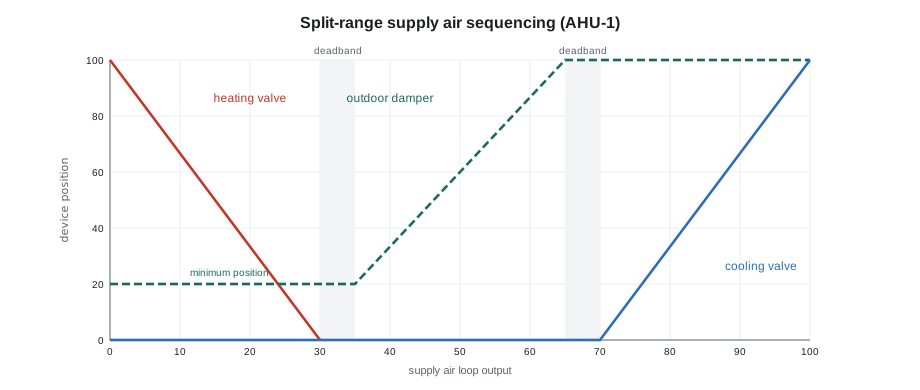
The order of the ranges matters. Outdoor air is free, so it comes before mechanical cooling. Heating comes before the economizer moves above minimum, because opening more outdoor air while heating would waste energy. When the economizer is at 100 and the supply air is still too warm, the cooling coil takes over with the outdoor air damper held fully open, which is called integrated economizer operation. Some older sequences locked the economizer out as soon as mechanical cooling started; energy codes now generally require integrated operation where the equipment allows it.
Economizer high limits
An economizer should stop using extra outdoor air when that air would add load instead of removing it. The control that decides this is the high limit, and energy codes specify which kinds are allowed in each climate zone and what their settings should be. The common types are listed below. ASHRAE 90.1 and the energy codes based on it, including the IECC, contain tables of allowed high-limit types and their settings by climate zone; the sequence should name the type and the setting, and the setting should match the table for the building's location.
| High-limit type | Economizer disabled when | Notes |
|---|---|---|
| Fixed dry-bulb | Outdoor air is warmer than a fixed setpoint | Simple; setting depends on the climate zone |
| Differential dry-bulb | Outdoor air is warmer than return air | Needs reliable outdoor and return sensors; not allowed in some humid zones |
| Fixed enthalpy with fixed dry-bulb | Outdoor enthalpy or temperature is above fixed limits | Needs an outdoor humidity sensor, which drifts |
| Differential enthalpy with fixed dry-bulb | Outdoor enthalpy is above return enthalpy, or outdoor temperature above a limit | Best performance when sensors are maintained |
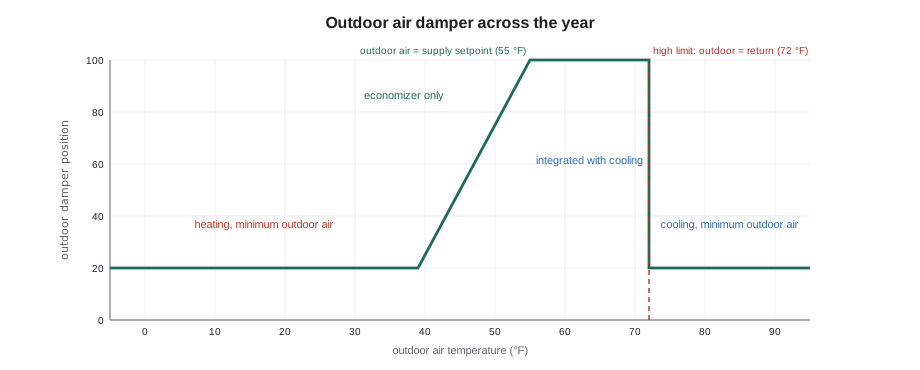
AHU-1's 2009 sequence used differential dry-bulb with a fixed upper limit: the economizer was disabled when the outdoor air was warmer than the return air or warmer than 70 °F, whichever was lower. Sophie did not change it. She noted that the choice should be checked against the current energy code if the sequence was ever rewritten, because the allowed types and settings vary by climate zone and have changed between editions.
Humidity sensors are the weak point of enthalpy economizers. A sensor that drifts high makes the outdoor air look too humid and locks the economizer out on cool dry days; one that drifts low lets humid air in on muggy days. Many engineers prefer dry-bulb limits in climates where they are allowed for exactly this reason, and those who specify enthalpy should also specify a calibration interval. Differential dry-bulb has its own failure: if the return air sensor reads low, the economizer locks out too early.
How much outdoor air the economizer needs
Rearranging the mixed air equation gives the outdoor air fraction that produces a target mixed air temperature. On a cool day this is how far the economizer will open to meet the supply air setpoint without any cooling.
Worked problem
Outdoor air needed for free cooling
AHU-1's return air is 72 °F and its supply air setpoint is 55 °F. Ignoring fan heat, what outdoor air fraction gives 55 °F mixed air when the outdoor air is 46 °F? What happens when the outdoor air is 59 °F?
Show solution
- At 46 °F: f = (72 − 55) ÷ (72 − 46) = 17 ÷ 26 = 0.65.
- At 59 °F: f = (72 − 55) ÷ (72 − 59) = 17 ÷ 13 = 1.31, which is more than 1.
Answer: At 46 °F the dampers open to about 65 in 100 outdoor air and no cooling is needed. At 59 °F even 100 in 100 outdoor air gives 59 °F mixed air, warmer than the setpoint, so the economizer stays fully open and the cooling coil makes up the last 4 °F. That is integrated economizer operation.
Minimum outdoor air control
Whatever the economizer is doing, the unit must bring in at least the minimum outdoor airflow that the ventilation design requires while the building is occupied. The simplest way is a fixed minimum damper position, set by the balancer at design airflow. Lesson 1 showed the problem: on a VAV unit, the outdoor airflow through a fixed damper position falls as the fan slows. Better sequences measure the outdoor airflow with an airflow station in the outdoor air intake and control a minimum outdoor air damper to hold the required flow, or calculate it from the mixed air temperature equation when the temperatures are far enough apart to make the calculation reliable, as BAS-220's guard on outdoor and return air temperatures showed.
AHU-1's mixing box had a single outdoor air damper with a minimum position of 20, set in 2009 at design airflow. BAS-220 showed the program line that took the larger of the minimum position and the economizer output. Sophie explained that the position of 20 delivered about 3,180 cfm only at full fan speed, and that the airflow fraction and damper position are different things: a damper 20 open can pass far more than 20 in 100 of the flow, because damper characteristics are not linear. She added an outdoor airflow station to her list of recommendations for the AHU-2 replacement, where the design already included one.
Mixed air low limit and freeze risk
On very cold days, poor mixing in the mixing box can let a stream of cold outdoor air hit part of the coil while the averaging sensor still reads an acceptable mixed air temperature. Sequences protect against this with a mixed air low limit: if the mixed air falls below a setting, the outdoor air damper is driven toward minimum regardless of what the economizer loop wants. AHU-1's low limit was 44.6 °F, the value in BAS-220's damper page. It acts well before the hardwired freezestat from lesson 2, and it is the first line of defense; the freezestat is the last.
| Protection | Typical setting | Action |
|---|---|---|
| Mixed air low limit (software) | About 45 °F | Override the economizer toward minimum outdoor air |
| Discharge air low limit (software) | A few degrees below setpoint for some minutes | Open heating, alarm |
| Low temperature limit (hardwired) | About 38 °F | Stop fan, close outdoor damper, open heating valve |
Relief and building pressure
When the economizer brings in more outdoor air than minimum, the same amount must leave the building, or the building pressurizes and doors stand open on their own. Sequences handle this with a relief damper linked to the outdoor damper, a relief fan controlled from building static pressure, or a return fan controlled to track the supply fan. BAS-120 described Ninefield's lobby pressure sensor with its cut reference tube, which made the building look far more positive than it was. Whatever the arrangement, the sequence should say what controls relief and what building pressure it maintains, typically a small positive value such as 0.02 in. w.c..
Testing an economizer sequence
An economizer that looks right in the program can still fail in the building, and economizer faults are among the most common faults found in air handlers. A functional test walks the unit through each part of the split range and checks what really happens, not what the graphics say. Because the outdoor conditions on test day decide which modes can be seen naturally, the test usually overrides the outdoor air temperature input inside the controller to push the sequence into each mode in turn, and then releases every override at the end.
| Check | What to look for |
|---|---|
| Outdoor air sensor | Reads within about 2 °F of a trusted reference, shaded from sun and away from exhaust |
| Damper stroke | Outdoor and return dampers move fully and in opposite directions; linkages tight |
| Minimum position or airflow | Measured outdoor airflow meets the minimum at low fan speed, not only at full speed |
| High limit | Raising the outdoor air reading above the limit returns the dampers to minimum |
| Mixed air low limit | A falling mixed air reading closes the outdoor damper toward minimum |
| Return to normal | Every override released and the release recorded |
Trends finish the job. A week of five-minute data for outdoor, return, mixed and supply air temperatures, the damper command and the valve commands shows whether the unit opens to the economizer when the outdoor air is cool and dry, whether the heating and cooling valves are ever open at the same time, and whether the mixed air temperature falls between the outdoor and return temperatures the way the damper position says it should. If the mixed air reading sits close to the return air temperature while the damper is commanded wide open, the damper or its actuator is not moving, or the mixed air sensor is in a poorly mixed corner of the plenum. An averaging sensor strung across the plenum gives a far more honest reading than a single point.
Sophie's habit was to look for the plain impossibilities first: a mixed air temperature colder than the outdoor air, or warmer than the return. Either one means a sensor is wrong, and no tuning of the sequence will fix a wrong sensor.
Common mistakes
MistakeOpening the economizer above minimum while the unit is heating.
InsteadSequence heating, economizer and cooling in order, with heating before the economizer moves.
MistakeLocking the economizer out whenever mechanical cooling runs.
InsteadUse integrated operation, with outdoor air held fully open while cooling runs, where the equipment allows.
MistakeUsing a high-limit type or setting not allowed for the climate zone.
InsteadCheck the energy code's table for the building's location and edition.
MistakeTreating a damper position as an airflow fraction.
InsteadMeasure or calculate outdoor airflow; damper position and airflow are not proportional.
MistakeRelying on the freezestat alone for freeze protection.
InsteadUse a mixed air low limit that acts earlier, with the freezestat as the last line.
Summary and key terms
- An economizer uses outdoor air for cooling and is required on most larger air handlers.
- Mixed air temperature is the outdoor and return air temperatures weighted by the outdoor air fraction.
- A split-range supply air loop sequences heating, economizer and cooling, with deadbands between them.
- High limits stop the economizer when outdoor air would add load; allowed types and settings depend on the climate zone.
- The outdoor air fraction needed for free cooling is (return − mixed) ÷ (return − outdoor); above 1 means cooling must help.
- Minimum outdoor air must be maintained by airflow, not only by damper position, on variable-volume units.
- A mixed air low limit protects the coil before the hardwired freezestat needs to act.
- Economizer
- Control that uses outdoor air for cooling when it is cool enough.
- Integrated economizer
- Operation with outdoor air fully open while mechanical cooling also runs.
- High limit
- The control that disables the economizer when outdoor air would add load.
- Differential dry-bulb
- A high limit that disables the economizer when outdoor air is warmer than return air.
- Enthalpy
- The total heat content of air, including the heat in its moisture.
- Minimum outdoor air
- The outdoor airflow required for ventilation whenever the space is occupied.
- Mixed air low limit
- A software limit that drives outdoor air toward minimum when the mixed air is too cold.
- Relief
- The path, damper or fan that removes air brought in by the economizer.
Practice problems
Work each problem on paper first, then reveal the answer to check.
Outdoor air 32 °F, return air 72 °F, outdoor air fraction 0.25. What is the mixed air temperature?
Show answer
0.25 × 32 + 0.75 × 72 = 62 °F.
Return 72 °F, target mixed 55 °F, outdoor 38 °F. What outdoor air fraction is needed?
Show answer
(72 − 55) ÷ (72 − 38) = 17 ÷ 34 = 0.50.
With differential dry-bulb, when is the economizer disabled?
Show answer
When the outdoor air is warmer than the return air.
In a split range of heating 0 to 30, economizer 35 to 65 and cooling 70 to 100, what does the outdoor damper do at loop output 50?
Show answer
It is halfway through its range, at about 50 between minimum and fully open, with heating and cooling both off.
Why does a VAV unit with a fixed minimum damper position fail to hold minimum outdoor air?
Show answer
The outdoor airflow through a fixed position falls as the supply fan slows.
Lesson quiz · 5 questions
Score 60% or more to complete this lesson.
Create a free account to save your progress, take quizzes and earn a certificate.