
BAS-130 · Lesson 8 of 12 · 25 min
Sequencing, staging and lead-lag
▶ Video coming soon A video version of this lesson is on the way.
On Monday, October 19, the Friday loop happened on a Monday, because Prakash wanted Callie at Ninefield Tower while Ilona Vescovi's maintenance contractor was there to swing the chillers over for the winter. Ninefield's plant has two 200-ton chillers, a single cooling tower and primary and secondary chilled water pumps, and in a mild October it rarely needs more than one chiller. Which chiller runs, when the second one starts, and how the two share their running hours are all decided by the controls. "A loop tells you how much," Prakash said. "Sequencing tells you which one, and in what order. Get the order wrong and you get two chillers fighting over a load one could carry."
This lesson covers the logic that sits between a loop's output and the equipment it commands when there is more than one way to meet the load. Sequencing divides one loop's output among several final elements, such as a heating valve, an economizer and a cooling valve. Staging turns a modulating demand into steps, switching equipment such as compressors or boilers on and off one at a time. Lead-lag decides which of several identical machines runs first and rotates the duty so they wear evenly, with a standby ready if one fails.
Sequencing one loop across several final elements
An air handler like Tilden's AHU-1 has several ways to change the supply air temperature: a heating coil, outdoor air through the economizer dampers and a cooling coil. They should never all work at once. Heating while bringing in cold outdoor air, or cooling while heating, wastes energy. A common solution is a single supply air loop whose output, from 0 to 100 in 100, is divided into ranges, each driving one final element in turn. This is called split-range or sequenced control. At low output the loop heats; in the middle it uses outdoor air; at high output it cools mechanically.
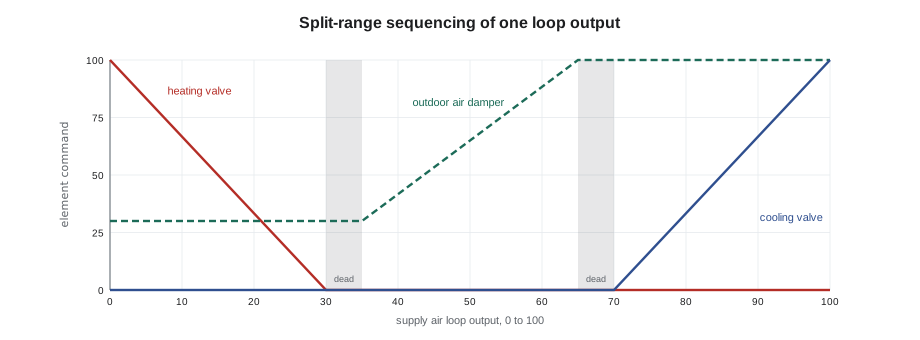
The small gaps between the ranges are deliberate. They act as dead zones, so that the heating valve is fully closed before the economizer begins to open, and the economizer is fully open before cooling starts. Without them, noise or a little overshoot could make two stages work at once. The ranges and the order come from the sequence of operation; BAS-230 covers economizer and mixed air sequences in detail.
Worked problem
Reading a split-range output
AHU-1's supply air loop divides its output as follows: heating valve from 100 in 100 open at an output of 0 to closed at 30; economizer outdoor air damper from its minimum position of 30 in 100 at an output of 35 to fully open at 65; cooling valve from closed at 70 to fully open at 100. What do the heating valve, outdoor air damper and cooling valve receive at loop outputs of 20, 50 and 85?
Show solution
- Output 20 is in the heating range: valve = (30 − 20) ÷ 30 = 0.33, about 33 in 100 open; damper at minimum; cooling closed.
- Output 50 is in the economizer range: fraction (50 − 35) ÷ 30 = 0.5, so damper = 30 + 0.5 × (100 − 30) = 65 in 100; heating and cooling closed.
- Output 85 is in the cooling range: valve = (85 − 70) ÷ 30 = 0.5, 50 in 100 open; damper fully open; heating closed.
Answer: At 20: heating 33, damper minimum. At 50: damper 65. At 85: damper fully open and cooling 50. Only one element is ever modulating at a time.
Split-range control has a tuning wrinkle: each stage changes the supply air temperature by a different amount for the same change in output. A heating coil fed with hot water is strong; an economizer damper's effect depends on the outdoor temperature; a cooling coil depends on the chilled water. A single set of PI settings is a compromise. Many modern programs instead use a separate loop for each stage, with the setpoints offset slightly so that they hand over cleanly, or sequence the stages from a single loop but use different gains in each range.
Staging equipment on and off
Much equipment cannot modulate smoothly over its whole range. A rooftop unit may have two compressors, or one compressor with two stages; a heating plant may have two or more boilers; a cooling tower may have fans with fixed speeds. Staging converts a modulating demand into a number of stages. The usual approach takes a loop's output and switches stages on as it passes thresholds and off as it falls back, with time delays to stop stages switching on and off too often.
| Rule | Typical form | Why |
|---|---|---|
| Stage-up threshold | Add a stage when demand stays above a high value for a set time | Give the running stages a chance first |
| Stage-down threshold | Remove a stage when demand stays below a low value for a set time | Avoid stopping a stage that is about to be needed |
| Interstage delay | Minimum time between adding stages | Let the system respond before adding more |
| Minimum on time | Once on, a stage stays on for a minimum period | Protect compressors and burners from short runs |
| Minimum off time | Once off, a stage stays off for a minimum period | Let pressures equalize and motors cool |
| Gap between thresholds | Stage-down well below stage-up | Prevent the stage cycling at one load |
At Ninefield's podium, each 10-ton rooftop unit has two compressor stages. The unit's own controller protects the compressors with minimum on and off times; the BAS asks for cooling stages through the unit's interface. Prakash showed Callie RTU-1's settings: stage 1 when the cooling demand stayed above 25 in 100 for 3 minutes, stage 2 above 75 for 5 minutes, each stage dropping out when demand fell below 15 in 100 for its own delay. "The delays matter more than the thresholds," he said. "A stage that comes on for ninety seconds and off for two minutes all afternoon is a compressor somebody will be replacing early." BAS-120 had already flagged RTU-2 and RTU-3 for actuator work in December, a reminder that the units were not young.
Lead-lag: which machine runs first
Where two or more identical machines serve the same duty, such as two chillers, two boilers, a pair of pumps or a pair of exhaust fans, the controls decide which runs first. The machine that starts first is the lead; the next is the lag. When the load needs only one machine, only the lead runs. When the lead cannot carry the load, the lag starts as well. If the lead fails, the lag takes over. And so that both machines wear evenly, the lead role is rotated.
Rotation can be done on a schedule, such as every Monday at 8:00, or by running hours, with the machine having fewer hours becoming lead. Schedule rotation is simple and predictable. Run-hour rotation equalizes wear more precisely but can leave a machine idle for weeks if the hours are far apart. Most plants also allow the operator to fix the lead manually, for instance to keep a machine out of service for repair. Whatever the method, rotation should happen only at a safe moment: never in the middle of a stage-up, and ideally when only one machine is running so that the changeover is a planned start of one and stop of the other.
Worked problem
Equalizing chiller hours
Ninefield's chiller 1 has 2,350 running hours and chiller 2 has 1,980. The plant is changed to run-hour lead-lag, so chiller 2 becomes lead. Suppose the plant runs 60 hours a week, with the lag chiller needed for 10 of those hours. How many weeks until the hours are about equal?
Show solution
- Difference: 2,350 − 1,980 = 370 hours.
- Each week chiller 2 runs 60 hours and chiller 1 runs 10, so the gap closes by 60 − 10 = 50 hours a week.
- Weeks to close the gap: 370 ÷ 50 = 7.4, about 7 or 8 weeks.
Answer: About seven to eight weeks. After that, rotation by hours keeps the two within a small band of each other, often by swapping the lead whenever the difference passes a set number of hours.
In practice Ninefield's chillers barely run in winter, so the example is a summer one. Ilona's contractor preferred a fixed weekly rotation, which was what the plant already did. Prakash checked that the rotation happened only when the plant was off or running one chiller, and that a failed chiller was skipped rather than called on as lead.
Failover and standby
Lead-lag control is also a safety net. If the lead machine is commanded on but its status does not prove within a set time, or if it trips during operation, the controls start the lag and raise an alarm. For pumps, this matters a great deal: losing the only running hot water pump in January can freeze coils within an hour. The proof comes from a separate status input, such as a current switch or differential pressure switch, exactly as BAS-120 explained. A command is never treated as proof.
Worked problem
Pump failover timing
Tilden's two hot water pumps run lead and standby. The program allows 20 seconds for the lead pump's current switch to prove after it is commanded on, then waits a further 10 seconds before calling it failed. If the lead pump's motor has tripped and never starts, how long after the command does the standby pump start?
Show solution
- Proof allowance: 20 s.
- Failure confirmation: 10 s.
- Standby start: 20 + 10 = 30 s after the lead command.
Answer: About 30 seconds after the command. The alarm tells the operator which pump failed, and the failed pump is held off until someone resets it, so the controls do not keep trying to start a motor with a fault.
Standby can be hot, with the standby machine ready to start the moment it is needed, or cold, needing preparation before it can run. A standby pump on the same piping is usually hot. A standby boiler that has been isolated for maintenance is cold, and the controls must know it is unavailable so that they do not count on it. Good programs let the operator mark a machine as out of service, which removes it from the lead-lag rotation and from failover until it is returned.
Staging boilers and chillers: let the equipment's controls lead
Large plant equipment, such as Harcastle's two low-pressure steam boilers or Ninefield's chillers, has its own controls and safety systems. The BAS usually enables the machine, sends it a setpoint and stages it on and off, but the machine's own controller manages its burner or compressor, its capacity and its safeties. Nell made this point firmly when Callie visited the steam plant: the boilers' flame safeguards and low-water cutoffs belong to the boilers and to the operators, and the BAS is not to override them. The BAS can call for a second boiler, but the boiler decides how and whether it starts.
Staging plant equipment also has rules of its own. Chillers are often staged on by load, measured as the plant's supply temperature, the chiller's own reported load or the flow and temperature difference, and staged off when the remaining machines can carry the load with a margin. Boilers in many plants run better at part load together than one at full fire, especially condensing boilers, so the staging rule may bring on a second boiler earlier than a simple threshold would suggest. These are design decisions for the sequence of operation, which BAS-230 covers.
Checking sequencing and staging
When commissioning or troubleshooting sequencing logic, the technician works through each transition: from off to one stage, from one to two, back down, and through every failover path. Each test checks that the right machine starts, that the delays are as specified, that a stage cannot cycle faster than its minimum times allow, and that a failed or disabled machine is skipped. Callie and Prakash tested Ninefield's chilled water pump failover that afternoon by opening the disconnect on the lead secondary pump with the maintenance contractor present: the standby pump started after 32 seconds, the alarm appeared on the front end, and the pump speed loop picked up without a pressure spike.
Common mistakes
MistakeLetting heating, economizer and cooling stages overlap.
InsteadLeave dead zones between split ranges, or use interlocked separate loops.
MistakeSetting stage-up and stage-down thresholds close together.
InsteadSeparate them widely and add time delays so stages do not cycle.
MistakeOverriding a compressor's or boiler's own protective timers.
InsteadStage through the equipment's controls and respect its minimum times.
MistakeRotating lead machines in the middle of a stage-up.
InsteadRotate only when the plant is off or running one machine.
MistakeTreating a command as proof that a machine is running.
InsteadUse separate status inputs and fail over when proof is lost.
MistakeLeaving a machine that is out for repair in the rotation.
InsteadMark it out of service so lead-lag and failover skip it.
Summary and key terms
- Sequencing divides one loop's output among several final elements in turn, with dead zones so they never overlap.
- Staging converts a modulating demand into on and off steps using thresholds, time delays and minimum on and off times.
- Lead-lag decides which of several identical machines runs first, brings on the lag when needed and fails over if the lead fails.
- Lead rotation by schedule or by running hours spreads wear; it should happen only at a safe moment.
- Failover depends on separate status proof and should alarm and lock out the failed machine.
- Large plant equipment manages its own capacity and safeties; the BAS enables and stages it.
- Split-range control
- Dividing one loop's output into ranges that each drive a different final element in sequence.
- Dead zone
- A gap between sequenced ranges in which no element moves, preventing overlap.
- Staging
- Switching equipment on and off in steps to meet a modulating demand.
- Interstage delay
- The minimum time between adding successive stages.
- Lead-lag
- Control that decides which of several machines runs first and when others join it.
- Lead rotation
- Changing which machine is lead, by schedule or by running hours.
- Failover
- Automatically starting a standby machine when the running one fails.
- Hot standby
- A standby machine ready to start immediately.
Practice problems
Work each problem on paper first, then reveal the answer to check.
In the AHU-1 split range, what does the heating valve receive at a loop output of 10?
Show answer
(30 − 10) ÷ 30 = 0.67, about 67 in 100 open.
At a loop output of 32, which elements are moving?
Show answer
None: 32 is in the dead zone between heating and the economizer.
Two pumps have 8,400 and 7,600 hours. With run-hour rotation, which leads?
Show answer
The pump with 7,600 hours.
Why should stage-down thresholds be well below stage-up thresholds?
Show answer
So that a stage does not switch on and off repeatedly at one load.
A lead pump is commanded on but its current switch never closes. What should the program do?
Show answer
After the proof delay, start the standby pump, alarm and lock out the failed pump until reset.
Lesson quiz · 5 questions
Score 60% or more to complete this lesson.
Create a free account to save your progress, take quizzes and earn a certificate.