
BAS-130 · Lesson 1 of 12 · 21 min
Open loop and closed loop control
▶ Video coming soon A video version of this lesson is on the way.
On Friday, September 11, at the end of her first week at Quillon Building Controls, Callie Rintoul sat with Prakash Deshmukh in the Tilden Hall mechanical room at Harcastle College with a cup of coffee and a printed trend. Prakash had a habit he called Friday loops: an hour at the end of each week spent on one idea from control theory, worked out on the equipment they had touched that week. "Most of what goes wrong in this business is a loop doing exactly what it was told," he said. "If you understand loops, you can tell whether the problem is the sensor, the actuator, the program or the settings. If you don't, you change things until it looks better and hope."
This course is about how control systems decide what to do. BAS-120 covered the devices at the ends of the wires: sensors that measure and actuators that move. This course covers the logic in between: how a controller compares a measurement with what it wants, how it decides how far to move a valve or how fast to run a fan, and how those decisions are tuned so that the building is comfortable without wasting energy or wearing out equipment. This first lesson sets out the two basic ways to control anything, open loop and closed loop, and the parts that every closed loop shares.
What control means
Control is the deliberate adjustment of something so that a quantity behaves the way we want. In a building, the quantity might be the temperature in a classroom, the pressure in a supply duct, the temperature of the hot water leaving a heat exchanger or the amount of outdoor air entering an air handler. The something adjusted might be a valve, a damper, a fan speed or the number of boilers running. A control system is the arrangement of sensors, controller and actuators that does the adjusting.
Every control system answers two questions over and over. What is happening now? And what should I do about it? The difference between open loop and closed loop control is whether the controller checks the result of its own action. An open loop controller acts on a plan or on some outside condition and never looks at the result. A closed loop controller measures the result and corrects itself. Both have their place in buildings, and a technician needs to recognize which is which, because they fail in different ways.
Open loop control
In open loop control, the controller sets the output from something other than the quantity being controlled. A time clock that starts an exhaust fan at 7:00 and stops it at 18:00 is open loop: it never checks whether the air in the washroom needs exhausting. A heating valve that opens by a fixed amount for each degree the outdoor temperature drops is open loop with respect to the room: it acts on the weather, not on the room temperature. Open loop control is simple, cheap and stable, because nothing feeds back to cause hunting. Its weakness is that it cannot see disturbances. If the sun comes out, a meeting fills the room or a window is left open, an open loop controller carries on as if nothing had happened.
Worked problem
An open loop radiation schedule
Some older buildings control perimeter radiation by outdoor temperature alone. Suppose a valve is scheduled to be closed at an outdoor temperature of 59 °F and fully open at −4 °F, in a straight line between. How far open is it at 23 °F?
Show solution
- Span of the schedule: 59 − (−4) = 63 °F.
- Distance below the closed point: 59 − 23 = 36 °F.
- Fraction open: 36 ÷ 63 = 0.571, about 57 in 100.
Answer: About 57 in 100 open, whatever the room temperature happens to be. On a sunny afternoon the south rooms overheat, because the schedule cannot see the sun.
Prakash pointed out that Tilden's fin-tube radiation had once been run this way, before the 1990s retrofit put a room sensor in each zone. Room 214, the cold office Callie had seen on Thursday, was on the north side, where a schedule set for the average room could never be right. Open loop control works best where the relationship between the output and the result is predictable and the disturbances are small, or as a starting point that a closed loop then trims.
Closed loop control
In closed loop control, the controller measures the quantity it is controlling and adjusts its output to bring that quantity to what it wants. The measurement is fed back to the controller, which is why closed loop control is also called feedback control. A thermostat that turns a heater on when the room is cold and off when it is warm is the simplest closed loop. The hot water loop in Tilden's basement is another: a sensor in the hot water supply pipe reads the water temperature, the controller compares it with the setpoint and opens or closes the steam valve on the heat exchanger to bring the water to temperature.
Because a closed loop watches the result, it corrects for disturbances it cannot see directly. If the campus steam pressure drops and the heat exchanger delivers less heat, the water cools, the controller sees it and opens the steam valve further. Nobody needs to tell it about the steam pressure. This is the great strength of feedback. Its weakness is that it can only act after an error has appeared, and if it reacts too strongly or too late it can overshoot and swing back and forth. Most of this course is about making closed loops act firmly enough to hold their setpoints without swinging.
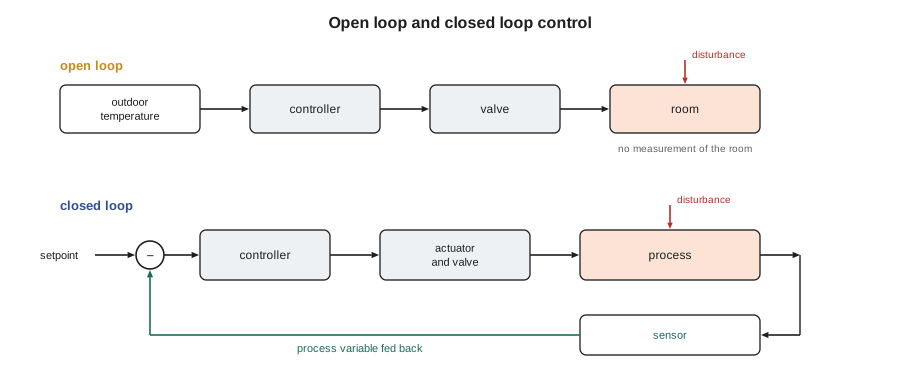
The parts of a closed loop
Every closed loop has the same parts, whatever it controls. Naming them makes it much easier to talk about a loop, read a manufacturer's documentation and find a fault, because each part can fail in its own way.
| Part | What it does | Tilden hot water example |
|---|---|---|
| Setpoint | The value the loop is trying to reach | Hot water supply setpoint |
| Sensor | Measures the controlled quantity | Immersion temperature sensor in the supply pipe |
| Process variable | The measured value the controller sees | Hot water supply temperature on the front end |
| Controller | Compares setpoint and process variable and calculates an output | The plant controller running a PI loop |
| Output | The command sent to the final element | Steam valve command, 0 to 100 in 100 |
| Final control element | The device that changes the process | Steam valve and its actuator |
| Process | The equipment whose condition is controlled | Steam-to-hot-water heat exchanger and piping |
| Disturbances | Outside influences that change the process | Steam pressure, return water temperature, building load |
Prakash drew the loop on the back of a work order, as he did with almost everything, and labeled each part with the actual point name from the front end. Then he asked Callie which parts could make the hot water too cold. Her list: a setpoint set too low, a sensor reading high, a controller with poor settings, a steam valve that would not open, an actuator with a slipped coupling, low steam pressure, or a load larger than the converter could meet. "Good," he said. "Now you know where to look. Only one of those is the loop's settings, and it's usually the last thing I'd change." It was a rule Callie would hear many more times that autumn.
Disturbances and load
A disturbance is anything outside the controller's command that changes the controlled quantity. In buildings the biggest disturbances are weather, people, sun, lights and equipment, and changes elsewhere in the system, such as another valve opening on the same pump. The total of all of these at any moment is the load on the loop. The controller's job is to find the output that exactly balances the load: the steam valve position that delivers just as much heat as the building is taking away, so that the water temperature holds steady.
The load changes all day. On a cold morning start-up, Tilden's converter might need the steam valve 80 in 100 open. By mid-afternoon on a mild day, 25 in 100 might be enough. A closed loop finds those positions by itself. An open loop needs someone to have worked them out in advance. This is why the output of a well-working closed loop moves around even when the process variable is steady: the loop is tracking the load. A steady output with a drifting process variable is often more worrying than the reverse.
Direct and reverse acting
A loop must know which way to move its output when the process variable rises. A cooling valve should open further as the temperature rises above setpoint. This is called direct acting: output rises as the process variable rises. A heating valve should close as the temperature rises. This is reverse acting: output falls as the process variable rises. Getting the action backwards is a classic commissioning mistake. The loop drives the wrong way, the error grows, and the output races to one end and stays there. In the field it looks like a stuck valve, which is why technicians check the action before they check anything else on a new loop.
| Loop | Process variable rises | Output should | Action |
|---|---|---|---|
| Heating valve on supply air | Supply air gets warmer | Close the valve | Reverse |
| Chilled water valve on supply air | Supply air gets warmer | Open the valve | Direct |
| Supply fan on duct static pressure | Pressure gets higher | Slow the fan | Reverse |
| Outdoor air damper on CO2 | CO2 gets higher | Open the damper | Direct |
| Relief fan on building pressure | Building pressure gets higher | Speed up the fan | Direct |
Some controllers name the action in the loop setup; others handle it by the sign of the gain, or by swapping the setpoint and process variable inputs. Callie found all three methods in the Quillon product library. The behavior is the same, and the check is always the same: raise the process variable a little, or lower the setpoint, and watch which way the output goes.
Combining open and closed loop
Many building loops combine the two approaches. A reset schedule, covered in lesson 7, sets the hot water setpoint from outdoor temperature in open loop fashion, and a closed loop then holds the water at that setpoint. A feedforward signal may start a fan at a known speed while the feedback loop takes over. A morning warm-up sequence may run the heating valve wide open for a fixed time before handing over to the room loop. In each case the open loop part does the predictable work quickly and the closed loop part cleans up what the prediction got wrong.
Prakash's view was that the best loops in a building are the ones nobody notices. A good closed loop holds its setpoint, moves its output smoothly as the load changes and recovers from upsets without drama. The rest of this course works through how controllers achieve that: two-position and floating control in lesson 3, proportional, integral and derivative action in lessons 4 and 5, tuning in lesson 6, and the ways loops are combined, sequenced and protected in lessons 7 to 9.
A first look at a trend
The trend Prakash had printed showed Tilden's hot water supply temperature and steam valve command over the previous 24 hours. The temperature line was nearly flat at its setpoint. The valve line moved slowly: higher overnight, lower at midday, higher again in the evening, with a sharp rise at 6:00 when the air handlers started and the building's heating load jumped. "That's a loop doing its job," he said. "Steady process variable, output following the load. Learn what this looks like, because next Friday we're going to look at one that isn't." Reading trends, and telling a healthy loop from a sick one, runs through the whole course.
The trend also showed something easy to miss. At 6:00, when the load stepped up, the temperature dipped by about a degree for ten minutes before the loop caught up. That dip is the price of feedback: the loop cannot act until it sees an error. Lesson 7 shows how a little open loop help at known events, such as fan start-up, can shrink dips like this one.
Common mistakes
MistakeCalling any control with a sensor closed loop.
InsteadA loop is closed only if the sensor measures the quantity the controller is adjusting. A valve scheduled from outdoor temperature is open loop with respect to the room.
MistakeSetting a heating loop to direct acting.
InsteadHeating loops are normally reverse acting: as the temperature rises, the output falls.
MistakeBlaming the loop settings first.
InsteadCheck the setpoint, sensor, actuator and final element too; most loop problems are not tuning.
MistakeExpecting a closed loop to prevent all error.
InsteadFeedback acts only after an error appears; some dip at a sudden load change is normal.
MistakeTreating a moving output as a fault.
InsteadA healthy loop's output follows the load; watch for a drifting or swinging process variable instead.
Summary and key terms
- Control is the deliberate adjustment of a final element so that a quantity behaves as wanted.
- Open loop control acts on a plan or outside condition and never checks the result; it is simple and stable but blind to disturbances.
- Closed loop, or feedback, control measures the result and corrects for disturbances, but can overshoot or swing if set badly.
- Every closed loop has a setpoint, sensor, process variable, controller, output, final control element, process and disturbances.
- The load is the total of all disturbances; the loop's output finds the position that balances it.
- Direct acting loops raise their output as the process variable rises; reverse acting loops lower it.
- Many building loops combine an open loop prediction with a closed loop correction.
- Open loop control
- Control that sets the output without measuring the result.
- Closed loop control
- Control that measures the controlled quantity and adjusts the output to reach the setpoint; also called feedback control.
- Setpoint
- The value a loop is trying to hold.
- Process variable
- The measured value of the quantity being controlled.
- Final control element
- The valve, damper, drive or other device that changes the process.
- Disturbance
- An outside influence that changes the controlled quantity.
- Load
- The total effect of all disturbances that the loop must balance.
- Direct acting
- A loop whose output rises as the process variable rises.
- Reverse acting
- A loop whose output falls as the process variable rises.
Practice problems
Work each problem on paper first, then reveal the answer to check.
A time clock runs a garage exhaust fan from 6:00 to 19:00. Open or closed loop?
Show answer
Open loop: it never measures the air quality in the garage.
Should a chilled water valve on a supply air loop be direct or reverse acting?
Show answer
Direct acting: as the air warms, the valve opens further.
Name three disturbances on a classroom temperature loop.
Show answer
Any three of: people, sun, outdoor temperature, lights, equipment, an open door or window.
Why does a healthy loop's output move during the day?
Show answer
It follows the changing load to keep the process variable at setpoint.
A radiation schedule is closed at 59 °F outdoor and fully open at −4 °F. How far open is it at 34 °F?
Show answer
(59 − 34) ÷ 63 = 0.397, about 40 in 100.
Lesson quiz · 5 questions
Score 60% or more to complete this lesson.
Create a free account to save your progress, take quizzes and earn a certificate.