
BAR-247 · Lesson 8 of 12 · 21 min
Virginia torts: contributory negligence, sovereign and charitable immunity and damages caps
▶ Video coming soon A video version of this lesson is on the way.
The most common call at Ruffin & Gatewood starts the same way. Someone was hurt in a car crash, a fall or an accident at a park, and wants to know whether there is a case. Linwood Ruffin's first three questions never change. 'Was the client careless at all? Who is the defendant: a person, a business, the state, a city or a charity? And when did it happen?' He told Peyton that the answers to those three questions decide more Virginia tort cases than the facts of the accident. 'In most states a client who was ten percent at fault still recovers ninety percent,' he said. 'In Virginia, that client may recover nothing. Against the Commonwealth there is a cap and a one-year notice. Against a city there is a six-month notice. Against a charity there may be immunity. You have to know all of it before you sign anyone up.'
This lesson covers the four features of Virginia tort law that dominate the Virginia Essay and early practice: contributory negligence and the last clear chance doctrine, claims against the Commonwealth under the Virginia Tort Claims Act, claims against localities and the notice statute, charitable immunity, and the caps on medical malpractice and punitive damages.
Contributory negligence
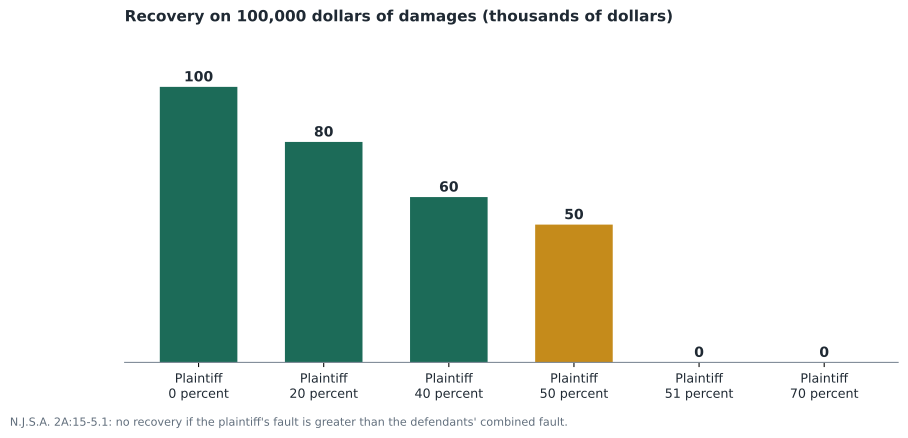
Virginia is one of a handful of jurisdictions that still follow the common law doctrine of contributory negligence. Under it, a plaintiff whose own negligence was a proximate cause of the injury cannot recover anything from a negligent defendant, no matter how small the plaintiff's share of fault. Virginia has not adopted comparative negligence for ordinary negligence claims, and bills to change the rule have repeatedly been introduced in the General Assembly without becoming law.
Contributory negligence is an affirmative defense. The defendant must plead it and prove it by the greater weight of the evidence. It has two parts: the plaintiff failed to use the care that a reasonable person would have used for the plaintiff's own safety, and that failure was a proximate cause of the injury. Ordinarily the question is for the jury. It becomes a question of law for the court only when reasonable people could not differ. Because Virginia juries apply the doctrine with common sense, a plaintiff's minor lapse does not always defeat a claim, but on the exam the candidate must state the rule as it is.
Contributory negligence is a defense to negligence. It is generally not a defense to an intentional tort, and it is not a defense to a claim of willful and wanton negligence, which Virginia treats as a more culpable form of conduct. A plaintiff who can prove willful and wanton conduct, such as a defendant who drove at high speed through a crowded area knowing of the danger, avoids the contributory negligence bar and may also seek punitive damages.
The last clear chance doctrine
The last clear chance doctrine softens contributory negligence in a limited set of cases. In Coutlakis v. CSX Transportation, Inc., 293 Va. 212 (2017), the Supreme Court of Virginia reaffirmed that the doctrine can allow a negligent plaintiff to recover when the defendant had the last clear opportunity to avoid the accident by exercising ordinary care. The Court described two categories of plaintiffs.
A helpless plaintiff is one who has negligently placed himself or herself in a position of peril from which the plaintiff is physically unable to escape. The defendant is liable if the defendant knew, or in the exercise of ordinary care should have known, of the plaintiff's peril and had a clear opportunity to avoid the harm by ordinary care, but failed to do so. An inattentive plaintiff is one who could escape the peril but is unaware of it. The defendant is liable only if the defendant actually saw, or should have seen, that the plaintiff was unaware of the danger and had a clear opportunity to avoid the harm. In Coutlakis, the plaintiff's decedent was walking near railroad tracks with earbuds in, and the Court held that the allegations fit the inattentive category and that the trial court had erred in sustaining a demurrer.
Last clear chance is a doctrine for the plaintiff. The plaintiff must plead and prove it. It is not a back door to comparative negligence; it applies only when the defendant had a genuinely clear chance to avoid the accident after the plaintiff's peril arose.
Claims against the Commonwealth: the Virginia Tort Claims Act
The Commonwealth of Virginia is immune from suit unless it consents. The Virginia Tort Claims Act, in Article 18.1 of Chapter 3 of Title 8.01, is a limited waiver. Under section 8.01-195.3, the Commonwealth is liable for damage to property, personal injury or death caused by the negligent or wrongful act or omission of a state employee acting within the scope of employment, under circumstances in which the Commonwealth, if a private person, would be liable. Transportation districts are covered on similar terms.
The waiver has firm limits. Recovery is capped at 100,000 dollars for claims accruing on or after July 1, 1993, or at the maximum limits of any liability insurance policy in force when the act occurred, if that is greater. Interest and costs are not counted against the cap, but the Commonwealth is not liable for prejudgment interest or for punitive damages. The Act does not apply to counties, cities or towns, whose immunity is unaffected. And the Act lists exclusions, including claims based on the acts of judges and the legislative function, acts done under a lawful court order, the assessment or collection of taxes, and judicial or administrative proceedings. Individual immunities of judges, the Attorney General, Commonwealth's attorneys and other public officers are preserved. Claims by inmates require exhaustion of the Department of Corrections grievance process.
The notice rule is where most claims fail. Under section 8.01-195.6, the claimant must file a written statement of the claim within one year after the cause of action accrues. The notice must state the nature of the claim, the time and place of the injury and the agency or agencies alleged to be liable. For claims against the Commonwealth, it goes to the Director of the Division of Risk Management or to the Attorney General. It is filed when the designated official receives it. Under section 8.01-195.7, the claim is forever barred unless the notice is properly filed. The claimant may sue after the claim is denied or after six months have passed without settlement, and the action must be commenced within 18 months after filing the notice, or within two years after the cause of action accrues.
Jurisdiction is divided by amount under section 8.01-195.4. The general district courts have exclusive original jurisdiction of claims up to 4,500 dollars, the general district and circuit courts share jurisdiction above that up to 50,000 dollars, and larger claims go to circuit court, where the parties are entitled to a jury.
| Defendant | Immunity rule | Written claim required | Cap |
|---|---|---|---|
| The Commonwealth or a state agency | Liable only as the Virginia Tort Claims Act allows | Written claim within one year of accrual (section 8.01-195.6) | 100,000 dollars or the insurance limit, if greater; no punitive damages or prejudgment interest |
| A county | Immune for tort claims unless a statute waives immunity | Written claim within six months (section 15.2-209) | Depends on the waiver |
| A city or town | Immune for governmental functions, liable for proprietary functions | Written claim within six months (section 15.2-209) | None by general statute |
| A charity | Immune from negligence claims by its beneficiaries | No special notice | Not applicable when immunity applies |
Claims against localities
Localities have their own immunity rules, set by Virginia case law. Counties, as political subdivisions of the Commonwealth, share the Commonwealth's immunity from tort liability unless a statute removes it. Cities and towns are immune for governmental functions, such as police and fire protection or the planning of streets, but are liable for negligence in proprietary functions, such as the routine maintenance of streets or the operation of a utility. Line-drawing between the two is a frequent exam issue.
Whatever the immunity analysis, a claimant must give notice. Under section 15.2-209, a negligence claim against a county, city or town is barred unless a written statement of the claim is filed within six months after the cause of action accrues with the locality's attorney or its chief executive or mayor, stating the nature of the claim and the time and place of the injury. The notice is filed when the office receives it, and a signed return receipt is prima facie proof of filing. A missing notice does not bar the claim if the attorney, chief executive or mayor, or the locality's insurer, had actual knowledge of the claim and of the time and place of the injury within the six months. The statute does not change the rules of sovereign immunity; it is a procedural requirement added on top of them.
Government employees have a separate immunity analysis. Virginia courts consider factors such as the nature of the function the employee performed, the government's interest and control, and whether the act involved judgment and discretion. Even a protected employee remains liable for gross negligence and for intentional torts. On an essay, a candidate should analyze the government entity's immunity and the individual employee's immunity separately.
Charitable immunity
Virginia retains a limited form of charitable immunity. In Ola v. YMCA of South Hampton Roads, Inc., decided November 4, 2005, the Supreme Court of Virginia restated the test. The charity must show, first, that it is organized for a recognized charitable purpose and operates in fact consistently with that purpose, and second, that the plaintiff was a beneficiary of its charity at the time of the injury. A person who receives something of value that the charity provides as part of its purpose is a beneficiary, even if the person pays full or reduced fees, and financial need is not required.
The limits are as important as the rule. Charitable immunity does not protect against claims by invitees or strangers who have no beneficial relationship with the charity, such as a delivery driver or a passerby. It does not protect against gross negligence or willful and wanton negligence. And a charity is immune for the negligence of its employees and agents only if it used due care in selecting and retaining them. The fact that a charity carries liability insurance does not waive the immunity. Because the defense depends on facts about the organization and the plaintiff, it is raised by plea in bar.
Damages caps
Virginia caps two kinds of damages. Under section 8.01-581.15, the total amount recoverable for injury to or death of a patient in a medical malpractice action is capped according to the date of the act of malpractice. The cap rises in steps each July 1. For malpractice occurring from July 1, 2026, through June 30, 2027, the cap is 2.75 million dollars. It continues to rise by 50,000 dollars a year until it reaches 3 million dollars for acts of malpractice on or after July 1, 2031. Because the cap depends on the date of the act, not the date of the trial, an essay that gives a date is often asking which cap applies.
Under section 8.01-38.1, punitive damages in any action accruing on or after July 1, 1988, including malpractice actions, may not exceed 350,000 dollars in total against all defendants. The jury is not told about the cap. If it awards more, the judge reduces the award to 350,000 dollars and enters judgment for that amount.

Worked problem
A pedestrian, a state truck and a city sidewalk
On September 14, 2026, Winfield Tibbs stepped off a city sidewalk in Roanoke into a crosswalk while texting. A Virginia Department of Transportation truck, driven by a state employee who was looking at a clipboard, struck him. Tibbs fell onto the curb, where a broken section of sidewalk that the city had been told about months earlier caused a second injury. He comes to Ruffin & Gatewood on November 16, 2026. Advise on the Virginia issues.
Show solution
- Contributory negligence: texting while stepping into a crosswalk may be negligence that proximately caused the first impact. If proved, it bars recovery for that injury unless last clear chance applies: Tibbs was an inattentive plaintiff, so he must show the driver actually saw or should have seen that he was unaware and had a clear chance to avoid him. The driver was looking at a clipboard, which makes that hard to prove.
- Claim against the Commonwealth: a negligence claim for the truck driver's conduct runs against the Commonwealth under the Virginia Tort Claims Act. The written notice must reach the Director of the Division of Risk Management or the Attorney General, or, because the claim involves the Department of Transportation, the Commissioner of Highways, by September 14, 2027, and recovery is capped at 100,000 dollars or the insurance limit.
- Claim against the city: sidewalk maintenance is usually treated as a proprietary function, so the city may be liable for negligence in failing to repair a known defect. The section 15.2-209 notice must be received by the city attorney or mayor within six months, by March 14, 2027.
- Contributory negligence again: the city will argue that Tibbs's texting also contributed to his fall onto the broken curb.
- Calendar both notices immediately; the city deadline comes first.
Answer: The first things Peyton should do are calendar the six-month city notice and the one-year state notice. A brilliant liability theory is worth nothing if the notice arrives late.
Common mistakes
MistakeA plaintiff who is ten percent at fault recovers ninety percent in Virginia.
InsteadVirginia follows contributory negligence: any negligence that proximately caused the injury bars recovery, subject to last clear chance.
MistakeLast clear chance applies whenever the defendant could have avoided the accident.
InsteadFor an inattentive plaintiff, the defendant must have actually seen or should have seen that the plaintiff was unaware, and had a clear chance to avoid the harm.
MistakeThe Virginia Tort Claims Act covers counties and cities.
InsteadIt covers the Commonwealth and transportation districts; localities keep their own immunity rules.
MistakeA charity loses immunity by buying insurance.
InsteadInsurance does not waive charitable immunity; immunity does not apply to non-beneficiaries or to gross negligence.
MistakeThe jury is told that punitive damages are capped at 350,000 dollars.
InsteadThe jury is not told; the judge reduces any larger award.
Summary and key terms
- Virginia follows contributory negligence; the defendant must plead and prove it, and it does not bar claims for intentional torts or willful and wanton negligence.
- Last clear chance (Coutlakis, 2017) helps a helpless or inattentive plaintiff when the defendant had a clear opportunity to avoid the harm.
- The Virginia Tort Claims Act waives the Commonwealth's immunity up to 100,000 dollars or the insurance limit, with written notice within one year and suit within 18 months of notice or two years of accrual.
- Counties are generally immune; cities and towns are immune for governmental but not proprietary functions; claims against localities require notice within six months under section 15.2-209.
- Charities are immune from negligence claims by beneficiaries (Ola, 2005), but not from claims by invitees or strangers or for gross negligence.
- Medical malpractice damages are capped at 2.75 million dollars for acts from July 1, 2026, to June 30, 2027, rising to 3 million dollars by July 1, 2031; punitive damages are capped at 350,000 dollars.
- 0
- contributory negligence
- 1
- last clear chance
- 2
- willful and wanton negligence
- 3
- Virginia Tort Claims Act
- 4
- notice of claim
- 5
- governmental function
- 6
- proprietary function
- 7
- charitable immunity
- 8
- medical malpractice cap
- 9
- punitive damages cap
Practice problems
Work each problem on paper first, then reveal the answer to check.
What two things must a defendant prove for contributory negligence?
Show answer
That the plaintiff failed to use reasonable care for the plaintiff's own safety, and that this failure was a proximate cause of the injury.
What is the cap under the Virginia Tort Claims Act?
Show answer
100,000 dollars for claims accruing on or after July 1, 1993, or the maximum limit of any liability insurance in force, if greater.
How long does a claimant have to give notice of a negligence claim against a Virginia city?
Show answer
Six months after the cause of action accrues, under section 15.2-209.
What is the Virginia malpractice cap for an act of malpractice on October 1, 2026?
Show answer
2.75 million dollars.
Lesson quiz · 5 questions
Score 60% or more to complete this lesson.
Create a free account to save your progress, take quizzes and earn a certificate.