
BAR-247 · Lesson 1 of 12 · 23 min
Becoming a lawyer in Virginia
▶ Video coming soon A video version of this lesson is on the way.
Peyton Barksdale grew up in Lynchburg, on a street that runs down toward the James River, and finished law school at an ABA-approved Virginia law school in May 2026. Since June 2026 she has worked as a law clerk at Ruffin & Gatewood, a four-lawyer firm in downtown Roanoke that handles car accidents and falls, claims against state agencies and towns, divorces and estates. The firm's senior partner, Linwood Ruffin, has practiced in the Roanoke Valley for twenty-eight years. He still tells new clerks about the morning he walked into the exam room in a suit and tie in the middle of a July heat wave, because Virginia expected bar applicants to dress as if they were going to court. Peyton filed her application for the February 2027 Virginia bar examination in early November 2026 and joined Hollis Marchetti's online study group that fall.
At her first one-on-one call with Marchetti, Peyton explained what was worrying her. 'My friends who are taking the bar in Maryland and the District talk about the UBE all the time,' she said. 'They say their score will travel. Virginia does not give the UBE, so my score will not travel the same way. Linwood says the Virginia essays are the hard part and that I need to learn contributory negligence cold. My classmates keep saying Virginia is switching to NextGen, but nobody agrees on when. And I keep hearing about a Law Reader Program, which sounds like something from the nineteenth century. I want one clear picture of what I am taking in February and what else stands between me and the oath.'
Marchetti opened her checklist. 'Virginia writes and grades its own exam,' she said. 'You take the Virginia Essay examination on the Tuesday, with essays and multiple-choice questions on Virginia law, and the Multistate Bar Examination on the Wednesday. The essay day counts for 60 percent and the MBE for 40 percent, and you need a combined score of 140 to pass. Virginia has adopted the NextGen exam, but it does not start until July 2028, so February 2027 is the current Virginia exam. Alongside the exam, the Board has to clear your character and fitness, and you need an MPRE score of 85. After admission you join the Virginia State Bar, which every active lawyer must belong to, and you have two years to take the Harry L. Carrico Professionalism Course. Linwood is right about the essays. Virginia law is the center of this exam, not a side topic.'
This lesson maps the whole process: who controls admission in Virginia, the bodies that do the work, the routes into practice and the usual order of events for a first-time candidate. Later lessons take each step in detail and then turn to the distinctive Virginia law that the Virginia Essay tests and that a new lawyer meets in practice in Richmond, Roanoke, Norfolk, Fairfax or Abingdon.
The Supreme Court of Virginia controls admission
Admission to practice law in Virginia is shared between the General Assembly, which sets the basic framework by statute, and the Supreme Court of Virginia, which regulates the profession through the Rules of the Supreme Court. The statutes on bar admission are in Title 54.1 of the Code of Virginia, beginning around section 54.1-3925, and they create the Virginia Board of Bar Examiners and give it power to examine applicants and issue licenses. The Supreme Court's own rules on admission without examination, corporate counsel, legal aid counsel and military spouses are in Part 1A of its Rules. The Virginia Rules of Professional Conduct and the organization of the Virginia State Bar are in Part 6.
The Supreme Court of Virginia has seven justices. Virginia is one of very few states in which the legislature elects judges: the General Assembly elects the justices of the Supreme Court and the judges of the Court of Appeals, the circuit courts and the district courts. That feature has nothing to do with the bar exam itself, but it explains why judicial selection is in the news in Richmond every winter when the General Assembly meets, and why new lawyers hear about it from senior colleagues.
For a candidate, the structure means that the Board of Bar Examiners is the body to deal with on applications, eligibility, testing accommodations and results, and that the Virginia State Bar is the body to deal with after admission on membership, dues, continuing legal education and discipline. Classmates, bar review companies and senior lawyers are useful for background, but they are not authority. Peyton keeps a folder with the current Rules of the Board, the Board's frequently asked questions page, the application instructions and every email she receives from the Board's office.
The Virginia Board of Bar Examiners
The Virginia Board of Bar Examiners administers the examination. Its office is at 2201 West Broad Street in Richmond, and its website at barexam.virginia.gov posts the Rules of the Board, the application forms, the fee schedule, notices and results. The Board receives applications, collects fees, confirms that each applicant meets an educational requirement, investigates character and fitness, arranges the exam, grades the Virginia Essay, combines the essay score with the MBE score supplied by the National Conference of Bar Examiners and certifies the results. The Board also runs the Law Reader Program and handles applications for admission without examination and for the special licenses described below.
One feature surprises candidates from other states. In Virginia, the same Board that runs the exam also investigates character and fitness. Many states use a separate committee for character review. In Virginia, the character and fitness questionnaire is filed with the bar application, at the same time, and the Board decides both whether the applicant has passed and whether the applicant has shown honest demeanor and good moral character. Lesson 3 covers that process in detail.
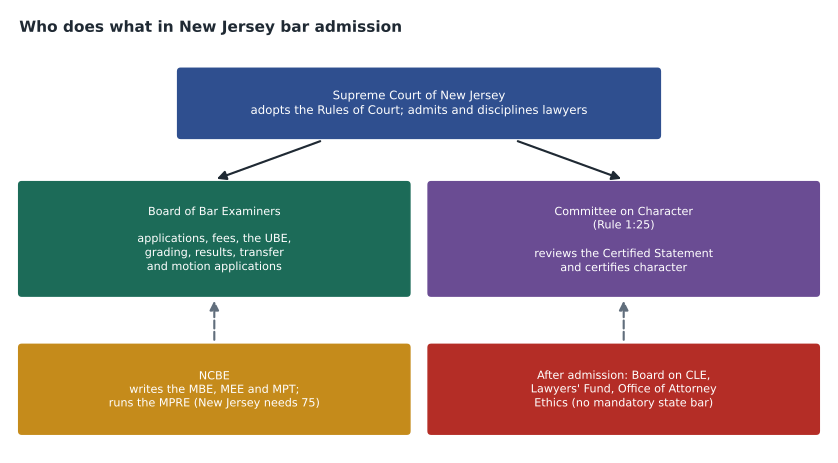
The Virginia State Bar and other bodies a new lawyer will meet
The Virginia State Bar is an integrated, or unified, bar. Every lawyer who practices law in Virginia must be a member, and the State Bar acts as an administrative agency of the Supreme Court of Virginia. It collects annual dues, keeps the membership records, administers the mandatory continuing legal education rules, runs the disciplinary system through Bar Counsel and the district committees, publishes legal ethics opinions and manages the Clients' Protection Fund. When a Virginia lawyer says 'the Bar,' this is usually what the lawyer means.
Virginia also has a voluntary association, the Virginia Bar Association, which is a separate private organization that lawyers may join for networking, programs and advocacy. The two names are easy to confuse. Membership in the Virginia State Bar is a condition of practice; membership in the Virginia Bar Association is a choice. Local bar associations, such as the Roanoke Bar Association that Linwood Ruffin once led, are also voluntary.
The National Conference of Bar Examiners writes and scores the MBE that Virginia candidates take on the second day and runs the Multistate Professional Responsibility Examination. NCBE does not write the Virginia Essay. The Virginia Judges and Lawyers Assistance Program offers confidential help with stress, mental health and substance use for law students, bar applicants and lawyers, and the Board publicizes it on its own website.
| Body | What it does for a candidate or new lawyer |
|---|---|
| Supreme Court of Virginia | Adopts the Rules of the Supreme Court, including Part 1A on special admissions and Part 6 on the State Bar and the Rules of Professional Conduct |
| General Assembly | Sets the statutory framework for the Board and for licensing in Title 54.1 |
| Virginia Board of Bar Examiners | Applications, fees, character and fitness, the Virginia Essay and its grading, results, MBE transfers, the Law Reader Program and admission without examination |
| NCBE | Writes and scores the MBE; runs the MPRE (Virginia needs 85) |
| Virginia State Bar | Mandatory membership, dues, MCLE, discipline, ethics opinions, the Carrico Professionalism Course |
| Virginia Bar Association | Voluntary professional association; not a regulator |
| Virginia Judges and Lawyers Assistance Program | Confidential support for students, applicants and lawyers |
The main routes into Virginia practice
There are two main routes to a full Virginia license. The first, and the one Peyton is taking, is admission by examination. An applicant sits for the Virginia bar exam, passes it with a combined score of 140 or more, meets an educational requirement, shows an MPRE score of 85 or more, satisfies the Board on character and fitness, and then takes the oath. Within admission by examination, the Board's rules describe three options. Most first-time takers use the first option and sit for both days. An applicant who already has an MBE scaled score of 133 or more from an exam within the past five years may transfer that score and sit only for the Virginia Essay. A lawyer in good standing who passed another jurisdiction's bar exam may take only the Virginia Essay and must earn at least 64 raw points out of 100. Lesson 4 explains the options in detail.
The second route is admission without examination under Rule 1A:1 of the Rules of the Supreme Court. Experienced lawyers from jurisdictions that offer similar treatment to Virginia lawyers may apply after at least three of the last five years of full-time practice, subject to character review and other conditions. Lesson 11 covers that route.
Several other paths allow limited practice. A lawyer licensed elsewhere may appear in a particular Virginia case pro hac vice, by motion, associated with Virginia counsel. An in-house lawyer may apply for a corporate counsel registration to work for a single employer. Rule 1A:9 allows lawyers licensed elsewhere who work for a Virginia legal aid society to be admitted as legal aid counsel. Rule 1A:8 provides for the licensure of military spouses. None of these gives the general right to practice that a full license gives, and none is a substitute for admission for someone who intends to build a Virginia practice.
Why Virginia's exam is different
Virginia is one of a small number of jurisdictions that has never adopted the Uniform Bar Examination. It does not give the Multistate Essay Examination or the Multistate Performance Test. Instead, the first day is Virginia's own essay examination, written and graded by the Board, and the second day is the MBE. Because the essay day carries 60 percent of the score and tests Virginia law, a Virginia candidate must learn the Virginia version of each tested subject, not just the national majority rules that the MBE tests.
That has two practical effects. First, a Virginia score does not transfer to UBE jurisdictions the way a UBE score does. Peyton's friends taking the UBE in Maryland or the District of Columbia can send their scores to other UBE jurisdictions within those jurisdictions' limits. Peyton cannot transfer a Virginia combined score, although her MBE score may help her elsewhere if another jurisdiction accepts transferred MBE scores. Second, Virginia does not accept UBE scores from other jurisdictions. A lawyer who passed the UBE in Maryland cannot simply transfer that score to Virginia; the lawyer must take the Virginia Essay, use another option, or qualify for admission without examination.
The order of events for a first-time candidate
Most first-time candidates follow the same sequence. They finish a J.D. at an ABA-approved or Board-approved law school, or complete the Law Reader Program, or qualify through one of the other educational routes. They file the application and the character and fitness questionnaire together with the Board, with the fees, by the filing deadline: December 15 for the February exam or May 10 for the July exam. Virginia does not accept late filings. They complete the attachments, including fingerprints, a recent photograph and educational certificates. They take the MPRE, if they have not already, and earn 85 or more. They register for the laptop program if they want to type the essays. They sit the two-day exam on the Tuesday and Wednesday before the last Wednesday of February or July. When the Board releases results and the character investigation is complete, they attend the Board's admission and orientation ceremony and take the oath, then join the Virginia State Bar.
After admission, the obligations begin quickly. A new lawyer must pay annual dues to the Virginia State Bar, meet the annual MCLE requirement starting with the first full reporting year after admission, and complete the Harry L. Carrico Professionalism Course within 24 months of becoming an active member. Lesson 11 covers those duties.
Worked problem
Mapping a candidate's next twelve months
Peyton filed her February 2027 application and character and fitness questionnaire on November 6, 2026, well before the December 15 deadline. She took the MPRE in August 2025 and scored 96. She has never taken the MBE. She would like to type her essays. Build her checklist from now until she can practice in Virginia.
Show solution
- Confirm that the Board received the application and the questionnaire together, with both fees paid by an accepted method, and that every attachment is in: law school certificate, fingerprint card and a photograph taken within the past twelve months.
- MPRE: her score of 96 is well above Virginia's 85. Under the Board's current notice, Virginia accepts a qualifying MPRE score earned at any time before the passing bar score expires, so she should make sure NCBE reports the score to the Board.
- Laptop: registration for the February exam opens on the second Wednesday of January, so she should mark Wednesday, January 13, 2027, and register within the initial ten-day period to avoid the late fee.
- Exam: Tuesday and Wednesday, February 23 and 24, 2027, under the first option (Virginia Essay plus MBE), with 140 needed to pass.
- Character and fitness: watch for the Board's status emails and answer any request promptly and fully.
- After results: the June admission and orientation ceremony for February passers, the oath, Virginia State Bar membership and dues, and the Carrico Professionalism Course within 24 months.
Answer: Peyton's critical path is the Virginia Essay itself. Her MPRE is done, and her filing was early, so her energy can go into learning Virginia law.
How this course is organized
Lessons 2 through 6 cover the admission process: eligibility, education and deadlines, character and fitness and the MPRE, the format and scoring of the current Virginia exam, the NextGen transition and what the Virginia Essay tests. Lessons 7 through 10 cover the Virginia law that the Virginia Essay tests heavily and that a new lawyer needs in early practice: Virginia courts and civil procedure, Virginia torts and claims against public bodies and charities, Virginia family law, wills and estates, and the places where the Virginia Rules of Professional Conduct differ from the ABA Model Rules. Lesson 11 covers MBE score transfer, admission without examination and life after admission. Lesson 12 is a capstone with original practice questions and an exam-day plan.
Marchetti closed the call with a reminder that applied to everything that followed. 'Write down the source for every rule you rely on,' she said. 'If it came from the Rules of the Board, a notice on the Board's website, the Code of Virginia or a rule of court, keep the citation. If it came from a classmate, check it. Virginia changes its subjects and its rules by notice, and the people who get hurt are the ones who relied on what was true three years ago.'
Common mistakes
MistakeVirginia gives the Uniform Bar Examination.
InsteadVirginia gives its own exam: the Virginia Essay on the first day and the MBE on the second. It does not give the MEE or the MPT, and it does not accept UBE scores.
MistakeNextGen starts in Virginia in 2027.
InsteadThe Board has announced that the first NextGen administration in Virginia will be in July 2028. The February 2027 and July 2027 exams use the current Virginia format.
MistakeThe Virginia State Bar and the Virginia Bar Association are the same thing.
InsteadThe Virginia State Bar is the mandatory, integrated bar that regulates lawyers. The Virginia Bar Association is a separate voluntary organization.
MistakeA separate committee handles character and fitness in Virginia.
InsteadThe Virginia Board of Bar Examiners handles both the exam and the character and fitness investigation, and the questionnaire is filed with the application.
MistakePassing the exam is the last step.
InsteadThe candidate must also satisfy the MPRE requirement and the character review, take the oath and join the Virginia State Bar, and then complete the Carrico Professionalism Course within 24 months.
Summary and key terms
- The General Assembly sets the statutory framework in Title 54.1, and the Supreme Court of Virginia regulates admission and the profession through its Rules, especially Part 1A and Part 6.
- The Virginia Board of Bar Examiners runs the exam, the character and fitness investigation, the Law Reader Program and admission without examination.
- Virginia gives its own two-day exam: the Virginia Essay (60 percent) and the MBE (40 percent), with a combined passing score of 140. NextGen begins in July 2028.
- The main routes are admission by examination (three options) and admission without examination under Rule 1A:1 after three of the last five years of full-time practice.
- The Virginia State Bar is mandatory and integrated; the Virginia Bar Association is voluntary.
- Virginia does not accept UBE scores, and a Virginia combined score does not transfer to UBE jurisdictions.
- 0
- Virginia Board of Bar Examiners
- 1
- Virginia State Bar
- 2
- integrated bar
- 3
- Virginia Essay
- 4
- admission without examination
- 5
- Rule 1A:1
- 6
- pro hac vice
- 7
- corporate counsel registration
- 8
- Harry L. Carrico Professionalism Course
Practice problems
Work each problem on paper first, then reveal the answer to check.
Which body runs both the Virginia bar exam and the character and fitness investigation?
Show answer
The Virginia Board of Bar Examiners.
Does Virginia give the MEE or the MPT?
Show answer
No. The first day is the Board's own Virginia Essay examination, and the second day is the MBE.
Is membership in the Virginia Bar Association required to practice law in Virginia?
Show answer
No. Membership in the Virginia State Bar is required; the Virginia Bar Association is voluntary.
Can a lawyer with a passing UBE score from Maryland transfer it to Virginia?
Show answer
No. Virginia does not accept UBE scores. The lawyer must use one of the Virginia exam options or qualify for admission without examination.
Lesson quiz · 5 questions
Score 60% or more to complete this lesson.
Create a free account to save your progress, take quizzes and earn a certificate.