
BAR-247 · Lesson 12 of 12 · 18 min
Capstone: Virginia practice questions and an exam-day plan
▶ Video coming soon A video version of this lesson is on the way.
On a Tuesday evening in mid-November 2026, Marchetti gave Peyton what she called a dress rehearsal: ten short questions to answer in fifteen minutes, one full Virginia-style essay to write in forty minutes, and then a conversation about exactly what Peyton would do from the evening of February 22 to the afternoon of February 24, 2027. 'The questions are original, not past Board questions,' Marchetti said, 'but they are built the way the Board builds them. Short facts, precise calls, and an answer that turns on a Virginia rule.' This lesson reproduces the rehearsal, with model answers and the plan Peyton built.
Work through each part before reading the answers. Time yourself. The goal is not just to know the rules but to state them in one clean sentence and apply them to the facts under time pressure, which is what the Virginia Essay rewards.
Part one: ten short questions
Answer each in two or three sentences.
Question 1. A plaintiff files a personal injury complaint in circuit court on the last day of the two-year limitations period and serves the defendant fourteen months later, without any attempt at service in between. What is the defendant's best argument?
Question 2. At trial, after the plaintiff rests, the defendant moves to strike the evidence. The court takes the motion under advisement. Before the court rules, the plaintiff asks for a nonsuit. It is the plaintiff's first. Must the court grant it?
Question 3. A Virginia lawyer's client says he plans to sell his elderly mother's house next week by forging her signature on a deed. What must the lawyer do?
Question 4. A city employee negligently fails to repair a pothole that the city had been told about. A driver is injured on June 1, 2026. On what date does the driver's notice period under section 15.2-209 expire, and what must the notice say?
Question 5. A testator wrote her will entirely by hand, signed it and dated it, but no one witnessed it. Is it valid?
Question 6. A husband inherited 100,000 dollars and deposited it in a joint account with his wife, where it was mixed with their paychecks and used for family expenses over five years. What classification is the husband's inheritance likely to receive?
Question 7. A jury awards a plaintiff 900,000 dollars in punitive damages against two defendants. What judgment does the court enter on the punitive award?
Question 8. A paying member of a nonprofit community swimming club, organized and operated for charitable purposes, slips on a wet deck the staff negligently failed to mop. A delivery driver slips on the same deck an hour later. Who may recover?
Question 9. A lawyer who passed the Maryland bar exam in July 2022 with an MBE scaled score of 138 wants to take the February 2027 Virginia exam without sitting for the MBE. Can she?
Question 10. A new Virginia lawyer is admitted in December 2027. By when must she complete the Harry L. Carrico Professionalism Course, and when is her first full MCLE reporting deadline?
Model answers to part one
Answer 1. The defendant should move to dismiss for failure to serve within one year of filing. Under the Rules of the Supreme Court, if service is not made within one year after filing, the action is subject to dismissal with prejudice unless the plaintiff shows due diligence in attempting service. With no attempt at service for fourteen months, the plaintiff is unlikely to show due diligence, and dismissal with prejudice would end the claim because the limitations period has run.
Answer 2. Yes. Under section 8.01-380, a nonsuit is cut off only when a motion to strike the evidence has been sustained, the jury has retired or the case has been submitted to the court for decision. A motion to strike under advisement has not been sustained, so the plaintiff's first nonsuit as of right must be granted, and the plaintiff may refile within six months under section 8.01-229(E)(3).
Answer 3. Under Virginia Rule 1.6(c)(1), the client has stated an intention to commit a crime, forgery and fraud, reasonably certain to cause substantial injury to the financial interests or property of another. Where feasible, the lawyer must advise the client of the legal consequences, urge him not to do it and tell him the lawyer must reveal it unless he abandons the plan. If he does not abandon it, the lawyer must promptly reveal the intention and the information necessary to prevent the crime.
Answer 4. Six months after the cause of action accrued, so December 1, 2026. The written statement must describe the nature of the claim and the time and place of the injury, and it must be filed with the city attorney or the mayor or chief executive. The claim is not barred if the city attorney, mayor or chief executive, or the city's insurer, had actual knowledge of the claim and of the time and place of the injury within six months. Pothole repair is likely a proprietary function, so the city is not immune for negligent maintenance.
Answer 5. Yes. Under section 64.2-403(B), a will wholly in the testator's handwriting and signed by the testator is valid without witnesses. At probate, its handwriting and signature must be proved by at least two disinterested witnesses.
Answer 6. Likely marital. Under section 20-107.3, when separate property is commingled with marital property and loses its identity, it is generally treated as marital. The husband keeps a separate claim only to the extent he can trace the inheritance by a preponderance of the evidence and it was not a gift; after five years of mixing with paychecks and spending on family expenses, tracing is unlikely.
Answer 7. Under section 8.01-38.1, total punitive damages against all defendants may not exceed 350,000 dollars. The jury was not told of the cap; the court reduces the award and enters judgment for 350,000 dollars in punitive damages.
Answer 8. The paying member is a beneficiary of the charity, even though she pays, so charitable immunity bars her ordinary negligence claim, as long as the club exercised due care in hiring and retaining the staff. The delivery driver is an invitee with no beneficial relationship to the charity, so immunity does not apply to him. Neither faces immunity if the club's conduct was grossly negligent. The club should raise immunity by plea in bar.
Answer 9. Yes, under Option 2, if her MBE score is within five years of the exam she applies for. July 2022 to February 2027 is about four years and seven months, and 138 is above the 133 minimum. She would sit for the Virginia Essay only, and her transferred MBE score would be combined with her essay score at the 40 and 60 percent weights. She could also consider Option 3 as an attorney who passed another bar exam.
Answer 10. She must complete the Carrico course within 24 months of becoming an active member, so by December 2029. The MCLE year runs from November 1 to October 31, so she was first admitted in the year that ends October 31, 2028, and that period is exempt. Her first full requirement is the year ending October 31, 2029, reported by December 15, 2029. Hours she earns in the exempt period, including the 5 Carrico hours, may carry forward up to the limits.
Part two: a full Virginia essay
Read the facts and answer the three questions. Allow forty minutes.
The facts. On October 2, 2025, afternoon traffic on Williamson Road in Roanoke was moving slowly when Jubal Pilcher drove his pickup truck through a red light and struck a car driven by Arliss Mattox. Mattox had glanced down at her phone to read a map just before entering the intersection on a green light. A state university van, driven by a university employee on a delivery run, then rear-ended Mattox's car because the van driver was following too closely. Mattox suffered a broken wrist and back injuries. She consulted a lawyer in March 2026, who sent a letter describing the accident, its time and place and the university's van to the university's general counsel on April 10, 2026. Mattox sued Pilcher and the Commonwealth in the Circuit Court of the City of Roanoke on September 30, 2027. Pilcher's answer raises contributory negligence. The Commonwealth files a plea in bar.
Question 1. Is Mattox's claim against Pilcher barred by contributory negligence? Discuss any doctrine that might help her.
Question 2. Should the court sustain the Commonwealth's plea in bar? Explain.
Question 3. If the Commonwealth's plea fails, what is the most Mattox can recover from the Commonwealth, and what damages are unavailable?
Model answer to part two
Question 1. Virginia follows the doctrine of contributory negligence. A plaintiff whose own negligence was a proximate cause of the injury cannot recover, and the defendant must plead and prove the defense. Pilcher will argue that Mattox was negligent in looking at her phone as she entered the intersection. Whether a brief glance at a map while proceeding on a green light was a failure to use reasonable care for her own safety, and whether it was a proximate cause of a collision with a driver who ran a red light, are questions for the jury unless reasonable people could not differ. A driver with a green light is entitled to assume that others will obey the signal until she sees otherwise, which supports Mattox. If the jury finds that her glance contributed to the collision, she cannot recover from Pilcher. The last clear chance doctrine may help only if Pilcher saw, or should have seen, that Mattox was inattentive and had a clear opportunity to avoid her by ordinary care; a driver who runs a red light at speed is unlikely to have had such a clear chance, so the doctrine probably does not help. If the facts showed that Pilcher ran the light deliberately or with reckless disregard, a willful and wanton finding would remove the contributory negligence defense.
Question 2. The plea in bar should probably be sustained. The Commonwealth is liable for the negligence of a state employee only under the Virginia Tort Claims Act. Under section 8.01-195.6, the claimant must file a written statement of the claim within one year after the cause of action accrues with the Director of the Division of Risk Management or the Attorney General. Mattox's lawyer sent the letter to the university's general counsel, not to either designated official. A notice counts as filed only when the designated official receives it, and section 8.01-195.7 provides that the claim is forever barred unless notice is properly filed. Unless the evidence shows that one of the designated officials actually received the statement by October 2, 2026, the notice was defective, and the one-year period has now run. The timing of the suit itself is not the problem: section 8.01-195.7 allows the action to be commenced within 18 months after filing the notice or within two years after the cause of action accrues, and September 30, 2027, is within two years of October 2, 2025. But a timely suit does not cure a defective notice. A plea in bar is the proper vehicle because the defense depends on facts outside the complaint, and the Commonwealth bears the burden of proving it.
Question 3. If the plea fails, recovery against the Commonwealth is capped at 100,000 dollars, or the maximum limit of any applicable liability insurance policy if that is greater, under section 8.01-195.3. Interest and costs are not counted against the cap, but the Commonwealth is not liable for prejudgment interest or for punitive damages. Contributory negligence remains available to the Commonwealth as a defense on the merits, and Mattox's glance at her phone is less likely to be a proximate cause of a rear-end collision caused by the van following too closely.
Part three: Peyton's exam-day plan
Marchetti asked Peyton to write her plan down, hour by hour, and to keep it on one page.
| When | What Peyton will do |
|---|---|
| By January 22, 2027 | Register for the laptop program within the initial ten-day window that opens Wednesday, January 13; install and test the software |
| Early February 2027 | Read the Board's February 2027 exam instructions as soon as they are posted (expected about February 1); confirm site, check-in time and permitted items |
| February 15 to 21 | Two full timed Virginia essay sessions and one 100-question MBE set; review the one-page Virginia trap list each night |
| Monday, February 22 | Light review of the trap list only; lay out court-appropriate clothes, identification, admission documents, laptop, charger, an extension cord of at least eight feet and pencils; no studying after 6 p.m. |
| Tuesday, February 23 (Virginia Essay) | Arrive early; morning: five essays, about 35 to 40 minutes each with a two-minute outline first; afternoon: four essays and the ten multiple-choice questions, answering the multiple choice last if time is tight |
| Tuesday evening | Do not discuss answers; switch to MBE mode: general and federal rules, comparative negligence unless told otherwise |
| Wednesday, February 24 (MBE) | Two sessions of 100 questions; about 1.8 minutes per question; mark and return to hard questions |
| After the exam | Rest; watch for results (about eight weeks for February); plan for the June 2027 admission and orientation ceremony |
Three habits make the plan work. First, Peyton outlines every essay before she writes, listing issues in the order the question asks. Second, she states the Virginia rule in one sentence, then applies it with facts from the question, then concludes. Third, she watches the clock. Leaving an essay blank costs far more points than writing a shorter answer to every question.
What the rehearsal taught Peyton
Peyton missed two of the ten short questions on her first try. On question 6 she wrote 'separate' because the money was inherited, forgetting the commingling rule. On question 10 she counted the MCLE years wrong. Both errors went onto her trap list. On the essay she spotted contributory negligence and the Tort Claims Act cap but initially missed the notice defect: the letter went to the wrong official. 'That is the Virginia essay in one sentence,' Marchetti said. 'The general rule gets you half the points. The Virginia detail gets you the rest.'
Common mistakes
MistakeAnswering a Virginia essay with the MBE rule.
InsteadLead with the Virginia rule and say that it is Virginia's: contributory negligence, the Tort Claims Act, the Virginia nonsuit and the Virginia Rules of Professional Conduct.
MistakeSending a Tort Claims Act notice to the agency involved.
InsteadThe notice goes to the Director of the Division of Risk Management or the Attorney General (or the officials the statute names for transportation districts and the Department of Transportation).
MistakeWriting a long answer to the first essay and running out of time.
InsteadBudget about 35 to 40 minutes per essay and answer every question.
MistakeRaising immunity or limitations by demurrer when the facts are outside the complaint.
InsteadUse a plea in bar.
MistakeStudying new material the night before.
InsteadReview only the trap list and get ready for the morning.
Summary and key terms
- Virginia essay answers turn on precise Virginia rules: contributory negligence and last clear chance, the Tort Claims Act notice and cap, locality notice under section 15.2-209, charitable immunity, the nonsuit and the plea in bar.
- Family and estates questions test the separation periods in section 20-91, the tracing and commingling rules in section 20-107.3, holographic wills under section 64.2-403 and the augmented estate.
- Professional responsibility questions test the Virginia Rules, especially Rule 1.6(c), Rule 3.4(i) and Rule 1.15.
- Admission questions test the 140 passing score, the 60 and 40 weights, the three options, the MPRE score of 85, MCLE and the Carrico course.
- An exam-day plan covers laptop registration, the instructions, clothing and equipment, time budgets for each essay and the switch from Virginia law on Tuesday to general law on Wednesday.
- 0
- plea in bar
- 1
- notice of claim
- 2
- proprietary function
- 3
- Option 2
- 4
- trap list
- 5
- time budget
- 6
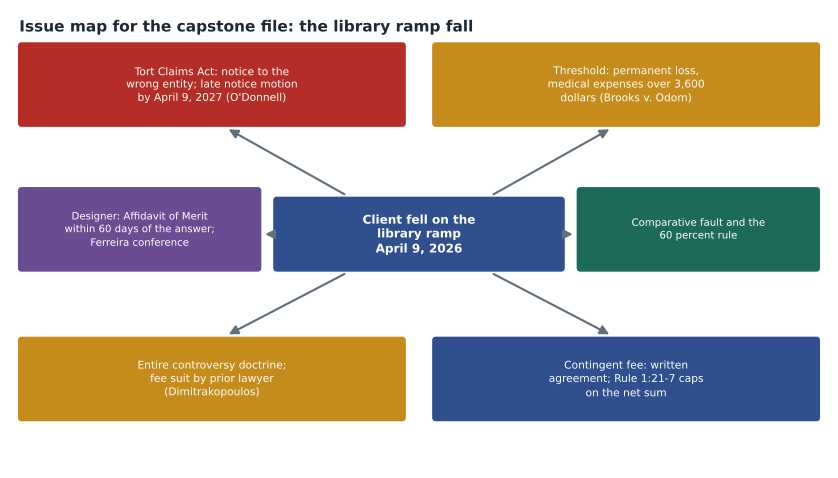
- issue map
Practice problems
Work each problem on paper first, then reveal the answer to check.
What is the first thing to check in any Virginia claim against a state agency?
Show answer
Whether written notice was filed within one year with the Director of the Division of Risk Management or the Attorney General.
What does Peyton do on Tuesday evening of the exam?
Show answer
Avoid discussing answers and switch to general and federal rules for the MBE.
How long should Peyton spend on each Virginia essay?
Show answer
About 35 to 40 minutes, including a two-minute outline.
Lesson quiz · 5 questions
Score 60% or more to complete this lesson.
Create a free account to save your progress, take quizzes and earn a certificate.