
BAR-247 · Lesson 3 of 12 · 20 min
Character and fitness and the MPRE
▶ Video coming soon A video version of this lesson is on the way.
Peyton's character and fitness questionnaire took her longer than her bar application. 'I listed every address since I turned eighteen, every job, every speeding ticket,' she told Marchetti. 'There is one thing I keep going back and forth on. In my second year of college I got an honor code warning for working on a problem set with a friend when the professor said not to. It was not a suspension, just a letter in my file. Do I have to list it? It feels like it will hurt me more to bring it up than to leave it out.' Marchetti did not hesitate. 'List it,' she said. 'Explain it in two sentences. A warning letter from 2019 is not the problem. Leaving it out is the problem. In Virginia you carry the burden of proof, and candor is one of the things the Board is measuring.'
This lesson explains the character and fitness standard in Section III of the Rules of the Virginia Board of Bar Examiners, the conduct that triggers further inquiry, the factors the Board weighs, how rehabilitation is shown, how the process runs alongside exam preparation and what the Multistate Professional Responsibility Examination requires in Virginia.
The standard and the burden
Section III.A of the Rules of the Board requires every applicant to prove honest demeanor and good moral character by clear and convincing evidence. Two features of that sentence matter. First, the burden is on the applicant. The Board does not have to prove that an applicant lacks good character; the applicant must prove that the applicant has it. Second, the standard is clear and convincing evidence, which is higher than the preponderance standard used in most civil cases. The same section adds that failing to answer questions or to provide information the Board requests may itself be held against the applicant.
The purpose is protective, not punitive. The Board's question is whether the applicant can be trusted with clients' money, confidences and legal problems, and whether the applicant will deal honestly with courts and opposing parties. Past mistakes matter to the extent they predict future conduct. That is why candor, rehabilitation and the passage of time weigh so heavily.
Conduct that triggers further inquiry
Section III.B lists fifteen categories of conduct or circumstances that may lead the Board to look more closely. They include criminal conduct, academic misconduct, false statements and omissions, disciplinary action by another licensing body, neglect of financial obligations, violation of court orders, misconduct in employment and conduct suggesting substance abuse or a condition that currently impairs the ability to practice. A matter in one of these categories does not by itself disqualify the applicant. It means the Board will ask questions, may request records and may invite the applicant to an informal meeting.
Peyton's honor code letter falls in the academic misconduct category, so the Board may well ask about it. The right response is a short, accurate explanation and a copy of the letter if she still has it. A disclosure that matches the school's records is routine. A disclosure the Board later discovers on its own, after the applicant answered no, is a serious problem, because it turns a minor college matter into a false statement on a sworn questionnaire.
The factors the Board weighs
Section III.C lists ten factors the Board considers when it evaluates conduct that raises concern. They include how recent the conduct was, how serious it was, the applicant's age and circumstances at the time, whether it was an isolated event or part of a pattern, evidence of rehabilitation and the applicant's candor in the admission process. A single traffic matter at nineteen is weighed very differently from a pattern of unpaid debts in the year before application.
Candor is a factor in its own right. An applicant who discloses fully and explains honestly gets credit for doing so. An applicant who minimizes, omits or shades the truth loses credibility on everything else in the file. Experienced bar admissions lawyers tell applicants the same thing Marchetti told Peyton: the cover-up is worse than the conduct.
Rehabilitation
Under Section III.D, an applicant who relies on rehabilitation must prove it by clear and convincing evidence. The rule describes the kinds of proof the Board expects, including compliance with any conditions imposed by a court or another body, such as probation, restitution or treatment; the passage of time without further misconduct; letters of reference from people who know about the past conduct; and evidence of positive activities since then. An applicant who completed a diversion program after an arrest, paid every dollar of court costs and has three years of clean conduct should gather the court records and ask references to address the matter directly.
The essential eligibility requirements
Section III.E lists ten essential eligibility requirements for the practice of law. They describe abilities and qualities, not specific past events, such as knowledge of the law, the ability to reason and analyze, the ability to communicate clearly with clients, lawyers and courts, the ability to manage time and meet deadlines, honesty and candor, financial responsibility, compliance with rules and court orders, and the ability to avoid acts that put clients or the public at risk. The list is useful because it explains why the Board asks what it asks. A history of missed court dates bears on the ability to meet deadlines; a history of ignored judgments bears on financial responsibility.
| Rule of the Board | What it covers |
|---|---|
| III.A | Burden on the applicant to prove honest demeanor and good moral character by clear and convincing evidence; failing to answer may count against the applicant |
| III.B | Fifteen categories of conduct that may trigger further inquiry |
| III.C | Ten factors the Board weighs, including recency, seriousness, rehabilitation and candor |
| III.D | Rehabilitation proved by clear and convincing evidence, with references and proof of compliance |
| III.E | Ten essential eligibility requirements for practice |
| III.F | Every applicant files the Character and Fitness Questionnaire and pays the fee |
How the process runs in practice
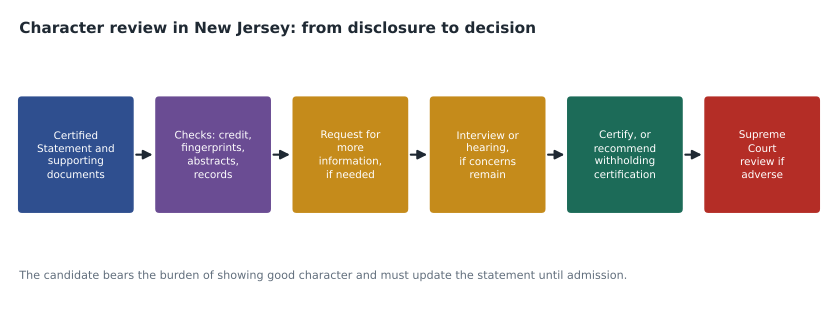
The questionnaire is filed with the application, at the same time. The Board then runs its investigation while the applicant studies. According to the Board's frequently asked questions page, most applicants who filed on time may sit for the exam even if their investigation is still open. The Board sends two status emails: the first no later than 60 days after the filing deadline, and the second within two to three weeks of the exam. The Board does not necessarily tell an applicant when the investigation is complete; its own page says that no news is good news.
Two practical rules follow. First, the questionnaire is a continuing statement. If something changes after filing, such as a new job, a new address, a court matter or a new debt in collection, the applicant should update the Board promptly. The Board's fee schedule includes an update form for applicants whose questionnaire was filed within the past five years. Second, the applicant should respond to every Board request quickly, completely and in writing. Delay in answering is the most common reason a file stays open.
The MPRE requirement
Section I.E of the Rules of the Board requires every applicant to submit evidence of a scaled score of 85 or greater on the Multistate Professional Responsibility Examination. NCBE's summary for Virginia lists the same 85 minimum on the MPRE's scale of 50 to 150. That number is higher than the 75 or 80 that many other jurisdictions require, so an applicant planning to practice in Virginia and another state should aim for Virginia's number.
The timing rule changed in recent years, and older study guides may be out of date. Under the Board's current notice and its rules, Virginia accepts a qualifying MPRE score obtained at any time before the applicant's passing Virginia bar score expires. A passing bar score is valid for five years from the exam date. In practice, that means an applicant can take the MPRE before the bar exam, as Peyton did, or after passing the bar exam, as long as the 85 is earned within the five-year life of the bar score. Some bar review materials still describe an older, shorter window; candidates should rely on the Board's current rules and notices.
The MPRE itself is a two-hour, 60-question multiple-choice exam given by NCBE several times a year at test centers. It tests the ABA Model Rules of Professional Conduct, the ABA Model Code of Judicial Conduct and generally accepted principles of lawyer regulation, not the Virginia Rules. That point matters in Virginia because, as lesson 10 explains, the Virginia Rules of Professional Conduct differ from the Model Rules in several places. On the MPRE, answer with the Model Rules. On the Virginia Essay, where professional responsibility is a tested subject, answer with the Virginia Rules.
An applicant must arrange for NCBE to send the MPRE score to the Board. The Board's fee schedule lists a fee for an MPRE score request handled through its office. Peyton printed the NCBE score report and confirmed with the Board that the score was on file.
Worked problem
Deciding what to disclose
Peyton's classmate Hobart Shifflett is filling out his questionnaire. He has three items: a reckless driving charge at age twenty that was reduced to improper driving after he completed a driving course; a credit card account sent to collection in 2023 that he paid off in 2024; and a semester when he was placed on academic probation for low grades. He wants to know which to list.
Show solution
- Read each question on the questionnaire literally. If it asks about charges, list the charge even though it was reduced, and explain the outcome.
- List the collection account if the questionnaire asks about accounts referred to collection or delinquent debts, and attach proof of payment.
- Academic probation for grades is not misconduct, but list it if the questionnaire asks about academic probation or discipline of any kind.
- For each item, write a short factual explanation: date, what happened, outcome and what has changed since.
- Gather documents: court disposition, payoff letter, school records.
Answer: All three should be disclosed if the questions reach them. None is likely to prevent admission if the explanations are accurate and the documents match. Leaving any of them out would create a candor problem far worse than the conduct.
Common mistakes
MistakeThe Board must prove that an applicant lacks good character.
InsteadThe applicant must prove honest demeanor and good moral character by clear and convincing evidence.
MistakeOld or minor matters can be left off the questionnaire.
InsteadAnswer every question fully. Omissions are judged under the candor factor and can be more damaging than the conduct.
MistakeVirginia requires an MPRE score of 75.
InsteadVirginia requires 85, one of the higher MPRE scores in the country.
MistakeThe MPRE must be passed before the bar exam.
InsteadUnder the Board's current rules, a qualifying MPRE score is accepted if obtained before the passing bar score expires, which is five years after the exam.
MistakeThe MPRE tests the Virginia Rules of Professional Conduct.
InsteadThe MPRE tests the ABA Model Rules and related principles; the Virginia Essay tests the Virginia Rules.
Common character and fitness problems, and how to avoid them
Marchetti keeps a short list of the character and fitness problems she has seen most often among Virginia candidates. The first is an inconsistent history: the questionnaire lists a job from June to August, but the law school application listed the same job from May to September. The Board compares documents, and unexplained inconsistencies lead to questions. The fix is to pull out every earlier application, including law school applications and any prior bar applications, and make the dates match or explain why they differ.
The second is financial trouble that the applicant has not addressed. An old medical bill in collection or a student loan in default is not disqualifying in itself, but an applicant who has ignored it looks careless with obligations. The applicant should contact the creditor, set up a payment plan or pay the debt, and attach proof. The third is a traffic or criminal record that the applicant remembers differently from the court. Before answering, the applicant should get the official disposition from the court that handled the matter. The fourth is a late response to a Board request. A request that goes unanswered for weeks can keep a file open after results are released.
Peyton found one inconsistency in her own file: she had listed her college library job as two years on her law school application but three semesters on her draft questionnaire. She checked her old pay stubs, corrected the questionnaire to the accurate dates and added a one-line note explaining the earlier error. 'That is exactly the right instinct,' Marchetti said. 'Fix it, explain it and move on.'
Summary and key terms
- Applicants must prove honest demeanor and good moral character by clear and convincing evidence; the burden is on the applicant (Rules of the Board III.A).
- Fifteen categories of conduct may trigger inquiry (III.B); the Board weighs ten factors, including recency, seriousness, rehabilitation and candor (III.C).
- Rehabilitation must also be proved by clear and convincing evidence (III.D); the ten essential eligibility requirements explain what the Board is testing (III.E).
- Most timely applicants sit for the exam while the investigation continues; the Board sends status emails within 60 days of the deadline and two to three weeks before the exam.
- Virginia requires an MPRE scaled score of 85, accepted if earned before the passing bar score expires five years after the exam.
- The MPRE tests the ABA Model Rules; the Virginia Essay tests the Virginia Rules of Professional Conduct.
- 0
- character and fitness
- 1
- clear and convincing evidence
- 2
- candor
- 3
- rehabilitation
- 4
- essential eligibility requirements
- 5
- MPRE
- 6
- scaled score
- 7
- status email
- 8
- update form
Practice problems
Work each problem on paper first, then reveal the answer to check.
Who bears the burden in a Virginia character and fitness review?
Show answer
The applicant, who must prove honest demeanor and good moral character by clear and convincing evidence.
Can an applicant whose investigation is still open sit for the exam?
Show answer
Usually yes, if the application was filed on time. The Board's FAQ says most such applicants may sit.
What MPRE score does Virginia require, and when must it be earned?
Show answer
85 or higher, earned before the applicant's passing bar score expires five years after the exam.
Which rules does the MPRE test?
Show answer
The ABA Model Rules of Professional Conduct and related principles, not the Virginia Rules.
Lesson quiz · 5 questions
Score 60% or more to complete this lesson.
Create a free account to save your progress, take quizzes and earn a certificate.