
BAR-245 · Lesson 8 of 12 · 19 min
Utah torts: comparative fault, no joint and several liability and the Governmental Immunity Act
▶ Video coming soon A video version of this lesson is on the way.
The file that taught Mele the most about Utah tort law came in during October 2026. A client, Lavinia Mahe, had been driving home from work on a county road in Utah County when a delivery van ran a stop sign and struck her car. The van's driver said the stop sign was hidden by overgrown trees that the county had not trimmed. Lavinia had glanced at her phone a moment before the crash. 'Three people may share the fault,' Brigid Arnesen said, 'one of them a county, and the client herself. In Utah that changes almost everything about how we value the case.' This lesson covers the Utah Liability Reform Act, the Governmental Immunity Act of Utah and a few damages rules every Utah injury lawyer knows.
The Liability Reform Act: modified comparative fault
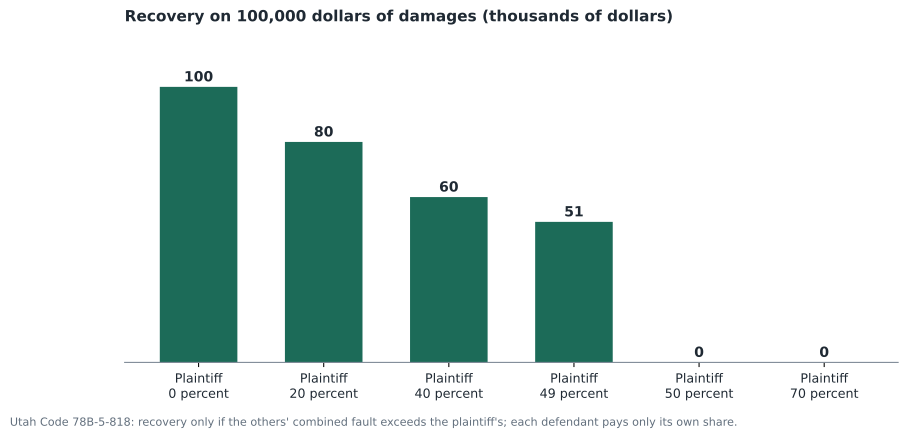
Utah abandoned contributory negligence long ago and now allocates fault under the Liability Reform Act, sections 78B-5-817 through 78B-5-823 of the Utah Code. Section 78B-5-818 sets the basic rule. The fault of a person seeking recovery does not by itself bar recovery. But a person seeking recovery may recover from a defendant or group of defendants only if their fault, combined with the fault of persons immune from suit and nonparties to whom fault is allocated, exceeds the fault of the person seeking recovery. A plaintiff who is 50 percent at fault, facing defendants and others who together are 50 percent at fault, recovers nothing, because their fault does not exceed hers. A plaintiff at 49 percent recovers damages reduced by her own percentage.
Utah's comparison is unusual in one respect: it compares the plaintiff's fault with the combined fault of everyone else to whom fault is allocated, not with each defendant individually. A plaintiff who is 30 percent at fault can recover from a defendant who is only 10 percent at fault, so long as the combined fault of all others exceeds 30 percent.
No joint and several liability
The second pillar of the Act is proportionate liability. Under sections 78B-5-818 and 78B-5-820, no defendant is liable for any amount in excess of the proportion of fault attributed to it. Utah has, in effect, abolished joint and several liability for defendants whose fault is allocated under the Act. Because each defendant pays only its own share, the Act also provides that a defendant has no right to contribution from another defendant: there is nothing to contribute, since no one pays more than its share.
The practical effect is that the risk of an insolvent or absent defendant falls on the plaintiff. If a jury allocates 40 percent of the fault to a driver who has no insurance and no assets, the plaintiff cannot collect that 40 percent from the solvent defendants. A Utah injury lawyer therefore investigates insurance and assets for every potentially responsible person at the start of the case.
Allocating fault to immune persons and nonparties
Under section 78B-5-818(4), the fact finder may, and when a party requests it must, allocate fault to each person seeking recovery, each defendant, any person immune from suit and other persons identified under the Act for whom there is a factual and legal basis to allocate fault. Section 78B-5-819 directs a special verdict that states the total damages and each person's percentage of fault. A nonparty must be identified properly under section 78B-5-821 for fault to be allocated to it.
Fault allocated to an immune person, such as an employer protected by workers' compensation immunity, is used only to determine the fault of the plaintiff and the defendants. It does not make the immune person liable in that action or any other. Section 78B-5-819(2) adds a distinctive reallocation rule: if the combined fault attributed to all persons immune from suit is less than 40 percent, the court reduces that fault to zero and reallocates it to the other parties and identified persons in proportion to their fault. If the immune persons' combined share is 40 percent or more, it stays where the jury put it. The jury is not told how the reallocation works, though it may be told that fault allocated to immune persons may reduce the plaintiff's award. Section 78B-5-818(2) applies the plaintiff's bar to the fault before any reallocation.
Worked problem
Allocating fault in Lavinia's case
Suppose a jury finds Lavinia's damages to be 300,000 dollars and allocates fault as follows: Lavinia 20 percent; the van driver's employer (vicariously liable) 50 percent; the county 30 percent. The county is a party and is not immune for this claim. What can Lavinia recover, and from whom?
Show solution
- Bar: the others' combined fault, 80 percent, exceeds Lavinia's 20 percent, so she may recover.
- Reduction: her recovery is measured by each defendant's share of the 300,000 dollars, not by a single joint judgment.
- Employer: liable for 50 percent of 300,000 dollars, or 150,000 dollars.
- County: liable for 30 percent, or 90,000 dollars, subject to the Governmental Immunity Act's notice rules and damages limits.
- Total: 240,000 dollars, which equals 300,000 dollars reduced by her 20 percent; no defendant pays more than its share, and there is no contribution between them.
Answer: Lavinia can recover 150,000 dollars from the employer and 90,000 dollars from the county, if the claim against the county complied with the Governmental Immunity Act.
The Governmental Immunity Act of Utah
Claims against the State, its political subdivisions and their employees are governed by the Governmental Immunity Act of Utah, Title 63G, Chapter 7. The Act starts with immunity and then waives it for specified kinds of claims, such as injuries caused by the negligent operation of a motor vehicle by a government employee or by a defective, unsafe or dangerous condition of a highway, road, street or public building, subject to listed exceptions. The exceptions keep immunity for many claims, including those arising out of the exercise of a discretionary function. Whether immunity is waived for a particular claim, and whether an exception restores it, are often the central legal questions in a case against a city or county.
The notice of claim
The Act's procedural requirements are strict. Under section 63G-7-402, a claim against a governmental entity, or against its employee for an act within the scope of employment, is barred unless a notice of claim is filed within one year after the claim arises. Under section 63G-7-401, a claim generally arises when the statute of limitations that would apply to a private person begins to run, but not until the claimant knew, or with reasonable diligence should have known, that she had a claim and the identity of the governmental entity or employee. The claimant bears the burden of proving reasonable diligence.
The notice must contain a brief statement of the facts, the nature of the claim, the damages incurred so far as they are known and, if the claim is against an employee individually, the employee's name. It must be signed by the claimant or the claimant's agent, attorney, parent or guardian. And it must be directed to the right official: the attorney general for a claim against the State, the city or town clerk for a city or town, the county clerk for a county, the superintendent or business administrator for a school district, and so on, or to an agent the entity has designated in the statement it files with the Division of Corporations and Commercial Code. The notice may be delivered by hand or by mail to the listed address or by email to the designated address, with a copy emailed at the same time to the entity's attorney.
After the notice is filed, the entity must acknowledge it in writing within 60 days, and the claimant may not sue until 60 days after filing the notice. Under section 63G-7-403, the action must be commenced within two years after the claim arises. If a timely action fails or is dismissed for a reason other than the merits, the claimant may file a new action within one year, but only once.
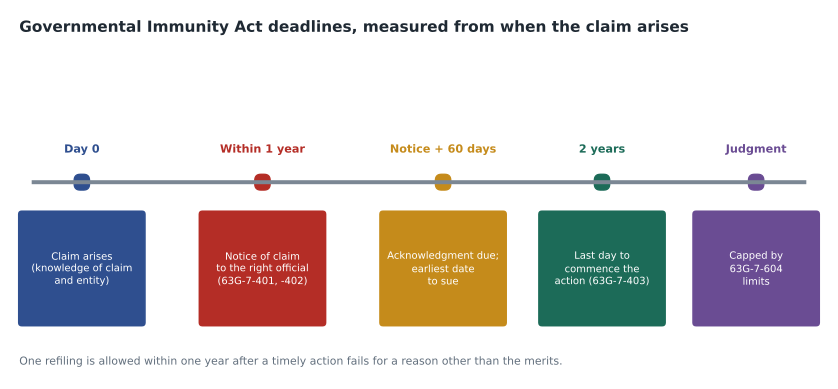
| Step | Rule under the Governmental Immunity Act |
|---|---|
| Filing the notice of claim | Within one year after the claim arises (63G-7-402), with the contents and recipient required by 63G-7-401 |
| Acknowledgment | Entity notifies the claimant in writing within 60 days that the notice was received |
| Waiting period | No suit until 60 days after the notice is filed (63G-7-403) |
| Suit | Within two years after the claim arises; one refiling within one year after a non-merits dismissal |
| Damages | Subject to the Act's limitation of judgment amounts, adjusted periodically by rule |
Limits on judgments against government
The Act also caps damages. Section 63G-7-604 sets limits on judgments against a governmental entity or employee, and the amounts are adjusted periodically for inflation by an administrative rule of the Division of Risk Management. For claims arising on or after July 1, 2022, the adjusted limits published in that rule were 827,000 dollars for one person in any one occurrence, an aggregate of 3,329,100 dollars for all persons in one occurrence and 326,200 dollars for property damage in one occurrence. Because the figures are adjusted over time, a lawyer must check the version of the rule that applies to the date the claim arose. The Act also bars punitive damages against governmental entities.
Other damages rules a Utah injury lawyer knows
Two other rules shape Utah injury practice. First, in medical malpractice cases, the Utah Health Care Malpractice Act caps noneconomic damages, at 450,000 dollars for claims arising after May 15, 2010, and requires a prelitigation review process before suit, along with a two-year limitations period. Second, punitive damages in Utah require proof by clear and convincing evidence that the defendant's conduct was willful and malicious or intentionally fraudulent, or manifested a knowing and reckless indifference toward the rights of others, and part of a large punitive award is paid to the State. Both rules vary in detail, and the statutes must be checked in each case.
Torts and the exam
On the MBE and MEE, torts questions test general principles. When a question involves comparative negligence, it typically states whether the jurisdiction follows pure or modified comparative negligence, and a candidate must apply what the question says. Joint and several liability, contribution and indemnity are tested in their traditional and common modern forms, not in Utah's form. Government immunity is tested, if at all, at the level of general principles. Mele's rule for February: on the exam, read the call and apply the stated system; at work, open Title 78B.
Common mistakes
MistakeA Utah plaintiff at 50 percent fault recovers half her damages.
InsteadShe recovers nothing, because the others' combined fault does not exceed hers.
MistakeA solvent Utah defendant pays an absent defendant's share.
InsteadNo defendant pays more than its own proportion of fault; there is no contribution.
MistakeFault allocated to an immune employer always stays on the verdict.
InsteadIf immune persons' combined fault is under 40 percent, the court reallocates it to the others.
MistakeA notice of claim against a city goes to the mayor.
InsteadIt goes to the city or town clerk, or the agent designated in the entity's filed statement.
MistakeA claim against government can be filed the day after the notice.
InsteadThe claimant must wait 60 days and sue within two years after the claim arises.
Investigating every responsible person early
Because Utah has no joint and several liability, the first weeks of an injury case focus on identifying everyone whose fault might be allocated and finding out who can pay. In Lavinia's case, Mele built a chart: the van driver, the delivery company, the county responsible for the trees and the sign, and any contractor hired to maintain the right of way. For each, she noted insurance, whether a notice of claim was required and what evidence would establish fault. Defendants do the same thing in reverse, identifying nonparties to whom fault can be allocated to reduce their own shares, and they must give notice of those nonparties as the rules require. A plaintiff's lawyer who has not investigated every possible nonparty may be surprised when a jury allocates a large share of fault to someone who is not in the case and cannot be made to pay.
Lavinia's case settled in principle before suit, but only after Mele confirmed that the notice of claim had been sent to the Utah County clerk well within the year. 'The notice was the most important document in the file,' Brigid said, 'and it was two pages long.'
Summary and key terms
- Under 78B-5-818, a plaintiff recovers only if the combined fault of defendants, immune persons and allocated nonparties exceeds hers.
- Under 78B-5-818 and 78B-5-820, no defendant pays more than its proportion of fault, and there is no contribution.
- Under 78B-5-819(2), immune persons' combined fault under 40 percent is reallocated to the others; 40 percent or more stays.
- Governmental Immunity Act: notice within one year (63G-7-402) to the correct official (63G-7-401), a 60-day wait and suit within two years (63G-7-403).
- Judgments against government are capped by 63G-7-604 at amounts adjusted by rule; punitive damages against government are barred.
- Medical malpractice noneconomic damages are capped at 450,000 dollars, with a prelitigation review requirement.
- 0
- Liability Reform Act
- 1
- modified comparative fault
- 2
- proportionate liability
- 3
- contribution
- 4
- person immune from suit
- 5
- reallocation
- 6
- Governmental Immunity Act of Utah
- 7
- notice of claim
- 8
- limitation of judgment
Practice problems
Work each problem on paper first, then reveal the answer to check.
A plaintiff is 45 percent at fault; two defendants are 30 and 25 percent. Can she recover, and how much from each?
Show answer
Yes; she recovers 30 percent and 25 percent of her damages from the respective defendants.
What happens to 25 percent of fault allocated to an immune employer?
Show answer
Because it is under 40 percent, the court reduces it to zero and reallocates it proportionally to the others.
Within what time must a notice of claim be filed?
Show answer
Within one year after the claim arises.
To whom is a notice of claim against a county directed?
Show answer
The county clerk, or the agent designated in the county's filed statement.
Lesson quiz · 5 questions
Score 60% or more to complete this lesson.
Create a free account to save your progress, take quizzes and earn a certificate.