
BAR-245 · Lesson 12 of 12 · 17 min
Capstone: Utah practice questions and an exam-day plan
▶ Video coming soon A video version of this lesson is on the way.
Mele's last one-on-one session of the fall, in the third week of November 2026, had two parts. First, Marchetti gave her ten short questions on Utah admission and Utah law, with ten minutes to answer. Then she handed over a short practice file built from the kinds of matters Arnesen & Ostler sees every week and asked for a forty-five minute memo. 'None of this is on the UBE,' Marchetti said. 'All of it is on your desk on the Monday after you are sworn in. And we finish with the plan for February.' This lesson reproduces the questions, the file, a model analysis and the plan.
Part one: ten short questions
Answer each question in a sentence or two. The answers follow.
1. Mele's study partner earned a 262 on the UBE in another state in July 2023. Can she transfer it to Utah in January 2027?
2. A candidate filed her February 2027 application on October 3, 2026. What happens?
3. A candidate scored 85 on the MPRE in 2021. Does it satisfy Utah's requirement?
4. A graduate sat for the July 2026 UBE in Arizona and failed. Can she use Utah's alternate pathway?
5. A complaint seeks 280,000 dollars. What discovery tier applies, and how many hours of fact depositions are allowed?
6. A jury finds a plaintiff 50 percent at fault and two defendants 25 percent each. What does the plaintiff recover?
7. A pedestrian is injured on March 10, 2026 by a city maintenance truck. By when must she file a notice of claim, and with whom?
8. A divorcing spouse has lived in Weber County for 75 days. May she file there?
9. A Utah lawyer wants to pay another lawyer 15 percent of a fee for a referral, with no other involvement. Is that allowed after November 1, 2026?
10. A new lawyer admitted in October 2027 who lives in Utah asks whether she must join the New Lawyer Training Program. What is the answer?
Answers
1. No. A July 2023 or later legacy score needs 260 under Rule 4-712, and 262 meets that standard, but the score is transferable only for 36 months after the July 2023 exam, so the window closed in July 2026. (Mele missed this one: she checked the score but not the window.)
2. The application is late. Since the February 2026 exam there is no late filing period, so she cannot sit in February 2027 and must apply for July 2027 by March 1, 2027.
3. No. Utah requires 86. Utah does not expire scores, but 85 is below the requirement, so she must retake.
4. No. Rule 4-703A excludes anyone who has previously sat for a bar exam in any United States jurisdiction, passed or failed.
5. Tier 2, because the amount is more than 50,000 and less than 300,000 dollars. Standard fact discovery allows 15 hours of depositions.
6. Nothing. Under section 78B-5-818 the defendants' combined fault must exceed the plaintiff's, and 50 percent does not exceed 50 percent.
7. Within one year after the claim arises, so by March 10, 2027 if she knew of the claim and the entity's identity at the time of injury. The notice goes to the city or town clerk, or to the agent designated in the city's statement on file with the Division of Corporations and Commercial Code.
8. Not on the basis of residence. Section 81-4-402 requires 90 days of residence in the county, unless another basis applies, such as military stationing or both parties' consent to jurisdiction. She should wait 15 more days.
9. No. Rule 3-5.4(c) prohibits referral fees. The lawyers could share a fee under Rule 5.8 only with the client's written agreement to each share, no increase in the total fee and reasonable shares.
10. Yes, if she is on active status and has less than two years of practice. She must complete the twelve-month mentoring term and the New Lawyer Ethics Program before the end of her first compliance cycle after admission.
Mele scored nine out of ten. Her one miss, the transfer window, is the kind of error that costs a real client a license, and she added a line to her checklist: always compute the date the window closes.
Part two: the Haws file
The file Marchetti handed over read as follows. It is a hypothetical, and every person and business in it is invented.
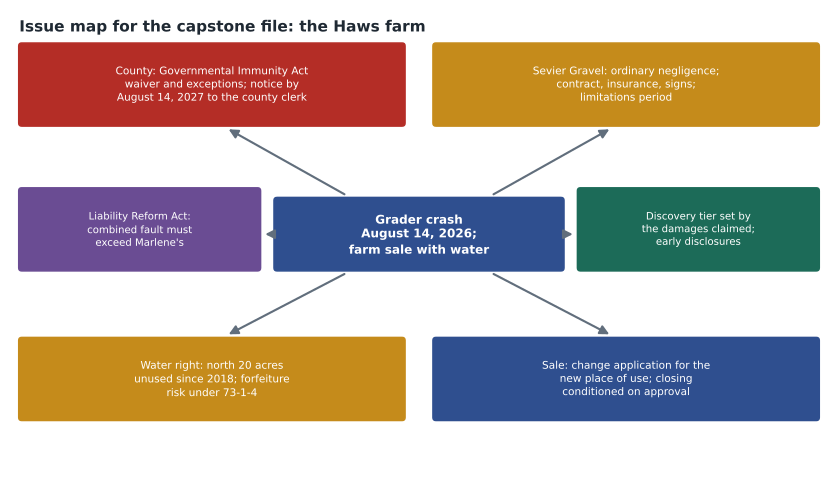
Verl and Marlene Haws own a 60-acre alfalfa farm near Delta, in Millard County, with an irrigation water right decreed in 1911. In 2018 they stopped irrigating the north 20 acres when Verl's health declined; they did not file a nonuse application. On August 14, 2026, Marlene was driving a farm truck on a county road when a county road grader, pulling out of a gravel pit, struck her truck. The grader operator says Marlene was speeding. Marlene says the grader pulled out without looking and that the county had removed the warning sign at the pit entrance a month earlier. A private contractor, Sevier Gravel LLC, operates the pit under a county contract and was responsible for the signs. Marlene's medical bills are 48,000 dollars, she lost three months of farm income, and her truck was destroyed. Separately, the Haws family has agreed to sell the farm, with its water right, to a dairy that wants to move the water to a pivot sprinkler on another parcel two miles away. Write a short memo identifying the issues and the next steps.
A model analysis
Question presented. What claims does the Haws family have arising from the August 14, 2026 crash, what must the firm do to preserve them, and what issues does the farm sale raise for the water right?
Brief answer. Marlene has negligence claims against the county and against Sevier Gravel. The county claim requires a notice of claim within one year, by August 14, 2027, to the Millard County clerk or the county's designated agent, followed by a 60-day wait and suit within two years. Fault will be allocated among Marlene, the county and Sevier Gravel under the Liability Reform Act, and each defendant will pay only its share. The farm sale raises a forfeiture risk for the water right on the north 20 acres and requires a change application to move the water.
Discussion: the county. The Governmental Immunity Act waives immunity for injuries caused by the negligent operation of a motor vehicle or equipment by a government employee and for certain dangerous conditions of roads, subject to exceptions, so the firm must analyze whether the waiver applies and whether any exception, such as the discretionary function exception for decisions about signs, restores immunity. The notice must include a brief statement of the facts, the nature of the claim and the damages known so far, signed by Marlene or her attorney, and be delivered to the county clerk or the agent in the county's filed statement, with an emailed copy to the county attorney if sent by email. Any judgment against the county is subject to the Act's limitation of judgment amounts in effect for the date the claim arose, and punitive damages are barred.
Discussion: Sevier Gravel. As a private contractor responsible for the warning signs, Sevier Gravel is an ordinary negligence defendant. Its claim is not subject to the Governmental Immunity Act's notice rules, though the firm should calendar the general limitations period for negligence claims and confirm it under Title 78B, Chapter 2. The contract between the county and Sevier Gravel should be requested early, because it may allocate responsibility for signs and require insurance.
Discussion: fault and recovery. Under section 78B-5-818, Marlene recovers only if the combined fault of the county, Sevier Gravel and any properly identified nonparties exceeds hers. If the jury finds her 20 percent at fault for speeding, the county 50 percent and Sevier Gravel 30 percent, she recovers 50 percent of her damages from the county and 30 percent from Sevier Gravel, with no joint and several liability and no contribution. If she is found 50 percent or more at fault, she recovers nothing, so the evidence on her speed matters a great deal.
Discussion: procedure. Marlene's damages include 48,000 dollars in medical bills, lost income and a truck, plus noneconomic damages. If the total claimed is more than 50,000 and less than 300,000 dollars, the case belongs in Tier 2; if it is 300,000 dollars or more, Tier 3. Pleading Tier 2 waives damages above that tier's limit, so the firm must value the claim carefully before filing. Early, complete initial disclosures are essential, because undisclosed evidence may be excluded under Rule 26(d).
Discussion: the water right. Under section 73-1-3, beneficial use is the basis, measure and limit of the right. The north 20 acres have not been irrigated since 2018, more than seven years, so that portion of the right is subject to forfeiture under section 73-1-4, though forfeiture requires a judicial action or a State Engineer proposed determination in a general adjudication and may be avoided if a statutory exemption applies. The firm should investigate exemptions, consider whether a nonuse application would protect the right going forward, and disclose the risk to the buyer. Moving the water to a pivot two miles away changes the place of use and possibly the point of diversion, so the dairy will need an approved change application, which the State Engineer will review for impairment of other rights. The purchase contract should make approval of the change application a condition of closing and should describe the water right expressly.
Next steps. Send the notice of claim to the county well before August 14, 2027; request the Sevier Gravel contract and insurance information; preserve the grader's records and the sign history; compute damages for the tier decision; pull the water right records from the Division of Water Rights; and advise the Haws family on the forfeiture risk before the sale closes.
Marchetti scored Mele's memo five out of six. It caught every major issue but did not mention the discretionary function exception, which the county would certainly raise on the sign claim. 'You saw the waiver and stopped,' she wrote. 'In a Governmental Immunity Act case, always ask what exception the government will argue.'
Part three: the exam-day plan
Mele's plan for February 23 and 24, 2027 followed the format in Lesson 4. In the two weeks before the exam she would take one full timed MBE set of 100 questions every other day, write two MEE answers a day under time, and complete two full MPTs each weekend. She would stop working at the firm on February 12. The day before the exam she would drive the route to the exam site, check her laptop software one last time and set out her admission ticket, identification and permitted items. On day one she would spend about 45 minutes reading and outlining each MPT before writing and would give each MEE answer about 30 minutes, moving on rather than overrunning. On day two she would mark and skip questions that ran long, keeping pace at about 1.8 minutes a question, and would answer every question, because there is no penalty for guessing.
Her last line was the one Marchetti asked every Utah candidate to write: 'Utah law stays at the office. In the exam room I apply the general rule or the rule the question gives me.'
| When | Mele's plan |
|---|---|
| Weeks before | Timed MBE sets, two MEE answers a day, two MPTs each weekend |
| February 12, 2027 | Last day at the firm before the exam |
| Day before | Drive the route, check laptop software, set out ticket, ID and permitted items |
| Day one, morning | Two MPT tasks: about 45 minutes reading and outlining, then writing |
| Day one, afternoon | Six MEE answers at about 30 minutes each |
| Day two | MBE pace about 1.8 minutes a question; answer every question |
Common mistakes
MistakeA qualifying transfer score is enough; the date does not matter.
InsteadAlways compute when the 36-month window closes.
MistakeA government waiver of immunity ends the analysis.
InsteadAlways ask which exception the government will raise, such as the discretionary function exception.
MistakeA contractor working for a county gets the county's notice-of-claim protection.
InsteadA private contractor is an ordinary defendant; the Governmental Immunity Act protects governmental entities and employees.
MistakeA farm sale moves the water right wherever the buyer wants it.
InsteadChanging the place of use or point of diversion requires an approved change application.
MistakeUtah law helps on the UBE.
InsteadThe UBE tests general law; Utah law is for practice.
After the exam
Marchetti closed with what happens after February 24. Mele would return to the firm the following week, keep working under Brigid's supervision and wait for results. If she passed, she would watch for the licensing email and pay within the window so that she could be sworn in on the next motion. If she did not, she would read the score report, decide with Marchetti which component to work on and file for the July 2027 exam before March 1, 2027, remembering that there is no late filing period. The Bar's results letter also sets a retake deadline, about three weeks after results are released, for repeat applicants.
Summary and key terms
- Short questions test the transfer window, the no-late-filing rule, the MPRE 86, pathway eligibility, discovery tiers, comparative fault, notice of claim, divorce residence, referral fees and the New Lawyer Training Program.
- The model memo applies the Governmental Immunity Act, the Liability Reform Act, discovery tiers and water rights forfeiture and change rules to one file.
- In a Governmental Immunity Act case, analyze waiver and exceptions.
- The exam-day plan schedules timed practice, logistics and pacing for both days.
- On the UBE, apply the general rule or the rule the question gives.
- 0
- transfer window
- 1
- notice of claim
- 2
- discretionary function exception
- 3
- proportionate liability
- 4
- discovery tier
- 5
- forfeiture
- 6
- change application
- 7
- exam-day plan
Practice problems
Work each problem on paper first, then reveal the answer to check.
Why did Mele miss question 1?
Show answer
She checked the score but not the 36-month transfer window, which had closed.
Is Sevier Gravel protected by the Governmental Immunity Act's notice rules?
Show answer
No; it is a private contractor and an ordinary negligence defendant.
What approval does the dairy need to move the water?
Show answer
A change application approved by the State Engineer.
What pace should Mele keep on the MBE?
Show answer
About 1.8 minutes a question, answering every question.
Lesson quiz · 5 questions
Score 60% or more to complete this lesson.
Create a free account to save your progress, take quizzes and earn a certificate.