
BAR-245 · Lesson 5 of 12 · 19 min
Exam changes ahead: NextGen in July 2028 and the alternate pathway
▶ Video coming soon A video version of this lesson is on the way.
Utah is in the middle of two changes at once, and candidates hear about both in the same breath. One is national: like many jurisdictions, Utah will replace the current UBE with NCBE's NextGen bar exam. The other is Utah's own: the Utah Supreme Court has approved an alternate pathway to licensure that does not use a bar exam at all. Mele's classmate Kenji was choosing between them and the current exam, and he asked Marchetti to explain all three side by side. This lesson does that.
The NextGen bar exam
The NextGen bar exam is NCBE's redesigned licensing exam. It replaces the separate MBE, MEE and MPT with a single integrated exam that tests foundational legal skills, such as legal research, writing, issue spotting and analysis, investigation and evaluation, client counseling and advising, negotiation and dispute resolution, and client relationship management, together with foundational concepts and principles in core subjects. It uses a mix of question formats, including stand-alone multiple-choice questions, question sets built around a common fact pattern and longer performance tasks, and it is scored on a new scale rather than the 400-point UBE scale. The first jurisdictions gave it in July 2026.
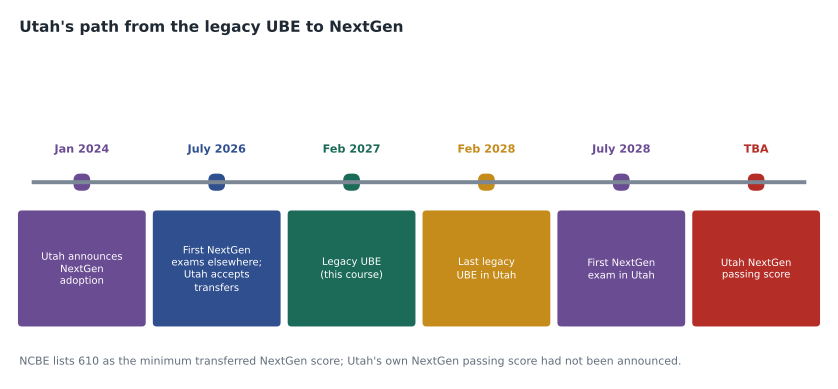
Utah announced its decision to adopt the NextGen exam in January 2024. Under NCBE's schedule for Utah, the last legacy UBE in Utah will be February 2028 and the first NextGen exam will be July 2028. Utah's NextGen passing score has not yet been announced; NCBE's summary lists it as to be announced. Every Utah exam through February 2028, including Mele's February 2027 exam, is the legacy UBE described in Lesson 4.
Transferring NextGen scores into Utah
Although Utah will not give the NextGen exam until 2028, it already accepts NextGen scores from other jurisdictions. The May 1, 2026 amendments to Rule 4-712 allow an applicant to transfer a score from either a legacy UBE or a NextGen UBE taken in another jurisdiction, beginning with the July 2026 administration. For a NextGen score, the rule requires a score equivalent to a passing score in Utah at the time the applicant sat for the exam. NCBE's summary of Utah's requirements lists a minimum transferred NextGen score of 610. Because Utah's own NextGen passing score has not been announced, a candidate relying on a NextGen transfer should confirm the current minimum with the Office of Admissions before applying.
What NextGen means for current candidates
For a candidate sitting before July 2028, NextGen changes little about what to study. The exam is still the legacy UBE, and the legacy UBE is still a respected and portable score. The main practical points are three. First, a candidate who fails in February 2028, the last legacy exam, would retake on NextGen, a different exam with different preparation materials. Second, study materials are shifting toward NextGen, and a legacy candidate must use legacy UBE materials. Third, an older MEE practice question on family law or trusts and estates no longer matches the current MEE, which dropped those subjects in July 2026.
The alternate pathway: what the Court approved
The second change is more unusual. In September 2025, after study by a working group that included judges, practitioners and academics, the Utah Supreme Court approved a skills-based alternate pathway to licensure, now in Rule 4-703A, effective October 1, 2025. The Bar announced it the same week. It is the first route in Utah that leads to a full law license without passing a bar examination, and the Court has said it intends the pathway to be permanent. The traditional bar exam remains available, and a candidate who begins the pathway may switch to the exam.
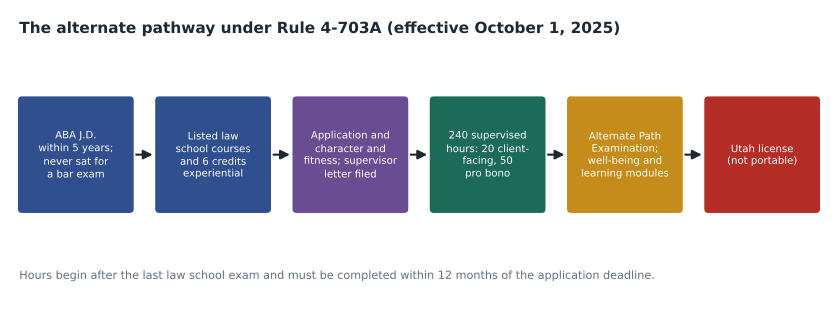
The pathway has several parts, and a candidate must complete all of them. Under Rule 4-703A and the Bar's materials, the candidate must:
- elect the alternate path when applying, hold a J.D. from an ABA-accredited law school, in Utah or elsewhere, and have graduated no more than five years before the date of application;
- never have sat for a bar exam in Utah or any other United States jurisdiction;
- have earned passing grades in the law school courses the rule lists, as certified by the law school registrar: writing and legal research, civil procedure, constitutional law, contracts, criminal law, property, torts and professional responsibility; at least three of administrative law, business law, evidence and legislation or statutory interpretation; three courses from a second list of electives; and at least six credits of experiential learning;
- complete 240 hours of supervised practice under a qualified supervising attorney, starting only after the last final exam of law school and finishing within 12 months of the application deadline, including at least 20 client-facing hours and at least 50 pro bono hours (candidates working in government or nonprofit service may meet the total without separate pro bono hours), with CLE and similar training limited to 5 percent of the total and every hour recorded in tenths of an hour and attested by the supervisor;
- pass the Alternate Path Examination, a written performance examination administered by the Utah State Bar, a three-hour, closed-universe test of lawyering tasks such as drafting a client letter, a persuasive memo or a contract provision, which the Bar plans to give in person twice a year;
- complete a six-hour well-being training and a two-hour self-directed learning module provided by the Bar, and the Bar's final survey.
Candidates on the pathway go through character and fitness review through the same online application as other applicants, and the rule provides that a candidate's eligibility to provide services under it ends immediately if the Bar determines that the candidate lacks the required character and fitness. Because every other Utah route requires an MPRE score of 86, a pathway candidate should confirm the current MPRE requirement with the Office of Admissions and plan to meet it. The rule's bar on prior exam attempts is strict: a person who has sat for any bar exam, passed or failed, is not eligible, and the Bar's FAQ says the Court will not grant exceptions. A graduate who did not take the listed courses may take them as a post-graduate student or take the bar exam instead.
Timing and the first applications
The Bar's materials describe applications opening January 1, 2026, with the application deadline for the pathway performance exam following the same March 1 and October 1 pattern as the bar exam and the same no-late-filing rule under Rule 4-707. The Bar's FAQ also cautioned that it would not accept applications until the written performance exam had been developed, which it expected as early as the summer of 2026. Because the pathway is new and the details are still being refined, Marchetti tells candidates to treat the Bar's current pathway page and checklist as the controlling source and to confirm dates with the Office of Admissions in writing.
The trade-off: portability
The biggest difference between the pathway and the exam is portability. A UBE score can be transferred to other UBE jurisdictions, and a lawyer admitted by examination can later seek admission by motion in states that offer reciprocity. The pathway produces a Utah license and nothing else. The Bar states that the alternate pathway license is not a portable license to practice law, because each jurisdiction sets its own admission requirements. A lawyer licensed through the pathway who later wants to practice in another state should expect to take that state's bar exam or meet whatever route that state offers to lawyers who were not admitted by examination. Many states' motion rules require admission by bar examination, so the pathway license may not count.
| Feature | Legacy UBE (through Feb 2028) | NextGen UBE (from July 2028 in Utah) | Alternate pathway (Rule 4-703A) |
|---|---|---|---|
| What is tested | MBE, MEE and MPT | Integrated skills and concepts | Supervised practice, listed courses and the Alternate Path Examination |
| Passing standard | 260 total | To be announced | Pass the Bar's performance exam and complete all requirements |
| Portable to other states | Yes, as a transferred UBE score | Yes, to NextGen-accepting jurisdictions | No |
| Who may use it | Eligible exam applicants | Eligible exam applicants | ABA J.D. graduates within five years who have never sat for a bar exam |
Worked problem
Kenji's decision
Kenji graduated in May 2026 from an ABA-approved Utah law school. He completed the skills courses on the rule's list, has never taken a bar exam, has a job offer from a Provo firm that will supervise him, and plans to stay in Utah for good. His MPRE score is 84. Should he choose the alternate pathway?
Show solution
- Eligibility: ABA J.D. within the past five years, listed courses complete, never sat for a bar exam; he appears eligible.
- Supervision: before starting, he must obtain the supervisor's consent and give the Office the supervisor's name and a signed letter confirming that the supervisor is qualified, willing and has read the rule; his 240 hours must include 20 client-facing and 50 pro bono hours.
- Timing: the supervised hours must be finished within 12 months of the application deadline, and he must pass the Alternate Path Examination.
- MPRE: 84 is below the 86 that every other Utah route requires; he should confirm the pathway's MPRE requirement and, in any case, retake so that every route stays open.
- Portability: he plans to stay in Utah, so the lack of portability matters less for him than for Mele.
Answer: The pathway fits Kenji's plans. He should confirm the MPRE requirement and his supervisor's letter with the Office before logging his first hour.
Advice for candidates choosing now
Marchetti's advice is practical. A candidate who may move, wants the widest range of options or already failed an exam should take the legacy UBE. A candidate who will stay in Utah, completed the listed courses and has a supervisor lined up may find the pathway faster and less expensive, but should read the current rule and the Bar's checklist with care, because the program is new and its details may continue to change. Either way, the character and fitness file and the MPRE score are the same, and they should be done early.
Common mistakes
MistakeUtah gives the NextGen exam starting in 2026.
InsteadUtah's first NextGen exam is July 2028; the last legacy UBE is February 2028.
MistakeUtah's NextGen passing score is 610.
InsteadUtah's own NextGen passing score is to be announced; NCBE lists 610 as the minimum for transferred NextGen scores.
MistakeThe alternate pathway is a shorter bar exam.
InsteadIt replaces the exam with coursework, 240 supervised hours, a performance exam and other modules.
MistakeA candidate who failed the UBE can switch to the pathway.
InsteadAnyone who has sat for a bar exam in any United States jurisdiction, passed or failed, is not eligible.
MistakeA pathway license lets a lawyer transfer to other states.
InsteadThe Bar says the pathway license is not portable.
Supervising attorneys and the hours log
For candidates on the pathway, the supervising attorney matters as much as any course. Rule 4-703A requires the candidate to obtain the supervisor's consent before beginning, to give the Office of Admissions the supervisor's name, and to provide a signed, dated letter in which the supervisor states that she is qualified and willing to serve and has read the rule. The supervisor may delegate direct supervision to another lawyer but remains responsible for compliance, and at the end she must attest to the accuracy of the candidate's record of hours. Court appearances and direct client work are permitted only with written consent from the client and the supervisor, and the rule sets stricter conditions for some kinds of cases, such as requiring the supervisor's presence in felony and class A misdemeanor matters.
The log itself is a professional document. Each entry should show the date, the time in tenths of an hour, the matter, the task and whether the work was client-facing or pro bono. Kenji set up a spreadsheet on his first day at the Provo firm and updated it every evening, because reconstructing 240 hours at the end of the year is far harder than recording them as they happen.
What the alternate path means for employers
The pathway also changes things for Utah firms and agencies. A firm that agrees to supervise a pathway candidate takes on real obligations, including training, attestation and responsibility for the candidate's work. Some employers may prefer candidates who have passed the exam because of portability or familiarity. Others may value the supervised practice hours, which give a new lawyer experience with clients before licensure. For a candidate considering the pathway, a frank conversation with the prospective employer about supervision, hours and timing should come before the application.
Watching for changes
Because both NextGen and the pathway are new, Marchetti asks Utah candidates to check three places every month: the Office of Admissions website, the Utah courts' pages listing rules approved and rules open for comment, and NCBE's page for Utah. The Utah Supreme Court publishes proposed rule changes for public comment before adopting them, so most changes are visible weeks or months in advance.
Summary and key terms
- Utah will give its last legacy UBE in February 2028 and its first NextGen exam in July 2028; the Utah NextGen passing score is to be announced.
- Since July 2026, Rule 4-712 lets applicants transfer NextGen scores from other jurisdictions; NCBE lists a 610 minimum.
- The alternate pathway (Rule 4-703A, effective October 1, 2025) requires an ABA J.D. within five years, listed courses, 240 supervised hours (20 client-facing, 50 pro bono), the Alternate Path Examination and well-being and learning modules.
- Applicants who have sat for any bar exam are not eligible for the pathway, and no exceptions are allowed.
- The pathway license is not portable; the UBE remains the portable choice.
- 0
- NextGen bar exam
- 1
- legacy UBE
- 2
- transferred NextGen score
- 3
- alternate pathway
- 4
- Rule 4-703A
- 5
- qualified supervising attorney
- 6
- performance examination
- 7
- portability
Practice problems
Work each problem on paper first, then reveal the answer to check.
When is Utah's first NextGen exam?
Show answer
July 2028; the last legacy UBE is February 2028.
How many supervised practice hours does the alternate pathway require?
Show answer
240 hours after graduation.
Who is not eligible for the alternate pathway?
Show answer
Anyone who has previously sat for a bar exam, and graduates more than five years out, among others.
Is the pathway license portable?
Show answer
No; the Bar says it is not a portable license.
Lesson quiz · 5 questions
Score 60% or more to complete this lesson.
Create a free account to save your progress, take quizzes and earn a certificate.