
BAR-245 · Lesson 11 of 12 · 21 min
Score transfer, admission by motion and practice after admission
▶ Video coming soon A video version of this lesson is on the way.
In mid-November 2026 Brigid Arnesen asked Mele to help with a hiring question. The firm wanted to add two lawyers. One, Shandra, had passed the UBE in Idaho in July 2024 with a 272 and had never practiced. The other, Jarom, had practiced for nine years in Colorado after passing its bar exam. 'Can either of them start soon,' Brigid asked, 'and what do they need to do?' Mele's research became the core of this lesson, which covers admission by transferred UBE score, admission by motion and the obligations that begin on the day a new Utah lawyer takes the oath.
Admission by transferred UBE score
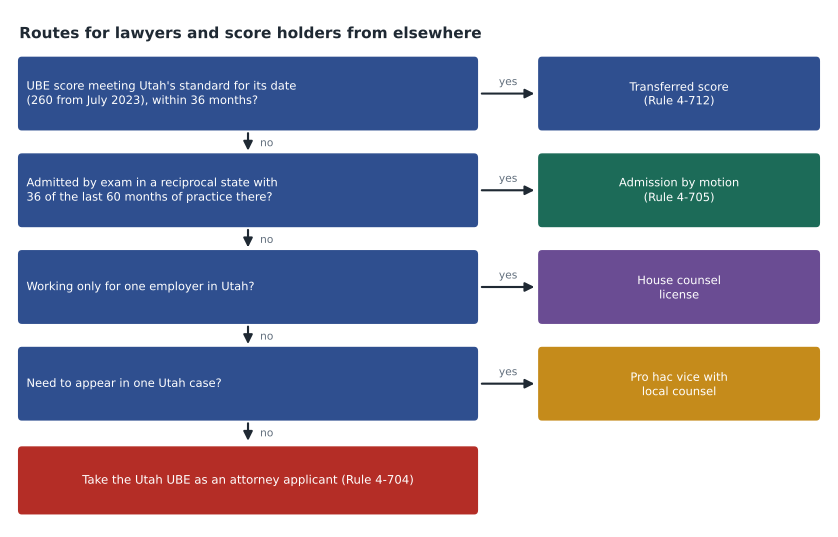
Rule 4-712 allows an applicant who earned a qualifying UBE score in another jurisdiction to be admitted in Utah without retaking the exam. The applicant must have taken the UBE in a single administration in a jurisdiction other than Utah and earned a score that meets Utah's standard for that exam date: 270 or more for a legacy UBE taken before July 2023, 260 or more for a legacy UBE taken in July 2023 or later, and, for a NextGen UBE, a score equivalent to a passing score in Utah when the applicant sat for it. NCBE's summary lists Utah's minimum transferred NextGen score as 610.
The score is transferable for 36 months after the administration in which it was earned. The applicant must meet the general requirements for a student or attorney applicant, must not have been denied admission in any jurisdiction on character and fitness grounds, must ask NCBE in writing to transfer the score and pay NCBE's fee, and the Bar must receive the score no later than nine months after the application is filed. Applications may be filed at any time, but the Bar warns that processing and the character and fitness investigation take at least four months. NCBE's chart notes that Utah permits a concurrent application, so a candidate can apply for transfer while awaiting results elsewhere. Utah does not accept a transferred MBE score by itself.
Worked problem
Can Shandra transfer her Idaho score?
Shandra took the UBE in Idaho in July 2024 and scored 272. She has a J.D. from an ABA-approved school, an MPRE score of 95 and a clean record. It is November 2026. Can she be admitted in Utah by transferred score, and by when must she act?
Show solution
- Score: a July 2024 legacy UBE score must be 260 or more; 272 qualifies.
- Window: the score is transferable for 36 months after the July 2024 exam, so until July 2027.
- Timing: the Bar must receive the score within nine months after she files, and processing takes at least four months, so she should file now.
- Other requirements: she must meet the student applicant requirements, pass character and fitness and satisfy the MPRE requirement; her 95 exceeds 86.
Answer: Shandra qualifies. She should file immediately and request the NCBE transfer so that she can be included in an admission motion well before her window closes in July 2027.
Admission by motion
Rule 4-705 governs admission by motion, sometimes called reciprocal admission. The rule begins with a warning: admission by motion is not a right, and the applicant must prove every requirement by clear and convincing evidence. The applicant must:
- pay the fee and file a complete application as a motion applicant and be at least 21 years old;
- have been admitted by bar examination before the highest court of a state, territory or the District of Columbia;
- hold a first professional degree in law from an approved law school and have passed the MPRE;
- be licensed in a jurisdiction that reciprocally admits Utah lawyers on similar terms;
- have been actively and lawfully engaged in the full-time practice of law for 36 of the 60 months immediately before filing, and that practice must have occurred in the reciprocal jurisdiction, in person or remotely;
- be in good standing everywhere admitted, with a record of ethical, civil and professional conduct, never having been delicensed or having resigned with discipline pending and not currently subject to discipline; and
- meet the character and fitness standard of Rule 4-708.
Several details matter. Time spent practicing from a Utah office does not count toward the 36 months unless the lawyer was complying with Utah's rules on practice by out-of-state lawyers. Lawyers licensed in Utah as house counsel may count their Utah practice time. Full-time law professors at Utah law schools may qualify on the basis of teaching. Attorneys from states without reciprocity with Utah cannot be admitted by motion; they may instead take the Utah exam as attorney applicants under Rule 4-704. NCBE's chart notes that lawyers admitted by diploma privilege are not eligible, consistent with the rule's requirement of admission by bar examination. NCBE's chart for Utah also lists the practice requirement in two inconsistent ways; the rule itself, 36 of the past 60 months, controls.
Worked problem
Can Jarom be admitted by motion?
Jarom passed the Colorado bar exam in 2017 and has practiced full time in Denver since then. He wants to move to Salt Lake City in early 2027. Assume Colorado offers reciprocity to Utah lawyers on similar terms. What does he need?
Show solution
- Admission by examination: he was admitted in Colorado by bar exam, not diploma privilege.
- Practice: nine years of full-time practice in Colorado easily covers 36 of the past 60 months; he should file before he moves so that the practice months are in the reciprocal state.
- Reciprocity: the rule requires that Colorado reciprocally admit Utah lawyers; he should confirm with the Office of Admissions.
- Other requirements: good standing, no discipline, an MPRE pass at Utah's 86 level as Utah applies it, an approved law school degree and character and fitness.
- Practice pending admission: while his application is pending he may qualify for a Practice Pending Admission certificate under Rule 4-809.
Answer: Jarom appears eligible. He should file before moving, confirm reciprocity and the MPRE requirement, and consider a Practice Pending Admission certificate.
Practice pending admission and limited licenses
Only active, licensed lawyers in good standing may practice law in Utah. Rule 4-809 offers a bridge: a motion applicant with a pending application may receive a Practice Pending Admission certificate that allows limited practice if the rule's conditions are met. The May 1, 2026 amendments extended the rule to a person who passed the most recent Utah bar exam and is awaiting the next motion for admission, for a period of up to six months. Utah also licenses in-house lawyers as house counsel, and out-of-state lawyers may appear in a particular Utah case through pro hac vice admission. Each of these has its own requirements and limits.
Taking the oath
After a candidate passes the exam or is approved by transfer or motion, the Office of Admissions places her on a motion for admission. Motions are presented four times a year, in February, May, August and October. The Bar's licensing department emails payment details, and the new lawyer has roughly ten days to pay the licensing fees; missing the window moves her to the next motion. After payment, the Board of Bar Commissioners and then the Supreme Court approve the motion, and the Court schedules the swearing-in ceremony.
Obligations after admission
Admission starts a set of ongoing obligations. A Utah lawyer must renew the license each year, with renewal beginning in June. The lawyer must certify compliance with the IOLTA rules each year and update the certification when the lawyer's trust account situation changes. Admission to the Utah state bar does not include admission to the United States District Court for the District of Utah, which has its own admission process, fees and annual registration. And Utah's rules encourage, though they do not require, at least 50 hours of pro bono service a year.
The New Lawyer Training Program
Most new Utah lawyers must complete the New Lawyer Training Program under Rule 4-808. Lawyers on active status who reside in Utah and have less than two years of practice must complete a twelve-month mentoring term with an approved mentor, following a written mentoring plan, before the end of the first CLE compliance cycle that begins after admission. They must also complete the New Lawyer Ethics Program. Completing the program earns 12 hours of accredited verified CLE for that cycle, and the New Lawyer Ethics Program satisfies the ethics and professionalism and civility requirements for that cycle. Mentors earn six hours of CLE. UBE transfer applicants with less than two years of practice are also subject to the program unless they live out of state and receive a waiver, and lawyers on inactive status are not subject to it.
Continuing legal education
Utah revised its CLE rule effective July 1, 2026. Under Rule 1-604 of the Supreme Court Rules of Professional Practice, a lawyer on active status must complete at least 12 hours of accredited CLE each compliance cycle, which runs annually from July 1 to June 30. At least six hours must be verified CLE, such as in-person programs, live remote programs or verified electronic programs, and the remaining hours may be verified or elective. The 12 hours must include at least one hour of ethics and one hour of professionalism and civility. A lawyer who completes more than the minimum may carry forward up to six excess verified hours, other than ethics and professionalism hours, to the next cycle, beginning with hours earned from July 1, 2026 for use in the cycle beginning July 1, 2027; the carryover is not available to lawyers in the New Lawyer Training Program. Lawyers admitted by motion comply in the cycle beginning after admission, and lawyers whose principal office is in another mandatory-CLE state may use that state's compliance, with at least one Utah ethics hour and one Utah professionalism and civility hour and the required forms.
| Obligation | Rule or source | Key point |
|---|---|---|
| Annual license renewal | Utah State Bar licensing | Renewal begins in June each year |
| IOLTA certification | Bar trust account rules | Certify each year; update when status changes |
| New Lawyer Training Program | Rule 4-808 and Rule 1-604(b) | Twelve-month mentoring plus New Lawyer Ethics Program; earns 12 CLE hours |
| Annual CLE | Rule 1-604 (effective July 1, 2026) | 12 hours a year: 6 verified, 1 ethics, 1 professionalism and civility |
| Federal court | District of Utah | Separate admission and annual registration |
| Pro bono | Rule 6.1 (aspirational) | At least 50 hours a year encouraged |
Common mistakes
MistakeAny passing UBE score can be transferred to Utah forever.
InsteadThe score must meet Utah's standard for its date and is transferable for 36 months.
MistakeAdmission by motion requires five of the past seven years of practice.
InsteadRule 4-705 requires 36 of the 60 months before filing, in the reciprocal jurisdiction.
MistakeA lawyer from any state may be admitted by motion.
InsteadThe licensing state must reciprocally admit Utah lawyers, and the lawyer must have been admitted by examination.
MistakeThe New Lawyer Training Program is optional.
InsteadActive Utah-resident lawyers with less than two years of practice must complete it.
MistakeUtah CLE is 24 hours every two years.
InsteadSince July 1, 2026, Rule 1-604 requires 12 hours each annual cycle, including one ethics and one professionalism and civility hour.
House counsel and lawyers who move in
Some lawyers who move to Utah do not need a full license. A lawyer who works only for a single employer, such as a corporation's in-house legal department, may qualify for a house counsel license, which allows practice for that employer but not for the public. A house counsel lawyer may later count Utah practice time toward admission by motion, as Rule 4-705 provides. And a lawyer who needs to appear in only one Utah case may seek pro hac vice admission with local counsel. Mele added a short note for Brigid: if Jarom joins the firm before his motion is granted, he should not advise Utah clients except as a Practice Pending Admission certificate allows.
Planning for the first year
Marchetti's last advice on admission concerns the first year of practice. A new Utah lawyer should find a mentor quickly, because the New Lawyer Training Program requires one and because the program's requirements must be met within the first compliance cycle. She should register for the New Lawyer Ethics Program early, calendar the license renewal and IOLTA certification, and keep a simple record of CLE hours from the start, even though the New Lawyer Training Program will satisfy most of the first cycle.
For Shandra and Jarom, the firm's plan was simple: Shandra would file for transfer that week, and Jarom would file for admission by motion before leaving Denver, with a request for a Practice Pending Admission certificate so that he could begin limited work when he arrived.
Summary and key terms
- Rule 4-712: transfer a UBE score meeting Utah's standard for its date (270 before July 2023, 260 after; NextGen equivalent) within 36 months; the score must arrive within nine months of filing.
- Rule 4-705: admission by motion for lawyers admitted by exam in a reciprocal jurisdiction with 36 of the last 60 months of full-time practice there, proved by clear and convincing evidence.
- Rule 4-809 Practice Pending Admission certificates bridge the gap for motion applicants and, since May 2026, recent Utah exam passers awaiting a motion.
- Admission motions occur in February, May, August and October; licensing fees must be paid within the Bar's window.
- New lawyers complete the New Lawyer Training Program; Rule 1-604 requires 12 CLE hours a year from July 1, 2026.
- 0
- transferred UBE score
- 1
- concurrent application
- 2
- admission by motion
- 3
- reciprocity
- 4
- clear and convincing evidence
- 5
- Practice Pending Admission certificate
- 6
- house counsel
- 7
- New Lawyer Training Program
- 8
- verified CLE
- 9
- professionalism and civility
Practice problems
Work each problem on paper first, then reveal the answer to check.
How long is a UBE score transferable to Utah?
Show answer
36 months after the administration in which it was earned.
How much practice does admission by motion require?
Show answer
Full-time practice for 36 of the 60 months before filing, in the reciprocal jurisdiction.
How many CLE hours must a Utah lawyer complete each cycle under Rule 1-604?
Show answer
At least 12, including six verified, one ethics and one professionalism and civility hour.
What does completing the New Lawyer Training Program earn?
Show answer
12 hours of accredited verified CLE for that cycle.
Lesson quiz · 5 questions
Score 60% or more to complete this lesson.
Create a free account to save your progress, take quizzes and earn a certificate.