
BAR-244 · Lesson 9 of 12 · 21 min
Texas community property, homestead, wills and estates
▶ Video coming soon A video version of this lesson is on the way.
If one body of Texas law reaches into almost every general practice, it is the law of marital property and what happens to it at divorce and death. Texas is a community property state, with a homestead protection written into its constitution and a probate system known for independent administration. Since July 2026 the MEE no longer tests family law or trusts and estates, and it never tested Texas community property, so none of this is on Dana's February 2027 exam. But family law and wills and administration are two of the six graded Texas Law Component subjects from July 2028, and Dana's firm opens new divorce and probate files every week.
The partner who handles the firm's probate work gave Dana a short test on her first day: 'A husband dies without a will. He and his wife have two children together. What does the wife inherit from the community property?' Dana, trained on common law states for the MBE, guessed a fraction. The answer, as this lesson explains, is all of it.
The community property system
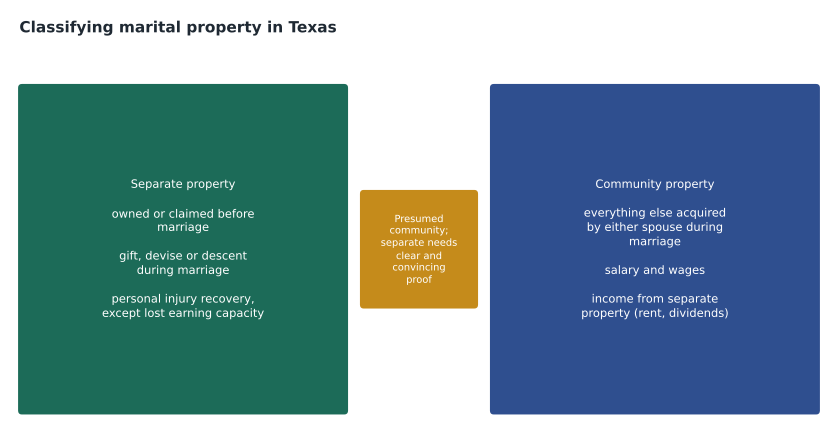
Texas classifies property owned by a married person as either separate or community. Under the Family Code, a spouse's separate property consists of property owned or claimed before marriage, property acquired during marriage by gift, devise or descent, and the recovery for personal injuries sustained during marriage, except any recovery for loss of earning capacity during marriage. Community property is all property, other than separate property, acquired by either spouse during marriage.
Property possessed by either spouse during or on dissolution of marriage is presumed to be community property. A spouse who claims that an asset is separate must prove it by clear and convincing evidence, usually by tracing the asset back to a separate source through documents. Tracing failures are the most common reason separate property is lost at divorce: a spouse who mixed a pre-marriage savings account with paychecks for ten years may be unable to prove what part of the balance is separate.
Texas has one rule that differs from some other community property states: income from separate property is community property. Rent from a house one spouse owned before marriage, dividends on separate stock and interest on a separate savings account are all community, unless the spouses have agreed otherwise in a valid marital property agreement. The asset itself remains separate, but its income does not.
| Asset | Classification in Texas |
|---|---|
| House owned before marriage | Separate |
| Rent from that house received during marriage | Community |
| Salary earned during marriage | Community |
| Inheritance received during marriage | Separate |
| Personal injury recovery for pain and suffering | Separate |
| Personal injury recovery for lost wages during marriage | Community |
| Car bought during marriage with salary | Community |
| Asset of uncertain origin | Presumed community; separate status must be proved by clear and convincing evidence |
Marital property agreements and reimbursement
Spouses and future spouses may change the default rules by agreement. A premarital agreement can define what will be separate and what will be community; during marriage, spouses can partition community property into separate property or agree that income from separate property will be separate. These agreements must be in writing and signed by both parties, and they are enforceable unless the challenging party proves that the agreement was not signed voluntarily or was unconscionable when signed with inadequate disclosure, under the standards in the Family Code.
When one marital estate pays for the benefit of another, for example when community funds pay down the mortgage on one spouse's separate house, the contributing estate may have a claim for reimbursement. At divorce, the court resolves reimbursement claims on equitable principles as part of the division of the estate.
Divorce in Texas
Texas permits divorce without regard to fault on the ground of insupportability: the marriage has become insupportable because of discord or conflict of personalities that destroys the legitimate ends of the marital relationship and prevents any reasonable expectation of reconciliation. Fault grounds such as cruelty, adultery and abandonment also exist, and fault can affect the division of property.
To file, one spouse must have been domiciled in Texas for the preceding six months and a resident of the county of filing for the preceding 90 days. The court may not grant a divorce before the 60th day after the petition was filed, with exceptions involving family violence.
At divorce, the court divides the community estate in a manner that the court deems just and right, having due regard for the rights of each party and any children. Just and right does not mean equal. Courts consider factors such as fault in the breakup, disparity of earning capacities, the spouses' health and the benefits the innocent spouse would have received from continuing the marriage. The court has no power to award one spouse's separate real property to the other spouse.
Texas has historically disfavored alimony, and court-ordered spousal maintenance is limited by statute. Eligibility generally requires that the spouse seeking maintenance will lack sufficient property to provide for minimum reasonable needs and that either the marriage lasted 10 years or more and the spouse lacks the ability to earn sufficient income, or the other spouse committed family violence, or the requesting spouse has an incapacitating disability or cares for a disabled child. Maintenance is limited to the lesser of 5,000 dollars a month or 20 percent of the paying spouse's average monthly gross income, and for long marriages its duration is limited to five, seven or ten years depending on the length of the marriage. Spouses can agree to contractual alimony beyond these limits.
Children: conservatorship and support
Texas calls custody conservatorship. There is a rebuttable presumption that appointing both parents as joint managing conservators is in the best interest of the child, although joint conservatorship does not necessarily mean equal time, and one parent usually has the exclusive right to designate the child's primary residence. Family violence rebuts the presumption. A standard possession order sets a default schedule of possession and access for the other parent.
Child support follows statutory guidelines based on a percentage of the paying parent's net resources, up to a statutory cap on net resources that is adjusted periodically: 20 percent for one child, 25 percent for two, 30 percent for three, 35 percent for four, 40 percent for five and at least 40 percent for six or more. The court may deviate from the guidelines when applying them would be unjust or inappropriate.
Homestead
The Texas Constitution gives homesteads some of the strongest protection in the country. A homestead is protected from forced sale for the payment of debts, except for a short list of debts the Constitution allows to be secured by the homestead. Those include purchase money, taxes on the property, owelty of partition, refinancing of permitted liens, home improvement contracts meeting constitutional formalities, and home equity loans and reverse mortgages that meet detailed constitutional conditions. A home equity loan, for example, may not exceed 80 percent of the home's fair market value when combined with other debt secured by the homestead, and it is subject to a waiting period after the borrower receives a required notice.
The Constitution also limits the size of the homestead. An urban homestead may consist of up to 10 acres of land in one or more contiguous lots, together with improvements. A rural homestead may consist of up to 200 acres for a family or 100 acres for a single adult, in one or more parcels. A married person may not sell or encumber the homestead without the joinder of the other spouse, whether the homestead is community or separate property.
At death, the surviving spouse has a constitutional right to occupy the homestead for life, or as long as the spouse elects to use or occupy it, even if title passes to others, such as children of a prior marriage. That right, sometimes called the probate homestead, is often decisive in blended families.
Wills under the Estates Code
The Texas Estates Code governs wills and the administration of estates. A person of sound mind who is at least 18, or who is or has been married, or who is serving in the armed forces, may make a will. A will must generally be in writing, signed by the testator or by another person at the testator's direction and in the testator's presence, and attested by two or more credible witnesses over the age of 14 who sign in the testator's presence.
Texas recognizes holographic wills. A will written wholly in the testator's handwriting does not need attesting witnesses. A typed will with handwritten additions is not a holographic will, and those additions are not effective without proper execution.
A will may be made self-proved by attaching an affidavit of the testator and the witnesses, signed before a notary, in the statutory form. A self-proved will can be admitted to probate without testimony from the witnesses, which saves time and expense. Most Texas lawyers have every will they draft self-proved.
Intestacy and the community estate
When a married person dies intestate, the distribution depends on whether property is community or separate. If all of the decedent's surviving children and descendants are also children or descendants of the surviving spouse, the surviving spouse takes the decedent's entire half of the community estate, so the survivor owns all of the community property. If the decedent has a child or descendant who is not also the surviving spouse's, the decedent's half of the community passes to the decedent's children and descendants, and the surviving spouse keeps only the spouse's own half.
Separate property passes differently. If the decedent leaves a spouse and children or descendants, the surviving spouse takes one-third of the decedent's separate personal property, and the children take the rest; the surviving spouse takes a life estate in one-third of the decedent's separate real property, with the remainder and the other two-thirds going to the children. Texas, as a community property state, has no elective share; the surviving spouse's protection comes from owning half of the community and from the homestead and other family allowances.
| Decedent leaves | Community property (decedent's half) | Separate personal property | Separate real property |
|---|---|---|---|
| Spouse and children who are all also the spouse's | All to surviving spouse | One-third to spouse, two-thirds to children | Spouse: life estate in one-third; children: the rest |
| Spouse and a child from a prior relationship | To the decedent's children | One-third to spouse, two-thirds to children | Spouse: life estate in one-third; children: the rest |
Administration: why Texas probate is usually manageable
Texas is known for independent administration. When a will so provides, or when all distributees agree, an independent executor or administrator can administer the estate with minimal court supervision: after appointment, filing an inventory or affidavit in lieu of inventory, and giving required notices, the independent executor can pay debts, sell property if authorized and distribute the estate without court orders for each step. Dependent administration, with closer court supervision, is used when independent administration is not available or is not desirable.
Texas also offers alternatives to administration. A will may be probated as a muniment of title when the estate owes no debts other than those secured by real estate, and the order admitting the will serves as evidence of title. A small estate affidavit is available for smaller estates within statutory limits, and a court can determine heirship when there is no will. Generally, a will must be offered for probate within four years after the testator's death, subject to limited exceptions.
Worked problem
Answering the partner's test, then complicating it
Solange Achord died intestate in Austin in 2026, survived by her husband and their two children. The couple's community property is worth 800,000 dollars, including their homestead. Solange also owned separate stock worth 90,000 dollars, inherited from her mother. Who takes what? Then assume Solange also had a son from a prior marriage.
Show solution
- Community property: Solange's half is 400,000 dollars. All her descendants are also her husband's, so her husband takes her half and owns the whole 800,000 dollar community estate.
- Separate personal property (the stock): one-third (30,000 dollars) to the husband and two-thirds (60,000 dollars) to the children.
- If Solange also had a son from a prior marriage: her 400,000 dollar half of the community passes to her three children in equal shares; her husband keeps his own 400,000 dollar half.
- The stock still divides one-third to the husband and two-thirds to the three children.
- Homestead: even if part of the home passes to the children, the husband has a constitutional right to occupy it for life.
Answer: With only joint children, the husband ends up owning all the community property and one-third of the separate stock. A child from a prior marriage changes the community result completely, which is why blended families need wills.
Common mistakes
MistakeTreating rent from separate property as separate
InsteadIn Texas, income from separate property is community unless a valid agreement provides otherwise.
MistakeAssuming just and right means an equal division
InsteadThe court divides the community estate in a manner it deems just and right, which may be unequal.
MistakeExpecting an elective share for a Texas surviving spouse
InsteadTexas has no elective share; the spouse owns half the community and has homestead and allowance rights.
MistakeTreating a typed will with handwritten changes as holographic
InsteadOnly a will wholly in the testator's handwriting is holographic.
MistakeSelling a homestead with only the titled spouse's signature
InsteadThe other spouse must join in a sale or encumbrance of the homestead.
Summary and key terms
- Separate property is property owned before marriage or acquired by gift, devise or descent, plus personal injury recovery except lost earning capacity; all else acquired during marriage is community.
- Property is presumed community; separate status requires clear and convincing evidence, usually tracing. Income from separate property is community.
- Divorce may be granted for insupportability after six months of Texas domicile, 90 days in the county and a 60-day waiting period; the community is divided in a just and right manner.
- Spousal maintenance is limited to the lesser of 5,000 dollars a month or 20 percent of average monthly gross income, with duration limits.
- Homestead: urban up to 10 acres, rural up to 200 acres (family) or 100 (single); protected from forced sale except listed liens; spousal joinder required.
- Wills need writing, signature and two witnesses over 14 unless holographic; independent administration and muniment of title make Texas probate efficient.
- 0
- community property
- 1
- separate property
- 2
- community presumption
- 3
- tracing
- 4
- reimbursement
- 5
- insupportability
- 6
- just and right division
- 7
- spousal maintenance
- 8
- joint managing conservators
- 9
- homestead
- 10
- holographic will
- 11
- self-proved will
- 12
- independent administration
- 13
- muniment of title
Practice problems
Work each problem on paper first, then reveal the answer to check.
Is a personal injury recovery received during marriage separate or community?
Show answer
Separate, except any recovery for loss of earning capacity during the marriage, which is community.
What burden applies to a spouse claiming property is separate?
Show answer
Clear and convincing evidence.
What are the residency requirements for a Texas divorce?
Show answer
Six months of domicile in Texas and 90 days of residence in the county of filing.
What size may a rural family homestead be?
Show answer
Up to 200 acres.
A married decedent dies intestate leaving a spouse and children who are all also the spouse's. Who takes the decedent's half of the community?
Show answer
The surviving spouse.
Lesson quiz · 5 questions
Score 60% or more to complete this lesson.
Create a free account to save your progress, take quizzes and earn a certificate.