
BAR-244 · Lesson 11 of 12 · 21 min
Score transfer, admission without examination and practice after admission
▶ Video coming soon A video version of this lesson is on the way.
Not every new Texas lawyer takes the Texas bar exam. Some earn a UBE or NextGen score in another jurisdiction and transfer it to Texas. Experienced lawyers from other states can be admitted without examination. And once licensed, every Texas lawyer takes the oath, joins the State Bar, completes the Justice James A. Baker Guide and meets continuing education requirements for the rest of a career. This lesson covers those routes and obligations.
Two questions from the study group framed the session. Dana asked again about her cousin in Tennessee, a lawyer with 12 years of practice there, who is thinking about moving to Austin and does not want to take a bar exam. Ngozi Adeyemi, who is sitting the New York exam in February, asked whether a New York UBE score could later take her to Texas. Marchetti answered both, then turned to what Dana herself will owe the State Bar after April.
Admission by transferred UBE or NextGen score
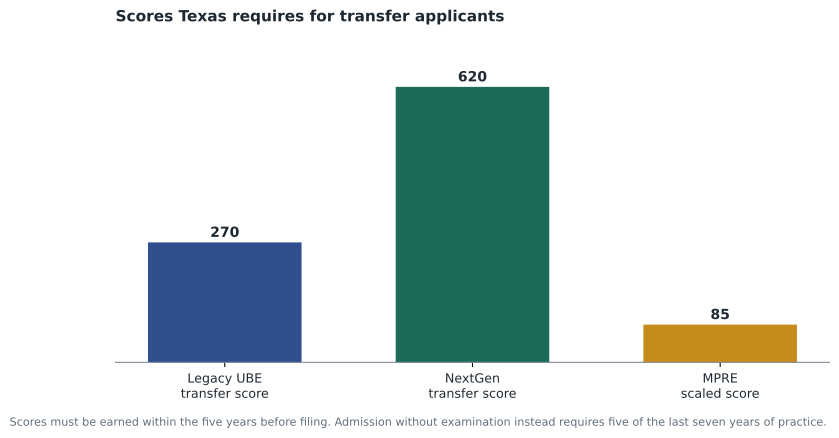
Texas accepts transferred UBE scores. Under the current rules, as amended in September 2026, an applicant with a UBE score of 270 or higher, or a NextGen score of 620 or higher, earned within the five years before filing, may be exempt from taking the Texas bar exam. The score can come from any UBE or NextGen jurisdiction; it does not matter whether the applicant was admitted there, and the Board's FAQ describes the five-year window without a separate practice requirement.
A score is not enough by itself. The transfer applicant must also meet the other requirements of Rule 2: a J.D. from an approved law school or a qualifying exception, completion of the Texas Law Component, an MPRE scaled score of 85 or higher and approval of present good moral character and fitness. The applicant must ask NCBE to send the score to Texas. The character and fitness investigation can take up to nine months, so a transfer applicant who wants to start practicing in Texas on a particular date should file well ahead.
Texas does not accept transferred MBE scores standing alone, so a candidate who took the MBE in a non-UBE jurisdiction cannot use that score to skip part of the Texas exam. And the amended rules include a firm limit: an applicant who has failed after five combined exams, or who does not have the required transfer score, may not test again or transfer a score unless the Board grants a waiver.
| Requirement for a transfer applicant | Current Texas rule |
|---|---|
| Qualifying score | UBE 270 or NextGen 620 or higher |
| Age of score | Earned within the five years before filing |
| Education | J.D. from an approved law school, or a Rule 13 exception |
| MPRE | Scaled score of 85 or higher |
| Texas Law Component | Complete the Texas Law Course |
| Character and fitness | Board approval; investigation may take up to nine months |
| Standalone MBE transfer | Not accepted |
| Transfer fee | 150 dollars under the September 2026 fee amendments, with application fees by applicant type |
For Ngozi, the answer is yes, with conditions. If she earns 270 or more on the February 2027 New York UBE, she could transfer the score to Texas within five years, provided she meets the education requirement or an exception for foreign-trained lawyers, scores 85 on the MPRE, completes the Texas Law Course and passes character and fitness. Her path through the education requirement, as an LLM graduate trained in Nigeria, is the technical part, and she should read the current rules on foreign-trained applicants before filing.
Admission without examination
An experienced lawyer licensed in another United States jurisdiction may apply for admission without examination. The core requirement is that the applicant has been actively and substantially engaged in the practice of law for at least five of the last seven years. The applicant must also meet the education requirement or an exception, the MPRE requirement, the Texas Law Component and character and fitness. There is no filing deadline, but the Board's FAQ notes that processing usually takes six to nine months.
Texas changed one rule in this area in 2019. Since December 1, 2019, a failed Texas bar exam no longer makes an applicant ineligible for admission without examination. A lawyer who once failed the Texas exam, passed elsewhere and then practiced for years can now apply on the same basis as anyone else.
For Dana's Tennessee cousin, 12 years of active, substantial practice satisfies the five-of-seven-years requirement, as long as the last seven years include at least five years of genuine, substantial legal work. She should collect evidence of her practice, such as letters from employers, judges or colleagues, and plan for a six-to-nine-month process.
Limited and temporary practice
A lawyer licensed elsewhere who is not admitted in Texas may ask a Texas court for permission to appear in a particular case, known as pro hac vice admission. The out-of-state lawyer generally must associate with a Texas lawyer, file a motion with required information and pay a fee, and the court decides whether to grant permission. Pro hac vice admission is limited to the case and is not a general license.
The admission rules also provide for temporary licensing of certain military-connected attorneys. The September 2026 order revised this area: it reserved the former military attorney registration rule and updated the military temporary license, which now requires licensure and good standing in another state, a notarized affidavit and completion of the Texas Law Component, with fees waived. Applicants in this situation should read the current rule text.
The oath and the first year
After the Board certifies that an applicant has met every requirement, the applicant receives eligibility for licensure and takes the oath of office required by the Government Code. The oath may be administered by an authorized person, such as a judge, a court clerk or a notary, and the Board's FAQ notes that it can be administered remotely, before or after the license arrives. The completed oath is attached to the back of the license; it is not sent to the State Bar or the Court. Large swearing-in ceremonies are held after each exam, but they are ceremonial; the oath before an authorized officer is what counts.
Within 12 months of licensure, a new Texas lawyer must complete the Justice James A. Baker Guide to Ethics and Professionalism in Texas, administered by the Texas Center for Legal Ethics. The Baker Guide covers practical ethics and professionalism topics for new lawyers and is required by Supreme Court order.
State Bar membership
Every licensed Texas lawyer is a member of the State Bar of Texas, must pay annual dues and must keep contact information current through the State Bar's online member account. Membership status, MCLE compliance and dues are tied together: a lawyer who does not pay dues or comply with MCLE can be suspended from practice until the problem is cured. New lawyers often find their first membership statement in their email shortly after licensure.
Minimum continuing legal education
The State Bar's MCLE rules require at least 15 hours of accredited continuing legal education in each compliance year, including at least 3 hours of legal ethics or professional responsibility. A lawyer's compliance year is tied to the lawyer's birth month: for lawyers licensed two or more years, it begins on the first day of the birth month and ends on the last day of the month before the birth month a year later.
Newly licensed lawyers have a longer first period. A new lawyer's initial compliance year is a 24-month period beginning on the first day of the birth month after the license date and ending two years later. Lawyers may carry forward a limited number of excess hours, including ethics hours, to the next compliance year, and self-study hours are limited; the current MCLE rules and regulations state the exact limits, which candidates should read rather than rely on summaries.
| Obligation | When | Who administers it |
|---|---|---|
| Oath of office | After eligibility for licensure | Any authorized officer, such as a judge, clerk or notary |
| Justice James A. Baker Guide | Within 12 months of licensure | Texas Center for Legal Ethics |
| State Bar dues and member account | Annually | State Bar of Texas |
| MCLE: 15 hours including 3 ethics | Each compliance year; first period 24 months for new lawyers | State Bar MCLE Department |
| IOLTA trust account (if holding client funds) | When the lawyer first holds client funds | Bank and the Texas Access to Justice Foundation |
Trust accounts and specialization
A lawyer who holds client or third-party funds must keep them separate from the lawyer's own funds in a trust account, under the safekeeping provisions of the disciplinary rules. Nominal or short-term client funds go into an Interest on Lawyers' Trust Accounts (IOLTA) account, and the interest supports civil legal aid through the Texas Access to Justice Foundation. A new lawyer in solo or small-firm practice should open the account before accepting the first retainer.
Texas also offers board certification in many practice areas through the Texas Board of Legal Specialization. Certification requires years of practice with substantial involvement in the specialty, peer references and a written examination, so it is a goal for later in a career. Under the advertising rules, only certified lawyers may describe themselves as certified in a specialty, with limited exceptions.
Worked problem
Sorting three applicants
Three hypothetical applicants ask about coming to Texas. Anselmo Achterhof earned a 274 UBE score in Colorado in July 2022, was admitted there and practiced for three years. Sunita Venkatraman earned a 268 UBE score in Missouri in February 2024 and practices in Kansas City. Gilberto Cavazos has practiced full time in New Mexico for six years and took the Texas exam in 2018 without passing. Which route fits each?
Show solution
- Anselmo: a 274 earned in July 2022 is above 270 and within five years if he files before July 2027; transfer is available, subject to MPRE, the Texas Law Course and character and fitness. He does not need admission without examination, which would require five years of practice.
- Sunita: 268 is below the Texas transfer score of 270, so transfer is not available; she has fewer than five years of practice, so she must take the Texas exam or build practice years first.
- Gilberto: six years of active practice in the last seven satisfies admission without examination; since December 1, 2019, his failed 2018 Texas exam no longer bars that route.
- All three must complete the Texas Law Component and meet the MPRE and character and fitness requirements.
Answer: Anselmo should transfer his score before July 2027; Sunita needs to take the Texas exam; Gilberto can apply for admission without examination and should expect six to nine months of processing.
Common mistakes
MistakeAssuming any passing UBE score transfers to Texas
InsteadTexas requires a UBE score of 270, or a NextGen score of 620, earned within five years before filing.
MistakeTransferring an MBE score from a non-UBE state
InsteadTexas does not accept standalone MBE transfers.
MistakeThinking a failed Texas exam bars admission without examination
InsteadSince December 1, 2019, it does not.
MistakeMailing the oath to the State Bar
InsteadThe completed oath is attached to the back of the license, not sent to the Bar or the Court.
MistakeWaiting a year to start the Baker Guide
InsteadIt must be completed within 12 months of licensure; start early.
Planning the first months after licensure
Dana's licensing plan, if she passes in February, runs like this. In mid-April she checks ATLAS for results and her eligibility letter. She takes the oath before a district judge she clerked for in law school, attaches it to her license and confirms her State Bar member account. In May she starts the Baker Guide, aiming to finish by summer rather than near the 12-month deadline. She notes her first MCLE compliance period, which for her begins on the first day of the birth month after her license date and runs 24 months. And she asks the firm's managing partner how the firm tracks MCLE hours and trust account access for new associates.
Moving from Texas to another jurisdiction later
A Texas license also opens doors elsewhere. A UBE score earned in Texas can be transferred to other UBE jurisdictions within their time limits and at their passing scores. Many jurisdictions also offer admission on motion to lawyers with enough years of practice, and Texas experience counts. The rules differ widely, and some jurisdictions require reciprocity, meaning they admit lawyers on motion only from jurisdictions that would admit their lawyers on similar terms. A Texas lawyer considering a move should check the destination jurisdiction's current rules and NCBE's comparison charts early.
Keeping the license in good standing
Once licensed, a Texas lawyer must keep paying dues, complete MCLE, keep contact information current and comply with any additional requirements the State Bar imposes, such as reporting trust account information if required. A lawyer who stops practicing can elect inactive status, which reduces dues and suspends the MCLE requirement but also suspends the right to practice. Returning to active status later requires completing any MCLE deficiency and following the State Bar's reinstatement procedures. These administrative details seldom appear in law school, but they matter for an entire career.
Summary and key terms
- Transfer: a UBE score of 270 or NextGen score of 620 earned within five years before filing, plus education, an 85 MPRE, the Texas Law Course and character and fitness.
- Texas does not accept standalone MBE transfers; an applicant who failed after five combined exams may not test or transfer without a waiver.
- Admission without examination requires active, substantial practice in five of the last seven years; no deadline; six to nine months of processing.
- Since December 1, 2019, a failed Texas exam no longer bars admission without examination.
- After eligibility, the oath may be given by a judge, clerk or notary; the Baker Guide is due within 12 months.
- MCLE: 15 hours a year including 3 ethics hours, with a 24-month first compliance period for new lawyers tied to the birth month.
- 0
- score transfer
- 1
- Rule 13 exemption
- 2
- admission without examination
- 3
- active and substantial practice
- 4
- pro hac vice
- 5
- oath of office
- 6
- Justice James A. Baker Guide
- 7
- MCLE compliance year
- 8
- IOLTA
- 9
- Texas Access to Justice Foundation
- 10
- board certification
Practice problems
Work each problem on paper first, then reveal the answer to check.
What UBE score can be transferred to Texas, and how old may it be?
Show answer
270 or higher, earned within the five years before filing.
What practice is required for admission without examination?
Show answer
Active and substantial practice of law in at least five of the last seven years.
Who may administer the Texas oath?
Show answer
An authorized person such as a judge, a court clerk or a notary.
How many MCLE hours must a Texas lawyer complete each year?
Show answer
At least 15, including at least 3 hours of ethics or professional responsibility.
When is the Baker Guide due?
Show answer
Within 12 months of licensure.
Lesson quiz · 5 questions
Score 60% or more to complete this lesson.
Create a free account to save your progress, take quizzes and earn a certificate.