
BAR-244 · Lesson 10 of 12 · 21 min
The Texas Disciplinary Rules of Professional Conduct and the grievance system
▶ Video coming soon A video version of this lesson is on the way.
Dana passed the MPRE by learning the ABA Model Rules of Professional Conduct. The day she is licensed, a different set of rules will govern her: the Texas Disciplinary Rules of Professional Conduct. The Texas rules follow the general structure of the Model Rules and share much of their substance, but they differ in numbering, wording and some important outcomes. Texas also has its own way of changing the rules, a member referendum, and its own grievance system, in which a lawyer accused of misconduct can choose to be tried in district court. This lesson covers the differences that matter most to a new Texas lawyer.
The firm's managing partner gave Dana a reason to care. 'Half the ethics calls I get from young lawyers are about things the Model Rules would answer one way and our rules answer another,' she said. 'Confidentiality, fees, advertising. Learn the Texas text, not the MPRE outline.'
How Texas makes its disciplinary rules
The Texas Disciplinary Rules of Professional Conduct took effect in 1990, replacing the older Code of Professional Responsibility. They are numbered by parts, like the Model Rules: Part I covers the client-lawyer relationship, Part III advocacy, Part IV transactions with non-clients, Part V law firms and associations, Part VII information about legal services and Part VIII maintaining the integrity of the profession.
Texas changes its disciplinary rules through a process that involves the lawyers themselves. Under the State Bar Act, proposed rules are developed by the State Bar's Committee on Disciplinary Rules and Referenda, published for comment, and then submitted to a referendum of State Bar members. Rules approved by the members go to the Supreme Court of Texas for final approval. The Court may also adopt rules directly in some circumstances. The member referendum is unusual among American jurisdictions.
The 2024 rules referendum shows how the system works. Members voted in April 2024. In August 2024 the Supreme Court gave final approval, effective October 1, 2024, to amendments to Rules 1.08, 1.09, 3.09, 4.03, 5.01 and 5.05, to new Rules 1.10 and 1.18, and to a new Rule of Disciplinary Procedure, along with new comments and terminology changes. The Court did not adopt proposed changes to Rules 1.00, 8.05 and 8.06. New Rule 1.18, on duties to prospective clients, and new Rule 1.10, on imputation of conflicts, brought Texas closer to the Model Rules in two areas where Texas had long had no separate rule.
The comments are guides, not rules
Like the Model Rules, the Texas rules are accompanied by comments. The Preamble explains that the comments are intended as guides to interpretation, while the text of each rule is authoritative. The Texas rules also state that they are not designed to be standards for civil liability, although courts sometimes look to them as evidence of a lawyer's duties.
Texas lawyers should also know the Texas Lawyer's Creed, a statement of aspirational professionalism standards adopted by the Supreme Court and the Court of Criminal Appeals in 1989. The Creed is not a disciplinary rule, but courts cite it, and the Justice James A. Baker Guide to Ethics and Professionalism that new lawyers complete within 12 months of licensure builds on it.
Confidentiality: Rule 1.05
Texas Rule 1.05 is the confidentiality rule, and it differs from Model Rule 1.6 in structure and in substance. It defines confidential information to include both privileged information, protected by the lawyer-client privilege, and unprivileged client information, meaning all other information relating to a client or furnished by the client that the lawyer acquires during or by reason of the representation. Both kinds are protected.
The rule permits disclosure in a number of listed situations, some broader than the Model Rule. And unlike Model Rule 1.6, which permits but does not require disclosure to prevent death or substantial bodily harm, Texas Rule 1.05 requires disclosure in a defined situation: when a lawyer has confidential information clearly establishing that a client is likely to commit a criminal or fraudulent act that is likely to result in death or substantial bodily harm to a person, the lawyer must reveal the information to the extent revelation reasonably appears necessary to prevent the act. Texas also requires disclosure when other rules, such as the duties of candor to the tribunal, require it.
On the MPRE, a question about a client's announced plan to commit a violent crime is answered under the Model Rule, which permits disclosure. In Texas practice, the lawyer may be required to disclose. That difference is exactly the kind Marchetti warned about.
| Issue | ABA Model Rules (tested on the MPRE) | Texas Disciplinary Rules |
|---|---|---|
| Scope of protected information | Information relating to the representation (Rule 1.6) | Privileged information and unprivileged client information (Rule 1.05) |
| Client likely to commit act causing death or substantial bodily harm | Disclosure permitted | Disclosure required when the information clearly establishes the likely act |
| Fee standard | Fee must be reasonable (Rule 1.5) | Fee must not be illegal or unconscionable (Rule 1.04) |
| Prospective clients | Rule 1.18 | Rule 1.18, added effective October 1, 2024 |
| Advertising review | No filing requirement | Many advertisements must be filed with the State Bar's Advertising Review Committee |
| Comments | Guides to interpretation | Guides to interpretation; the rule text controls |
Fees: Rule 1.04
Texas Rule 1.04 states the fee standard differently from Model Rule 1.5. The Texas rule says a lawyer shall not enter into an arrangement for, charge or collect an illegal fee or an unconscionable fee. A fee is unconscionable if a competent lawyer could not form a reasonable belief that the fee is reasonable. The rule lists factors for determining reasonableness that are similar to the Model Rule factors. The practical difference is in the disciplinary threshold: discipline follows an unconscionable fee, while reasonableness remains the standard in fee disputes and in court awards of attorney fees.
A contingent fee agreement must be in writing and must state the method by which the fee is to be determined. Contingent fees are prohibited in criminal cases. When lawyers in different firms divide a fee, the division must be in proportion to the services each performs or made with each lawyer assuming joint responsibility, and the client must consent in writing to the terms of the arrangement, including the share each lawyer will receive.
Advertising, solicitation and barratry
Part VII of the Texas rules regulates advertising and solicitation in more detail than the Model Rules. Texas requires many advertisements and solicitation communications to be filed with the State Bar's Advertising Review Committee, with a fee, unless an exemption applies. The rules also regulate the content of advertisements, the use of certain claims about results and specialization, and the solicitation of prospective clients.
Improper solicitation can also be a crime. Texas criminalizes barratry in its Penal Code, which reaches certain in-person and other solicitation of clients for pecuniary gain, and the Government Code allows clients to void contracts for legal services procured through barratry and to recover fees paid under them. The combination makes improper solicitation especially risky in Texas.
Conflicts and supervision
Texas Rule 1.06 is the general conflict rule. It prohibits representing opposing parties in the same litigation and prohibits representations that involve a substantially related matter in which a client's interests are materially and directly adverse to another client, or that reasonably appear to be adversely limited by duties to others or the lawyer's own interests, unless the lawyer reasonably believes the representation will not be materially affected and each affected client consents after full disclosure. Rule 1.08 addresses specific prohibited transactions, such as business transactions with clients and gifts, and Rule 1.09 addresses conflicts with former clients. The 2024 amendments revised Rules 1.08 and 1.09 and added Rule 1.10 on imputation.
Rule 5.01 governs the responsibilities of partners and supervisory lawyers, and Rule 5.05 addresses the unauthorized practice of law and multijurisdictional practice; both were amended in 2024. A new lawyer supervising a paralegal or a law clerk should read them in full.
Reporting misconduct
Texas Rule 8.03 requires a lawyer who knows that another lawyer has committed a violation of the rules raising a substantial question as to that lawyer's honesty, trustworthiness or fitness as a lawyer to inform the appropriate disciplinary authority, with exceptions for confidential information and for information gained in an approved lawyer assistance program. The rule parallels Model Rule 8.3.
The grievance system
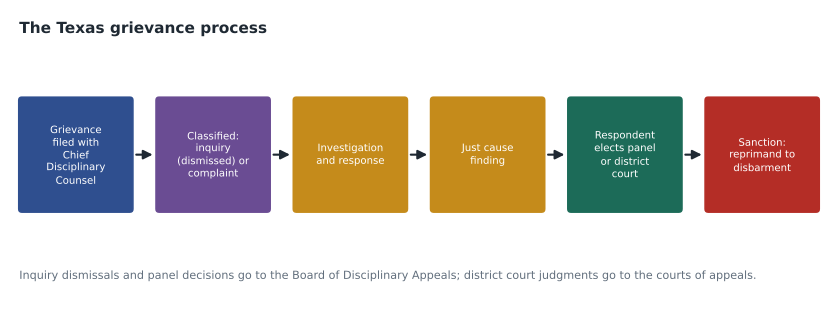
The Texas attorney discipline system is governed by the Texas Rules of Disciplinary Procedure. Anyone may file a grievance with the Office of Chief Disciplinary Counsel. The Chief Disciplinary Counsel first classifies the grievance. If it does not allege professional misconduct, it is dismissed as an inquiry, and the grievant may appeal that classification to the Board of Disciplinary Appeals. If it does allege misconduct, it becomes a complaint, and the lawyer, called the respondent, must respond.
After investigation, the Chief Disciplinary Counsel determines whether there is just cause to believe that the respondent committed misconduct. If there is, the respondent is notified and faces a distinctive Texas choice: the respondent may elect to have the case heard by an evidentiary panel of the local grievance committee, made up of lawyers and public members, or by a district court, with or without a jury. Appeals from evidentiary panels go to the Board of Disciplinary Appeals, and appeals from district court judgments go to the courts of appeals.
Sanctions include private reprimand, public reprimand, suspension, which may be probated, and disbarment, along with restitution and other conditions. The Board of Disciplinary Appeals also handles compulsory discipline for lawyers convicted of certain crimes and reciprocal discipline for lawyers disciplined in other jurisdictions. A Client Security Fund reimburses clients who lose money through a lawyer's dishonest conduct.
Worked problem
Applying Rule 1.05 to a client's threat
Dana's firm represents Garrick Pettibone, a hypothetical client in a bitter custody case. During a meeting, Garrick tells a firm lawyer, calmly and in detail, that he plans to drive to his former spouse's house on Saturday with a gun and 'end this.' He describes the route and the time. What must the lawyer do under the Texas rules, and how does the answer differ on the MPRE?
Show solution
- The statement is confidential information under Rule 1.05; it was acquired during the representation.
- The information clearly establishes that the client is likely to commit a criminal act likely to result in death or substantial bodily harm: a specific plan, a weapon, a time and a target.
- Texas Rule 1.05 requires the lawyer to reveal the information to the extent revelation reasonably appears necessary to prevent the act, such as by alerting law enforcement.
- On the MPRE, Model Rule 1.6 would permit, but not require, disclosure to prevent reasonably certain death or substantial bodily harm.
- The lawyer should also consider withdrawal and document the decision, while disclosing no more than necessary.
Answer: In Texas, disclosure is required here, not merely permitted. On the MPRE, the correct answer would say the lawyer may disclose.
Common mistakes
MistakeApplying Model Rule numbers and text in Texas practice
InsteadTexas has its own rules; numbering and text differ, for example Rule 1.04 on fees and Rule 1.05 on confidentiality.
MistakeTreating the death-or-bodily-harm exception as permissive in Texas
InsteadTexas Rule 1.05 requires disclosure when the information clearly establishes the likely act.
MistakeRunning an ad without checking the filing requirement
InsteadMany Texas advertisements must be filed with the Advertising Review Committee.
MistakeThinking an evidentiary panel is the only forum for a grievance
InsteadAfter a just cause finding, the respondent may elect a district court trial, with or without a jury.
MistakeIgnoring the 2024 amendments
InsteadNew Rules 1.10 and 1.18 and amendments to Rules 1.08, 1.09, 3.09, 4.03, 5.01 and 5.05 took effect October 1, 2024.
The Texas Lawyers' Assistance Program and peer support
The disciplinary system is not the only part of the State Bar concerned with conduct. The Texas Lawyers' Assistance Program offers confidential help to lawyers, judges and law students dealing with substance use, mental health or other issues that affect their practice. Its confidentiality is protected by statute, and Rule 8.03 exempts information gained through an approved lawyer assistance program from the reporting duty. Many grievances arise from neglect and poor communication during personal crises, so early help often prevents discipline.
A practical checklist for a new lawyer
Marchetti gave Dana a short list for her first year of practice. Read Rules 1.04, 1.05 and 1.06 and the safekeeping property rule in full. Keep every fee agreement in writing, especially contingent fees. Check every advertisement or website change against Part VII and the filing requirement. Return client calls within a day, because neglect and failure to communicate drive many grievances. And when an ethics question arises, call the State Bar's ethics helpline or a senior lawyer before acting, not after.
Summary and key terms
- The Texas Disciplinary Rules of Professional Conduct govern Texas lawyers; the MPRE tests the ABA Model Rules instead.
- Texas rules change through a State Bar member referendum followed by Supreme Court approval; the 2024 changes took effect October 1, 2024.
- Rule 1.05 protects privileged and unprivileged client information and requires disclosure to prevent a client's likely act causing death or substantial bodily harm.
- Rule 1.04 forbids illegal or unconscionable fees; contingent fees must be in writing, and fee divisions need written client consent.
- Texas regulates advertising closely, including filing with the Advertising Review Committee, and criminalizes barratry.
- Grievances go to the Chief Disciplinary Counsel; after a just cause finding the respondent elects an evidentiary panel or a district court trial.
- 0
- Texas Disciplinary Rules of Professional Conduct
- 1
- rules referendum
- 2
- Committee on Disciplinary Rules and Referenda
- 3
- unprivileged client information
- 4
- unconscionable fee
- 5
- Advertising Review Committee
- 6
- barratry
- 7
- Office of Chief Disciplinary Counsel
- 8
- just cause
- 9
- evidentiary panel
- 10
- Board of Disciplinary Appeals
- 11
- Texas Lawyer's Creed
Practice problems
Work each problem on paper first, then reveal the answer to check.
How are the Texas disciplinary rules amended?
Show answer
Through a referendum of State Bar members on proposed rules, followed by approval by the Supreme Court of Texas.
What fee standard triggers discipline under Texas Rule 1.04?
Show answer
An illegal or unconscionable fee.
When does Texas Rule 1.05 require disclosure?
Show answer
When confidential information clearly establishes that a client is likely to commit a criminal or fraudulent act likely to result in death or substantial bodily harm, to the extent reasonably necessary to prevent it, and when other rules require it.
What choice does a respondent have after a just cause finding?
Show answer
An evidentiary panel of the grievance committee or a district court trial, with or without a jury.
Which rules did the 2024 referendum add?
Show answer
New Rules 1.10 and 1.18, effective October 1, 2024.
Lesson quiz · 5 questions
Score 60% or more to complete this lesson.
Create a free account to save your progress, take quizzes and earn a certificate.