
BAR-244 · Lesson 7 of 12 · 21 min
Texas courts and civil procedure: two high courts, the Business Court and the Texas Rules of Civil Procedure
▶ Video coming soon A video version of this lesson is on the way.
On a Monday in October, one of the partners at Tejeda & Marwick gave Dana a new file and three questions on a sticky note: which court, which rules, and what is due when? The client, a small Austin bakery supply company, wanted to sue a distributor for about 180,000 dollars in unpaid invoices. Dana spent the week learning that Texas civil practice has its own architecture: two high courts, an intermediate court with statewide jurisdiction created in 2023, a specialized Business Court, and a set of civil procedure rules that resemble the federal rules in places and differ sharply in others.
None of this is on the UBE. The MBE and MEE test the Federal Rules of Civil Procedure. But Texas civil procedure is one of the six graded Texas Law Component subjects from July 2028, and it is the first thing a new Texas litigator needs. This lesson covers the court structure, the Business Court, the main features of the Texas Rules of Civil Procedure and the key deadlines.
Two high courts
Texas is one of only two states with two courts of last resort. The Supreme Court of Texas, with a chief justice and eight justices, has final appellate jurisdiction in civil and juvenile cases. The Court of Criminal Appeals, with a presiding judge and eight judges, has final appellate jurisdiction in criminal cases, including automatic review of death sentences. The justices and judges of both courts are elected statewide in partisan elections for six-year terms, and vacancies between elections are filled by gubernatorial appointment with Senate confirmation.
The Supreme Court decides which civil cases it will hear, mostly by granting petitions for review from the courts of appeals. It also has original jurisdiction to issue writs of mandamus, and mandamus review of trial court orders, especially discovery and arbitration rulings, is a significant part of Texas practice. Beyond deciding cases, the Supreme Court adopts the Texas Rules of Civil Procedure, the Texas Rules of Appellate Procedure and the Texas Rules of Evidence, and it regulates the legal profession, as Lessons 1 and 10 explain.
The courts of appeals, including the Fifteenth
Below the high courts are the courts of appeals. Fourteen regional courts of appeals hear civil and criminal appeals from trial courts in their districts. In 2023 the Legislature created the Fifteenth Court of Appeals, which began operating on September 1, 2024. Unlike the regional courts, it has statewide jurisdiction over certain appeals, principally appeals in cases brought by or against the State and its agencies and officers, and appeals from the Business Court. Its creation reflected a policy choice to have one appellate court with statewide reach decide cases involving the State, rather than leaving them to the regional court where the case happened to be filed.
Trial courts
District courts are the trial courts of general jurisdiction. They hear felony criminal cases, divorce and family cases, civil cases above the jurisdictional limits of lower courts, title to land and contested elections. In larger counties, many district courts specialize by docket, such as civil, criminal, family or juvenile.
Each county has a constitutional county court, presided over by the county judge, which in many rural counties also handles probate and misdemeanor cases. Larger counties have statutory county courts, often called county courts at law, with civil jurisdiction overlapping the district courts up to a statutory amount, and statutory probate courts with exclusive jurisdiction over probate and guardianship matters in some counties. Justice courts hear small civil cases, including small claims and evictions, generally up to 20,000 dollars, and Class C misdemeanors. Municipal courts hear city ordinance violations and Class C misdemeanors within city limits.
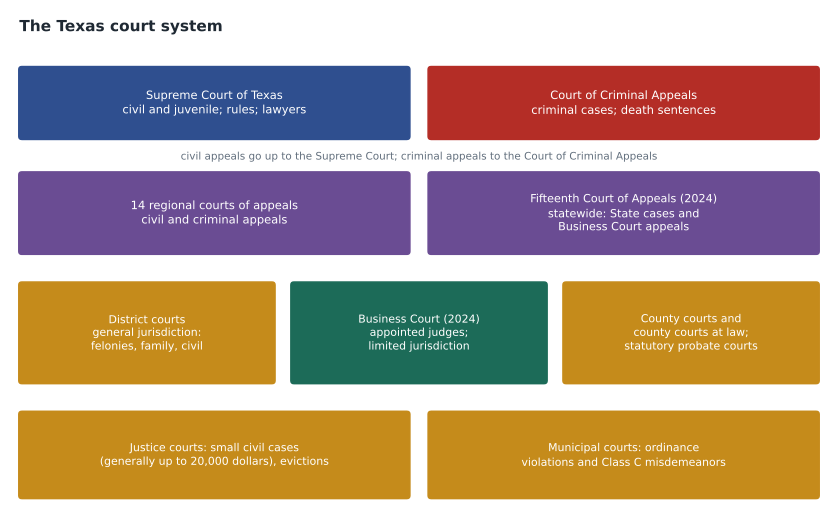
| Court | Main jurisdiction |
|---|---|
| Supreme Court of Texas | Final review in civil and juvenile cases; mandamus; rulemaking; regulation of lawyers |
| Court of Criminal Appeals | Final review in criminal cases; automatic review of death sentences |
| Courts of appeals (14 regional) | Intermediate appeals in civil and criminal cases from their districts |
| Fifteenth Court of Appeals | Statewide: appeals involving the State and its agencies; Business Court appeals |
| District courts | General jurisdiction: felonies, family, larger civil cases, land title |
| Business Court | Specified business disputes above statutory thresholds |
| County courts and county courts at law | Misdemeanors, civil cases within statutory limits, probate in some counties |
| Justice courts | Small civil cases and evictions, generally up to 20,000 dollars; Class C misdemeanors |
The Texas Business Court
The Legislature created the Texas Business Court in 2023, and it began hearing cases on September 1, 2024. Unlike other Texas trial judges, Business Court judges are appointed by the Governor with the advice and consent of the Senate, for two-year terms. The court sits in divisions, and the divisions in the state's largest metropolitan areas, including Dallas, Austin, San Antonio, Fort Worth and Houston, were the first to operate. Other divisions exist on paper but depend on legislative funding.
The Business Court's jurisdiction is defined by statute and is limited. It hears specified internal governance disputes, such as derivative actions, claims about the governance of business entities and claims for breach of duties owed by owners, managers and controlling persons, generally above a minimum amount in controversy unless a party is a publicly traded company. It also hears certain commercial disputes arising from qualified transactions. In 2025 the Legislature amended the court's statute: it lowered the amount-in-controversy threshold for commercial disputes from 10 million to 5 million dollars, clarified that a qualified transaction can be a series of related transactions, and added jurisdiction over certain arbitration-related actions and intellectual property and trade secret disputes. Many personal injury, consumer, family and employment claims are excluded.
The Business Court issues written opinions, which is unusual for a trial court, and appeals go to the Fifteenth Court of Appeals. Dana's bakery supply case, at about 180,000 dollars, is far below the court's thresholds and belongs in a district court or a county court at law.
The Texas Rules of Civil Procedure: pleading
The Texas Rules of Civil Procedure govern civil cases in the district and county courts. Texas follows fair notice pleading: a petition must give the defendant fair notice of the claims and the relief sought. Rule 47 requires a plaintiff to state that the damages sought are within the jurisdictional limits of the court and to state which of several ranges of monetary relief the plaintiff seeks, such as only monetary relief of 250,000 dollars or less, excluding interest, statutory or punitive damages and penalties, and attorney fees and costs. That statement has consequences: it determines whether the case is an expedited action.
A defendant who wants to challenge personal jurisdiction must file a special appearance under Rule 120a before any other plea or motion, or the objection is waived. A defendant may move under Rule 91a to dismiss a cause of action that has no basis in law or fact; the motion must be filed within 60 days after the first pleading containing the challenged cause of action is served, and the rule generally requires the court to award costs and attorney fees to the prevailing party.
Expedited actions and discovery levels
Rule 169 creates expedited actions for suits in which all claimants affirmatively plead that they seek only monetary relief aggregating 250,000 dollars or less, excluding interest, statutory or punitive damages and penalties, and attorney fees and costs. Expedited actions have limited discovery, a shortened timetable and limited trial time. Dana's 180,000 dollar collection case qualifies if the firm pleads it that way.
Rule 190 sets discovery levels. Level 1 applies to expedited actions and divorces with no children and limited property; Level 2 is the default; and Level 3 is a tailored discovery control plan ordered by the court. Each level limits the discovery period, the hours of deposition and the number of written discovery requests.
Since January 1, 2021, Rule 194 has required initial disclosures without awaiting a discovery request, generally within 30 days after the filing of the first answer or general appearance. The disclosures include the names of persons with knowledge of relevant facts, a computation of damages, copies of documents the party may use to support its claims or defenses and other basic information. Before 2021, parties had to serve requests for disclosure to obtain this information, so lawyers trained under the old rules sometimes miss the automatic deadline.
Summary judgment, the TCPA and trial
Rule 166a provides two kinds of summary judgment. A traditional motion under Rule 166a(c) asks for judgment because there is no genuine issue of material fact and the movant is entitled to judgment as a matter of law. A no-evidence motion under Rule 166a(i), available after adequate time for discovery, asserts that there is no evidence of one or more elements of a claim or defense on which the opposing party bears the burden of proof; the burden then shifts to the nonmovant to produce evidence raising a fact issue. The no-evidence motion is a distinctive Texas tool.
The Texas Citizens Participation Act, Chapter 27 of the Civil Practice and Remedies Code, lets a party move to dismiss a legal action based on or in response to the party's exercise of the right of free speech, the right to petition or the right of association. The motion generally must be filed within 60 days after service of the legal action, and discovery is stayed while it is pending. The Legislature narrowed the Act in 2019, but it remains a powerful early motion in defamation and related cases.
Texas guarantees a right to jury trial in civil cases. District court juries have 12 members and county court juries six. In civil cases a verdict may be returned by 10 of 12 jurors in district court or five of six in county court, rather than requiring unanimity, although certain findings, such as those supporting exemplary damages, require unanimity.
Limitations and appellate deadlines
The general limitations period for personal injury and most property damage claims is two years, and for breach of contract and debt claims four years, under Chapter 16 of the Civil Practice and Remedies Code. The discovery rule may defer accrual where the injury was inherently undiscoverable and objectively verifiable. Health care liability claims have their own two-year period, covered in Lesson 8.
Under the Texas Rules of Appellate Procedure, a notice of appeal is generally due 30 days after the judgment is signed, extended to 90 days if a party timely files a motion for new trial or certain other post-judgment motions. Accelerated appeals, including interlocutory appeals, are due within 20 days. These deadlines are jurisdictional in effect, so missing them can end the appeal.
| Item | Texas deadline or threshold |
|---|---|
| Expedited action (Rule 169) | Monetary relief of 250,000 dollars or less, as pleaded |
| Initial disclosures (Rule 194) | Generally within 30 days after the first answer |
| Rule 91a motion to dismiss | Within 60 days after the first pleading with the claim is served |
| TCPA motion to dismiss | Generally within 60 days after service of the legal action |
| Personal injury limitations | Two years |
| Contract or debt limitations | Four years |
| Filing the notice of appeal | 30 days after judgment; 90 days with a timely motion for new trial |
| Accelerated appeal | 20 days |
Worked problem
Choosing a court and track
Dana's client claims 180,000 dollars in unpaid invoices from a Dallas distributor under a written supply contract. The last invoice came due in March 2025. The client also wants attorney fees under Chapter 38 of the Civil Practice and Remedies Code. Where should the firm file, and what procedural choices follow?
Show solution
- Limitations: a contract claim has a four-year period, so there is time, but the firm should file promptly.
- Court: the amount is far below Business Court thresholds, so the case goes to a district court or a county court at law with sufficient jurisdiction, in a county where venue is proper.
- Pleading: under Rule 47, the petition states that the client seeks only monetary relief of 250,000 dollars or less, excluding interest and fees; that makes it an expedited action under Rule 169 with Level 1 discovery.
- Disclosures: the firm calendars Rule 194 initial disclosures for 30 days after the distributor answers.
- Early motions: if the distributor answers with only a general denial, the firm can consider a traditional summary judgment motion supported by the contract, invoices and an affidavit on the account.
Answer: File in a district court or county court at law where venue lies, plead into the expedited action track and calendar the initial disclosure deadline. The Business Court has no role in a case this size.
Common mistakes
MistakeTaking a criminal appeal to the Supreme Court of Texas
InsteadFinal review in criminal cases belongs to the Court of Criminal Appeals.
MistakeFiling a motion to dismiss before a special appearance
InsteadA Rule 120a special appearance must come before any other plea or motion, or the jurisdictional objection is waived.
MistakeWaiting for a request before making disclosures
InsteadSince 2021, Rule 194 requires initial disclosures within 30 days after the first answer, without a request.
MistakeSending every business dispute to the Business Court
InsteadIts jurisdiction is limited to specified disputes above statutory thresholds; many claims are excluded.
MistakeAssuming a civil verdict must be unanimous
InsteadIn district court, 10 of 12 jurors may return a civil verdict, though some findings, such as exemplary damages, require unanimity.
Summary and key terms
- Texas has two high courts: the Supreme Court of Texas (civil and juvenile) and the Court of Criminal Appeals (criminal).
- Fourteen regional courts of appeals and the Fifteenth Court of Appeals, operating since September 1, 2024, form the intermediate level; the Fifteenth has statewide jurisdiction over State cases and Business Court appeals.
- The Business Court began September 1, 2024, with appointed judges and limited statutory jurisdiction; 2025 amendments lowered the commercial threshold to 5 million dollars and added arbitration and IP matters.
- Rule 47 damage statements, Rule 169 expedited actions (250,000 dollars) and Rule 190 discovery levels shape every case.
- Rule 194 initial disclosures, Rule 91a motions, no-evidence summary judgment under Rule 166a(i) and TCPA motions are distinctive Texas tools.
- Key deadlines: two years for personal injury, four for contract; 30 days for a notice of appeal (90 with a motion for new trial).
- 0
- Supreme Court of Texas
- 1
- Court of Criminal Appeals
- 2
- Fifteenth Court of Appeals
- 3
- Business Court
- 4
- fair notice pleading
- 5
- special appearance
- 6
- expedited action
- 7
- initial disclosures
- 8
- no-evidence summary judgment
- 9
- Texas Citizens Participation Act
- 10
- mandamus
Practice problems
Work each problem on paper first, then reveal the answer to check.
Which Texas court has final appellate jurisdiction in criminal cases?
Show answer
The Court of Criminal Appeals.
What appeals does the Fifteenth Court of Appeals hear?
Show answer
Statewide appeals involving the State and its agencies and officers, and Business Court appeals.
What qualifies a case as an expedited action?
Show answer
All claimants plead that they seek only monetary relief of 250,000 dollars or less, excluding interest, statutory or punitive damages, penalties, fees and costs.
When are Rule 194 initial disclosures due?
Show answer
Generally within 30 days after the first answer or general appearance.
What does a no-evidence summary judgment motion do?
Show answer
It asserts there is no evidence of an element on which the nonmovant has the burden, shifting the burden to the nonmovant to produce evidence raising a fact issue.
Lesson quiz · 5 questions
Score 60% or more to complete this lesson.
Create a free account to save your progress, take quizzes and earn a certificate.