
BAR-240 · Lesson 4 of 12 · 19 min
The Rhode Island UBE: format, scoring and the 270 passing score
▶ Video coming soon A video version of this lesson is on the way.
Joana's first practice MBE set came back with a 61 percent raw score, and she spent an evening convinced she would never reach 270. Marchetti asked her to stop converting every practice result into a bar score. 'You are mixing up three different numbers,' she said. 'A raw percentage on a practice set, a scaled MBE score and a total UBE score are different things. Rhode Island adds your written work and your MBE together on a 400-point scale. Once you understand how that adding works, you will know where an extra hour of study pays off.'
This lesson explains the two days of the Rhode Island exam, the three components and their weights, how written answers become scaled scores, what 270 means, how results and reviews work, and what the numbers mean for a study plan.
Two days in Providence
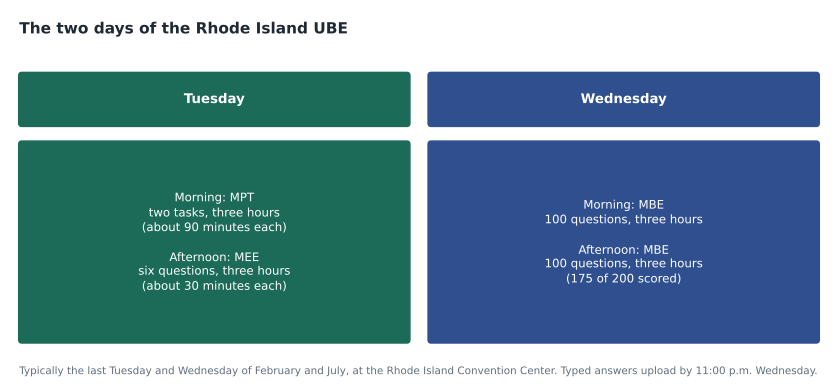
Rhode Island gives the Uniform Bar Examination twice a year, in February and July, on two consecutive days. Under the Board's Rules of Practice, the exam is typically held on the last Tuesday and Wednesday of the month. For the February 2027 exam that means Tuesday, February 23 and Wednesday, February 24, 2027. The Board's FAQ says the exam is typically held at the Rhode Island Convention Center at One Sabin Street in downtown Providence unless applicants are told otherwise.
Rhode Island's first day has an order that differs from some other UBE states. In the morning applicants take the Multistate Performance Test: two tasks in three hours. After lunch they take the Multistate Essay Examination: six questions in three hours. The second day is the Multistate Bar Examination: 200 multiple-choice questions in two three-hour sessions, 100 in the morning and 100 in the afternoon.
The three components
The Multistate Bar Examination tests seven subjects: Civil Procedure, Constitutional Law, Contracts, Criminal Law and Procedure, Evidence, Real Property and Torts. Of the 200 questions, 175 are scored and 25 are unscored pretest questions that look like the others. NCBE grades the MBE and reports a scaled score on a range up to about 200.
The Multistate Essay Examination consists of six 30-minute essay questions. Beginning with the July 2026 exam, NCBE narrowed the MEE to eight subject areas to line up with the NextGen exam: Business Associations, Civil Procedure, Constitutional Law, Contracts including sales under Article 2 of the UCC, Criminal Law and Procedure, Evidence, Real Property and Torts. Conflict of Laws, Family Law, Trusts and Estates and Secured Transactions were removed from the MEE. NCBE has said that Family Law and Trusts and Estates may still appear as the subject of an MPT task through February 2028, where the library provides the law you need.
The Multistate Performance Test gives the applicant a file of facts and a library of legal authorities and asks for a practical lawyering task, such as an objective memo, a persuasive brief, a client letter or a set of contract provisions. Each task is designed to take 90 minutes. The MPT tests skills, not memorized law: the law you need is in the library.
How the components are weighted
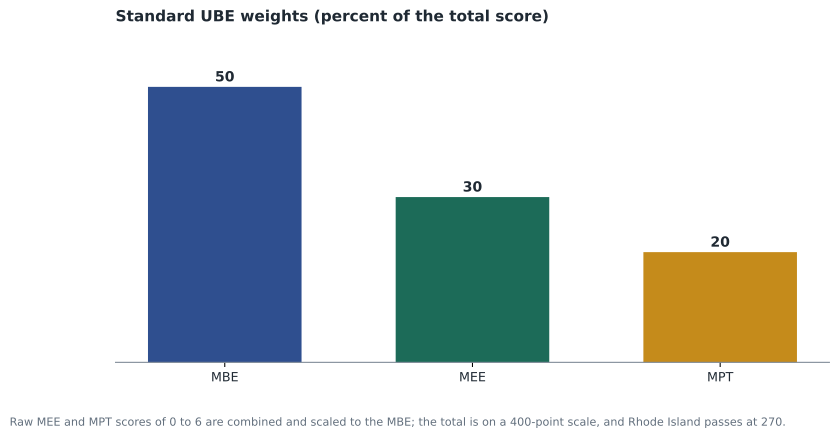
On the UBE, NCBE's standard weighting is 50 percent for the MBE, 30 percent for the MEE and 20 percent for the MPT. The written components together are therefore half the score. Because each MPT task is worth twice as much as each MEE question in the overall result, an MPT task is one of the most valuable single items on the exam.
| Component | What it is | Time | Weight |
|---|---|---|---|
| MPT | Two practical tasks using a file and library | 3 hours, Tuesday morning | 20 percent |
| MEE | Six essay questions, about 30 minutes each | 3 hours, Tuesday afternoon | 30 percent |
| MBE | 200 multiple-choice questions, 175 scored | 6 hours, Wednesday | 50 percent |
How written answers are graded and scaled
In Rhode Island, members of the Board of Bar Examiners grade the MEE and MPT answers, using NCBE's grading materials and calibration. Each answer receives a raw score from 0 to 6. An unanswered or irrelevant response receives 0. Applicants are identified only by a unique five-digit number during grading, so graders do not know whose answer they are reading.
The Rules of Practice explain the next step. The raw MEE and MPT scores are combined and then scaled to the MBE. Scaling means converting the written raw scores to the same scale as the MBE, using the MBE scores of the same group of applicants. It corrects for differences in difficulty and grading from one administration to the next: a strong group on the MBE in a given administration will have a strong distribution of written scores after scaling, and a weaker group a weaker one. The scaled written score is then combined with the scaled MBE score, using the weights above, to produce a total UBE score on a 400-point scale.
The practical lesson from scaling is that your written score depends on your rank among the people who took the exam with you, not on a fixed number of points. An answer that earns a 4 in a given group may scale differently from a 4 in another group. What you control is writing answers that rank well: they spot the issues, state the rules accurately, apply them to the facts and reach conclusions.
What 270 means
Rhode Island requires a total scaled UBE score of 270 to pass. The Court lowered the requirement from 276 to 270 by an order of March 25, 2021, effective with the February 2021 exam. Justice Robinson dissented from that order, writing that caution should be the watchword, which shows how seriously the Court treats the choice of a cut score. The Board does not waive passing scores.
A 270 means an average of 135 on each half of the exam. A candidate who scores 140 on the MBE needs only 130 on the written portion; a candidate who scores 130 on the MBE needs 140 on the written portion. That trade-off is the most useful number for planning. NCBE's chart shows that UBE cut scores across states range from 260 to 270, so 270 is at the top of the range. A score that passes in Rhode Island will meet every other UBE jurisdiction's passing score, which is one reason Rhode Island scores are attractive to transfer, subject to each state's own time limits.
Laptops and the written day
Laptop use on the written day is optional and free. An applicant who wants to type registers directly with ExamSoft. Registration typically opens about a month after the filing deadline and closes about a month before the exam. An ExamSoft representative is on site during the written day. The Board's FAQ recommends laptops for applicants whose handwriting is hard to read.
The upload rule is strict. Typed answers must be uploaded by 11:00 p.m. on the second day of the exam. Missing the upload deadline is an automatic failure unless the applicant shows good cause. The Board does not guarantee the software and is not responsible for technical problems, so applicants who type should run the practice exams ExamSoft provides and should upload as soon as they reach home on Tuesday.
Results
February results are usually released in May and July results in November. Applicants are notified by email once the release date is set, results are posted and the names of passing applicants are made public. Swearing-in ceremonies are usually held one to three weeks after results in the Supreme Court courtroom on the seventh floor of the Licht Judicial Complex. Guest seating is limited.
An applicant who fails may ask to meet with up to two members of the Board within 15 days after results are released. The review covers only answers that received a raw score of 2 or below and is informational only: it helps the applicant understand what went wrong but does not change the score. There is no regrading process. A decision of the Board may be appealed to the Supreme Court by petition within 30 days.
Worked problem
Reading a score report
Joana's friend Wendy took the July 2026 Rhode Island exam and received a total score of 266, with an MBE scaled score of 141. What does the report tell her, and what should she do?
Show solution
- Total of 266 is four points short of 270, so she did not pass in Rhode Island.
- Her MBE of 141 is above the 135 average needed; her written scaled score was about 125.
- The written portion is where she lost points. She should request the informational review within 15 days to see any answer scored 2 or below.
- Her plan should shift time to MPT tasks and MEE structure, while keeping MBE practice steady.
- A 266 meets the passing score of several other UBE states, but each sets its own transfer rules.
Answer: The score report shows where the deficit lies. Wendy should rebalance her study toward the written components.
What this means for study
Because the MBE is half the score, steady MBE practice matters every week. But many candidates neglect the MPT, which is 20 percent of the score and requires no memorization at all. Two or three timed MPTs before the exam, each followed by a careful comparison with NCBE's point sheet, is one of the most efficient ways to raise a total score. For the MEE, the most important habit is structure: a clear heading for each issue, the rule stated in one or two sentences, application to the facts and a conclusion.
Joana's plan, built with Marchetti, set a target of 138 on the MBE by mid-February and an equal written performance, giving her a margin above 270. Her weekly schedule had MBE questions every day, one MEE question every other day and a full MPT every second weekend.
Common mistakes
MistakeA 61 percent raw score on a practice set means a failing MBE.
InsteadRaw practice percentages do not translate directly into scaled scores; track trends, not single sets.
MistakeThe MPT is a minor part of the exam.
InsteadThe MPT is 20 percent of the total; each task is worth about twice an MEE question.
MistakeRhode Island regrades close failures.
InsteadThere is no regrading; the review is informational only.
MistakeTyped answers can be uploaded any time the next day.
InsteadUploads are due by 11:00 p.m. on the second exam day, or the result is an automatic failure absent good cause.
How a grader reads an answer
Because Board members grade Rhode Island's written answers, it helps to picture the grader's task. A grader may read hundreds of answers to the same MEE question over several days, using NCBE's analysis and a calibration process designed to make the scores consistent. A grader rewards an answer that is easy to follow: a heading that names each issue, a rule stated accurately and briefly, application that uses the facts of the question rather than general statements, and a conclusion. A grader does not reward length for its own sake, repetition of the facts, or a discussion of issues the question did not raise.
For the MPT, graders look for an answer that does the assigned task in the assigned format. If the task memo asks for an objective memo, a persuasive brief earns fewer points. If it asks for a statement of facts, leaving one out costs points. If it says not to include a separate section, including one wastes time. The first five minutes of each MPT task, spent reading the task memo carefully and outlining, are the most valuable minutes of the morning.
Practice that matches the scoring
Joana built her practice around the scoring. For the MBE, she worked through sets of 33 or 34 questions under time pressure, about 1.8 minutes a question, and reviewed every miss by writing a one-line rule. For the MEE, she wrote one timed answer every other day and compared it against NCBE's analysis, marking each issue she missed. For the MPT, she completed a full 90-minute task every second weekend and scored it against the point sheet. Every two weeks she did a mixed set under exam conditions, so that the Tuesday sequence, MPT then MEE, would feel normal by February.
Joana also kept a simple score log. After each timed MBE set she recorded the subject, the number correct and the type of mistake: a rule she did not know, a rule she knew but misapplied, or a misread fact. By December the log showed that most of her civil procedure misses were misreads, which called for slower reading rather than more memorization.
Summary and key terms
- Rhode Island gives the UBE on the last Tuesday and Wednesday of February and July, typically at the Rhode Island Convention Center.
- Tuesday has two MPT tasks in the morning and six MEE questions in the afternoon; Wednesday is the 200-question MBE.
- Standard weights are MBE 50 percent, MEE 30 percent and MPT 20 percent; written raw scores of 0 to 6 are scaled to the MBE.
- The passing score is 270 on a 400-point scale, lowered from 276 in 2021; the Board does not waive it.
- February results usually come in May; failed applicants may request an informational review within 15 days; there is no regrading.
- 0
- Multistate Bar Examination
- 1
- Multistate Essay Examination
- 2
- Multistate Performance Test
- 3
- scaled score
- 4
- scaling
- 5
- raw score
- 6
- total UBE score
- 7
- ExamSoft
Practice problems
Work each problem on paper first, then reveal the answer to check.
What is the order of components on the first day of the Rhode Island exam?
Show answer
Two MPT tasks in the morning, then six MEE questions in the afternoon.
What are the standard UBE weights?
Show answer
MBE 50 percent, MEE 30 percent and MPT 20 percent.
If an applicant scores 132 on the MBE, what written scaled score is needed to reach 270?
Show answer
138.
When must typed answers be uploaded?
Show answer
By 11:00 p.m. on the second day of the exam.
Lesson quiz · 5 questions
Score 60% or more to complete this lesson.
Create a free account to save your progress, take quizzes and earn a certificate.