
BAR-240 · Lesson 2 of 12 · 19 min
Eligibility, education, deadlines and fees
▶ Video coming soon A video version of this lesson is on the way.
Joana filed her petition on November 12, 2026, nineteen days before the deadline for the February exam. She was proud of that until a classmate called in a panic. He had assumed Rhode Island worked like a state he had read about online, where late filing is allowed for an extra fee, and he had planned to file in mid-December. Rhode Island does not work that way. Its deadlines are strictly enforced, they fall at 11:59 p.m. on the deadline date, and there is no late filing period at all. He would sit in July instead.
Marchetti used the story to open their second session. 'Eligibility and deadlines are the least interesting part of bar admission and the easiest place to lose six months,' she said. 'Rhode Island's rules are short and strict. Read them once, put the dates on your calendar and then stop worrying about them.'
This lesson covers who may apply, the education requirement, the filing windows for each kind of applicant, the documents a petition needs and the fees. It also covers deferral, withdrawal and reapplication, and the five-failure limit, which is one of the strictest in the country.
Basic eligibility under Rule 1
An applicant for admission on examination under Rule 1 must show four things. First, the applicant must be a United States citizen, a lawful permanent resident or otherwise lawfully authorized to work in the United States. Second, the applicant must be of good moral character, which the applicant proves through the character and fitness process discussed in Lesson 3. Third, the applicant must be over 21 years of age. Fourth, the applicant must have graduated from a law school accredited by the American Bar Association and approved by the Board.
The education rule is the one that most often decides eligibility. For a Rule 1 applicant, the law degree must be a J.D. from an ABA-accredited school. Rhode Island does not accept a degree from an unaccredited or state-accredited school for Rule 1, and it does not let a foreign-trained lawyer qualify through an American LL.M. Graduates of non-ABA schools and foreign-educated lawyers may seek admission only through the attorneys' examination under Rule 1A, which requires at least five years of admission and five of the last ten years of full-time practice elsewhere. This is why NCBE's chart shows Rhode Island as not requiring an ABA degree for every applicant: the Rule 1A route is open to experienced lawyers regardless of where they studied.
Rhode Island also expects the J.D. to be complete. The petition requires law school documentation from every law school the applicant attended, and the dean's office must witness the applicant's handwriting sample. A third-year student who will graduate after the exam cannot sit early.
The five-failure limit
Rhode Island has a hard cap on attempts. Under Rule 1, an applicant who has failed a bar examination five or more times in total, in Rhode Island or any other jurisdiction, may not seek admission by taking the Rhode Island exam or by transferring a UBE score. The rule says plainly that the Court will not grant special exceptions. Failing to reach the minimum passing score in any jurisdiction counts as a failed exam, so a UBE score that fell short of another state's cut score counts even if it would have passed somewhere else.
Two other rules make attempts count faster than candidates expect. A no-show is a failure: an applicant who does not appear for the exam without first deferring or withdrawing is treated as having failed, and that failure counts toward the limit. And every attempt anywhere counts, including attempts in states that do not give the UBE. A candidate with a history of attempts elsewhere should count them carefully before filing.
Filing windows
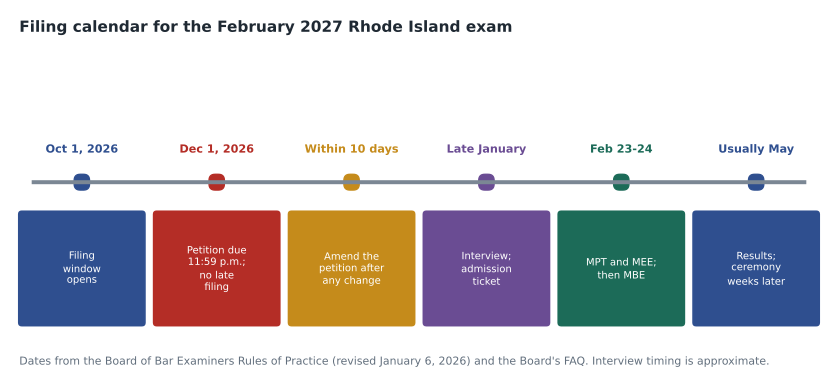
Rhode Island uses filing windows, not just deadlines. A Rule 1 petition for the February exam may be filed from October 1 through December 1 of the year before the exam. A Rule 1 petition for the July exam may be filed from March 1 through May 1 of the exam year. The Board's FAQ adds that petitions may not be filed earlier than 60 days before the deadline, which matches those opening dates.
Rule 1A attorneys file earlier, because their character investigations take longer. Their window for the February exam runs from July 1 through September 1 of the year before, and for the July exam from December 1 through February 1. Rule 1B score-transfer petitions are processed on a rolling basis throughout the year, with admission ceremonies tied to the regular results cycles.
Every deadline is strictly enforced. A petition is due by 11:59 p.m. on the deadline date, and all required documents must be filed by the deadline. Incomplete files do not carry over to the next exam. NCBE's chart confirms that Rhode Island has no late filing deadline.
| Applicant | February exam | July exam |
|---|---|---|
| Rule 1 (examination) | October 1 to December 1 of the prior year | March 1 to May 1 of the exam year |
| Rule 1A (attorneys' examination) | July 1 to September 1 of the prior year | December 1 to February 1 |
| Rule 1B (UBE transfer) | Rolling | Rolling |
How to file
Filing is a two-step electronic process. First, the applicant completes NCBE's online character and fitness application. Second, the applicant files a Petition for Admission through RISCAP, the Rhode Island Supreme Court Attorney Portal, which attaches the NCBE application. The petition is made under oath. Bar Admissions staff communicate by email, and the FAQ asks applicants to do the same.
Some documents come from other people and are sent separately, either to Bar Admissions or directly to the Committee on Character and Fitness. They include law school documentation from every school attended, certificates of good moral character and employment verification forms. Certificates of good moral character may come from anyone not related to the applicant by blood and not already listed as a reference elsewhere in the application.
Other documents the applicant gathers. A credit report from Equifax, Experian or TransUnion must be obtained within 30 days of filing. A criminal background check is required from each jurisdiction where the applicant lived for at least six cumulative months after age 18; a national check does not substitute, and no check is required for time spent abroad. Applicants admitted elsewhere need certificates of good standing from every jurisdiction and court of admission, including inactive memberships, and any administrative suspension must be resolved first. A handwriting sample is witnessed through the dean's office for Rule 1 applicants or notarized for Rule 1A applicants.
The application questions are detailed. Employment history starts at age 21 and includes paid and unpaid internships and clerkships. Male applicants must give a Selective Service number or explain why they did not register. A question that does not apply should be marked not applicable rather than left blank, and a question that cannot be fully answered in the space provided requires an addendum.
The duty to update
Filing is not the end of the applicant's obligations. The Rules of Practice require an applicant to report any change in the information in the petition within ten days by filing an amended petition. That includes a new address, a new job, a new charge or citation, a new debt in collection, or a new fact that makes an earlier answer incomplete. The duty lasts until admission. Joana planned to move from East Providence to an apartment in Pawtucket in January; Marchetti told her to put the amended petition on her calendar for the day she signed the lease.
Fees
Rule 5 sets the fees. The application fee for a Rule 1 petition is 975 dollars, paid to the Clerk. A repeat applicant pays 975 dollars again with a petition to reapply. Deferring an application to the next exam costs an additional 300 dollars. Transferring a Rhode Island MBE score to another jurisdiction costs 25 dollars per jurisdiction. NCBE's chart lists 1,475 dollars for attorneys, including Rule 1A applicants, and shows no fee for using a laptop. Rule 1A and Rule 1B applicants pay NCBE separately for their character investigations. All fees are nonrefundable.
| Item | Amount | Source |
|---|---|---|
| Rule 1 application | 975 dollars | Article II, Rule 5 |
| Petition to reapply after failure or deferral | 975 dollars | Article II, Rule 5 |
| Deferral to the next exam | 300 dollars additional | Article II, Rule 5 |
| Attorney applicants (NCBE chart) | 1,475 dollars | NCBE jurisdiction chart |
| MBE score transfer out of Rhode Island | 25 dollars per jurisdiction | Article II, Rule 5 |
| Laptop use on the written day | No fee | NCBE chart; Board FAQ |
Deferral, withdrawal and reapplication
Plans change, and Rhode Island has a clear procedure for it. An applicant may defer to the next exam at any time until one week before the exam by filing a request in RISCAP and paying the deferral fee. A deferral only holds the application for the next exam; the applicant must still file a petition to reapply by the next deadline, or the file is closed. An applicant may instead withdraw at any time until one week before the exam, but a withdrawn applicant must file a completely new petition to sit later. Requests within the final week require good cause.
After a failure, the applicant may sit for the next exam by filing a petition to reapply, typically within 14 days of the results letter, and must still meet every prerequisite. Each failure counts toward the five-failure limit. The Board may also defer an applicant on its own initiative, at no cost, if the applicant's attendance could disrupt the exam or violate a court or agency order.
Public information and confidentiality
Petitions are confidential, with limited exceptions. On written request, the public may learn an applicant's name, address, year of birth, law schools attended and the months and years of exams taken. The Court also publishes applicants' names in a daily newspaper at least ten days before the exam, a long Rhode Island practice that lets anyone with information about an applicant's character come forward. After results, the names of those who passed are made public. Petitions are kept for at least ten years.
Worked problem
Can Joana's friends sit in February?
Three of Joana's classmates ask about the February 2027 exam. Paulina graduated in May 2026 from an ABA-accredited school and has not filed. Rafe graduated from a state-accredited California school and passed the California bar in 2019. Iolanda, a Brazilian lawyer, earned an American LL.M. in 2026. Who can sit under Rule 1 in February?
Show solution
- Paulina can file under Rule 1 if she files by 11:59 p.m. on December 1, 2026 with all required documents.
- Rafe's degree is not from an ABA-accredited school, so Rule 1 is closed. He is admitted elsewhere, but he must have been admitted at least five years and practiced full time five of the last ten years to use Rule 1A, and the Rule 1A window for February closed September 1, 2026.
- Iolanda cannot use an LL.M. to qualify under Rule 1. A foreign-educated lawyer may proceed only under Rule 1A, which also requires five years of admission in a United States jurisdiction.
Answer: Only Paulina can sit in February under Rule 1. Rafe may qualify for a later Rule 1A exam; Iolanda cannot yet qualify in Rhode Island.
Common mistakes
MistakeRhode Island allows late filing for an extra fee.
InsteadThere is no late filing period; the deadline is 11:59 p.m. on the deadline date and incomplete files do not carry over.
MistakeAn American LL.M. lets a foreign lawyer sit under Rule 1.
InsteadRule 1 requires a J.D. from an ABA-accredited school; foreign-educated lawyers may proceed only under Rule 1A.
MistakeOnly Rhode Island failures count toward the attempt limit.
InsteadFailures in any jurisdiction count, and a no-show without deferral or withdrawal counts as a failure.
MistakeA deferral automatically puts you on the next exam.
InsteadA deferral holds the file; the applicant must still file a petition to reapply by the next deadline.
A filing checklist
Marchetti's filing checklist for Rhode Island has six lines. Open the NCBE application early, because it asks for addresses, jobs and references going back years. Order the credit report no more than 30 days before filing. Request background checks from every state where you lived at least six months after 18, and allow time for slow agencies. Ask the dean's office to witness the handwriting sample and send the law school documentation. Send the MPRE score from NCBE to the Clerk. File the petition in RISCAP well before 11:59 p.m. on the deadline, keep the confirmation and calendar the ten-day duty to update for every change that follows.
Summary and key terms
- Rule 1 applicants must be authorized to work in the United States, of good character, over 21 and graduates of an ABA-accredited, Board-approved law school.
- Anyone who has failed five or more bar exams anywhere may not sit or transfer a score; no exceptions are granted.
- Rule 1 windows run October 1 to December 1 for February and March 1 to May 1 for July; Rule 1A windows are earlier; Rule 1B is rolling.
- The Rule 1 fee is 975 dollars; deferral adds 300 dollars; the duty to update runs for ten days after any change.
- Deferral and withdrawal close one week before the exam; a no-show is a failure.
- 0
- Rule 1
- 1
- filing window
- 2
- RISCAP
- 3
- petition to reapply
- 4
- deferral
- 5
- five-failure limit
- 6
- amended petition
- 7
- certificate of good moral character
Practice problems
Work each problem on paper first, then reveal the answer to check.
When is the last moment to file a Rule 1 petition for the February 2027 exam?
Show answer
11:59 p.m. on December 1, 2026.
What happens to an applicant who has failed bar exams five times in other states?
Show answer
The applicant may not seek admission in Rhode Island by examination or by UBE transfer; no exceptions are granted.
How long does an applicant have to report a change in petition information?
Show answer
Ten days, by filing an amended petition.
What does a deferral cost, and what else must the applicant do?
Show answer
An additional 300 dollars, and the applicant must file a petition to reapply by the next deadline.
Lesson quiz · 5 questions
Score 60% or more to complete this lesson.
Create a free account to save your progress, take quizzes and earn a certificate.