
BAR-240 · Lesson 12 of 12 · 21 min
Capstone: Rhode Island practice questions and an exam-day plan
▶ Video coming soon A video version of this lesson is on the way.
In mid-November 2026, Marchetti met Joana for a final fall session. The petition was filed, the MPRE score was on file, the study schedule was running and the interview would come in late January. 'This is the session where we put the pieces together,' Marchetti said. 'First you will work through an exam-style essay and a few multiple-choice items, answering the way the exam wants. Then you will do a Rhode Island practice problem, the way Domingos wants. Then we will write down exactly what you will do on February 23 and 24.'
This capstone has four parts: an original MEE-style essay with a model answer on general principles; original multiple-choice items with explanations; a Rhode Island practice problem answered in memo form; and an exam-day plan for the Rhode Island UBE. All the questions are original and written for this course. None are released bar exam questions.
Part one: an MEE-style essay
Facts. Garnet, a homeowner in the State of Franklin, hired Silvan, a contractor, to replace her deck for a fixed price of 24,000 dollars. The written contract required Silvan to use pressure-treated lumber of a named grade and to finish by June 1. Silvan used a cheaper grade that looked the same, finished on June 10 and asked for payment. Garnet discovered the substitution when an inspector pointed it out. Replacing the boards with the specified grade would cost 18,000 dollars; the difference in the market value of the house with the cheaper boards is about 2,000 dollars. Garnet refuses to pay anything. While arguing in her driveway, Silvan backed his truck into Garnet's car. Garnet was standing behind the car looking at her phone and was knocked down, breaking her ankle. A jury could find Silvan 70 percent at fault and Garnet 30 percent at fault. Franklin has adopted no statute on comparative fault.
Call. (1) What are Silvan's and Garnet's rights under the contract? (2) May Garnet recover for her ankle injury, and how would her own fault affect recovery?
Model answer, issue 1: breach and damages. A construction contract for services is governed by the common law, not Article 2 of the UCC, because its predominant purpose is services and the lumber is incidental. Silvan breached by using a lower grade of lumber and by finishing late. The question is whether the breaches are material. Under the doctrine of substantial performance, a contractor who has substantially performed may recover the contract price less damages for the defects, but a willful deviation from an express specification weighs against substantial performance. Silvan's substitution appears deliberate, which supports Garnet's argument that he did not substantially perform; the ten-day delay alone, without a time-is-of-the-essence clause, is likely a minor breach. If Silvan did substantially perform, Garnet must pay the price less her damages. If he did not, he may still recover in restitution the reasonable value of his work less Garnet's damages in many jurisdictions.
The measure of Garnet's damages raises the classic choice between cost of completion and diminution in value. The usual rule awards the cost to complete or correct the work, here 18,000 dollars. But where correction would involve economic waste grossly disproportionate to the benefit, and the breach was not willful, courts may limit recovery to diminution in value, here about 2,000 dollars. Because Silvan's deviation appears willful and the specification concerned the quality of a structural component, a court is likely to award cost of correction. Garnet would therefore owe the contract price less 18,000 dollars and any proven delay damages. Garnet's refusal to pay anything is not justified if Silvan substantially performed; she may withhold only the amount of her damages.
Model answer, issue 2: negligence and comparative fault. Silvan owed Garnet a duty of reasonable care in driving. Backing a truck without looking, in a driveway where he knew Garnet was present, breached that duty, and the breach was the actual and proximate cause of her broken ankle. Garnet's own inattention may be contributory negligence. The effect depends on Franklin's approach, which the facts do not specify. Under the traditional rule of contributory negligence, still followed in a few jurisdictions, any negligence by the plaintiff bars recovery, subject to doctrines such as last clear chance. Under pure comparative negligence, Garnet recovers 70 percent of her damages. Under modified comparative negligence, which most states follow, Garnet recovers 70 percent of her damages because her fault, 30 percent, is less than Silvan's. Under any comparative system she recovers, and in a contributory negligence jurisdiction she would need last clear chance or a similar doctrine. A complete answer identifies the approaches, notes that most states use comparative negligence and concludes that Garnet likely recovers 70 percent of her damages.
Look at what the model answer does not do. It does not cite Rhode Island's pure comparative negligence statute or Rhode Island's ten-year limitation period, because the question is set in Franklin and asks about general principles. Joana's instinct from the firm would be to write 'Garnet recovers 70 percent under section 9-20-4.' The exam answer reaches the same number by a general route.
Part two: multiple-choice items
Item 1. A plaintiff sues a corporation in federal court on a state-law claim, alleging that the corporation is incorporated in Delaware with its principal place of business in Rhode Island, and that the plaintiff is a citizen of Massachusetts. The amount in controversy is 90,000 dollars. Is there subject-matter jurisdiction? Answer: yes. The parties are completely diverse, because the corporation is a citizen of Delaware and Rhode Island and the plaintiff is a citizen of Massachusetts, and the amount exceeds 75,000 dollars.
Item 2. At trial, a witness testifies that, moments after a crash, a bystander shouted, 'That blue car just ran the red light!' The bystander is unavailable. Is the statement admissible over a hearsay objection? Answer: yes, as a present sense impression or an excited utterance, both of which apply regardless of the declarant's availability.
Item 3. A grantor conveys land to A for life, then to B's children who reach age 25. B is alive with one child, age 3. Under the common law Rule Against Perpetuities, is the gift to B's children valid? Answer: no. B could have another child, and all of B's children alive at B's death might not reach 25 within 21 years after the deaths of all lives in being. The interest might vest too remotely and is void under the common law rule, although many states have modified the rule.
Item 4. A buyer and seller sign a written contract for the sale of a used car for 6,000 dollars. The seller later claims the parties orally agreed that the price would rise if the buyer did not pay within ten days. The writing appears to be a complete and final expression of the agreement. Is the oral term admissible? Answer: no. Under the parol evidence rule, evidence of a prior or contemporaneous oral agreement that contradicts or adds to a fully integrated writing is not admissible to vary its terms.
| Item | Subject | Key rule |
|---|---|---|
| 1 | Civil Procedure | Complete diversity and an amount over 75,000 dollars; a corporation is a citizen of its state of incorporation and principal place of business |
| 2 | Evidence | Present sense impressions and excited utterances are exceptions regardless of availability |
| 3 | Real Property | The common law Rule Against Perpetuities voids an interest that might vest too remotely |
| 4 | Contracts | The parol evidence rule bars prior or contemporaneous terms that vary a fully integrated writing |
Part three: a Rhode Island practice problem
Facts. In October 2026 a Providence client, Noemi Dufresne, was injured when a Town of Lincoln recycling truck rear-ended her car at a stop sign. The driver was a town employee on his route. A second car, driven by Halden Kettleby, a private motorist, then hit Noemi's car from the side while swerving to avoid the scene. Noemi's damages are about 300,000 dollars. A Connecticut lawyer who referred Noemi wants to share the fee and to appear in the case. Write a short memo to Domingos identifying the main Rhode Island issues.
Model memo. Question presented: what Rhode Island rules govern Noemi's recovery against the town and Kettleby, and what must the firm do about the referral?
Short answer: Noemi may sue both defendants. Her recovery against the town is likely limited to 100,000 dollars, because operating a recycling truck is likely a governmental function under the Governmental Tort Liability Act; Kettleby, as a private defendant, faces no statutory limit. Any fault of Noemi reduces but does not bar recovery under pure comparative negligence, and pecuniary damages carry 12 percent interest from accrual. The fee division and the Connecticut lawyer's appearance must comply with Rule 1.5 and Article II, Rule 9.
Discussion, liability and limits. Section 9-31-3 limits damages against a town to 100,000 dollars unless the town was performing a proprietary function. Refuse collection is ordinarily treated as a governmental function, so the limit is likely to apply; we should research Rhode Island decisions on refuse collection and motor vehicle operation before conceding the point. The public duty doctrine is unlikely to bar the claim, because driving a vehicle on a public road is an activity that private persons also perform. Before suit, we must present the claim to the Lincoln Town Council under section 45-15-5 and allow the statutory waiting period. The limitation period for personal injury is three years under section 9-1-14.
Discussion, multiple defendants. Kettleby is a private defendant and is not subject to any statutory limit. If both defendants caused an indivisible injury, each may be jointly liable, with contribution between them under chapter 10-6. Any settlement with one defendant must be drafted with sections 10-6-7 and 10-6-12 in mind, because the release affects the claim against the other. Because the town's exposure is limited, Kettleby's liability insurance will be critical to Noemi's recovery.
Discussion, interest and fault. If the defendants argue that Noemi stopped short, any fault assigned to her reduces her damages proportionally but cannot bar her claim under section 9-20-4. Section 9-21-10 adds 12 percent a year from October 2026 to any award of pecuniary damages; whether and how interest applies on top of the town's limit must be researched in current case law.
Discussion, professional conduct. The contingent fee agreement must be in a writing signed by Noemi stating the percentages for settlement, trial and appeal. Any division of the fee with the Connecticut lawyer requires Noemi's agreement to the arrangement, including each lawyer's share, confirmed in writing, and must satisfy the other conditions of Rule 1.5. If the Connecticut lawyer wishes to appear, she must be admitted pro hac vice under Article II, Rule 9 on a petition sponsored by one of our lawyers, who must sign all filings; she may appear in no more than three Rhode Island cases in five years without a waiver. All settlement funds go into our Rhode Island trust account, which only a Rhode Island lawyer may sign.
Part four: the exam-day plan
The February 2027 Rhode Island exam is on Tuesday, February 23 and Wednesday, February 24, 2027, typically at the Rhode Island Convention Center in Providence. Joana's plan covers the week before, both exam days and the night in between.
The week before: confirm the location, start times and the Board's list of permitted items in the exam instructions. Print the admission ticket received at the interview and keep it with valid photo identification. If typing, run the ExamSoft mock exam, check that the laptop is registered and charged and that the software is up to date. Plan the drive and parking in downtown Providence in February weather, with extra time. Shift sleep toward an early wake-up. Stop new learning by Saturday; review outlines and the MPT approach.
Tuesday: MPT in the morning, two tasks in three hours. Spend about 90 minutes on each, reading the task memo first, then the library, then the file, and outline before writing. At lunch, eat something familiar and do not discuss the morning. MEE in the afternoon, six questions in three hours: about 30 minutes each, a heading for every issue, the rule in one or two sentences, application and a conclusion. If typing, upload answers as soon as possible after the session and in any case before 11:00 p.m. on Wednesday.
Wednesday: the MBE in two sessions of 100 questions, about 1.8 minutes a question. Mark and move on from hard questions; answer every question, because there is no penalty for guessing. Remember that 25 of the 200 questions are unscored, so a run of strange questions may not count.
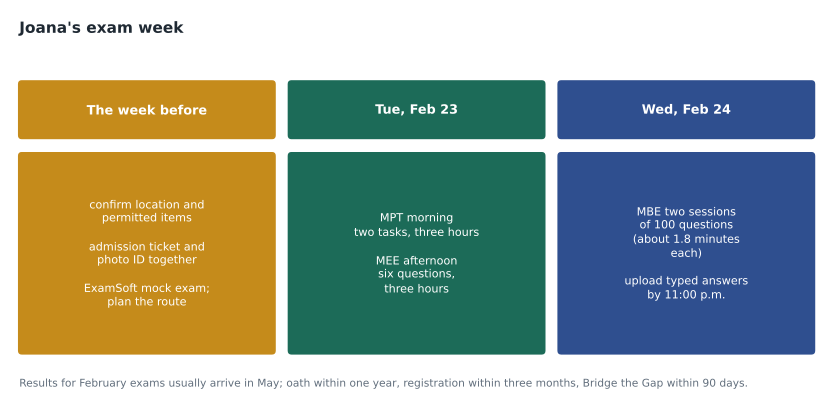
After the exam: rest, return to work at the firm and wait for results, which for February exams are usually released in May. If she passes, she will take the oath at the ceremony a few weeks later, register within three months, complete Bridge the Gap within 90 days and begin the regular CLE cycle in the next reporting year. If she does not, she will request the informational review within 15 days, file a petition to reapply and plan for July 2027 with time to spare before the NextGen switch in July 2028.
Worked problem
A final checklist
Write Joana's one-page checklist for the last month.
Show solution
- Late January: character and fitness interview at 250 Benefit Street; bring photo ID and a copy of the petition; collect the admission ticket.
- Any change in address, job or record: file an amended petition within ten days.
- Two weeks out: full timed MPT and MEE practice day; full timed MBE practice set.
- One week out: confirm logistics, permitted items, ExamSoft registration and route.
- Exam days: MPT and MEE Tuesday, MBE Wednesday; typed answers uploaded by 11:00 p.m. Wednesday.
- After: results usually in May; oath within one year; registration within three months; Bridge the Gap within 90 days.
Answer: A written plan removes decisions from exam week and keeps the administrative deadlines from slipping.
Common mistakes
MistakeCiting a Rhode Island statute on an MEE answer earns extra points.
InsteadThe MEE tests general principles; cite the rule the question supplies or the general rule.
MistakeLeaving hard MBE questions blank saves time.
InsteadThere is no penalty for guessing; answer every question.
MistakeThe admission ticket arrives by mail.
InsteadApplicants receive the admission ticket at the character and fitness interview.
MistakeA loss on the exam ends the process for the year.
InsteadA petition to reapply can be filed for the next exam, usually within 14 days of the results letter.
Summary and key terms
- Answer MEE questions on general principles with one heading per issue, a short rule, application and a conclusion.
- MBE items test general rules; practice explaining why the right answer is right.
- Rhode Island practice problems combine pure comparative negligence, the governmental limits, presentment, 12 percent interest and the Rhode Island conduct rules.
- The February 2027 exam is on February 23 and 24, typically at the Rhode Island Convention Center, with the MPT in the morning and the MEE in the afternoon of day one.
- After results: oath within one year, registration within three months, Bridge the Gap within 90 days.
- 0
- substantial performance
- 1
- cost of correction
- 2
- diminution in value
- 3
- complete diversity
- 4
- excited utterance
- 5
- parol evidence rule
- 6
- admission ticket
- 7
- exam-day plan
Practice problems
Work each problem on paper first, then reveal the answer to check.
In the deck problem, which measure of damages is a court likely to use, and why?
Show answer
Cost of correction, because the contractor's deviation from the specification appears willful.
Under a modified comparative negligence system, what does a plaintiff 30 percent at fault recover?
Show answer
70 percent of her damages, because her fault is less than the defendant's.
What limit applies to Noemi's claim against the Town of Lincoln?
Show answer
Likely 100,000 dollars under section 9-31-3, because refuse collection is ordinarily a governmental function.
By when must typed answers be uploaded?
Show answer
By 11:00 p.m. on the second day of the exam.
Lesson quiz · 5 questions
Score 60% or more to complete this lesson.
Create a free account to save your progress, take quizzes and earn a certificate.