
BAR-240 · Lesson 11 of 12 · 19 min
Score transfer, the attorneys' examination and practice after admission
▶ Video coming soon A video version of this lesson is on the way.
Moira Quinlan was hiring. Faria & Quinlan needed a fifth lawyer, and two applicants looked promising. One, Kasimir, had passed the UBE in Massachusetts in July 2025 with a 281 and practiced in Fall River since. The other, Rowena, had practiced in New Hampshire for eleven years after passing that state's bar in 2015. Both assumed they could be admitted in Rhode Island quickly. Moira asked Joana to work out what each would need. 'Rhode Island is not like Massachusetts or Connecticut,' Moira said. 'There is no admission on motion. Find out what each of them can actually do.'
This lesson covers the ways a lawyer licensed elsewhere can become a Rhode Island lawyer, the temporary and limited forms of practice Rhode Island allows, and what every new Rhode Island lawyer must do after the oath: registration, Bar Association membership, Bridge the Gap and continuing legal education.
No admission on motion
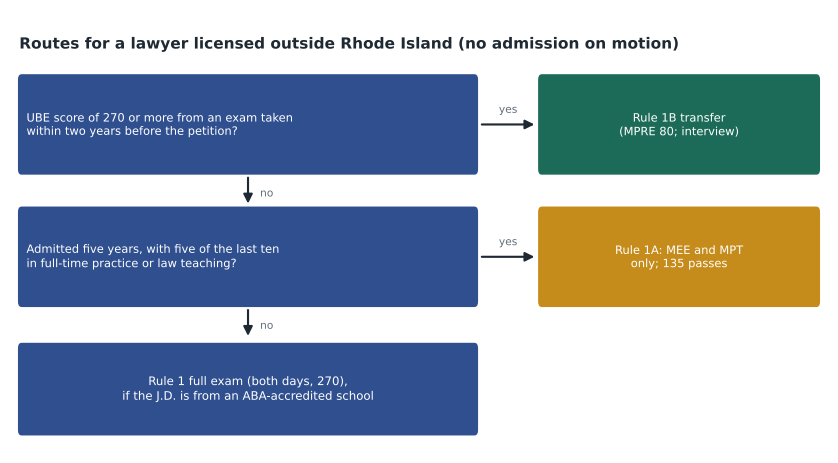
Rhode Island does not admit lawyers on motion and has no reciprocity with any other jurisdiction. NCBE's chart confirms that Rhode Island's rules do not provide for admission on motion. A lawyer licensed elsewhere has two ways in: transfer a recent UBE score under Rule 1B or take the attorneys' examination under Rule 1A. A lawyer who qualifies for neither must take the full exam under Rule 1, subject to its education requirement.
UBE score transfer under Rule 1B
A UBE score of 270 or higher may be transferred to Rhode Island if the exam was taken within two years before the transfer petition is filed. The score must come from a UBE administration; a score from a non-UBE jurisdiction does not qualify, even if that jurisdiction gave the same MBE, MEE and MPT components. NCBE must send the certified score to the Clerk before the petition is filed, and the score is final. Rhode Island does not accept a transferred MBE score by itself, and it does not accept concurrent applications, in which an applicant asks for transfer of a score from an exam whose results are not yet out.
Transfer applicants must meet the other basic requirements of Rule 1: work authorization, age, good character and an ABA-accredited J.D. They must have an MPRE score of 80 earned within five years before the transfer petition is filed. They are subject to the five-failure limit. The Board may require an NCBE character investigation, for an additional fee. And transfer applicants, like everyone else, have a one-on-one interview with a member of the Committee on Character and Fitness, which is scheduled only after the petition is complete.
Transfer petitions are processed on a rolling basis, but admission ceremonies follow the results cycle. The Board's FAQ has described filing by mid-January for a March admission and by mid-June for an August admission, with later petitions moving to the next cycle. Applicants should check the current timing before relying on it.
Kasimir's Massachusetts score of 281 was well above 270, but the July 2025 exam would be more than two years old after July 2027. If he filed in time and completed the interview, the MPRE and the documents, he could be admitted on that score. If he waited too long, his only path would be the attorneys' examination once he had five years of practice, or the full exam.
The attorneys' examination under Rule 1A
Rule 1A is Rhode Island's alternative to admission on motion. It is open to a lawyer who has been admitted for at least five years to the highest court of a state, district or territory, and who has spent at least five of the last ten years immediately before filing in full-time active practice of law, or in full-time teaching at an ABA-accredited law school. Some judicial clerkships and judicial positions can count as practice under the Board's rules. A Rule 1A applicant takes only the first day of the exam, the MPT and the MEE, and does not take the MBE. The passing score on that day is a scaled score of 135.
Rule 1A is also the only route for lawyers who did not graduate from an ABA-accredited law school, including foreign-educated lawyers, as long as they meet the admission and practice requirements. Rule 1A applicants file earlier than Rule 1 applicants: from July 1 to September 1 for the February exam, and from December 1 to February 1 for the July exam. They need certificates of admission from every jurisdiction, an NCBE character investigation and, for each later exam, a supplemental NCBE report. Their handwriting sample is notarized.
Rowena, with eleven years of practice in New Hampshire, met the requirements. She had missed the September 1, 2026 deadline for February 2027, so her first chance would be July 2027, with a petition filed between December 1, 2026 and February 1, 2027. She could not use the MBE at all, but she would need to write six MEE answers and two MPTs well enough to reach 135.
| Route | Who qualifies | What is required | Timing |
|---|---|---|---|
| Rule 1B transfer | Anyone with a UBE score of 270 or more | Score from an exam taken within two years before filing; MPRE 80 within five years; interview | Rolling; admission tied to ceremony cycles |
| Rule 1A attorneys' examination | Admitted five years; five of the last ten in full-time practice or law teaching | MEE and MPT only; scaled score of 135; NCBE investigation; interview | File July 1 to September 1 for February; December 1 to February 1 for July |
| Rule 1 full exam | ABA J.D. graduates | Both days; 270 | File October 1 to December 1 for February; March 1 to May 1 for July |
Temporary and limited admission under Rule 2
Rule 2 allows temporary admission in a few specific situations. Lawyers who have practiced full time for at least a year may be admitted to work for an indigent legal services program for up to two years, ending if they leave the program. Active-duty military lawyers may practice in Rhode Island in service-related matters, and military spouses with at least a year of full-time practice and an ABA J.D. may be admitted for up to three years. Judge advocates in the Rhode Island National Guard may represent the Guard. Full-time law faculty may supervise clinical students representing indigent clients.
Rule 2 also lets a lawyer who has filed a Rule 1A petition practice while waiting for the exam, for up to a year from filing. The conditions are strict: good standing everywhere, supervision by an active Rhode Island lawyer who works full time in the same office, notice through RISCAP and a bar number before starting, practice either in a private firm with at least five Rhode Island lawyers or in the Attorney General's office, and professional liability insurance for private practice. Time practicing under Rule 2 does not count toward the Rule 1A practice requirement, and a lawyer who fails the Rhode Island exam loses temporary admission immediately. A lawyer who has previously failed the Rhode Island exam is not eligible for Rule 2.
Faria & Quinlan had four lawyers, so Rowena could not practice there under the pending Rule 1A provision until the firm grew to five. Moira wrote that down.
Pro hac vice, in-house counsel and law students
Rule 9 governs other limited forms of practice. A lawyer licensed elsewhere may be admitted pro hac vice to appear in a particular Rhode Island case, on a petition sponsored by a member of the Rhode Island bar who also signs all filings. A nonresident lawyer may appear pro hac vice in no more than three cases in any five-year period unless the Court waives the limit. In-house counsel who are members in good standing of another bar may register to work for their employer in Rhode Island, but they may not appear in the state courts, and a lawyer who has failed the Rhode Island exam is not eligible. Senior law students who have completed at least three full-time semesters and have taken or are enrolled in evidence or trial practice may be certified, with the dean's approval, to appear under supervision.
After the oath: registration and the Bar Association
Passing the exam is not the end. A successful applicant must take the oath within one year after results are released, administered by a justice of the Supreme Court, usually at a ceremony in the Supreme Court courtroom one to three weeks after results. Within three months of the oath, the new lawyer must register with the Supreme Court and obtain a bar number. The lawyer's admission date is the date of that first registration, and only then may the lawyer practice. Missing either deadline without good cause closes the petition and voids the scores.
Every year after that, the lawyer must register between April 1 and July 1, paying 200 dollars for active status or 50 dollars for inactive status. Registration includes certifying that the lawyer has read Rule 1.15 on client funds and stating whether the lawyer carries professional liability insurance. Late registration brings a 125-dollar late fee and removal from the Master Roll. Every Rhode Island lawyer must also be a member of the Rhode Island Bar Association, a professional organization separate from the Court.
Bridge the Gap and CLE
Within 90 days of admission, the new lawyer must complete the one-day Rhode Island Bridge the Gap course described in Lesson 6, unless exempt because of at least three years of admission elsewhere. Bridge the Gap carries no CLE credit, and new lawyers are exempt from the regular annual requirement for their first reporting period.
After that, Article IV, Rule 3 requires ten credit hours of continuing legal education in each MCLE reporting year, which runs from July 1 to June 30. At least two of the ten hours must be in legal ethics, and since July 1, 2025 at least one hour must be in diversity, equity and inclusion, as defined in an appendix to the rules. Compliance must be documented by June 30. Hours above ten in one year may be carried forward to the next year only. Several groups are exempt, including inactive and retired lawyers, full-time judges and lawyers 70 or older. A lawyer who does not correct a delinquency within 180 days of notice is removed from the Master Roll.
Federal court
Admission to the Rhode Island bar does not admit a lawyer to the United States District Court for the District of Rhode Island. That court has its own admission process under its local rules, and a new lawyer who expects to handle federal cases should apply soon after state admission.
Worked problem
Advising Moira on her two candidates
Summarize for Moira what Kasimir and Rowena must do and when each could start at Faria & Quinlan.
Show solution
- Kasimir: transfer his July 2025 Massachusetts UBE score of 281 under Rule 1B before July 2027; confirm an MPRE of 80 within five years; complete the petition and interview; admission at the next ceremony after the file is complete.
- Kasimir cannot practice in Rhode Island courts before admission except by pro hac vice in a particular case.
- Rowena: no transfer is available because New Hampshire is not giving her a recent UBE score; she qualifies for Rule 1A and must file between December 1, 2026 and February 1, 2027 for the July 2027 essay day and score 135.
- Rowena cannot practice at the firm under Rule 2 while her petition is pending unless the firm has at least five Rhode Island lawyers.
- After admission, each must register within three months; Kasimir may be exempt from Bridge the Gap only if he has been admitted elsewhere at least three years, which by 2027 he will not; Rowena will be exempt.
Answer: The routes differ sharply, and timing controls both. Kasimir should file promptly; Rowena should plan for July 2027.
Common mistakes
MistakeExperienced lawyers can be admitted to Rhode Island on motion after five years.
InsteadRhode Island has no admission on motion; Rule 1A requires passing the essay day.
MistakeAny UBE score of 270 can be transferred at any time.
InsteadThe exam must have been taken within two years before the transfer petition is filed.
MistakeA score from a state that gives the MBE, MEE and MPT but not the UBE can be transferred.
InsteadOnly scores from UBE administrations qualify.
MistakeCLE carryover can be banked for several years.
InsteadHours above ten carry forward to the next reporting year only.
Limited liability entities
A new lawyer who forms or joins a firm organized as a limited liability entity should also read Article II, Rule 10. It requires professional liability insurance of at least 50,000 dollars per attorney, with a minimum of 100,000 dollars and a maximum required amount of 500,000 dollars, and it sets rules for the entity's name consistent with Rule 7.5 of the Rules of Professional Conduct.
Summary and key terms
- Rhode Island has no admission on motion and no reciprocity.
- Rule 1B accepts UBE scores of 270 or more from exams taken within two years before the petition; MBE-only and non-UBE scores do not qualify.
- Rule 1A lets lawyers admitted five years, with five of the last ten in full-time practice or teaching, take only the MEE and MPT and pass at 135.
- Rule 2 allows limited temporary admission, including practice while a Rule 1A petition is pending in a firm with at least five Rhode Island lawyers; pro hac vice is limited to three cases in five years.
- After the oath: register within three months, then each year from April 1 to July 1; join the Bar Association; complete Bridge the Gap within 90 days; then ten CLE hours a year, including two ethics and one DEI.
- 0
- Rule 1B
- 1
- Rule 1A
- 2
- temporary admission
- 3
- pro hac vice
- 4
- in-house counsel registration
- 5
- annual registration
- 6
- MCLE reporting year
- 7
- carryover
Practice problems
Work each problem on paper first, then reveal the answer to check.
May a lawyer with 15 years of practice in Connecticut be admitted to Rhode Island on motion?
Show answer
No; Rhode Island has no admission on motion. The lawyer may take the Rule 1A attorneys' examination or transfer a qualifying recent UBE score.
What passing score applies to the Rule 1A attorneys' examination?
Show answer
A scaled score of 135 on the MEE and MPT.
How many pro hac vice appearances may a nonresident lawyer make in Rhode Island?
Show answer
No more than three cases in any five-year period, unless the Court waives the limit.
How many CLE hours does a Rhode Island lawyer need each year, and in what subjects?
Show answer
Ten hours, including at least two in legal ethics and one in diversity, equity and inclusion.
Lesson quiz · 5 questions
Score 60% or more to complete this lesson.
Create a free account to save your progress, take quizzes and earn a certificate.