
BAR-238 · Lesson 5 of 12 · 21 min
Exam changes: from the legacy UBE to NextGen in July 2026
▶ Video coming soon A video version of this lesson is on the way.
Hana's supervising partner took the Oregon bar exam in the 1990s, before the Uniform Bar Examination existed, and he still remembered the Oregon essays. When Hana told him she would be sitting a new national exam with no Oregon questions at all, he shook his head. 'In my day you had to know the Oregon rules cold,' he said. Then he thought for a moment. 'Of course, I learned most of what I actually use in my first two years here.' Hollis laughed when Hana told her the story. 'Every generation of lawyers thinks the exam got easier after them,' she said. 'This one did not get easier. It got different.'
This lesson explains how Oregon moved from the legacy Uniform Bar Examination to the NextGen exam, why the change was made, what it means for repeaters and for transferred scores, and how a candidate should adjust her preparation. It also places the change in the wider set of licensing reforms Oregon has made since 2020.
The legacy UBE in Oregon
Oregon adopted the Uniform Bar Examination in the 2010s, joining a national movement toward a common exam whose scores could be transferred between jurisdictions. The legacy UBE had three parts written by NCBE. The Multistate Bar Examination contained 200 multiple-choice questions over a full day and counted for 50 percent of the score. The Multistate Essay Examination had six 30-minute essays and counted for 30 percent. The Multistate Performance Test had two 90-minute tasks and counted for 20 percent. Scores were reported on a 400-point scale, and Oregon's passing score was 270. Oregon added no Oregon-specific test to it.
The legacy exam was widely used and highly portable, but it was criticized for emphasizing memorization of a broad range of rules, testing skills only through the performance test, and bearing little relation to the work new lawyers actually do. Those criticisms led NCBE to begin a long review.
Why NCBE redesigned the exam
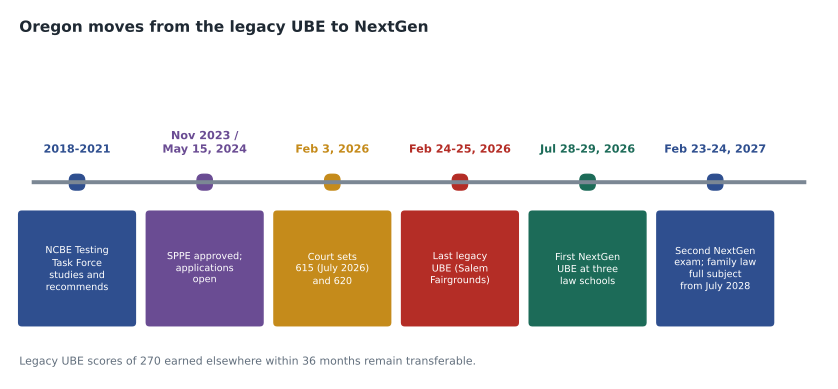
In 2018, NCBE formed a Testing Task Force to study what the bar exam should test. The task force surveyed thousands of lawyers about the work they did in their first years of practice, held listening sessions with judges, educators and regulators, and in 2021 recommended a new exam built around foundational legal skills and a narrower set of foundational concepts and principles. NCBE's board adopted the recommendations, and NCBE spent the following years writing and field-testing questions, building the software and setting the score scale.
The result was designed to test fewer subjects in greater depth, to measure practical skills directly rather than through two performance tests, and to integrate doctrine with skills in the way practice does. NCBE also designed the exam to be taken on a laptop with its own software, which allowed new question formats such as multiple-select questions and integrated sets with short written answers.
Oregon as an early adopter
Oregon decided to be among the first jurisdictions to give the new exam. The Oregon State Bar's examiners and the Supreme Court had already been rethinking licensing for several years, and the NextGen design, with its emphasis on practical skills, fit the direction Oregon had chosen. By mid-2024 it was publicly known that Oregon would give the NextGen exam in July 2026, and ABA Journal coverage of the Supervised Practice Portfolio Examination that June noted that Oregon was overhauling its bar exam on that schedule.
The timeline from there was short. Oregon gave its last legacy UBE on February 24 and 25, 2026 at the Salem Fairgrounds. On February 3, 2026, the Supreme Court set the NextGen passing scores. And on July 28 and 29, 2026, Oregon gave its first NextGen exam at its three law schools. Hana's February 2027 exam is Oregon's second NextGen administration.
| Feature | Legacy UBE (through February 2026) | NextGen UBE (from July 2026) |
|---|---|---|
| Length | Two full days | One and a half days, three three-hour sessions |
| Multiple choice | MBE: 200 questions, 50 percent | About 120 standalone questions, 49 percent |
| Written work | Six MEE essays (30 percent), two MPTs (20 percent) | Integrated sets (21 percent), three performance tasks (30 percent) |
| Subjects | Twelve or more tested subjects | Eight foundational subjects, plus family law and trusts and estates with resources |
| Skills | Mainly through the MPT | Tested directly throughout |
| Score scale | 400 points; Oregon passed at 270 | 500 to 750; Oregon passes at 620 after July 2026 |
| Format | Paper or laptop, by component | Laptop with NCBE software |
Repeaters and the transition
The switch matters most for candidates who failed the legacy exam. Oregon no longer gives the legacy UBE, so a candidate who did not pass in February 2026 or earlier must sit the NextGen exam to try again in Oregon. Her legacy score does not carry over or combine with a NextGen score; the two exams are scored on different scales and measure somewhat different things. A repeater has to prepare for the new format, including the integrated sets and the heavier written component, rather than simply reviewing the MBE subjects again.
Hollis has worked with several such candidates. 'The repeaters who struggle are the ones who keep studying for the exam they failed,' she said. 'The ones who do well start over with the new question types and treat their old preparation as a foundation.'
Transferred legacy scores
The change does not end the value of legacy scores earned elsewhere. Oregon continues to accept a legacy UBE score of at least 270 earned in another jurisdiction within the 36 months before the application. A lawyer who passed the legacy UBE in another state in, say, July 2025 can still use that score to seek admission in Oregon until the score ages out. Because the last legacy administrations were given in 2026 in most jurisdictions that had not already switched, legacy scores will gradually disappear from transfer applications over the next few years.
Oregon also accepts NextGen scores earned in other jurisdictions. NCBE's chart listed Oregon's minimum for a transferred NextGen score as 615 at the time of the first administration, and Oregon's own passing score for later exams is 620. A candidate planning a transfer should confirm the current minimum with the admissions department before applying.
Wider reforms in Oregon
The move to NextGen is one of several licensing changes Oregon has made in a short time. In 2020, during the COVID-19 pandemic, the Oregon Supreme Court granted a one-time diploma privilege that allowed certain recent graduates to be admitted without an exam. That experience, along with long-running concerns about whether the bar exam measured competence to practice, encouraged the examiners to study alternatives.
The most significant result was the Supervised Practice Portfolio Examination. The Supreme Court approved it in late 2023, applications opened on May 15, 2024, and the first lawyers licensed through it were announced in early 2025. Lesson 6 covers it in detail. Oregon also changed its rule for experienced lawyers in July 2022, replacing a reciprocity rule with a comity rule, and has licensed paralegals to provide limited legal services in family law and landlord-tenant matters. Together these changes give Oregon one of the most varied sets of entry points in the country.
Andre found this history useful. 'It explains why the SPPE exists,' he said. 'It is not a loophole. The state decided that the exam is one way to show competence, not the only way.' Hollis agreed. 'And the NextGen exam is the state's way of making the exam itself look more like practice,' she said.
How to adjust your preparation
The change affects how a candidate should study. Commercial bar review courses have rebuilt their materials for NextGen, and a candidate should make sure the materials she uses were written for the new exam rather than adapted lightly from legacy MBE and MEE content. NCBE publishes sample questions, an official study guide and practice materials for each question type, and Hollis insists that every candidate work through them.
Four adjustments matter most. First, spend more time on written work. Performance tasks and the written parts of integrated sets carry a large share of the score, and they reward organization and clear, efficient writing. Second, practice the multiple-select format, which punishes guessing differently from single-answer questions. Third, practice reading documents quickly: integrated sets and performance tasks give candidates contracts, emails, deposition excerpts and statutes, and the skill is in finding what matters. Fourth, practice on the software. Candidates who first see the interface on exam day lose time navigating it.
Hollis built Hana's plan around those adjustments. Two weekday evenings each week would go to multiple-choice practice in the eight foundational subjects. One evening would go to an integrated set, written out fully. Every Saturday morning in January would go to a full performance task under timed conditions, followed by a self-graded comparison with NCBE's sample answer. 'If I had to choose one habit,' Hollis said, 'it would be the Saturday performance task. It is where people find out they cannot finish.'
What has not changed
Some things are the same as they were under the legacy exam. The exam is still given twice a year, in February and July. Scores are still scaled and equated. The exam is still uniform, so a score earned in Oregon can be transferred to other jurisdictions that accept NextGen scores. Character and fitness review, the MPRE and the oath are unchanged. And the exam still tests general principles rather than Oregon law, as the legacy UBE did.
Worked problem
A repeater's plan
Nessa sat the legacy UBE in Oregon in February 2026 and scored 264, below the 270 she needed. She wants to try again in February 2027. Her old outlines are organized around the MBE's seven subjects and the MEE's essay topics. What should she do?
Show solution
- Oregon no longer gives the legacy UBE, so she must sit the NextGen exam.
- Her legacy score cannot be combined with a NextGen score; she starts fresh against Oregon's 620 standard.
- NextGen tests fewer subjects but integrates skills, uses new formats and weights written work at about half the score.
- She should keep her outlines for doctrine in the eight foundational subjects, but rebuild her practice around integrated sets, multiple-select questions and timed performance tasks on NCBE's software.
Answer: She should file for the February 2027 NextGen exam, use her old outlines only as a doctrinal foundation, and spend most of her practice time on the new question types and timed written work.
Common mistakes
MistakeA failed legacy score counts toward a NextGen retake.
InsteadThe two exams use different scales; a repeater starts fresh against 620.
MistakeOregon will stop accepting legacy scores immediately.
InsteadIt accepts legacy scores of 270 earned within the last 36 months.
MistakeNextGen still makes multiple choice half the score.
InsteadStandalone multiple choice is 49 percent, but written and document work is about half.
MistakeThe SPPE was a pandemic emergency measure.
InsteadThe 2020 diploma privilege was the emergency measure; the SPPE is a permanent program approved in 2023.
MistakeLegacy MBE materials are enough for NextGen.
InsteadCandidates need practice with integrated sets, multiple-select questions and performance tasks.
Practice problems
Work each problem on paper first, then reveal the answer to check.
When did Oregon give its last legacy UBE?
Show answer
February 24 and 25, 2026, at the Salem Fairgrounds.
What was Oregon's legacy UBE passing score?
Show answer
270.
When did NCBE's Testing Task Force recommend the new exam?
Show answer
In 2021.
Which earlier pandemic measure did Oregon adopt in 2020?
Show answer
A one-time diploma privilege for certain recent graduates.
When did Oregon replace its reciprocity rule with a comity rule?
Show answer
In July 2022.
A short history of Oregon's own exam
Before Oregon adopted the UBE, it gave its own bar exam, combining the MBE with essays written by Oregon examiners on Oregon law. Hana's supervising partner remembered studying Oregon civil procedure and Oregon domestic relations law for those essays. The move to the UBE gave up those Oregon questions in exchange for portability: an Oregon score could be used to seek admission in Washington, Idaho and many other jurisdictions. The move to NextGen keeps that portability while changing what the exam measures. In both changes, Oregon accepted that a new lawyer would learn Oregon law mainly after admission, through practice, mentoring and continuing legal education.
What NextGen means for law schools
The new exam also changed how Oregon's law schools prepare students. Because NextGen tests skills directly, schools have put more weight on writing, counseling, negotiation and practice-based courses, and several have expanded bar preparation programs. The University of Oregon, for example, publicized new investments in bar preparation and licensure support in this period. Andre's school offered free bar support to its graduates, which he planned to use whether he sat the exam or pursued the SPPE.
A checklist for the transition
Hollis gave Hana a short checklist for the new exam. Confirm that every study resource was written for NextGen. Complete NCBE's sample questions for each question type. Practice on NCBE's software, including the tutorial, well before exam day. Learn the eight foundational subjects to the depth the content outline describes, not to the breadth the old MBE required. Read basic family law and trusts and estates concepts so that the provided resources make sense quickly. And schedule at least two full simulated sessions before February.
Watching for further change
The transition is not finished. NCBE has announced that family law will become a fully tested subject from July 2028, and the treatment of trusts and estates after February 2028 may change as well. Oregon's own jurisdiction-specific requirement for NextGen applicants is listed by NCBE as to be announced. And the Supreme Court can adjust passing scores, as it did for the first administration. Hollis told both candidates to check the bar's admissions page and NCBE's Oregon page at three points: when filing, a month before the exam, and after results, before taking the oath. 'Most of the time nothing will have changed,' she said, 'but you only need to miss one change once.'
Summary and key terms
- The legacy UBE (MBE 50, MEE 30, MPT 20 percent, 400-point scale) passed at 270 in Oregon.
- NCBE's Testing Task Force (2018 to 2021) led to the NextGen design.
- Oregon's last legacy UBE was February 2026 and its first NextGen exam July 2026.
- Repeaters sit NextGen and start fresh; legacy scores do not combine with NextGen scores.
- Oregon accepts legacy transfers of 270 within 36 months and NextGen transfers at its current minimum.
- Preparation must shift toward written work, multiple-select questions, document reading and the software.
- legacy UBE
- The Uniform Bar Examination given before NextGen, combining the MBE, MEE and MPT.
- Testing Task Force
- NCBE's 2018 to 2021 study group that recommended the NextGen design.
- diploma privilege
- Admission without a bar exam based on graduation from a law school; Oregon used a one-time version in 2020.
- comity
- Oregon's rule, since July 2022, for admitting experienced lawyers from other jurisdictions based on their own practice.
- repeater
- A candidate retaking the bar exam after not passing.
Lesson quiz · 5 questions
Score 60% or more to complete this lesson.
Create a free account to save your progress, take quizzes and earn a certificate.