
BAR-238 · Lesson 3 of 12 · 22 min
Character and fitness and the MPRE
▶ Video coming soon A video version of this lesson is on the way.
Hana had two things to disclose on her character and fitness questionnaire. The first was a speeding ticket from a summer drive to Boise, paid in full. The second was a semester of academic probation in her first year of college, when she had worked nights at a grain elevator during harvest and stopped going to an early statistics class. She asked Hollis whether the second one even counted. Hollis read the question aloud to her, slowly, and Hana answered it herself: it asked about any academic discipline or probation, and probation was probation. 'You were nineteen and working nights,' Hollis said. 'Say so, attach the records and show what you did next. What hurts applicants is never the probation. It is leaving it out.'
This lesson covers the character and fitness requirement in Oregon, how the investigation works, what kinds of history draw attention, how rehabilitation is shown, what happens when an application raises concerns, and the Multistate Professional Responsibility Examination, on which Oregon requires a scaled score of 85.
The requirement
Oregon's statute on admission, ORS 9.220, requires every applicant to show that she is a person of good moral character and fit to practice law. The Oregon State Bar's admissions pages emphasize that the requirement applies to every route into the profession: the bar exam, the Supervised Practice Portfolio Examination, score transfer, comity, house counsel and the other limited admissions. An applicant who scores well above the passing score is not admitted if she cannot satisfy this requirement.
The requirement looks forward. The question is not whether the applicant has ever made a mistake but whether her record, taken as a whole, gives reason to trust her with clients' money, secrets and cases, with obligations to courts and with the duties of honesty owed to opposing parties and the public. Past conduct matters because it is the best evidence of future conduct, and candor during the process is itself some of the strongest evidence of all.
The burden is on the applicant. She must provide complete and accurate information and, if her history raises questions, she must show that she has the character and fitness the statute requires. That burden is why the questionnaire is so detailed and why the admissions staff can ask for more.
How the investigation works
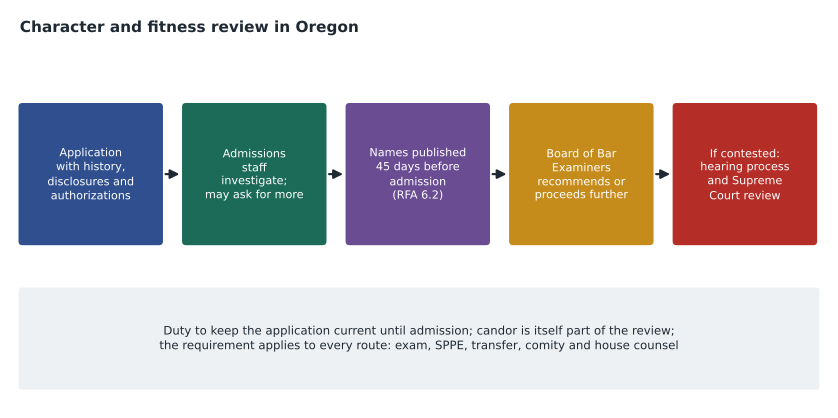
The investigation begins when the application is filed. The questionnaire asks about residences, education, employment, military service, civil litigation, criminal matters including charges that were dismissed or expunged, traffic violations above minor parking matters, financial history including defaults and bankruptcies, professional licensing, academic discipline, and conduct in other bar applications. The applicant signs authorizations that allow the admissions department to request records directly from schools, employers, courts, agencies and others.
Admissions staff review the file, verify the information and follow up on anything incomplete or concerning. They may ask for explanations, court records, letters from employers or treating professionals, or an interview. The process takes months for most applicants and longer when there are issues to explore, which is one reason the filing deadlines fall so long before the exam.
Oregon does not use NCBE's character and fitness service; the investigation is done in Tigard by the bar's own staff under the Rules for Admission. Oregon adds a public step that many states do not have. Under RFA 6.2, the names of applicants are published at least 45 days before admission, and licensed Oregon lawyers may send the admissions department information that bears on an applicant's moral character. The bar's admissions page posts these lists with expiration dates, and for the July 2026 exam the lists showed dates in September 2026.
What draws attention
Certain kinds of history appear again and again in character and fitness matters across the country, and Oregon is no different. The most serious is dishonesty: fraud, forgery, theft, academic cheating or plagiarism, false statements to employers or agencies, and, above all, lack of candor in the bar application itself. Next come criminal conduct, especially conduct involving violence, drugs or dishonesty; financial irresponsibility such as unpaid judgments, defaulted loans or unpaid child support; neglect of professional obligations; and conduct suggesting that the applicant does not respect court orders or the law.
Most applicants have nothing of the kind. Many have something small: a speeding ticket, a minor-in-possession citation from college, a dismissed charge, a short period of unpaid debt. Small matters disclosed completely almost never prevent admission. The trouble comes when an applicant hides them, minimizes them or gives an account that the records contradict. Admissions staff see thousands of applications, and an omission that seemed harmless to the applicant often looks to them like a decision to conceal.
| Kind of history | Why it matters | What helps |
|---|---|---|
| Lack of candor in the application | Goes directly to honesty with the Board and the Court | Full disclosure from the start; correcting any omission promptly |
| Academic dishonesty | Suggests willingness to deceive for advantage | Records, the school's findings, a clear account and later conduct |
| Criminal matters | Bears on respect for law; some offenses go to honesty | Court records, completion of sentence, time and conduct since |
| Financial problems | Clients' money will be in the lawyer's trust account | A payment plan, explanations, evidence of responsibility |
| Minor traffic matters | Usually little, if disclosed | Disclose as asked; attach proof of payment |
Mental health and substance use
Applicants often worry about questions concerning mental health or substance use. Across the country, bar examiners have moved away from broad questions about diagnosis and treatment and toward questions about conduct and current ability to meet a lawyer's obligations, partly in response to concerns that broad questions discouraged people from seeking help. An applicant should read Oregon's questionnaire exactly as written, answer what it asks, and no more. Seeking counseling or treatment is not misconduct, and many lawyers who have sought help practice successfully. Where conduct connected to a condition is part of the record, evidence of treatment and stability is the kind of rehabilitation evidence the process values.
Rehabilitation
When an applicant has significant past misconduct, the question becomes rehabilitation. Bar examiners generally look at how long ago the conduct occurred, how old the applicant was, how serious it was, whether it was isolated or part of a pattern, whether the applicant has accepted responsibility, whether restitution was made, and what the applicant's conduct has been since. Positive evidence matters: steady employment, community service, letters from people who know the history, and a record of honesty in the application itself.
Hana's college probation fit easily within that framework. It was long ago, it involved no dishonesty, she explained why it happened, and her later record, including law school and a year of responsible work, showed what came next. Hollis suggested she add one more line to her explanation: what she would tell a client who asked about it. 'If you can say it plainly to a client,' Hollis said, 'you can say it plainly to the Board.'
When there is a concern
Most applications are approved without any hearing. When admissions staff and the Board of Bar Examiners have concerns that further information does not resolve, the Rules for Admission provide a process that can include an interview, a request for more evidence and, if the Board is inclined to recommend against admission, notice to the applicant and an opportunity for a hearing. The Supreme Court makes the final decision, and an applicant who disagrees with the Board's recommendation can seek review there. An applicant facing that process should consider consulting a lawyer experienced in admissions matters.
The duty to update
The application is a continuing statement. Until the day she is admitted, an applicant must update it when anything material changes: a new address, a new job, a new citation, a new lawsuit, a new financial problem. Hana moved from a shared house in Pendleton to an apartment of her own in mid-November 2026, a week after filing, and she reported the new address the same day. 'An application that was true in November can become untrue in January,' Hollis said, 'and the fix is a two-minute email.'
The MPRE
Every applicant for admission by examination in Oregon must also pass the Multistate Professional Responsibility Examination with a scaled score of at least 85. The MPRE is written and administered by NCBE. It is a two-hour, computer-based exam with 60 multiple-choice questions, 50 of them scored and 10 being pretested, given at Pearson VUE test centers and, in some cases, by remote proctoring. It is offered three times a year, usually in March, August and November. Scaled scores run from 50 to 150, and each jurisdiction sets its own passing score. Oregon's 85 is in the middle of the national range; some states require 75 or 80, and a few require 86.
The MPRE tests the ABA Model Rules of Professional Conduct and the ABA Model Code of Judicial Conduct, along with generally accepted principles from leading cases and the Restatement of the Law Governing Lawyers. It does not test Oregon's own rules. Lesson 10 explains several places where the Oregon Rules of Professional Conduct differ from the Model Rules, and a candidate should keep the two straight: on the MPRE, the Model Rules control; in Oregon practice, the Oregon rules do.
Timing matters. Bar review materials summarizing Oregon's rule report that the MPRE score must be earned within 36 months before the application is filed or while the application is pending. A candidate should confirm the current time limit on the bar's admissions pages before relying on an old score. Hana took the MPRE in August 2025 and scored 89, comfortably above 85 and well within the window.
The MPRE and the SPPE
Applicants pursuing the Supervised Practice Portfolio Examination also need to satisfy a professional responsibility requirement, but they have a choice. The bar's SPPE pages provide that a portfolio applicant may either submit a passing MPRE score or complete a journaling alternative, a structured written reflection on professional responsibility issues encountered during the supervised practice. Andre noticed the difference immediately. 'So if I go the SPPE route,' he said, 'I might never sit for the MPRE at all.' Hollis said that was possible, but she suggested he take it anyway in March 2027. 'If you ever want to be admitted somewhere else,' she said, 'every other state will ask for a score.'
Studying for the MPRE
Most candidates prepare for the MPRE in two to four weeks of part-time study. The most efficient approach is to learn the main rules on conflicts of interest, confidentiality, the client-lawyer relationship, fees, duties to the court and to third parties, advertising and solicitation, and the regulation of the profession, then to work through many practice questions under time pressure. NCBE sells official practice exams. Candidates who know the subject from law school often find that the hardest part is reading each question carefully enough to notice which rule it is really about.
Worked problem
A late disclosure
Suppose that later this winter, while her application is pending, Hana remembers a small-claims judgment entered against her in 2021 over a disputed security deposit, which she paid within two months. Her questionnaire did not mention it. What should she do?
Show solution
- The questionnaire asks about civil litigation and judgments, so the matter should have been disclosed.
- The application is a continuing statement that must be kept accurate and complete until admission.
- Correcting an omission promptly and on the applicant's own initiative is evidence of candor; leaving it for the investigators to find is evidence of the opposite.
- She should file an amendment with the court records and proof of payment and a short explanation of why it was left out.
Answer: She should promptly amend her application, disclose the judgment with the court records and proof of payment, and explain the omission candidly.
Common mistakes
MistakeA dismissed or expunged charge need not be disclosed.
InsteadRead the question: Oregon's questionnaire, like most, asks about charges regardless of outcome.
MistakeCharacter and fitness applies only to bar exam applicants.
InsteadIt applies to every route, including the SPPE, comity and house counsel.
MistakeThe MPRE tests the Oregon Rules of Professional Conduct.
InsteadIt tests the ABA Model Rules and related sources; Oregon practice follows the Oregon rules.
MistakeOregon accepts an MPRE score of 80.
InsteadOregon requires a scaled score of at least 85.
MistakeOnce filed, the application does not need to be changed.
InsteadIt must be updated until admission whenever anything material changes.
Practice problems
Work each problem on paper first, then reveal the answer to check.
Which statute requires good moral character for Oregon admission?
Show answer
ORS 9.220.
What does RFA 6.2 provide?
Show answer
Publication of applicant names at least 45 days before admission, so that licensees can send relevant information.
What MPRE scaled score does Oregon require?
Show answer
85.
How many MPRE questions are scored?
Show answer
50 of 60; 10 are pretest questions.
What alternative to the MPRE does the SPPE allow?
Show answer
A journaling alternative on professional responsibility.
Writing a good explanation
Hollis keeps a short list of rules for disclosure explanations, and she went through it with both candidates. Answer the question asked, completely. State the facts in order: what happened, when, what the result was. Attach the records that prove it, such as the court disposition, the school's letter or proof of payment. Accept responsibility without excuses or minimizing words like 'just' or 'only'. Explain briefly what changed afterward. Keep the tone plain; this is not a personal statement. And make sure the explanation matches the records exactly, because inconsistencies between an applicant's account and the documents are what turn small matters into large ones.
Hana's final explanation of her college probation ran to five sentences. It gave the semester, the cause, the school's decision, her grades the following year and a line about how she manages a heavy workload now. Hollis read it and said it was exactly right. 'The admissions staff should be able to read it once and move on,' she said.
Social media and online history
Applicants sometimes ask whether character and fitness staff look at social media. The questionnaire governs what an applicant must disclose, but conduct that is publicly visible can come to the bar's attention in other ways, including through the RFA 6.2 publication process, in which lawyers may send information about an applicant. The practical advice is the same as for any future lawyer: assume that what is public will be seen, and avoid posting anything that a client, a judge or an opposing party would read as dishonest, threatening or contemptuous of the law.
When the MPRE and the exam fall close together
Some candidates leave the MPRE until after the bar exam. Oregon's rule permits a score earned while the application is pending, so that is possible, but it adds risk: a candidate who passes the bar exam and then fails the MPRE cannot be admitted until she passes it at a later administration, which may mean months of delay. Andre planned to take the MPRE in March 2027, before his final semester ended, so that the score would be in hand well before the July exam whether he sat for it or not.
Summary and key terms
- ORS 9.220 requires good moral character and fitness for every route to admission.
- The applicant bears the burden; candor in the application is itself key evidence.
- Oregon investigates in-house, and RFA 6.2 publishes names at least 45 days before admission.
- Rehabilitation turns on time, seriousness, responsibility, restitution and later conduct.
- The application must be updated until admission.
- The MPRE requires a scaled 85 in Oregon; SPPE applicants may use a journaling alternative.
- good moral character
- The quality of honesty and trustworthiness an applicant must show under ORS 9.220.
- rehabilitation
- Evidence that an applicant has overcome past misconduct, such as time, responsibility and good conduct since.
- candor
- Full and honest disclosure in the application and throughout the process.
- MPRE
- The Multistate Professional Responsibility Examination, NCBE's ethics exam.
- scaled score
- A score adjusted so that results are comparable across administrations.
Lesson quiz · 5 questions
Score 60% or more to complete this lesson.
Create a free account to save your progress, take quizzes and earn a certificate.