
BAR-238 · Lesson 2 of 12 · 21 min
Eligibility, education, application deadlines and fees
▶ Video coming soon A video version of this lesson is on the way.
Hana filed her application on November 9, 2026, six days before the timely filing deadline for the February exam. She had meant to file in October. 'Every week I said next week,' she told Hollis. 'Then a partner handed me a water right transfer and I lost ten days.' Hollis was not worried about Hana, who had made it, but she wanted the lesson recorded for Andre, who would face the April deadline for July 2027 in the middle of his last semester. 'The calendar is the easiest part of this process to control,' she said, 'and the part people most often get wrong.'
This lesson covers who may apply to take the Oregon bar exam, the education requirement, the filing calendar for February and July, what a complete application includes, fees and withdrawals, testing accommodations and the practical choice between a February and a July exam.
Who is eligible
Oregon's statute on admission requires that an applicant be at least 18 years old, be of good moral character and fit to practice, and meet the educational and examination requirements set by the Supreme Court. The Rules for Admission spell out those requirements, and the first of them is education.
The standard route is a Juris Doctor or Bachelor of Laws degree from a law school accredited by the American Bar Association. Hana and Andre both qualify that way. The Oregon State Bar's admissions pages also describe RFA 3.1(3), which allows an applicant with a law degree from a foreign law school to qualify if the school is evaluated, by one of the third-party credential evaluators the bar lists, as equivalent to an ABA-accredited school. The bar's page lists seven approved evaluators. A foreign-educated applicant should order the evaluation early, because it takes time and the application is not complete without it.
NCBE's jurisdiction chart reports that Oregon does not require an ABA-approved degree in every case, and that foreign law graduates may be eligible. That is accurate in the sense that RFA 3.1 provides alternatives, but those alternatives are narrow and depend on the applicant's particular education and licensing history. An applicant who did not graduate from an ABA-accredited school should read RFA 3.1 carefully and, if the answer is unclear, ask the admissions department in writing before filing.
A student in her last year of law school may apply before graduating. The law school must later certify that the degree has been conferred, and the applicant cannot be admitted until it has. Oregon's three law schools coordinate graduation certification with the bar, and Andre's school had already explained the process to its 3L class.
The filing calendar
Oregon has a timely filing deadline and a later deadline for late filing, each tied to a particular exam. According to NCBE's chart for Oregon, the timely deadline for a February exam is November 15 and the late deadline is December 15. For a July exam, the timely deadline is April 15 and the late deadline is May 15. A late application carries an additional fee and leaves less time for the character and fitness investigation and for accommodations.
Dates can shift. For the February 2026 exam, the bar's admissions page recorded that the timely filing deadline closed on November 17, 2025, a Monday, because November 15 fell on a weekend, and that the late filing deadline was extended to January 5, 2026. Candidates should treat the NCBE dates as the starting point and confirm the actual deadline on the bar's admissions page for their exam.
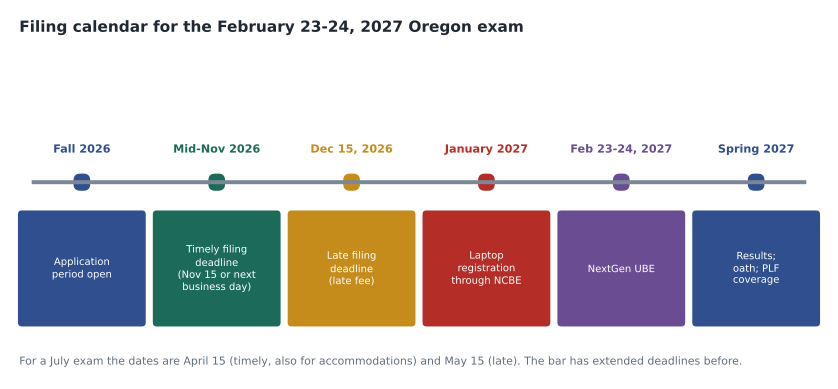
For the July exam, the April 15 timely deadline is also the deadline for requesting testing accommodations, as the bar's page for the July 2026 exam reminded applicants. Requests filed after that date are still considered, but the page warned that late requests may not be accommodated. A student who will need accommodations should start gathering documentation early in the spring semester.
| Exam | Timely filing deadline | Late filing deadline | Notes |
|---|---|---|---|
| February | November 15 (next business day if a weekend) | December 15 | February 2026: timely deadline closed November 17, 2025; late deadline extended to January 5, 2026 |
| July | April 15 | May 15 | April 15 is also the timely date for accommodation requests |
What a complete application includes
Applications are filed online through the Oregon State Bar's admissions system. A complete application has several parts: the application form itself, with full residence, education and employment histories; the character and fitness questionnaire, with explanations and records for any disclosures; authorizations that allow the admissions staff to request records from schools, employers and agencies; the fee; and, for applicants whose eligibility depends on it, proof such as a credential evaluation or a certificate of good standing from another jurisdiction.
The law school's certification of graduation comes later, after commencement, and the MPRE score is reported by NCBE when the applicant has one. Neither needs to be in hand when the application is filed, but both must be on file before admission.
Hollis gave Hana and Andre the same practical rule she gives every candidate: order every outside record the week the application is opened. Transcripts, court records for any citation or charge, even one dismissed or expunged, records from prior states of residence and employment verifications can each take weeks. None of them can be rushed in the last days before a deadline. Hana had ordered her records in October, which is why a November 9 filing was still comfortable for her.
Fees, transfers and withdrawals
Oregon charges an application fee for each route to admission, along with a late fee for late filing. The fee schedule is set under the Rules for Admission, and RFA 4.2 makes application fees non-refundable. The admissions pages consulted for this course did not list current dollar amounts for the exam application, so a candidate should check the current fee schedule before filing. The pages did list two figures for alternative routes: the comity application fee is 1,750 dollars, and the initial fee for the Supervised Practice Portfolio Examination is 1,000 dollars.
Because fees are non-refundable, Oregon offers transfer credit instead of refunds when an applicant withdraws. For the July 2026 exam, the bar's page explained the schedule: an applicant who withdrew by April 15, 2026 received credit for 100 percent of the fee toward a future application, by May 15 for 75 percent, and by June 30 for 50 percent. The credit applies to a future application, not automatically to the next exam, and the schedule for each exam is posted with that exam's information.
Two other costs arrive separately. NCBE charges its own fees for the MPRE and for any score transfer. Laptop registration for the exam software also runs through NCBE, which emails applicants the registration dates and fee; the bar's admissions page noted that the laptop registration period for July 2026 was open after applications closed. Candidates should budget for all of these, along with a commercial review course if they use one, and for travel and lodging near the testing site.
Where the exam is given
The location depends on the administration. The bar's page for February 2026 listed the Salem Fairgrounds as the site. For the July 2026 NextGen exam, the bar announced testing on July 28 and 29, 2026 at Oregon's three law schools, with each school's graduates testing at their own school, out-of-state applicants assigned by available space, and applicants with accommodations testing at the Oregon State Bar Center in Tigard. The site for February 2027 is announced to applicants by the admissions department, and Hana was told to watch her email in January.
Accommodations
Applicants with disabilities may request testing accommodations, such as extra time, a separate room, breaks or assistive technology. A request requires an exam application and supporting documentation. For the July 2026 exam, the timely deadline for accommodation requests was the same as the timely filing deadline, April 15, and the bar noted that pending requests had become past due after that date. Applicants who need accommodations should file early and expect follow-up questions.
February or July
Most new graduates sit in July, right after law school ends. Oregon's July calendar is built for them: the timely deadline of April 15 falls in the last semester, and the law school certifies the degree after commencement. Candidates who graduate in December, who need more time, who work full time, or who did not pass in July sit in February, with a timely deadline in mid-November.
Neither exam is easier. NCBE equates scores across administrations, so a 620 means the same thing in February as in July. February groups usually include more repeat takers, which tends to make February pass rates lower in many jurisdictions, but that reflects who takes the exam, not its difficulty. The choice should turn on readiness, work and family obligations and how much uninterrupted study time a candidate can protect.
Hana chose February because she was working. Her firm agreed to reduce her hours from early January and to give her the two weeks before the exam off entirely. Andre will sit in July 2027, and he has a second decision to make before the April deadline: whether to file for the exam at all, or to look for a qualifying employer and pursue the Supervised Practice Portfolio Examination instead. Hollis suggested he file for the exam on time regardless. 'If an SPPE job comes through, you can withdraw and get credit,' she said. 'If it does not, you have not lost the July exam.'
A filing checklist
Hollis gave both candidates the same checklist. Create an NCBE account and note the number. Register for the MPRE if it is not done. Open the Oregon application early and order all outside records that week. Disclose everything the character and fitness questions ask, with records, even when it seems trivial. File before the timely deadline and keep the confirmation. Request accommodations with the application if they are needed. Watch for laptop registration. Budget for every fee. Keep the application current with any change of address, job or legal matter until admission.
Worked problem
Filing and withdrawing
Andre files a timely application for the July 2027 exam in early April 2027. In mid-May he receives a job offer from a Portland nonprofit whose director is willing to serve as his SPPE supervisor, and he decides to withdraw from the exam. Assume the July 2027 withdrawal schedule matches the one the bar posted for July 2026. What happens to his fee?
Show solution
- Oregon application fees are non-refundable under RFA 4.2.
- Instead of refunds, the bar gives transfer credit toward a future application on a posted schedule.
- On the July 2026 schedule, a withdrawal requested by May 15 earned credit for 75 percent of the fee.
- The credit applies to a future application, so he should ask whether it can be applied to an SPPE application.
Answer: He receives no refund but, if he withdraws by the posted May date, credit for 75 percent of the fee toward a future application; he should confirm with the admissions department how that credit can be used.
Common mistakes
MistakeOregon refunds the fee if you withdraw early.
InsteadFees are non-refundable under RFA 4.2; withdrawal earns transfer credit on a posted schedule.
MistakeThe February deadline is always exactly November 15.
InsteadIt moves to the next business day when November 15 falls on a weekend, and the bar has extended deadlines before.
MistakeAccommodation requests can be filed any time before the exam.
InsteadThe timely date is the filing deadline; later requests are considered but may not be granted.
MistakeOnly ABA graduates can ever sit in Oregon.
InsteadRFA 3.1 includes narrow alternatives, such as foreign degrees evaluated as ABA-equivalent.
MistakeA July exam is easier because more first-time takers sit.
InsteadScores are equated; pass rates differ because of who takes each exam.
Practice problems
Work each problem on paper first, then reveal the answer to check.
What are the timely and late filing deadlines for a February exam in Oregon?
Show answer
November 15 (moved for weekends) and December 15.
What are they for a July exam?
Show answer
April 15 and May 15.
Which rule makes Oregon application fees non-refundable?
Show answer
RFA 4.2.
Where did applicants test for the July 2026 NextGen exam?
Show answer
At Oregon's three law schools, with accommodated applicants at the OSB Center in Tigard.
What is the comity application fee?
Show answer
1,750 dollars.
Three applicants, three timelines
Hollis likes to test the calendar with examples. Consider three applicants for the February 2027 exam. The first files on November 9, 2026, with every record ordered weeks earlier, as Hana did. She pays the standard fee, her character and fitness investigation begins in November, and she has three months to answer any follow-up questions before the exam. The second files on December 10, 2026, within the late window. She pays the late fee and has the same exam date, but her investigation starts a month later, and any delay in her records now collides with the holidays. The third decides on December 20 that she wants to sit in February. The late deadline has passed, and unless the bar has announced an extension, as it did for February 2026, she must wait for July.
The same logic applies in reverse for Andre. His timely deadline for July 2027 is April 15, in the middle of his last semester, and the late deadline is May 15, during finals. A law student who plans to file 'after exams' has already missed the timely date. Hollis told Andre to open his application during spring break and to file before the end of March.
Keeping copies
The admissions system keeps the application, but an applicant should keep her own complete copy: every form as filed, every attachment, every confirmation email and every later amendment. Character and fitness questions sometimes arise months later, and an applicant who can see exactly what she said, and when, can answer them accurately. The same copy becomes useful again if she later applies for admission in another state, because many applications ask the same questions and compare the answers.
Working while studying
Many February candidates work, as Hana does. The filing calendar is only part of planning for that. A working candidate should agree with her employer, in writing if possible, on reduced hours in the final six to eight weeks and on time off immediately before the exam. She should also plan for the days after the exam, which are often more tiring than expected. Hana's firm agreed to a schedule that cut her to three days a week from January 4, 2027 and gave her the two weeks before the exam off entirely, and she put the agreement in an email to the partners so that no one would be surprised in February.
Summary and key terms
- Applicants need an ABA-accredited JD or LLB, or a narrow alternative under RFA 3.1, plus good moral character.
- Deadlines: February exam November 15 and December 15; July exam April 15 and May 15, with weekend adjustments.
- Applications are filed online with full histories, disclosures, authorizations and the fee.
- Fees are non-refundable; withdrawals earn transfer credit on a posted schedule.
- Accommodation requests are timely with the application; laptop registration and MPRE fees run through NCBE.
- February and July exams are equated; choose by readiness and study time.
- timely filing deadline
- The last date to file an application without a late fee.
- late filing deadline
- The final date to file, with an added fee.
- transfer credit
- Credit for part of a non-refundable fee toward a future application after a withdrawal.
- credential evaluator
- A third-party service that evaluates a foreign law degree for equivalence to an ABA-accredited degree.
- testing accommodations
- Changes to exam conditions for applicants with disabilities, such as extra time or a separate room.
Lesson quiz · 5 questions
Score 60% or more to complete this lesson.
Create a free account to save your progress, take quizzes and earn a certificate.