
BAR-238 · Lesson 10 of 12 · 22 min
The Oregon Rules of Professional Conduct, the Professional Liability Fund and lawyer discipline
▶ Video coming soon A video version of this lesson is on the way.
Hana's firm uses a written fee agreement for divorce clients that includes a flat fee for an uncontested case. When a new client paid in December, the office manager deposited the check in the firm's operating account rather than the trust account. Hana noticed it and asked the partner, a little nervously, whether that was allowed. He showed her the agreement: it said, in bold type, that the fee was earned on receipt, that it would not be placed in trust, that the client could fire the firm at any time and that the client might be entitled to a refund if the work was not completed. 'That paragraph is why it is allowed,' he said. 'Without it, that money belongs in trust.' Hollis made the paragraph the center of this lesson.
This lesson covers the Oregon Rules of Professional Conduct and several places where they differ from the ABA Model Rules tested on the MPRE, the rules on fees and trust accounts, Oregon's Professional Liability Fund and the Oregon Attorney Assistance Program, and the lawyer discipline system.
The Oregon Rules of Professional Conduct
The Oregon Supreme Court adopted the Oregon Rules of Professional Conduct effective January 1, 2005. They replaced the Oregon Code of Professional Responsibility, which had followed the older ABA Model Code. The Oregon rules follow the numbering and much of the text of the ABA Model Rules, but they differ in several respects, and Oregon did not adopt the Model Rules' comments as part of its rules. Oregon lawyers rely instead on the text of the rules, on Oregon disciplinary decisions, and on formal ethics opinions issued by the Oregon State Bar. The bar's ethics opinions and its publication The Ethical Oregon Lawyer are the first places a new lawyer should look with a question.
Because the MPRE tests the Model Rules, a candidate must keep two sets of rules in mind. Hollis put it simply: 'On the MPRE, answer under the Model Rules. On Monday morning, check the Oregon rule.'
Confidentiality
Oregon's confidentiality rule, RPC 1.6, protects information relating to the representation of a client, but Oregon defines that phrase in RPC 1.0 differently from the Model Rules. In Oregon, information relating to the representation of a client means both information protected by the attorney-client privilege and other information gained in the professional relationship that the client has requested be held inviolate or the disclosure of which would be embarrassing or would likely be detrimental to the client. That definition carries forward the older Oregon Code's protection of client confidences and secrets. In practice, it covers most of what a lawyer learns in a representation, as the Model Rule does, but a lawyer should use the Oregon definition when deciding whether information is protected. The exceptions in Oregon's RPC 1.6(b), which permit disclosure in listed circumstances, also differ in some respects from the Model Rule, and should be read in full before a lawyer relies on one.
Covert activity
Oregon's most famous variation is in RPC 8.4. Like the Model Rule, Oregon's RPC 8.4(a)(3) makes it misconduct to engage in conduct involving dishonesty, fraud, deceit or misrepresentation that reflects adversely on the lawyer's fitness to practice. But Oregon's RPC 8.4(b) adds an exception: it is not professional misconduct for a lawyer to advise clients or others about, or to supervise, lawful covert activity in the investigation of violations of civil or criminal law or constitutional rights, provided the lawyer's conduct is otherwise in compliance with the rules. The rule defines covert activity and allows it only where the lawyer in good faith believes there is a reasonable possibility that unlawful activity has taken place or will take place in the foreseeable future.
The exception has a history. In In re Gatti, 330 Or 517 (2000), the Oregon Supreme Court disciplined a lawyer who had posed as a chiropractor and as a doctor to gather information about an insurer's practices, and the Court declined to recognize an exception for lawyers involved in investigations. Government lawyers and others who supervise undercover work were concerned, and the rule was amended to permit supervision of lawful covert activity in limited circumstances. The current RPC 8.4(b) reflects that change. It does not permit a lawyer to lie personally in other settings, and a lawyer relying on it should read the rule's limits carefully.
Fees
Oregon's fee rule, RPC 1.5, prohibits clearly excessive fees, as the Model Rule prohibits unreasonable ones, and it lists prohibited arrangements, such as a fee in a domestic relations matter contingent on obtaining a divorce or on the amount of support or property, and a contingent fee for representing a defendant in a criminal case. Oregon adds a specific rule for fees that are earned on receipt or nonrefundable. Under RPC 1.5(c)(3), a lawyer may not collect such a fee unless it is agreed to in a writing signed by the client that explains the intent of the parties as to the nature and amount of the fee and explains that the funds will not be deposited into the lawyer's trust account, and that the client may discharge the lawyer at any time and in that event may be entitled to a refund of all or part of the fee if the services for which it was paid are not completed.
That is the paragraph in the partner's agreement. Without such a writing, an advance payment is the client's money until it is earned, and it belongs in the lawyer's trust account. The rule also makes clear that even a fee labeled nonrefundable may have to be refunded in part if the lawyer does not complete the work, because the label does not override the prohibition on excessive fees.
| Situation | Where the money goes | Why |
|---|---|---|
| Advance fee with no earned-on-receipt writing | Trust account | Client funds until earned |
| Flat fee with a signed RPC 1.5(c)(3) writing | Operating account | Earned on receipt by written agreement |
| Advance for costs, such as filing fees | Trust account | Client funds held for a purpose |
| Settlement proceeds | Trust account, then prompt distribution | Funds in which client and others have interests |
Trust accounts
Oregon's trust account rules are RPC 1.15-1 and 1.15-2. A lawyer must hold client and third-party property separate from her own, in a trust account in an eligible financial institution, keep complete records and promptly deliver funds that a client or third person is entitled to receive. Small or short-term client funds go into an IOLTA account, whose interest is paid to the Oregon Law Foundation to support legal services for low-income Oregonians. Banks holding Oregon lawyer trust accounts agree to report overdrafts to the Oregon State Bar, so a bounced trust check can start a disciplinary inquiry. New lawyers should reconcile their trust accounts monthly and never use trust funds for anything other than the client purpose for which they were deposited.
The Professional Liability Fund
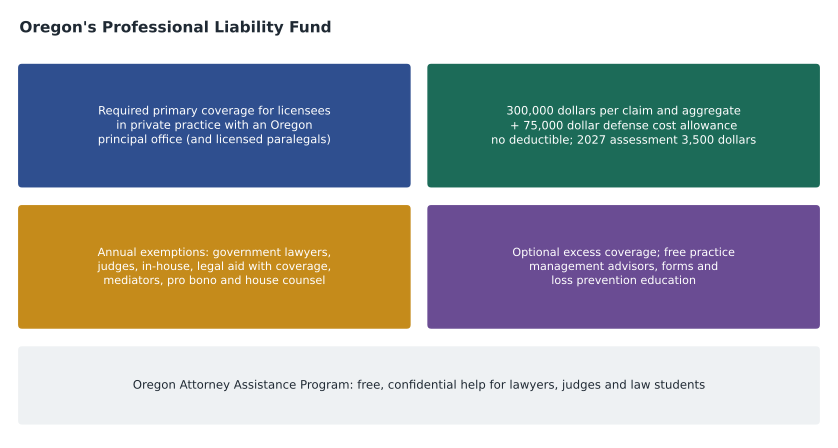
Oregon is unusual in requiring malpractice coverage for lawyers in private practice and in providing it through its own fund. The Professional Liability Fund, created under Oregon law in the late 1970s, provides primary coverage to every Oregon State Bar licensee in private practice whose principal office is in Oregon. The PLF's coverage pages describe limits of 300,000 dollars per claim and 300,000 dollars in the aggregate each year, including defense and indemnity costs, with a separate 75,000 dollar claims expense allowance available only for defense costs and no deductible. The assessment for 2027 is 3,500 dollars per covered licensee. Licensed paralegals who practice privately with an Oregon principal office must also carry PLF coverage.
Lawyers who are not in private practice can claim an exemption each year. The PLF's exemption list includes lawyers who are not engaged in private practice, such as in-house counsel and nonprofit employees, lawyers whose principal office is outside Oregon, government lawyers and judges, legal aid and public defender lawyers with qualifying alternative coverage, lawyers practicing exclusively as mediators or arbitrators, lawyers in active pro bono or house counsel status, and lawyers who are not working in law. Lawyers whose principal office is outside Oregon but who practice in Oregon must still meet the bar's alternative coverage requirements.
Many Oregon lawyers buy additional excess coverage above the PLF's primary limit, and the PLF offers an excess program. The fund also runs free practice management assistance, publishes practice handbooks and forms and offers continuing education on avoiding malpractice. Hana's supervising partner told her that the PLF's forms library had saved him more time than any software he had ever bought.
The Oregon Attorney Assistance Program
The PLF also supports the Oregon Attorney Assistance Program, which offers free, confidential help to Oregon lawyers, judges and law students dealing with substance use, mental health concerns, stress, career problems and other difficulties. The program's confidentiality is protected by rule and statute, and lawyers can seek help without it being reported to the bar. Hollis made a point of mentioning it to both candidates. 'Most lawyers who get into trouble were in trouble for a long time before anyone noticed,' she said. 'Oregon built a place to go before that happens. Use it.'
Lawyer discipline
Complaints about Oregon lawyers go first to the Oregon State Bar's Client Assistance Office, which screens them. Matters that may involve misconduct are referred to Disciplinary Counsel's Office for investigation. The State Professional Responsibility Board, a body of lawyers and public members, decides whether to dismiss a matter, issue an admonition or authorize formal proceedings. A formal proceeding is tried before a trial panel of the Disciplinary Board, which applies a clear and convincing evidence standard and decides the sanction. Trial panel decisions may be reviewed by the Supreme Court, and only the Court may disbar a lawyer or impose certain other serious sanctions. Oregon looks to the ABA Standards for Imposing Lawyer Sanctions and to its own prior cases in choosing sanctions.
The most common sources of discipline for new lawyers are not dramatic. They are neglect of a client matter, failure to communicate with a client, mishandling of trust funds and conflicts of interest that were not recognized. The PLF's practice management advisors and the bar's ethics helpline exist to prevent exactly those problems, and a new lawyer who calls before acting rarely ends up before a trial panel.
Reporting misconduct
Oregon's RPC 8.3 requires a lawyer who knows that another lawyer has committed a violation of the rules that raises a substantial question as to that lawyer's honesty, trustworthiness or fitness as a lawyer to inform the Oregon State Bar's Client Assistance Office, subject to exceptions, including for information protected by RPC 1.6 and for information learned through a lawyer assistance program. The duty to report is narrower than some new lawyers fear and broader than some experienced lawyers act on. A new lawyer uncertain about whether a duty applies should call the bar's ethics helpline.
Worked problem
A flat fee without a writing
A new Oregon lawyer agrees by phone to handle a client's uncontested dissolution for a flat fee of 2,500 dollars. The client pays the full amount the next day. The lawyer deposits it in her operating account. Two weeks later, before she has filed anything, the client fires her. What went wrong, and what must she do?
Show solution
- Under RPC 1.5(c)(3), a fee earned on receipt or nonrefundable requires a writing signed by the client with the required explanations.
- Without that writing, the advance belongs to the client until earned and must be held in the trust account under RPC 1.15-1.
- Depositing it in the operating account commingled client funds with her own.
- On discharge, she must refund the unearned portion promptly and account for any work done.
Answer: She should have deposited the advance in trust or obtained a signed earned-on-receipt agreement. She must promptly refund the unearned part of the fee and should correct her procedures; the commingling may expose her to discipline.
Common mistakes
MistakeThe Oregon rules adopt the ABA comments.
InsteadOregon adopted the rules without the Model Rules' comments; Oregon decisions and bar ethics opinions guide interpretation.
MistakeA lawyer may always deposit a flat fee in her operating account.
InsteadOnly with a signed writing meeting RPC 1.5(c)(3); otherwise it goes in trust.
MistakeOregon RPC 8.4(b) lets lawyers lie whenever it helps an investigation.
InsteadIt permits advising about or supervising lawful covert activity in limited circumstances.
MistakePLF coverage is optional extra insurance.
InsteadIt is required primary coverage for private practitioners with an Oregon principal office.
MistakeThe Oregon State Bar can disbar a lawyer.
InsteadOnly the Oregon Supreme Court may disbar.
Practice problems
Work each problem on paper first, then reveal the answer to check.
When did the Oregon Rules of Professional Conduct take effect?
Show answer
January 1, 2005.
Which case led to Oregon's covert activity exception?
Show answer
In re Gatti, 330 Or 517 (2000).
What must an earned-on-receipt fee agreement say under RPC 1.5(c)(3)?
Show answer
That the funds will not be deposited in trust and that the client may discharge the lawyer and may be entitled to a refund if the work is not completed.
What is the PLF assessment for 2027?
Show answer
3,500 dollars per covered licensee.
Which body decides whether to authorize formal disciplinary proceedings?
Show answer
The State Professional Responsibility Board.
Conflicts in a small community
In a small town, conflicts of interest arrive in ordinary ways. The firm may have represented the other driver's employer, the farm on the other side of the water dispute or both spouses' parents. Oregon's conflict rules, RPC 1.7 through 1.10, follow the structure of the Model Rules: a current-client conflict may be waived with informed consent confirmed in writing when the lawyer reasonably believes she can provide competent and diligent representation to each client, and a former-client conflict turns on whether the matters are the same or substantially related. Hana's firm runs every new name through its conflict system before the first meeting, including spouses, businesses and opposing parties, and she learned that the habit matters more in Pendleton than in Portland because everyone knows everyone.
Using the bar's ethics resources
Oregon lawyers have several free places to ask an ethics question. The Oregon State Bar's ethics helpline gives informal guidance on the rules, the bar's formal ethics opinions address recurring questions, and the PLF's practice management advisors answer questions about procedures such as file retention, conflict checks and trust accounting. A new lawyer who keeps a note of each question and the answer she received builds her own practice manual within a year.
Hollis ended the lesson with a reminder that tied it to the MPRE. 'You will answer MPRE questions under the Model Rules,' she said. 'You will spend your career under the Oregon rules. The differences are small in number, but each one is the kind of thing that ends up in a disciplinary opinion.'
Summary and key terms
- The Oregon RPCs took effect January 1, 2005, follow the Model Rules' numbering but differ in places, without the comments.
- Oregon defines information relating to the representation to include privileged information and other client confidences.
- RPC 8.4(b) permits advising about or supervising lawful covert activity, after In re Gatti (2000).
- RPC 1.5(c)(3) allows earned-on-receipt fees only with a signed writing; otherwise advances go in trust.
- The PLF provides required primary coverage (300,000 dollars plus 75,000 for defense); the 2027 assessment is 3,500 dollars.
- Discipline runs from the Client Assistance Office through the SPRB and a trial panel to the Supreme Court.
- earned on receipt
- A fee that becomes the lawyer's property when paid, permitted in Oregon only with a signed writing under RPC 1.5(c)(3).
- covert activity
- Lawful undercover investigation that Oregon RPC 8.4(b) allows lawyers to advise about or supervise in limited circumstances.
- IOLTA
- An interest-bearing trust account for small or short-term client funds, whose interest supports legal services.
- OAAP
- The Oregon Attorney Assistance Program, offering confidential help to lawyers.
- SPRB
- The State Professional Responsibility Board, which decides whether to bring formal disciplinary charges.
Lesson quiz · 5 questions
Score 60% or more to complete this lesson.
Create a free account to save your progress, take quizzes and earn a certificate.