
BAR-235 · Lesson 9 of 12 · 22 min
Oil, gas and mineral law in North Dakota
▶ Video coming soon A video version of this lesson is on the way.
Most of Jonas's working day at the Dickinson firm is spent with a stack of county records and a spreadsheet of names. A client, an operator planning a well in western Stark County, needs a title opinion for a spacing unit: who owns the oil and gas under every tract, who holds the leases and who must be paid. On one tract, a 1941 deed from a farmer named in the records as O. Haugland conveyed the land but reserved half the minerals. Nobody had recorded anything about that reserved half since. 'Is it still Haugland's?' Jonas asked the group. 'Or did it go to the surface owner years ago?' Hollis said that was the Dormant Mineral Act, and it was one of four statutes every western North Dakota lawyer has to know.
None of this is on the bar exam. All of it is daily work in the Bakken. This lesson covers the split between surface and mineral estates, the Dormant Mineral Act and the Marketable Record Title Act, pooling and risk penalties under the Industrial Commission's orders, the Surface Owner Protection Act, royalty valuation and the 2022 decision on pore space.
Two estates in one tract
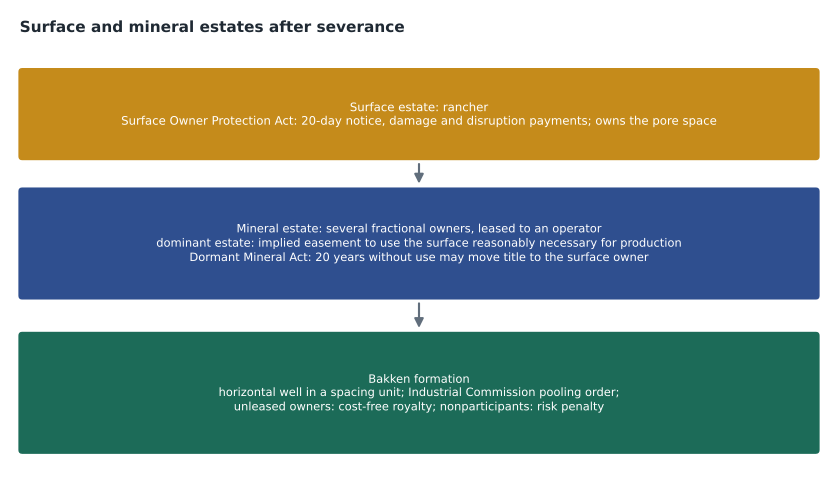
North Dakota law recognizes that ownership of land can be split horizontally. The mineral estate, the oil, gas and other minerals beneath the surface, can be severed from the surface estate by a deed that conveys one and reserves the other, or by a conveyance of minerals alone. After severance, the two estates have different owners, and each can be sold, leased, mortgaged and inherited separately. A single section of land in McKenzie County may have one surface owner and dozens of mineral owners, each holding a fractional interest traced through a century of deeds and estates.
The mineral estate is dominant. The mineral owner and its lessee have an implied easement to use as much of the surface as is reasonably necessary to explore for and produce the minerals. That rule protects development, but it is limited to what is reasonably necessary for production, as the Supreme Court emphasized in the 2022 pore space decision discussed below. North Dakota's statutes add protections and payments for surface owners on top of it.
The Dormant Mineral Act
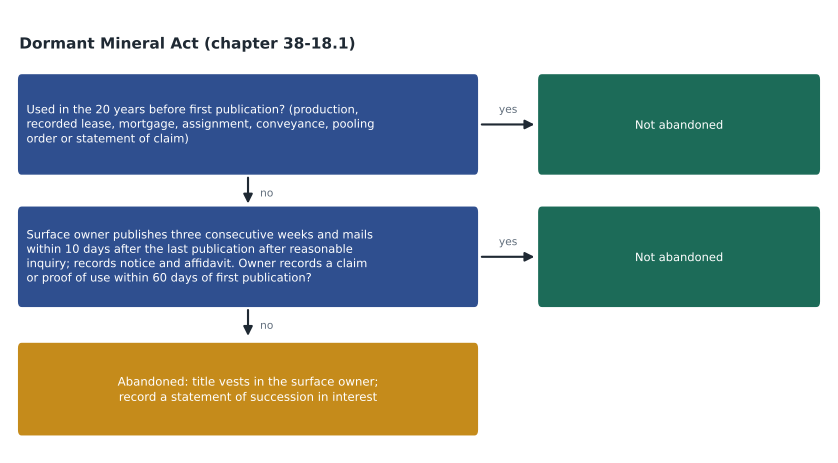
Chapter 38-18.1 of the Century Code allows unused severed mineral interests to pass to the surface owner. Under section 38-18.1-02, a mineral interest is deemed abandoned if it has not been used for a period of 20 years immediately before the first publication of the notice the chapter requires, unless a statement of claim has been recorded. Title to an abandoned interest vests in the owner or owners of the surface estate as of the date of abandonment, and the surface owner may record a statement of succession in interest.
Section 38-18.1-03 defines use. A mineral interest is used if any minerals are produced under it; if operations are being conducted on the land for injection, withdrawal, storage or disposal of water, gas or other fluids; if a lease, mortgage, assignment or conveyance of the interest is recorded in the office of the county recorder; if a pooling or unitization order or agreement covering the interest is recorded; or if a proper statement of claim is recorded. For solid minerals, production from a common vein or seam by the owners also counts. Payments into an account held for a mineral owner who cannot be located do not count as use.
Section 38-18.1-04 describes the statement of claim. The owner, or someone acting for the owner, records it in the county where the interest is located before the 20-year period ends. It must give the owner's name and address, a legal description of the land and the type of interest. A joint tenant may record one for the other joint tenants, but a tenant in common may not record one for other tenants in common.
The notice procedure
Abandonment is not automatic in practice, because the surface owner must give notice. Section 38-18.1-06 requires the surface owner to publish notice once a week for three consecutive weeks in the official county newspaper and, if the mineral owner's address appears of record or can be found by reasonable inquiry, to mail a copy within 10 days after the last publication. The notice gives the record owner's name, a description of the land and the surface owner's name. The surface owner then records the notice and an affidavit of service, which is prima facie evidence that notice was given.
The statute defines reasonable inquiry. The surface owner must search the county recorder's records for any use of the interest, the clerk of court's records for judgments, liens and probate records, the Social Security death index if the owner is believed to be dead, and publicly available internet databases. Fee-based private databases are not required. The Supreme Court has decided a long line of cases on whether a surface owner's search was reasonable, and a title examiner who relies on a Dormant Mineral Act notice reads the affidavit of service closely for exactly this reason.
Section 38-18.1-05 gives the mineral owner a last chance. Within 60 days after the first publication of the notice, the record owner may record a statement of claim or proof of use, and another person claiming the interest may record a sworn statement explaining the basis of the claim. If that happens, the interest is not abandoned.
Jonas worked through the Haugland reservation with the group. Had any minerals been produced from the tract? No well had ever been drilled on it. Had any lease, mortgage, assignment or conveyance of the reserved half been recorded? His search found an oil and gas lease signed by Haugland's heirs in 2011 and recorded in Stark County. That was a use under section 38-18.1-03. The 20-year clock had been reset in 2011, so even if the surface owner had published notice, the interest could not have been abandoned. 'The heirs signed a lease in a boom year and never knew they were saving their minerals,' Jonas said.
The Marketable Record Title Act
Chapter 47-19.1 is a separate statute with a different purpose: clearing old claims from title generally. A person who has an unbroken chain of title of record to an interest in land for 20 years or more, and is in possession, has marketable record title, which is free of interests and claims that depend on any act, transaction, event or omission that occurred 20 or more years earlier, unless the claimant has recorded a notice preserving the claim within the 20-year period.
The Act has its own rule for severed minerals. A person who owns a severed mineral interest is deemed to be in possession of it if he or she has used the minerals, as use is defined in the Dormant Mineral Act, and records an affidavit of possession stating that use. The two statutes therefore work together, and a careful title examiner checks both.
Spacing, pooling and the risk penalty
North Dakota's oil and gas conservation law, chapter 38-08, is administered by the Industrial Commission, made up of the governor, the attorney general and the agriculture commissioner, through the Department of Mineral Resources' Oil and Gas Division. The Commission sets spacing units, the area a single well or set of wells is allowed to drain, and can require the interests within a spacing unit to be pooled so that every owner shares in production.
Under section 38-08-08, owners in a spacing unit may pool voluntarily. If they do not, the Commission, on application of any interested person and after notice and a hearing, must enter a pooling order. An unleased mineral owner pooled after July 31, 2009, receives a cost-free royalty equal to the acreage-weighted average royalty of the leased tracts in the unit, or, if the operator elects, a cost-free royalty of 16 percent. The rest of the unleased owner's interest is treated as a cost-bearing working interest.
An owner who chooses not to pay a share of the costs of drilling and completing the well is a nonparticipating owner, and the statute allows the participating owners to recover a risk penalty from that owner's share of production, in addition to the owner's share of the actual costs. For a leased nonparticipating owner, the penalty is 200 percent of that owner's share of the reasonable actual costs of drilling and completing the well. For an unleased nonparticipating owner, it is 50 percent, and only if the paying owner first made a good faith but unsuccessful attempt to obtain a lease or joinder and gave the required notice. The penalty is recovered only out of production.
| Owner pooled after July 31, 2009 | Royalty | Risk penalty if not participating |
|---|---|---|
| Leased owner (working interest holder) who does not pay | Lease royalty to lessor | 200 percent of share of drilling and completion costs, from production |
| Unleased owner | Cost-free royalty: acreage-weighted average, or 16 percent if the operator elects | 50 percent of share of costs on the rest of the interest, after a good faith lease offer |
| Participating owner | Shares in production by interest | None |
The Surface Owner Protection Act
Chapter 38-11.1 protects surface owners from the effects of drilling. Section 38-11.1-04.1 requires the mineral developer to give the surface owner written notice, by registered mail or hand delivery, at least 20 days before drilling begins, unless the parties waive it. The notice describes the planned work, includes a plat map and includes a state form explaining the surface owner's rights, including the right to request hydrogen sulfide monitoring. For activities that do not disturb the surface, such as surveying and staking, at least seven days' notice is required. A developer that fails to give notice can be liable for relief that includes punitive damages.
Section 38-11.1-04 requires the developer to pay the surface owner, and a tenant for the tenant's share, for lost land value, lost use of and access to the land and lost value of improvements caused by drilling operations. The parties may agree on any formula. Section 38-11.1-08 requires the developer, unless the parties agree otherwise in writing, to make a written settlement offer when it gives the 20-day notice.
The remedies have teeth. Under section 38-11.1-07, a person seeking compensation must notify the developer of the damages within two years after the injury occurs or would become apparent to a reasonable person; the lawsuit itself must be brought within the six-year period of section 28-01-16. Under section 38-11.1-09, if the claimant rejects the developer's offer and the court awards more than the offer, the court must award reasonable attorney's fees, costs and interest from the day drilling began, at the prime rate of the Bank of North Dakota on the date of judgment.
Royalty valuation
Royalty disputes often turn on where the oil or gas is valued. Many leases say the royalty is based on the value of production 'at the well.' In Blasi v. Bruin E&P Partners, 2021 ND 86, decided May 20, 2021, the Supreme Court answered a question certified by the federal district court and held that a royalty clause of that kind unambiguously sets the valuation point at the well. Because value at the well is value before transportation and processing, post-production costs incurred after the well can be deducted in calculating the royalty. The decision does not decide every lease: royalty clauses vary, and each must be read on its own terms.
Pore space
Pore space is the open space in rock formations below the surface, used to store carbon dioxide or dispose of saltwater produced with oil. In Northwest Landowners Association v. State, 2022 ND 150, decided August 4, 2022, the Supreme Court held that surface owners own the pore space beneath their land under long-standing North Dakota law, confirmed by a 2009 statute. It struck down provisions of a 2019 statute, Senate Bill 2344, that would have barred surface owners from prohibiting or demanding payment for the use of pore space by operators, excluded pore space from the land for which surface damages are paid and immunized injection from trespass claims. Those provisions authorized a physical invasion of private property without compensation and so were a taking under the federal and state constitutions. The Court rejected the argument that the dominant mineral estate's easement justified the invasion, because disposal of saltwater from outside a unit is not reasonably necessary to production within it.
Worked problem
Dormant minerals
A hypothetical surface owner, Mikkel, owns a quarter section in Williams County. A 1952 deed reserved all minerals to a seller whose heirs cannot be found. No lease, mortgage, assignment, conveyance, pooling order or statement of claim has been recorded since 1952, and no minerals have been produced. In June 2026 Mikkel publishes notice for three consecutive weeks and mails a copy to the last known address after a reasonable inquiry. No one responds within 60 days of first publication. Who owns the minerals?
Show solution
- The interest has not been used in the 20 years before first publication.
- Mikkel published for three consecutive weeks and mailed within 10 days after the last publication after a reasonable inquiry.
- No statement of claim or proof of use was recorded within 60 days after first publication.
- The interest is deemed abandoned and vests in Mikkel as the surface owner; he should record the notice, the affidavit of service and a statement of succession in interest.
Answer: Mikkel owns the minerals, provided his inquiry and notice met the statute; a title examiner will check the affidavit closely.
Common mistakes
MistakeRecording a lease does not count as use under the Dormant Mineral Act.
InsteadA recorded lease, mortgage, assignment or conveyance is use and resets the 20-year period.
MistakeAn abandoned mineral interest passes to the state.
InsteadIt vests in the surface owner.
MistakeThe risk penalty for every nonparticipating owner is 200 percent.
InsteadIt is 200 percent for leased owners and 50 percent for unleased owners, after a good faith lease offer.
MistakeAn at-the-well royalty forbids deducting post-production costs.
InsteadBlasi (2021) held such a clause values production at the well, so post-production costs may be deducted.
MistakeOperators may use pore space without the surface owner's consent under SB 2344.
InsteadNorthwest Landowners (2022) held those provisions unconstitutional; surface owners own the pore space.
Practice problems
Work each problem on paper first, then reveal the answer to check.
How long must a severed mineral interest go unused before it is deemed abandoned?
Show answer
Twenty years before first publication of notice, absent a recorded statement of claim.
How is Dormant Mineral Act notice published?
Show answer
Once a week for three consecutive weeks in the official county newspaper, with mailing within 10 days after the last publication.
What royalty may an operator elect for an unleased owner pooled after July 31, 2009?
Show answer
A cost-free royalty of 16 percent.
How many days' notice must precede drilling under the Surface Owner Protection Act?
Show answer
At least 20 days.
What did Northwest Landowners Association v. State, 2022 ND 150, hold?
Show answer
Surface owners own pore space; parts of SB 2344 were an uncompensated taking.
Summary and key terms
- Mineral and surface estates can be severed; the mineral estate is dominant but limited to what is reasonably necessary.
- Dormant Mineral Act: 20 years without use, notice by publication and mail after reasonable inquiry, a 60-day window, then title vests in the surface owner.
- Marketable Record Title Act: 20-year chains clear old claims; mineral owners show possession by use and an affidavit.
- Pooling orders give unleased owners a cost-free royalty; risk penalties are 200 percent for leased and 50 percent for unleased nonparticipants.
- Surface Owner Protection Act: 20-day notice, damage and disruption payments, a settlement offer and fee shifting if the award beats the offer.
- Blasi (2021): at-the-well royalties allow post-production deductions; Northwest Landowners (2022): surface owners own pore space.
- severance
- The division of mineral and surface ownership of the same land.
- dominant estate
- The mineral estate's right to use the surface reasonably necessary for production.
- statement of claim
- A recorded notice that preserves a mineral interest under the Dormant Mineral Act.
- risk penalty
- An extra recovery from a nonparticipating owner's share of production for the risk of drilling.
- pore space
- Open space within rock formations, owned in North Dakota by the surface owner.
Lesson quiz · 5 questions
Score 60% or more to complete this lesson.
Create a free account to save your progress, take quizzes and earn a certificate.