
BAR-235 · Lesson 2 of 12 · 20 min
Eligibility, education, application deadlines and fees
▶ Video coming soon A video version of this lesson is on the way.
Jonas mailed his application packet to Bismarck on September 14, 2026, by certified mail with a return receipt, and kept a photocopy of every page. Hollis asked him to walk the group through it at the second session, because the North Dakota process has two halves that run in parallel and applicants who treat it as one form get into trouble. 'One half lives on NCBE's website,' Jonas said. 'The other half is paper in an envelope. If either half is late, the application is late.'
This lesson covers who may sit for the North Dakota exam, the two filing calendars, the fees and the way they are paid, the 17-applicant rule for February, the documents that must reach the Board and the special rules for third-year law students.
Who may sit
North Dakota's eligibility rule is short. An applicant for admission by examination must hold a JD or equivalent degree from a law school approved or provisionally approved by the American Bar Association, or be on track to receive one before the exam. NCBE's summary for North Dakota states that foreign law graduates are not eligible: there is no route by which a degree from a law school outside the United States, or from a school that is not ABA-approved, qualifies a person to sit in North Dakota. That is a stricter rule than some jurisdictions use, and it explains why North Dakota attracts few foreign-trained applicants compared with New York or California.
The applicant must also be at least 18 and must pass character and fitness review and the MPRE, which Lesson 3 covers. The JD must be conferred before the applicant sits. The Board's guides require the official JD transcript showing the degree conferred to reach the Board office directly from the law school or a transcript clearinghouse, and for a February exam the guide sets February 1 as the date by which it must arrive. A student who has not graduated by then cannot sit that February.
Two calendars
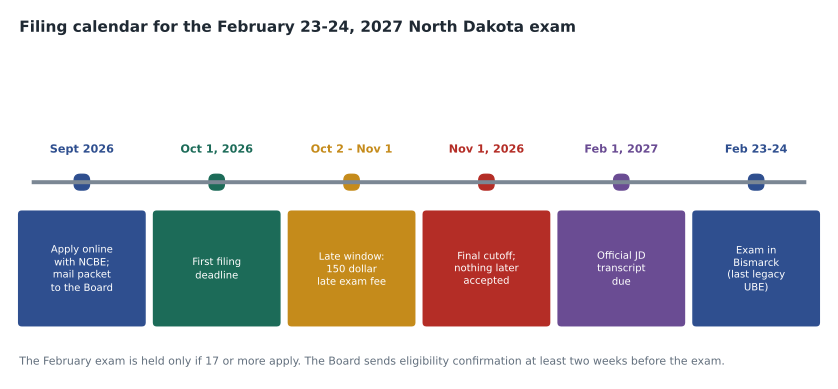
North Dakota gives the exam on the last Tuesday and Wednesday of July and, when enough applicants register, on the last Tuesday and Wednesday of February. Each exam has a first filing deadline and a final late deadline.
| Item | February 2027 exam | July exam |
|---|---|---|
| Exam dates | Tuesday and Wednesday, February 23 and 24, 2027 | Last Tuesday and Wednesday of July |
| First filing deadline | October 1, 2026 | March 15 |
| Late filing window | October 2 to November 1, 2026 | March 16 to May 1 or May 15 (check the current guide) |
| Final cutoff | November 1, 2026; nothing later is accepted | The late deadline in the current July guide |
| JD transcript due | February 1, 2027 | Before the exam |
| Exam format | Legacy Uniform Bar Examination (last one) | NextGen exam from July 2027 |
For the July exam, the deadlines in NCBE's chart are March 15 for first filing and May 1 for late filing. The Board's own July instructions list late tiers running through May 15 and contain language that is internally inconsistent about whether an application postmarked on May 15 is accepted. Hollis's advice for anyone planning a July exam was simple: file by March 15, and if that becomes impossible, call the Board before relying on any late date.
The 17-applicant rule
North Dakota's February exam comes with a condition that surprises applicants from larger states. The Board's guide states that the February exam depends on 17 or more applicants. If fewer than 17 apply, there is no February exam, and the Board refunds the exam fee and any late exam fee. The applicant would then sit the next July exam, which for anyone planning on February 2027 means the first NextGen exam in July 2027.
Jonas had thought about this before choosing February. 'If they cancel, I lose seven months and I take a different test,' he said. 'So I asked the Board office how many people usually sit in February, and I asked my classmates who were waiting for February too.' Hollis approved. She also told him to keep his NextGen materials from the group's earlier NextGen sessions in a drawer, not in the recycling bin, until the Board confirmed his eligibility. The Board sends that confirmation at least two weeks before the exam.
Fees
Fees are paid in two places. The Board collects its exam fee, any late fee and, for some applicants, a late law student registration fee. NCBE separately collects the character and fitness investigation fee when the applicant completes the online application. The Board accepts only a check or money order. It does not take credit cards, and an application that arrives without the right check is not complete.
The February guide divides applicants into two groups. The first is current law students and recent graduates: those whose JD was awarded before the exam application period opened or within the past year, who have never filed a North Dakota law student registration and who have not applied in another jurisdiction. The second group is everyone else: graduates whose JD was awarded more than a year earlier, and anyone who has applied in another jurisdiction.
| Applicant group | Filed by October 1 | Filed October 2 to November 1 |
|---|---|---|
| Current students and graduates within a year, no prior registration or other application | 200 exam fee plus 400 late law student registration fee: 600 dollars to the Board | 600 plus 150 late exam fee: 750 dollars to the Board |
| JD more than a year ago, or applied elsewhere | 200 dollars to the Board | 200 plus 150 late exam fee: 350 dollars to the Board |
The 400 dollar late law student registration fee is the price of not registering as a law student earlier. North Dakota invites law students to file a law student registration, which starts the character and fitness review well before graduation. A student who never registered pays the late registration fee as part of the exam application. A student who did file a North Dakota law student registration within the past three years follows a separate supplemental guide for third-year students and does not pay the late registration fee again.
The Board's July instructions on the court system's website, which may be an older version, show a different schedule: a 150 dollar exam fee, a 400 dollar late law student registration fee and late exam fees of 100 and then 150 dollars, with an NCBE character and fitness fee of 355 dollars for current students and 500 dollars for other applicants, or a 225 dollar supplemental fee where NCBE completed an original investigation in another state within four years. Fee schedules change. The rule Hollis gave the group was to use the guide for the exact exam you are taking, printed the week you file, and NCBE's current fee schedule for the investigation fee.
Board fees are generally nonrefundable. The exception is the one described above: if fewer than 17 apply for a February exam, the exam fee and late fee are refunded.
Jonas's numbers
Jonas graduated in May 2026, had not filed a North Dakota law student registration and had not applied anywhere else. He was in the first group. He filed well before October 1, so his check to the Board was 600 dollars: the 200 dollar exam fee and the 400 dollar late law student registration fee. He paid NCBE's investigation fee online when he submitted the character and fitness application. 'The late registration fee stings,' he said. 'Nobody told me in my second year that registering would have saved me money.' Hollis said that was the single most common regret she heard from North Dakota candidates.
The documents
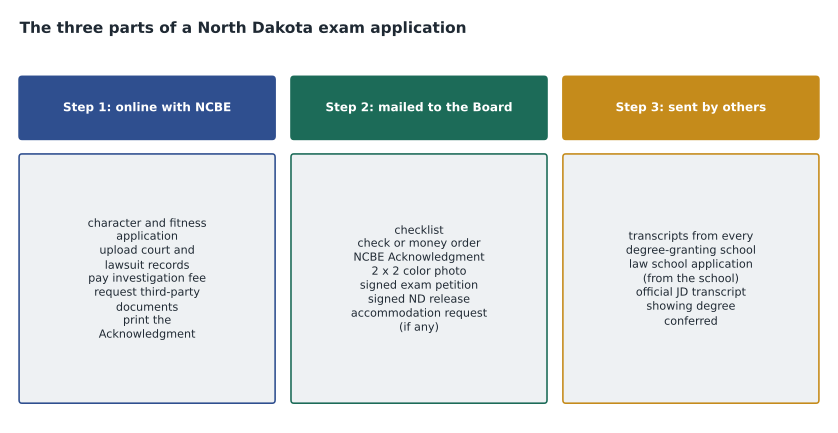
The February guide organizes the application into three steps, and an application is not considered received until the core documents from the first two arrive on time.
Step one happens online with NCBE. The applicant completes the character and fitness application, uploads supporting documents such as court records and lawsuit papers, pays the investigation fee and requests that third parties send documents to the Board. When the online application is complete, NCBE generates an Acknowledgment of Complete Application, found under the character and fitness tab of the applicant's NCBE account, and the applicant prints it.
Step two is the envelope to Bismarck. It contains the completed checklist, the check or money order for the Board's fees, the NCBE Acknowledgment, a recent two-inch by two-inch color photograph, the original signed exam petition, the original signed North Dakota release and, if the applicant needs testing accommodations, the accommodation request. Accommodation requests must accompany the application; they cannot be sent separately later. The guide recommends a trackable mailing method, and the final deadline is a receipt deadline, not a postmark deadline, for the February exam.
Step three is documents sent by others. Every degree-granting college or university the applicant attended sends an official transcript directly to the Board. The law school sends a copy of the applicant's law school application. After graduation, the registrar sends the official JD transcript showing the degree conferred.
Why the law school application matters
The requirement that the law school send the applicant's law school application surprises some applicants. The Board compares what the applicant disclosed when applying to law school with what the applicant discloses on the bar application. A criminal charge, a school disciplinary matter or a job termination that appears on one and not the other is a problem, and the problem is usually the missing disclosure rather than the underlying event. Jonas read his law school application again before he filed. It mentioned one of his two college speeding tickets but not the other. He disclosed both on the bar application and called the law school's dean of students to ask how to amend his law school record.
Keeping the application current
An application is not frozen once filed. The applicant has a continuing duty to update it, which in North Dakota's process means logging in to the NCBE account and using the amend application function for any change in address, employment or background, including a new traffic citation. The Board's guide also warns that applicants will not receive confirmation when the character and fitness investigation is complete; the investigation is not final until the applicant is recommended for admission. Silence, in other words, is normal.
What delays applications
The Board's FAQ lists the most common reasons applications stall: not following the online instructions and checklists, missing documents, questions left unanswered or incomplete without explanation, missing signatures or a missing Acknowledgment page, and fees paid by something other than a check or money order. For motion applicants, missing CLE evidence, judge references, score transfers or certificates of good standing are the usual culprits. Hollis read the list aloud and asked each person in the group to identify which mistake they were most likely to make. Jonas said the photograph. He had already had to retake it once.
Worked problem
Fees and deadlines
Kari graduated from an ABA-approved law school in December 2025. She has never filed a North Dakota law student registration and has not applied anywhere else. She mails her February 2027 application on October 20, 2026, and it arrives on October 22. What does she owe the Board, and is her application timely?
Show solution
- Her JD was awarded within the past year, she has no prior registration and no other application, so she is in the first fee group.
- Her application arrived after October 1 but before November 1, so it is in the late window.
- First-group fees in the late window are the 200 dollar exam fee, the 400 dollar late law student registration fee and the 150 dollar late exam fee.
- NCBE's investigation fee is paid separately online.
Answer: Her application is timely but late; she owes the Board 750 dollars by check or money order, plus NCBE's investigation fee paid to NCBE.
Common mistakes
MistakeThe October 1 deadline is a postmark deadline, so mailing on October 1 is enough.
InsteadThe February guide speaks of Board receipt by October 1; mail early and use a trackable method.
MistakeFees can be paid by credit card on the Board's website.
InsteadThe Board accepts only checks or money orders; NCBE's fee is paid separately online.
MistakeA February exam is always held.
InsteadIt is held only if 17 or more apply; otherwise the exam and late fees are refunded.
MistakeTesting accommodation requests can be filed after the application.
InsteadThey must accompany the application.
MistakeOnce the application is filed, nothing more is required until the exam.
InsteadApplicants must amend the NCBE application for any change and respond promptly to requests.
Practice problems
Work each problem on paper first, then reveal the answer to check.
What degree must a North Dakota exam applicant hold?
Show answer
A JD or equivalent from an ABA-approved or provisionally approved law school.
When is the first filing deadline for the February exam?
Show answer
October 1.
What is the final cutoff for the February exam?
Show answer
November 1; applications received after that date are not accepted.
How many applicants are needed for a February exam to be held?
Show answer
17 or more.
By when must the official JD transcript reach the Board for a February exam?
Show answer
February 1.
Summary and key terms
- Eligibility: JD from an ABA-approved or provisionally approved school; foreign law graduates are not eligible.
- February exam: first deadline October 1, late window to November 1, final cutoff November 1; JD transcript by February 1.
- July exam: first deadline March 15; check the current July guide for late tiers.
- February is given only with 17 or more applicants; otherwise exam fees are refunded.
- Board fees by check or money order; NCBE's investigation fee is separate. Students who never registered pay a 400 dollar late registration fee.
- The application has three parts: NCBE online, the mailed packet and third-party documents.
- law student registration
- An early North Dakota filing by a law student that starts character and fitness review before graduation.
- late law student registration fee
- The 400 dollar fee paid by applicants who never filed a law student registration.
- Acknowledgment of Complete Application
- The NCBE page that confirms the online application is complete and must be mailed to the Board.
- exam petition
- The signed form asking the Board for leave to sit for the exam.
- continuing duty to update
- The applicant's obligation to amend the application for any change until admission.
Lesson quiz · 5 questions
Score 60% or more to complete this lesson.
Create a free account to save your progress, take quizzes and earn a certificate.