
BAR-235 · Lesson 8 of 12 · 22 min
North Dakota torts: modified comparative fault, several liability, damages limits and claims against public bodies
▶ Video coming soon A video version of this lesson is on the way.
The Interstate 94 case grew more complicated in November. The other driver said a state highway department truck had stopped in the right lane ahead of him with its warning lights off, forcing him to swerve, and that the rancher's pickup had been going too slowly for the conditions. Suddenly there were three people who might share the fault: the rancher, the other driver and the state. 'In law school this was one hypothetical,' Jonas said. 'At the firm it is a spreadsheet.' Hollis asked him to build the spreadsheet in front of the group.
This lesson covers North Dakota's comparative fault statute and its rule of several liability, the damages statute's categories and limits, punitive damages, the medical malpractice cap and the rules for suing the state and political subdivisions, including the liability limits that changed on July 1, 2026.
Fault
North Dakota's tort damages rules are collected in chapter 32-03.2 of the Century Code, adopted as part of the state's tort reform of the 1980s. Section 32-03.2-01 defines fault broadly. It includes negligent or reckless acts or omissions, tort liability generally, dram shop liability, strict product liability, breach of warranty, assumption of risk, misuse of a product and failure to use reasonable care to avoid an injury or to mitigate damages. Because all of these are fault, all of them are compared under one statute. A plaintiff's unreasonable assumption of a risk does not operate as a complete defense; it becomes a percentage on the verdict form.
Modified comparative fault: the as-great-as bar
Section 32-03.2-02 sets the rule. Contributory fault does not bar recovery unless the plaintiff's fault was as great as the combined fault of all other persons who contributed to the injury. If recovery is not barred, the plaintiff's damages are reduced in proportion to her share of the fault. The court may, and on request of any party must, direct the jury to find separate special verdicts determining the total damages and the percentage of fault of each person.
Two features of that rule matter in every case. First, the comparison is between the plaintiff and the combined fault of all others, not each defendant separately. A plaintiff 40 percent at fault can recover against two defendants each 30 percent at fault, because 40 is less than the combined 60. Second, the bar applies at equality. A plaintiff whose fault is 50 percent, against others whose combined fault is 50 percent, recovers nothing, because her fault is as great as theirs.
Several liability
The same section abolishes joint and several liability in most cases. When two or more parties contribute to the injury, liability is several only, not joint: each party is liable only for the amount of damages attributable to its own percentage of fault. The exception is for persons who act in concert in committing a tortious act, who aid or encourage the act, or who ratify or adopt it for their benefit. Those persons are jointly liable for the damages attributable to their combined fault.
Several liability shifts the risk of an insolvent or absent defendant to the plaintiff. If one defendant cannot pay its share, the others do not make up the difference. That is why the fault of everyone who contributed, including persons who are not parties, matters so much at trial: every percentage point assigned to an empty chair is a point no one may pay.
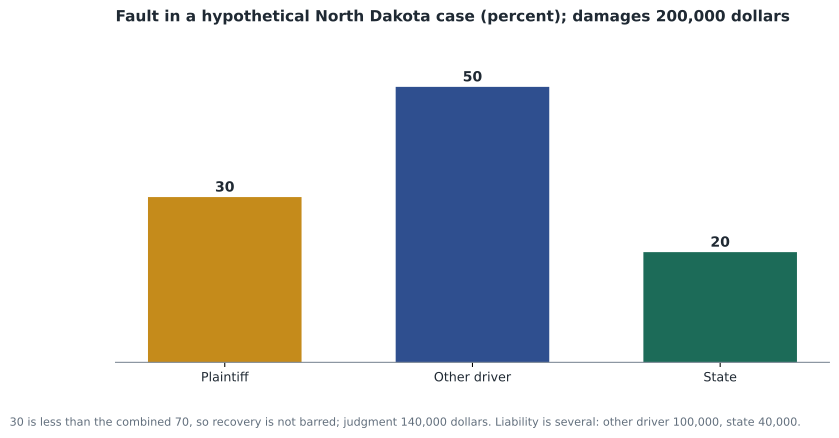
Jonas built the spreadsheet. Suppose the jury finds total damages of 200,000 dollars and assigns 30 percent of the fault to the rancher, 50 percent to the other driver and 20 percent to the state. The rancher's 30 percent is less than the combined 70 percent of the others, so recovery is not barred. His damages are reduced by his 30 percent share to 140,000 dollars. Under several liability, the other driver owes 50 percent of 200,000, or 100,000 dollars, and the state owes 20 percent, or 40,000 dollars. If the other driver had no insurance and no assets, the rancher would collect only the state's 40,000.
A small exception for car property damage
Section 32-03.2-02.1 adds a narrow exception. In a motor vehicle accident involving two persons who are both at fault, property damages are not reduced for comparative fault if the direct property damages are 5,000 dollars or less, indirect damages are 1,000 dollars or less, and the defendant's fault exceeds 50 percent. The section does not apply to personal injury. It is designed for fender-benders: a driver mostly not at fault gets his small repair bill paid in full without a fault-apportionment fight.
Categories of damages
Section 32-03.2-04 defines the categories used in actions for wrongful death or injury to a person, whether the claim sounds in contract or tort. Economic damages are objectively verifiable pecuniary losses: medical expenses, rehabilitation, custodial care, lost earnings and earning capacity, burial costs and the cost of substitute domestic services. Noneconomic damages are the rest: pain, suffering, inconvenience, physical impairment, disfigurement, mental anguish, emotional distress, loss of society and companionship, loss of consortium and injury to reputation. Under section 32-03.2-05, the jury must find past economic damages, future economic damages and noneconomic damages separately.
Two statutes then adjust the economic award. Under section 32-03.2-06, after an award of economic damages, the party responsible for paying may ask the court to reduce the award by collateral source payments the plaintiff received and need not repay. Life insurance, death and retirement benefits and insurance the injured person purchased are excluded from the reduction. Under section 32-03.2-08, an award of economic damages exceeding 250,000 dollars, measured before reductions for fault and collateral sources, may be reviewed, and the court must reduce it if the moving party shows that it bears no reasonable relation to the economic damage incurred and to be incurred.
Punitive damages
North Dakota calls punitive damages exemplary damages, and section 32-03.2-11 controls them. They may be awarded in an action not arising from contract only on clear and convincing evidence that the defendant was guilty of oppression, fraud or actual malice. Malice, under the definitions section, means either a direct intention to injure or a reckless disregard of another's rights.
The procedure is distinctive. A complaint may not seek exemplary damages at the outset. A party who wants them must move to amend the pleadings, supported by affidavits or deposition testimony, and the court grants the motion only if it finds sufficient evidence to support a finding of oppression, fraud or actual malice. An amendment relates back for limitations purposes. At trial, evidence of the defendant's financial condition or net worth is not admissible in the exemplary damages proceeding.
The amount is capped. Exemplary damages may not exceed the greater of two times the compensatory damages or 250,000 dollars, and none may be awarded without compensatory damages. The jury is not told about the cap; the court reduces any excess.
| Rule | Section | North Dakota requirement |
|---|---|---|
| Standard | 32-03.2-11 | Clear and convincing evidence of oppression, fraud or actual malice |
| Pleading | 32-03.2-11 | Not in the initial complaint; motion to amend with affidavits or depositions |
| Cap | 32-03.2-11 | Greater of two times compensatory damages or 250,000 dollars |
| Evidence of wealth | 32-03.2-11 | Financial condition and net worth are inadmissible |
| Public bodies | 32-12.1-03, 32-12.2-02 | No punitive damages against the state or a political subdivision |
The medical malpractice cap
Section 32-42-02 limits noneconomic damages in a health care malpractice action. The total noneconomic damages that a claimant and the claimant's family may receive for an injury may not exceed 500,000 dollars, regardless of the number of health care providers and other defendants and regardless of the number of actions or claims. The jury is not told of the cap, and the court reduces any award that exceeds it. The section contains no inflation adjustment, and economic damages are not capped.
The cap survived a state constitutional challenge. In Condon v. St. Alexius Medical Center, 2019 ND 113, decided April 22, 2019, the Supreme Court held that the cap does not violate the equal protection guarantee of the North Dakota Constitution. Applying intermediate scrutiny, because the right to recover for personal injuries is an important substantive right, the Court found a close correspondence between the cap and the legislature's goals. It distinguished Arneson v. Olson, its 1978 decision striking down an earlier malpractice damages cap, because the current cap does not limit economic damages. Section 32-42-03 also requires the parties to make a good faith effort at alternative dispute resolution before the claimant files suit, and lawyers must certify compliance in the pleadings.
Claims against the state
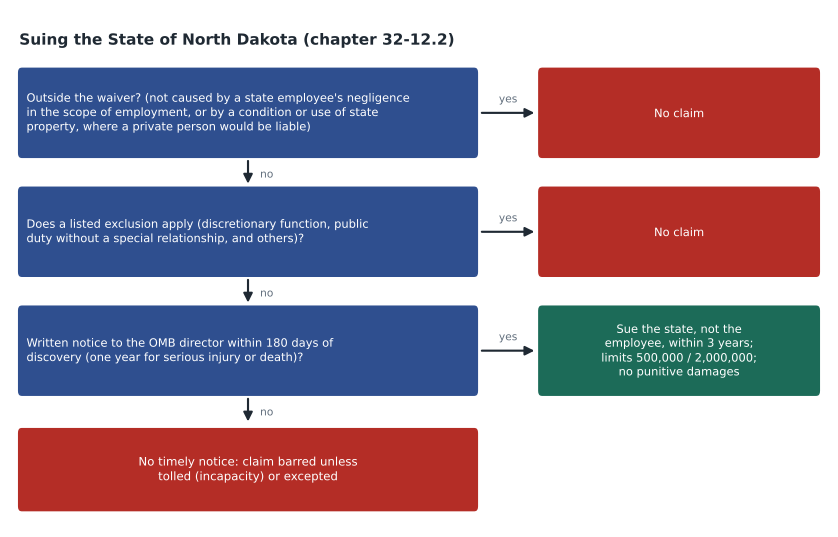
Chapter 32-12.2 governs claims against the state. Under section 32-12.2-02, the state is liable for money damages for injury proximately caused by the negligence or wrongful act of a state employee acting within the scope of employment, in circumstances where the employee would be personally liable, and for injury caused by a condition or use of tangible property where a private person would be liable. The statute then lists many exclusions. The state is not liable for discretionary acts, including the design of public projects; for legislative and judicial decisions; for public duties such as inspection and law enforcement, unless a special relationship exists; for snow, ice or debris on highways unless negligently caused by a state employee; for wild animals in their natural state; or for conditions of unimproved state land, among others.
The liability limits changed in 2026. House Bill 1142, signed in March 2025, replaced the earlier schedule of annual increases, which had reached 468,750 dollars per person and 1,875,000 dollars per occurrence on July 1, 2025, with flat limits that apply after June 30, 2026: 500,000 dollars per person and 2,000,000 dollars for all claims arising from a single occurrence. A judgment above the per-occurrence limit may be paid only if the legislature appropriates the money. The state is never liable for punitive damages and may not indemnify an employee for them.
Section 32-12.2-03 protects state employees. An action for an employee's negligence within the scope of employment must be brought against the state, not the employee, and the employee is not personally liable for those acts. An employee may be personally liable for acts outside the scope of employment, which the plaintiff must prove by clear and convincing evidence.
Notice of claim to the state
Before suing the state, a claimant must give written notice to the director of the Office of Management and Budget within 180 days after the injury is discovered or reasonably should have been discovered. For a serious injury, as defined in the state's no-fault insurance statute, or a death, the notice period is one year. The notice must state the time, place and circumstances of the injury, the names of any known state employees involved, and the amount of compensation or other relief demanded. Time does not run while the injured person is incapacitated from giving notice, and the notice requirement does not apply to claims based on sexual abuse. When the claimant later sues, a copy of the summons and complaint must also be delivered to the director. The limitations period for actions against the state is three years under section 28-01-22.1.
Claims against political subdivisions
Counties, cities, school districts, townships and other political subdivisions are governed by a parallel chapter, 32-12.1. Section 32-12.1-03 makes a political subdivision liable for injuries proximately caused by the negligence or wrongful act of an employee within the scope of employment and for injuries caused by a condition or use of tangible property, in circumstances where a private person would be liable. It lists immunities similar to the state's: due care in executing a statute, legislative and quasi-legislative acts, judicial and quasi-judicial acts such as licensing decisions, discretionary functions, injuries caused by nonemployees, and public duties such as inspection, ordinary law enforcement and fire protection, unless a special relationship exists. Political subdivisions are never liable for punitive damages.
House Bill 1142 changed the political subdivision limits on the same schedule as the state's: after June 30, 2026, they are 500,000 dollars per person and 2,000,000 dollars for all claims arising from one occurrence, regardless of how many political subdivisions or employees are involved. The chapter also has its own notice-of-claim and limitations provisions, and a lawyer with a claim against a city or county must read them before relying on the state's rules, because the recipient of the notice and the deadlines differ.
Jonas went back to the spreadsheet. The highway department truck belonged to the state, so the state's notice rule applied: written notice to the director of the Office of Management and Budget within 180 days after the injury was discovered, or within one year if the rancher's injuries qualified as serious. The crash had been on August 12, 2026. He calendared the 180-day date for the partner and flagged the serious injury question for the medical records review.
Worked problem
Applying the as-great-as bar
A hypothetical plaintiff, Sigrid, is injured when her car collides with a county snowplow on a county road. The jury finds total damages of 300,000 dollars and apportions fault: Sigrid 45 percent, the county 35 percent and another driver 20 percent. The other driver is uninsured and judgment-proof. What can Sigrid collect?
Show solution
- Sigrid's 45 percent is less than the combined 55 percent of the others, so recovery is not barred.
- Her recoverable damages are 300,000 reduced by 45 percent, or 165,000 dollars.
- Liability is several: the county owes 35 percent of 300,000, or 105,000 dollars; the other driver owes 60,000 dollars.
- The county's share is within the political subdivision limit of 500,000 dollars per person; no punitive damages are available against it.
Answer: Sigrid can collect 105,000 dollars from the county. The other driver's 60,000 dollar share is several only and, because he cannot pay, is lost.
Common mistakes
MistakeA plaintiff 50 percent at fault recovers half her damages in North Dakota.
InsteadRecovery is barred when her fault is as great as the combined fault of others.
MistakeEach North Dakota defendant is jointly and severally liable.
InsteadLiability is several only, except for those who act in concert, aid or ratify.
MistakeA complaint may demand exemplary damages from the start.
InsteadA party must move to amend with supporting affidavits or depositions.
MistakeThe state's liability limit is still 250,000 dollars per person.
InsteadAfter June 30, 2026, it is 500,000 dollars per person and 2,000,000 dollars per occurrence.
MistakeA state employee can be sued personally for negligence on the job.
InsteadThe action must be brought against the state; the employee is not personally liable within the scope of employment.
Practice problems
Work each problem on paper first, then reveal the answer to check.
When is a North Dakota plaintiff's recovery barred by her own fault?
Show answer
When her fault is as great as the combined fault of all others who contributed.
What is the exception to several liability in 32-03.2-02?
Show answer
Persons who act in concert, aid or encourage, or ratify a tortious act are jointly liable.
What is the cap on exemplary damages?
Show answer
The greater of two times compensatory damages or 250,000 dollars.
What is the medical malpractice noneconomic damages cap, and which case upheld it?
Show answer
500,000 dollars; Condon v. St. Alexius Medical Center, 2019 ND 113.
To whom, and when, is notice of a claim against the state given?
Show answer
The director of the Office of Management and Budget, within 180 days of discovery, or one year for serious injury or death.
Summary and key terms
- Fault under 32-03.2-01 includes negligence, strict liability, warranty, assumption of risk and failure to mitigate.
- Recovery is barred if the plaintiff's fault is as great as the combined fault of others; otherwise damages are reduced.
- Liability is several only, except for those acting in concert, aiding or ratifying.
- Exemplary damages require clear and convincing proof, leave to amend and are capped at the greater of twice compensatory or 250,000 dollars.
- Medical malpractice noneconomic damages are capped at 500,000 dollars; Condon (2019) upheld the cap.
- Claims against the state and political subdivisions: listed exclusions, notice requirements, no punitive damages and limits of 500,000 and 2,000,000 dollars after June 30, 2026.
- modified comparative fault
- A system that reduces recovery by the plaintiff's fault and bars it at a threshold; North Dakota bars at equality.
- several liability
- Liability of each defendant only for its own percentage of fault.
- exemplary damages
- North Dakota's term for punitive damages.
- collateral source
- A payment to the plaintiff from a source other than the defendant, which may reduce economic damages.
- special relationship
- The circumstances that remove the public duty immunity for the state or a political subdivision.
Lesson quiz · 5 questions
Score 60% or more to complete this lesson.
Create a free account to save your progress, take quizzes and earn a certificate.