
BAR-235 · Lesson 7 of 12 · 21 min
North Dakota courts, the four-vote rule and civil procedure
▶ Video coming soon A video version of this lesson is on the way.
The first case Jonas worked on at the Dickinson firm began without anyone filing anything. A rancher's pickup was rear-ended on Interstate 94 outside Belfield, and the firm's senior partner had Jonas draft a summons and complaint, which a process server delivered to the other driver at his home in Glendive, Montana. The papers sat in the firm's file. The court had no record of the case at all. 'That is normal here,' the partner told him. 'The case exists because we served it.' Jonas brought the story to the seventh session because it surprised everyone who had studied only federal procedure.
This lesson covers the structure of the North Dakota courts, the constitutional rule that four of five justices must agree before a statute is declared unconstitutional, how civil actions begin and how the demand for filing works, the limitation periods a new lawyer meets most often and where to find the rules.
The Supreme Court
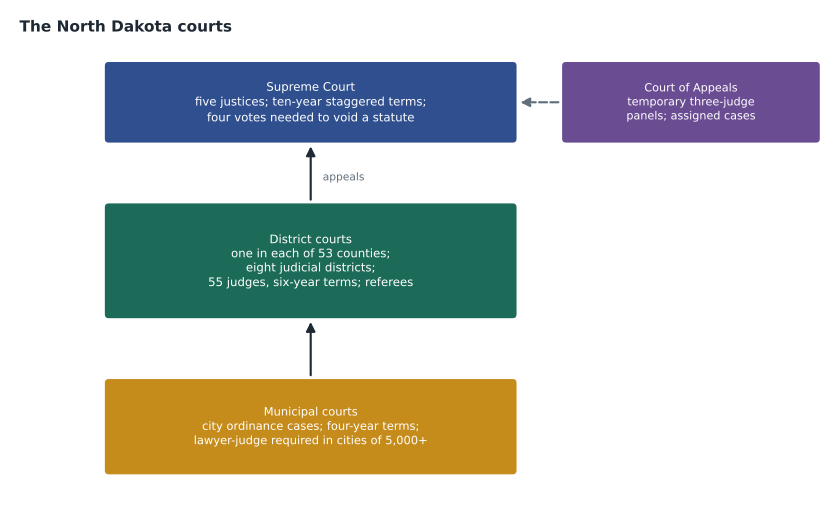
The North Dakota Supreme Court has five justices, elected to ten-year terms arranged so that one justice is elected every two years. The chief justice serves a five-year term as chief, chosen by the justices and the district judges. The Court hears appeals from the district courts, supervises the court system and the practice of law, and adopts the rules of procedure and practice.
Article VI, section 6 of the North Dakota Constitution does not guarantee appeals as a matter of right in the constitution itself; it provides that appeals shall be allowed from the district courts to the Supreme Court as may be provided by law. The legislature has provided for appeals of final judgments and certain orders, and in practice North Dakota appeals generally go directly to the Supreme Court.
A temporary court of appeals
North Dakota has no permanent intermediate appellate court. In 1987 the legislature created a Court of Appeals to help the Supreme Court with its workload. It is assembled from three judges chosen from active and retired district judges, retired justices and attorneys, each serving a one-year term, and it hears cases the Supreme Court assigns to it. A decision of the Court of Appeals can be reviewed by the Supreme Court. The court system's description of the Court of Appeals says plainly that it was created to assist the Supreme Court, not to stand as a separate level of review for every case.
The district courts
The district court is North Dakota's trial court of general jurisdiction. There is a district court in each of the state's 53 counties, organized into eight judicial districts. The court system lists 55 district judges, elected to six-year terms, and five judicial referees who serve in three districts and handle matters such as child support and some juvenile cases. District courts hear civil cases of every size, criminal cases, family law, probate, juvenile matters and appeals from administrative agencies.
Below them are municipal courts, which hear violations of city ordinances. Municipal judges are elected to four-year terms. In cities of 5,000 people or more, the municipal judge must be a licensed North Dakota lawyer; smaller cities may choose to require it.
The four-vote rule
Article VI, section 4 of the North Dakota Constitution contains a rule found in very few states: the Supreme Court shall not declare a legislative enactment unconstitutional unless at least four of the members of the court so decide. On a five-member court, a simple majority of three is not enough to strike down a statute.
The rule has decided cases. On November 21, 2025, in Access Independent Health Services v. Wrigley, the Court considered a district court judgment that had declared North Dakota's abortion statute, chapter 12.1-19.1 of the Century Code, unconstitutional and void. Three justices concluded the statute was unconstitutional. Because four votes were required to declare a statute unconstitutional and only three agreed, the Court did not reach the supermajority required, and the district court judgment was reversed. The statute remained in force even though a majority of the Court believed it violated the state constitution.
Hollis was careful to keep the discussion on the rule, not the subject. 'The lesson for a new lawyer is structural,' she said. 'When you challenge a North Dakota statute under the state constitution, you need four votes on appeal, not three. That changes how you build the record, which arguments you lead with and whether a statute-based challenge or a narrower argument is the better path for your client.'
The rule applies only to declaring a legislative enactment unconstitutional. It does not apply to interpreting a statute, to striking down an administrative rule that conflicts with a statute, or to deciding that a statute does not apply to particular facts. Lawyers who want to avoid the four-vote hurdle often argue for a reading of the statute that avoids the constitutional problem, which needs only a majority.
How a civil action begins
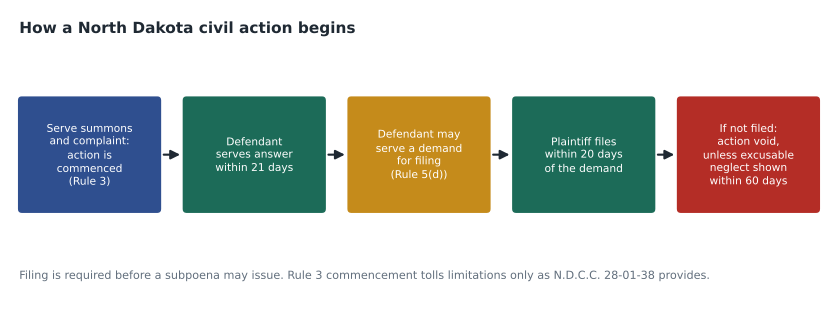
The North Dakota Rules of Civil Procedure are modeled on the federal rules, with important differences. The first one is in Rule 3. In federal court, an action is commenced by filing a complaint with the court. In North Dakota, a civil action is commenced by the service of a summons. The explanatory note to Rule 3 says so directly: serving a summons on a defendant is all that is needed to start a civil action, and North Dakota, unlike Federal Rule 3, does not require filing the complaint to commence an action.
That is why Jonas's case existed only in the firm's file. The summons and complaint had been served, so the action had begun. Nothing required the firm to file them with the court until the case needed the court: a motion, a request for a hearing or a subpoena. Under Rule 5(d), the initiating document must be filed before a subpoena may be issued.
Rule 3 adds a caution: commencement under the rule does not count for tolling a statute of limitations except as section 28-01-38 of the Century Code provides. A lawyer working close to a limitations deadline must read that statute, not just Rule 3, before relying on service to stop the clock.
The demand for filing
A defendant who wants the case in front of a court can force the plaintiff's hand. Under Rule 5(d)(2), a defendant may serve a written demand for filing on the plaintiff. The plaintiff then has 20 days after service of the demand to file the summons and complaint with the court. If the plaintiff does not, the court system's self-help guide explains, the action is void, and the plaintiff would have to start over by serving new papers. The plaintiff can avoid that result by moving the court within 60 days after service of the demand and showing excusable neglect.
The demand does not extend the defendant's own deadline. A defendant must still serve an answer within 21 days after service of the summons and complaint, the same period the federal rules use, or risk a default. Hollis drew a timeline for the group: service on day one, a demand for filing served on day five, the plaintiff's filing deadline on day 25, and the defendant's answer still due on day 22.
Limitation periods a new lawyer meets first
North Dakota's limitation periods are collected in chapter 28-01 of the Century Code. The general six-year statute, section 28-01-16, covers actions on contracts and other obligations, liability created by statute, trespass on real property, injury to goods and, unless another statute provides otherwise, actions for injury to the person or rights of another not arising on contract. That makes North Dakota's ordinary personal injury limitations period six years, longer than in most states. Fraud claims accrue when the facts constituting the fraud are discovered.
Section 28-01-18 sets a two-year period for libel, slander, assault, battery and false imprisonment, for malpractice and for wrongful death. A malpractice claim is subject to an outside limit: the period can be extended for nondiscovery, but not beyond six years after the act or omission, unless a physician's or hospital's fraudulent conduct prevented discovery. A wrongful death claim accrues at death, or, if the death resulted from malpractice, when the malpractice is discovered. Section 28-01-46 adds a requirement for malpractice claims against licensed health care providers: the plaintiff must serve an expert affidavit within three months after commencing the action, or the action must be dismissed without prejudice, unless the court extends the time for good cause.
Claims against the state have their own three-year period under section 28-01-22.1, which applies to actions against the state and its employees and officials acting within the scope of their employment. Lesson 8 covers the notice requirements that come before those claims.
| Claim | Period | Section |
|---|---|---|
| Contract; personal injury not otherwise provided for; trespass; injury to goods | Six years | 28-01-16 |
| Libel, slander, assault, battery, false imprisonment | Two years | 28-01-18 |
| Malpractice | Two years, with a six-year outside limit absent fraud; expert affidavit within three months | 28-01-18, 28-01-46 |
| Wrongful death | Two years from death (or discovery of fatal malpractice) | 28-01-18 |
| Claims against the state | Three years | 28-01-22.1 |
Where the rules live
The North Dakota Rules of Civil Procedure, the Rules of Evidence, the Rules of Appellate Procedure, the Rules of Court and the Administrative Rules are published on the court system's website, each with explanatory notes. The Century Code is published by the Legislative Assembly. Hollis's advice to Jonas for his first year was to read the explanatory note every time he relied on a rule, because the notes explain where North Dakota departs from the federal model and why.
Judicial selection
North Dakota elects its judges. Supreme Court justices and district judges run in nonpartisan elections; a vacancy between elections is filled by appointment by the governor from candidates nominated by the Judicial Nominating Committee, and the appointee later stands for election. A new lawyer should know which judges sit in the district where he or she practices and should read the local practices of that district, which supplement the statewide rules.
Default and answering in North Dakota
Because a North Dakota case can exist without a court file, a defendant who receives a summons may be tempted to wait until something is filed. That is a mistake. The 21-day period to serve an answer runs from service, not from filing, and a plaintiff can file the papers and seek a default judgment once the time has passed. A new lawyer who receives a summons from a client should calendar the answer date from the date of service at once, decide whether to serve a demand for filing, and check whether the plaintiff's claims are subject to any of the special notice or affidavit requirements covered in this lesson and the next.
The same discipline applies on the plaintiff's side. A lawyer who serves a summons to commence an action close to the end of a limitations period should confirm under section 28-01-38 whether service alone stops the clock in that situation, and should be ready to file promptly if the defendant serves a demand. Jonas kept a single checklist for every new file: date of service, answer date, demand for filing date if any, and the governing limitations period with its statute.
Worked problem
Commencement and the demand
Jonas's firm serves a summons and complaint on a hypothetical defendant, Arvid, on March 2. Arvid's lawyer serves a demand for filing by mail on March 6, treated as served that day for this problem. The firm forgets to file. On April 15, the firm realizes its mistake. What happened, and what can the firm do?
Show solution
- The action was commenced on March 2 by service of the summons.
- The demand required filing within 20 days after March 6, by March 26.
- Because the firm did not file, the action is void under Rule 5(d) unless the court finds excusable neglect.
- A motion for relief must be brought within 60 days after service of the demand, by May 5, so the firm can still move, but it must show excusable neglect.
Answer: The action is void unless the firm moves by May 5 and shows excusable neglect; otherwise it must start over with new service, checking the limitations period first.
Common mistakes
MistakeIn North Dakota, filing the complaint commences the action.
InsteadService of the summons commences it under N.D.R.Civ.P. 3.
MistakeA simple majority of the Supreme Court can declare a statute unconstitutional.
InsteadArticle VI, section 4 requires at least four of the five justices.
MistakeNorth Dakota has a permanent intermediate appellate court.
InsteadIts Court of Appeals is a temporary panel that hears cases the Supreme Court assigns.
MistakeA demand for filing extends the defendant's answer deadline.
InsteadThe answer is still due 21 days after service.
MistakeNorth Dakota's personal injury limitations period is two years.
InsteadThe general period is six years under 28-01-16; malpractice, wrongful death and intentional torts are two years.
Practice problems
Work each problem on paper first, then reveal the answer to check.
How many justices must agree to declare a North Dakota statute unconstitutional?
Show answer
At least four of five (N.D. Const. art. VI, section 4).
How is a civil action commenced in North Dakota?
Show answer
By service of a summons (N.D.R.Civ.P. 3).
How long does a plaintiff have to file after a demand for filing?
Show answer
20 days after service of the demand.
How many judicial districts and counties does North Dakota have?
Show answer
Eight judicial districts and 53 counties.
When must a malpractice plaintiff serve an expert affidavit?
Show answer
Within three months after commencing the action (28-01-46).
Summary and key terms
- The Supreme Court has five justices with ten-year staggered terms; a temporary Court of Appeals hears assigned cases.
- District courts sit in all 53 counties in eight judicial districts; municipal courts hear ordinance cases.
- Four of five justices must agree to declare a statute unconstitutional; in 2025 a three-justice majority was not enough.
- A civil action is commenced by service of the summons; filing can come later.
- A demand for filing gives the plaintiff 20 days to file or the action is void, subject to excusable neglect within 60 days.
- Limitation periods: six years generally, two years for malpractice, wrongful death and intentional torts, three years against the state.
- four-vote rule
- The constitutional requirement that four of five justices agree to declare a statute unconstitutional.
- demand for filing
- A defendant's written demand that the plaintiff file the summons and complaint within 20 days.
- judicial referee
- A judicial officer who hears specified matters such as child support under a district judge.
- Court of Appeals
- North Dakota's temporary three-judge appellate panel created in 1987.
- expert affidavit
- The affidavit a malpractice plaintiff must serve within three months under 28-01-46.
Lesson quiz · 5 questions
Score 60% or more to complete this lesson.
Create a free account to save your progress, take quizzes and earn a certificate.