
BAR-232 · Lesson 8 of 12 · 20 min
New Mexico torts: pure comparative fault, the Tort Claims Act and the Civil Rights Act
▶ Video coming soon A video version of this lesson is on the way.
On September 28, 2026, Wanda Peshlakai was driving her pickup north on a county road outside Gallup when a McKinley County road grader pulled out from a side road without stopping. Her truck hit the grader's blade. She broke her wrist, spent two nights in the hospital and missed six weeks of work at the school where she drives a bus. She was also going about ten miles an hour over the limit, which the deputy noted in his report. She came to Benally & Trujillo in early November. Ray Trujillo handed Paloma the file. 'Three questions,' he said. 'How does her speeding affect her claim, what do we have to do to sue the county, and how much can she recover?'
Each of those questions has a distinctive New Mexico answer. New Mexico uses pure comparative fault, so Ms. Peshlakai's own negligence reduces but does not bar her recovery. Claims against governmental entities run through the Tort Claims Act, which waives immunity only in listed situations, requires written notice within ninety days and caps damages. And for violations of rights under the New Mexico Constitution, the Civil Rights Act of 2021 provides a separate remedy without a qualified immunity defense. This lesson covers all three.
Pure comparative fault
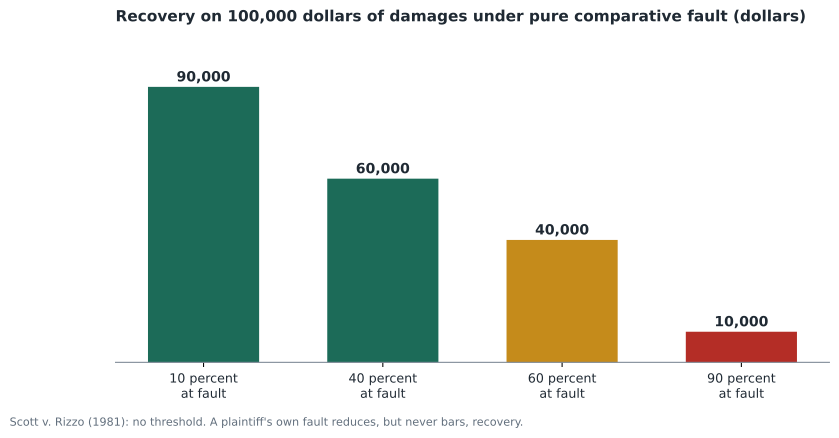
New Mexico adopted pure comparative negligence in Scott v. Rizzo, 1981-NMSC-021, 96 N.M. 682, 634 P.2d 1234. The Supreme Court abolished contributory negligence as a complete bar and held that a plaintiff's own negligence reduces the plaintiff's damages in proportion to the plaintiff's share of fault. Unlike the modified systems in many states, New Mexico has no threshold. A plaintiff who is 60 percent at fault still recovers 40 percent of the damages; a plaintiff who is 90 percent at fault still recovers 10 percent.
The Court made that choice by judicial decision rather than by statute, and New Mexico courts have since applied comparative fault broadly. Fault is compared among everyone whose negligence contributed to the injury, including the plaintiff, the defendants and nonparties who are not before the court. That last point matters for the next rule.
Several liability and its exceptions
After Scott, the Court of Appeals in Bartlett v. New Mexico Welding Supply, Inc. (1982) held that concurrent tortfeasors would no longer be jointly and severally liable; each would pay only its own share of fault. The Legislature codified and refined the rule in 1987 in section 41-3A-1 of the New Mexico Statutes Annotated. In cases to which comparative fault applies, joint and several liability is abolished, and each defendant's liability is several. A defendant who proves that another person's fault contributed to the injury pays only its percentage share, measured against the total fault of everyone involved, including the plaintiff and nonparties.
The statute keeps joint and several liability in four situations: for persons who acted with the intention of inflicting injury or damage; for persons whose relationship makes one liable for the acts of the other, such as an employer and employee, but only for their combined share; for persons strictly liable for manufacturing or selling a defective product, again only for their combined share; and in other situations having a sound basis in public policy. A severally liable defendant has no right of contribution and cannot reduce its share by amounts the plaintiff received from others.
Several liability changes litigation strategy. Because fault can be allocated to a nonparty, a defendant has every incentive to blame someone who is not in the case, such as a driver who cannot be found, and a plaintiff who does not sue every potentially responsible party may be left with an uncollectible share. In Ms. Peshlakai's case, the county will argue that her speeding contributed to the collision, and any share assigned to her reduces her recovery.
The Tort Claims Act: immunity unless waived
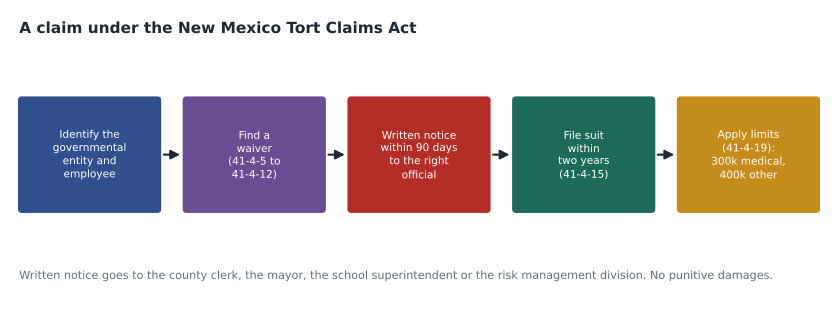
The New Mexico Tort Claims Act, sections 41-4-1 through 41-4-30, starts from the opposite direction from ordinary tort law. Governmental entities and public employees acting within the scope of their duties are immune from tort liability except where the Act waives immunity. The waivers appear in sections 41-4-5 through 41-4-12 and cover negligence in the operation or maintenance of motor vehicles, aircraft and watercraft; in the operation or maintenance of buildings, public parks, machinery, equipment and furnishings; airports; public utilities; medical facilities; health care providers; the construction and maintenance of highways and streets; and certain torts and constitutional violations by law enforcement officers acting within the scope of their duties.
A claim that does not fit a waiver fails, however strong the facts. The first question in every claim against a New Mexico public body is therefore which waiver applies. A road grader is a piece of machinery and equipment operated by the county, and its operation on a road may also fall within the motor vehicle waiver, so Ms. Peshlakai's claim fits comfortably within the Act.
Written notice within ninety days
Section 41-4-16 requires a person with a claim against the state or a local public body to present written notice within ninety days after the occurrence giving rise to the claim. The notice must state the time, place and circumstances of the loss or injury. It goes to the risk management division for claims against the state, to the mayor for a municipality, to the superintendent for a school district, to the county clerk for a county, and to the administrative head of any other local public body. For wrongful death, notice may be presented within six months after the injury that caused the death.
Failure to give notice bars the suit unless the governmental entity had actual notice of the occurrence. Courts read actual notice narrowly: the entity must have known not just that an accident happened, but that litigation was likely. A police report alone usually does not establish actual notice. The ninety-day period excludes up to ninety days during which the injured person was incapacitated by the injury, and the courts have applied the requirement flexibly to minors who cannot give notice themselves. But no lawyer should rely on those exceptions when a timely notice can be sent.
Ms. Peshlakai's accident happened on September 28, 2026, so ninety days run to December 27, 2026. Paloma drafted a notice addressed to the McKinley County clerk describing the time, place and circumstances of the collision, and Ray Trujillo sent it by certified mail on November 12, 2026, keeping the return receipt in the file.
Two years to sue, and the damages limits
Under section 41-4-15, an action under the Act must be commenced within two years after the occurrence, a shorter period than the three years for ordinary personal injury. Section 41-4-19 then limits recovery. For a single occurrence, the governmental entity's liability is capped at 200,000 dollars for each legally described parcel of real property damaged or destroyed; 300,000 dollars for all past and future medical and medically related expenses; and 400,000 dollars per person for all other damages, such as pain and suffering and lost wages. The combined liability for real property and other damages from a single occurrence cannot exceed 750,000 dollars; the medical expense limit sits outside that aggregate. No judgment under the Act may include punitive or exemplary damages or prejudgment interest, and post-judgment interest runs at two percentage points above the prime rate.
| Category | Limit per occurrence (dollars) |
|---|---|
| Real property damage | 200,000 per legally described parcel |
| Past and future medical expenses | 300,000 |
| All other damages | 400,000 per person |
| Aggregate for real property and other damages | 750,000 (medical limit outside the aggregate) |
| Punitive damages, prejudgment interest | Not recoverable |
Worked problem
Ms. Peshlakai's claim
Assume a jury finds Ms. Peshlakai's damages to be 60,000 dollars in medical expenses and 150,000 dollars in other damages, and assigns 20 percent of the fault to her and 80 percent to the county's grader operator.
Show solution
- Comparative fault reduces her recovery by her 20 percent share: 48,000 dollars of medical expenses and 120,000 dollars of other damages.
- Several liability does not change the result here because the county, through its employee, is the only other party at fault.
- The reduced amounts are below the Act's limits of 300,000 dollars for medical expenses and 400,000 dollars per person for other damages.
- No punitive damages or prejudgment interest are available against the county.
Answer: She recovers 168,000 dollars, assuming timely notice and a suit filed within two years.
The New Mexico Civil Rights Act
In 2021 the Legislature enacted the New Mexico Civil Rights Act, which took effect in July 2021 and is codified as article 4A of chapter 41. It creates a state-law claim against a public body for the deprivation of rights, privileges or immunities secured by the Bill of Rights of the New Mexico Constitution, committed by the public body or by a person acting on its behalf. The claim runs against the public body, which must indemnify employees, rather than against individual officers.
The Act's most discussed feature is that it bars the defense of qualified immunity. In federal claims under 42 U.S.C. section 1983, officers can avoid liability unless the right they violated was clearly established. The New Mexico Act removes that defense for claims under the state constitution. The Act allows actual damages, equitable relief and injunctive relief, caps damages at 2 million dollars per claimant, adjusted for cost of living, and requires suit within three years for violations occurring after July 1, 2021. It contains its own notice requirement, with a one-year window. Judgments, settlements and complaints under the Act are public records.
Bills to narrow the Act have been introduced since its passage. In the 2026 session, Senate Bill 146 would have replaced the 2 million dollar cap with Tort Claims Act-style limits, shortened the limitations period to two years, imposed a ninety-day notice rule and restored a form of qualified immunity. The bill died in committee in February 2026, so the 2021 Act remains in force as written. A lawyer should still check for amendments before filing.
A single incident can give rise to claims under both statutes and under federal law. If a deputy used excessive force during an arrest in Gallup, the victim might have a Tort Claims Act claim under the law enforcement waiver, a Civil Rights Act claim for violation of the state constitution's protection against unreasonable searches and seizures, and a section 1983 claim in federal court. Each has its own defendant, notice rule, limitations period, damages rules and immunities, and the choice among them is one of the first strategic decisions in such a case.
Common mistakes
MistakeA plaintiff who is more than 50 percent at fault recovers nothing in New Mexico.
InsteadNew Mexico uses pure comparative fault under Scott v. Rizzo; recovery is reduced, never barred, by the plaintiff's share.
MistakeAll defendants are jointly and severally liable for the whole judgment.
InsteadSection 41-3A-1 makes liability several, with exceptions for intentional torts, vicarious liability, strict products liability and sound public policy.
MistakeA claim against a county must be filed within three years like other personal injury claims.
InsteadThe Tort Claims Act requires written notice within ninety days and suit within two years.
MistakeQualified immunity applies to claims under the New Mexico Civil Rights Act.
InsteadThe 2021 Act bars the qualified immunity defense; an attempt to restore it in 2026 died in committee.
When the defendant is a tribe or a tribal business
In McKinley County, a lawyer must ask one more question before suing an entity: is it a tribe or an arm of a tribe? The Tort Claims Act applies to the state and its local public bodies, not to tribes. Tribes have sovereign immunity from suit under federal law unless Congress has abrogated it or the tribe has clearly waived it. The Supreme Court of the United States held in Kiowa Tribe of Oklahoma v. Manufacturing Technologies, Inc. (1998) that tribal immunity extends to commercial activities off the reservation, and it reaffirmed that rule in Michigan v. Bay Mills Indian Community (2014). A tribally owned business that qualifies as an arm of the tribe usually shares that immunity.
Immunity is not always the end of the matter. Many tribes waive immunity in part, for example through insurance programs, gaming compacts that require a forum for patron injury claims, or contracts with express waiver clauses. And in Lewis v. Clarke (2017), the Supreme Court held that a tribal employee sued in his individual capacity for negligent driving off the reservation could not invoke the tribe's immunity, even though the tribe would indemnify him. A lawyer whose client was hurt by a tribal vehicle should look for a waiver, consider an individual-capacity claim and consider whether tribal court is the proper forum, a subject lesson 10 takes up.
Practical points in public body cases
Three practical habits prevent most mistakes. First, send the Tort Claims Act notice early and to the exact official the statute names, even if the entity's risk office already knows about the accident; actual notice is a narrow safety net. Second, identify every potentially responsible party early, because several liability allows fault to be allocated to nonparties. Third, evaluate damages against the statutory limits before investing heavily in expert witnesses: in a catastrophic injury case against a county, the 400,000 dollar per-person limit for non-medical damages may control the value of the case regardless of the jury's view of the harm.
Summary and key terms
- Scott v. Rizzo, 1981-NMSC-021, adopted pure comparative negligence: a plaintiff's fault reduces but never bars recovery.
- Section 41-3A-1 abolished joint and several liability in comparative fault cases, except for intentional torts, vicarious liability, strict products liability and sound public policy.
- The Tort Claims Act grants immunity except for the waivers in sections 41-4-5 through 41-4-12.
- Written notice within ninety days goes to the right official under section 41-4-16; suit must follow within two years under section 41-4-15.
- Section 41-4-19 caps damages at 200,000 dollars per parcel, 300,000 dollars medical and 400,000 dollars per person for other damages, with a 750,000 dollar aggregate, and bars punitive damages.
- The 2021 Civil Rights Act gives a claim against public bodies for state constitutional violations, bars qualified immunity and caps damages at 2 million dollars.
- 0
- pure comparative fault
- 1
- several liability
- 2
- Tort Claims Act
- 3
- waiver of immunity
- 4
- actual notice
- 5
- damages limits
- 6
- Civil Rights Act
- 7
- qualified immunity
Practice problems
Work each problem on paper first, then reveal the answer to check.
Which case adopted pure comparative negligence in New Mexico?
Show answer
Scott v. Rizzo, 1981-NMSC-021.
To whom is Tort Claims Act notice sent for a claim against a county?
Show answer
The county clerk.
What is the per-person limit for non-medical, non-property damages under section 41-4-19?
Show answer
400,000 dollars.
What happened to Senate Bill 146 in 2026?
Show answer
It died in committee, leaving the 2021 Civil Rights Act unchanged.
Lesson quiz · 5 questions
Score 60% or more to complete this lesson.
Create a free account to save your progress, take quizzes and earn a certificate.