
BAR-232 · Lesson 10 of 12 · 20 min
Indian law and tribal jurisdiction in New Mexico
▶ Video coming soon A video version of this lesson is on the way.
In early November 2026 two files landed on Paloma's desk on the same day. In the first, a Navajo Nation district court had entered a judgment for a Navajo family against a Gallup car dealer, a non-Indian business, after a sale and repossession that took place on the reservation. The family wanted to enforce the judgment against the dealer's assets in McKinley County. In the second, a Gallup feed store owned by a non-Indian wanted to sue a Navajo rancher in state court for an unpaid account; the sale had been made on credit at the rancher's home on the reservation. 'These two files are the same question from opposite directions,' Delores Benally said. 'Which court has the power to decide, and what does the other court have to do with the result?'
Indian law is federal law about the relationships among tribes, the United States and the states. It is not on the UBE, but it is one of the three subjects of the required New Mexico law course, and in much of New Mexico it is part of ordinary practice. This lesson gives a working framework: the tribes in New Mexico, the meaning of Indian country, the rules for criminal and civil jurisdiction, how state courts treat tribal judgments, and the family law rules that protect Indian children.
Tribes in New Mexico
Twenty-three tribes are located wholly or partly within New Mexico: nineteen Pueblos, from Taos in the north to Isleta south of Albuquerque and Zuni in the west; three Apache tribes, the Jicarilla Apache Nation, the Mescalero Apache Tribe and the Fort Sill Apache Tribe; and the Navajo Nation, whose reservation extends into Arizona and Utah and whose capital is Window Rock, Arizona. Each tribe is a sovereign government with its own constitution or traditional governance, laws and, in most cases, courts. The state's Indian Affairs Department, a cabinet-level department since 2003, works with the tribes on state-tribal relations.
Tribal sovereignty predates the United States, and the Supreme Court has recognized it since Worcester v. Georgia (1832). Tribes retain the powers of self-government that Congress has not taken away and that are not inconsistent with their status. In Santa Clara Pueblo v. Martinez (1978), a case from one of New Mexico's Pueblos, the Supreme Court held that the Indian Civil Rights Act did not create a federal cause of action against a tribe, other than habeas corpus, and that tribal sovereign immunity barred the suit. The decision left disputes about a Pueblo's membership rules to the Pueblo's own institutions.
Indian country
Federal jurisdiction rules turn on whether events happened in Indian country, a term defined in 18 U.S.C. section 1151. Indian country includes all land within the limits of an Indian reservation, whether or not owned by Indians; dependent Indian communities; and Indian allotments still held in trust. In New Mexico, Pueblo lands are Indian country, a status the Supreme Court recognized for Pueblo Indians in United States v. Sandoval (1913) and that Congress has confirmed in legislation on Pueblo lands.
New Mexico's own constitution reinforces the federal framework. Article XXI, section 2 provides that the people of the state forever disclaim all right and title to lands owned or held by Indian tribes, and that those lands remain under the absolute jurisdiction and control of Congress until title is extinguished. Unlike some western states, New Mexico never assumed criminal or civil jurisdiction over Indian country under Public Law 280. The result is that state authority in Indian country in New Mexico is limited to what federal law allows.
Criminal jurisdiction
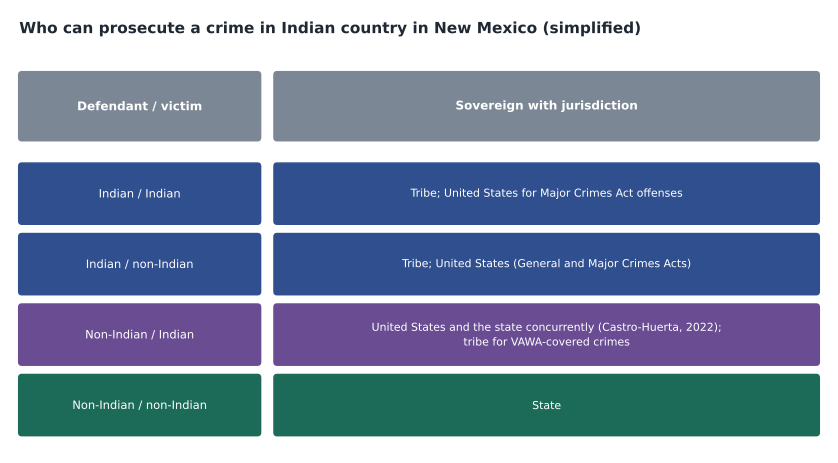
Criminal jurisdiction in Indian country depends on who the defendant is, who the victim is and what the crime is. For crimes by Indians, tribal courts have jurisdiction under their own law, and federal courts have jurisdiction over the serious crimes listed in the Major Crimes Act, 18 U.S.C. section 1153, and over interracial crimes under the General Crimes Act, 18 U.S.C. section 1152. Tribal courts generally may not prosecute non-Indians, under Oliphant v. Suquamish Indian Tribe (1978), except for the special jurisdiction Congress restored in the Violence Against Women Act reauthorizations of 2013 and 2022 for covered crimes such as domestic violence against Indian victims.
Two recent Supreme Court decisions reshaped the field. In McGirt v. Oklahoma (2020), the Court held that the Creek reservation in Oklahoma had never been disestablished, so crimes by Indians there were within federal, not state, jurisdiction. Two years later, in Oklahoma v. Castro-Huerta (2022), the Court held that states have concurrent jurisdiction with the federal government to prosecute non-Indians for crimes against Indians in Indian country. Crimes by non-Indians against non-Indians in Indian country remain within state jurisdiction. For a New Mexico practitioner, the practical result is that a crime on a reservation or Pueblo may be prosecuted by the tribe, the United States or the state depending on the identities of the parties, and a defense lawyer's first task is to determine which sovereign has the power to prosecute.
For the Pueblos specifically, Congress addressed criminal jurisdiction in the Pueblo Lands Act Amendments of 2005, which confirm Pueblo jurisdiction over offenses by members and other Indians, federal jurisdiction over offenses covered by federal law, and New Mexico jurisdiction over offenses by non-Indians against non-Indians that federal law does not cover.
Civil jurisdiction
Civil jurisdiction follows a different set of rules. The starting point is Williams v. Lee (1959), a case arising on the Navajo reservation in Arizona. A non-Indian trader sued a Navajo couple in state court to collect a debt for goods sold on the reservation. The Supreme Court held that the state court had no jurisdiction: allowing it would infringe on the right of reservation Indians to make their own laws and be ruled by them, and the tribal court was the proper forum. The feed store case on Paloma's desk is Williams v. Lee in New Mexico form. A suit by a non-Indian against a tribal member over a transaction on the reservation generally belongs in tribal court.
Tribal authority over nonmembers is narrower. Under Montana v. United States (1981), tribes generally lack civil regulatory authority over the conduct of nonmembers on non-Indian fee land within a reservation, with two exceptions: a tribe may regulate nonmembers who enter consensual relationships with the tribe or its members, such as commercial dealings, contracts or leases, and conduct that threatens or directly affects the tribe's political integrity, economic security, or health or welfare. The Supreme Court has applied that framework to tribal court jurisdiction as well, and federal courts generally require litigants to exhaust tribal court remedies before challenging tribal jurisdiction in federal court.
State taxation and regulation inside Indian country are also limited. In McClanahan v. Arizona State Tax Commission (1973), the Court held that a state could not tax the income of a Navajo tribal member earned on the reservation. States have more room to regulate non-Indians in Indian country, subject to federal preemption analysis that weighs federal, tribal and state interests.
| Situation | Likely forum or rule | Authority |
|---|---|---|
| Non-Indian sues tribal member over a reservation transaction | Tribal court | Williams v. Lee (1959) |
| Tribe regulates nonmember who signed a contract with the tribe | Tribal authority under the consensual relationship exception | Montana v. United States (1981) |
| State taxes a member's income earned on the reservation | Not permitted | McClanahan (1973) |
| Non-Indian commits a crime against an Indian in Indian country | Federal and state concurrent | Castro-Huerta (2022) |
| Suit against a tribe in any court | Barred unless immunity waived or abrogated | Santa Clara Pueblo (1978); Kiowa (1998) |
Tribal judgments in New Mexico courts
The car dealer case runs the other way: a tribal court has already decided, and the question is whether a New Mexico state court will enforce the result. New Mexico courts have long given tribal judgments substantial respect. In Jim v. CIT Financial Services Corp. (1975), the New Mexico Supreme Court treated Navajo law as entitled to full faith and credit. In Halwood v. Cowboy Auto Sales, Inc., 1997-NMCA-098, 124 N.M. 77, the Court of Appeals considered a Navajo tribal court judgment that awarded punitive damages against a non-Indian auto dealer for a repossession on the reservation. It held that the award was civil, not penal, that the tribal court had jurisdiction over the dealer's on-reservation conduct, and that New Mexico courts should recognize the whole judgment, reaching the same result whether the doctrine applied was full faith and credit or comity.
For Benally & Trujillo's clients, Halwood is close to directly on point. The steps are to obtain a certified copy of the Navajo judgment, file it in the district court in McKinley County under the procedure New Mexico provides for tribal court judgments, serve the dealer, and be prepared to show that the tribal court had jurisdiction and that the dealer received due process. A dealer who chose to do business on the reservation, entering contracts with Navajo customers, falls squarely within Montana's consensual relationship exception.
Worked problem
The two files
File one: a Navajo Nation court judgment against a non-Indian Gallup car dealer for an on-reservation repossession, to be enforced in McKinley County. File two: a non-Indian Gallup feed store wants to sue a Navajo rancher in state court for goods sold on credit at the rancher's reservation home.
Show solution
- File one: the dealer entered a consensual commercial relationship with tribal members on the reservation, so the tribal court likely had jurisdiction under Montana.
- New Mexico courts recognize such judgments under Jim and Halwood, whether described as full faith and credit or comity, if the tribal court had jurisdiction and the defendant received due process.
- File two: a suit by a non-Indian against a tribal member over a reservation transaction belongs in tribal court under Williams v. Lee. A state court would likely dismiss for lack of jurisdiction.
- The feed store should file in Navajo Nation court and may need a lawyer admitted to practice there.
Answer: The family can likely enforce the tribal judgment in state court; the feed store must sue in tribal court.
Indian children and families
Family cases involving Indian children follow special rules. The federal Indian Child Welfare Act of 1978 sets standards for state child custody proceedings involving Indian children, including notice to the tribe, the tribe's right to intervene, transfer to tribal court in many cases, heightened standards for removal and placement preferences. In Haaland v. Brackeen (2023), the Supreme Court rejected constitutional challenges to the Act and left it in force.
New Mexico has added its own law. The Indian Family Protection Act, House Bill 135, signed by Governor Michelle Lujan Grisham on March 3, 2022, codifies the federal Act's protections in the New Mexico Children's Code and extends them. It requires affirmative efforts to determine a child's tribal affiliation, active notice to the tribe, collaboration with tribal courts on jurisdiction and an opportunity for the tribal court to assume jurisdiction, coordination with tribes in investigations, interpreters for family members with limited English, and the tribe's right to intervene. A New Mexico lawyer handling an abuse and neglect case should check for possible tribal affiliation at the first meeting.
Common mistakes
MistakeNew Mexico state courts have the same jurisdiction on reservations and Pueblos as elsewhere in the state.
InsteadNew Mexico disclaimed jurisdiction over Indian lands in Article XXI, section 2, and never assumed jurisdiction under Public Law 280; federal law defines what the state may do.
MistakeA non-Indian business can always sue a tribal member in state court over a debt.
InsteadIf the transaction occurred on the reservation, Williams v. Lee generally requires suit in tribal court.
MistakeTribal courts cannot prosecute non-Indians for any crime.
InsteadOliphant is the general rule, but the 2013 and 2022 VAWA reauthorizations restored jurisdiction over covered crimes.
MistakeNew Mexico courts treat tribal judgments as foreign judgments with little weight.
InsteadJim (1975) and Halwood (1997) give tribal judgments full faith and credit or comity, including punitive awards.
Land status in the checkerboard
Around Gallup the first jurisdiction question is often the hardest: where exactly did this happen? East of the main Navajo reservation lies an area known as the checkerboard, where tribal trust land, individual Indian allotments, private fee land, state land and federal land are mixed together parcel by parcel. A ranch road can cross four kinds of land status in a few miles. Because Indian country includes trust allotments and dependent Indian communities, a car accident or a sale on one side of a fence may fall within tribal jurisdiction while the same event a hundred yards away does not.
Lawyers in McKinley and San Juan counties learn to confirm land status before deciding on a forum. The usual sources are land status maps and title records from the Bureau of Indian Affairs, county property records and, in criminal cases, the investigating agency's report, which often notes whether the location is trust land. When the answer is uncertain, a careful lawyer considers filing protectively in the forum most likely to have jurisdiction and researching whether a tribal court will accept a case that a state court declines, or the reverse, before a limitations period runs.
Working with tribal courts
Tribal courts vary widely. Some, like the Navajo Nation courts, have a full system of trial courts, an appellate court, published opinions and detailed rules of procedure. Others are smaller, with judges who may or may not be lawyers and with procedures rooted in tradition. Many tribes, including the Navajo Nation, also offer peacemaking or other traditional dispute resolution. A lawyer appearing in a tribal court should obtain the tribe's code and court rules, confirm admission requirements, learn whether customary law applies and approach the court with the same respect owed to any sovereign's courts.
Summary and key terms
- Twenty-three tribes are located in New Mexico: nineteen Pueblos, three Apache tribes and the Navajo Nation.
- Indian country under 18 U.S.C. section 1151 includes reservations, dependent Indian communities such as Pueblo lands, and trust allotments.
- New Mexico disclaimed jurisdiction over Indian lands in Article XXI, section 2, and is not a Public Law 280 state.
- Criminal jurisdiction depends on the identities of defendant and victim; Castro-Huerta (2022) gives states concurrent jurisdiction over non-Indian crimes against Indians.
- Williams v. Lee (1959) sends reservation-based suits against tribal members to tribal court; Montana (1981) limits tribal authority over nonmembers, with two exceptions.
- Halwood v. Cowboy Auto Sales, 1997-NMCA-098, recognizes Navajo judgments in New Mexico courts; ICWA and the 2022 Indian Family Protection Act govern cases involving Indian children.
- 0
- tribal sovereignty
- 1
- Indian country
- 2
- Public Law 280
- 3
- Major Crimes Act
- 4
- Williams v. Lee
- 5
- Montana exceptions
- 6
- full faith and credit
- 7
- Indian Family Protection Act
Practice problems
Work each problem on paper first, then reveal the answer to check.
Which New Mexico constitutional provision disclaims title to Indian lands?
Show answer
Article XXI, section 2.
Which case held that a state court lacked jurisdiction over a trader's suit against a Navajo couple for a reservation debt?
Show answer
Williams v. Lee (1959).
What did Oklahoma v. Castro-Huerta (2022) decide?
Show answer
States have concurrent jurisdiction to prosecute non-Indians for crimes against Indians in Indian country.
What did Halwood v. Cowboy Auto Sales hold?
Show answer
A Navajo court's punitive damages judgment against a non-Indian dealer for on-reservation conduct is enforceable in New Mexico courts.
Lesson quiz · 5 questions
Score 60% or more to complete this lesson.
Create a free account to save your progress, take quizzes and earn a certificate.