
BAR-232 · Lesson 12 of 12 · 18 min
Capstone: New Mexico practice questions and an exam-day plan
▶ Video coming soon A video version of this lesson is on the way.
Paloma's last session with Hollis Marchetti before the Thanksgiving break came in the third week of November 2026. Marchetti had prepared two things: a set of ten original questions on New Mexico admission rules and New Mexico law, and a New Mexico fact pattern to be answered as a memo, the way Paloma would answer a question from Delores Benally. 'None of this will be on the UBE,' Marchetti said. 'But the admission questions are your next three months, and the New Mexico law is your next thirty years. Then we will build your plan for February 23 and 24.'
This lesson works through both parts with full answers and ends with a study plan and an exam-day plan for the February 2027 exam. All questions and facts are original hypotheticals.
Part one: ten short questions
Paloma answered each question in a sentence or two, under a ten-minute limit for the set, and then checked her answers against Marchetti's key. The questions and answers appear below so that you can work them the same way. Cover the answers, write your own and compare.
| Question | Answer |
|---|---|
| 1. A candidate files for February 2027 on December 10, 2026. Is the filing timely, and what fee applies? | Yes, if the Board's posted late deadline is December 15, 2026, as NCBE reports; the late fee of 1,250 dollars applies. |
| 2. A candidate who fails in February 2027 asks to defer her application to July. What happens? | New Mexico does not permit deferral. She must file a new application for July 2027, which will be a NextGen exam with a 610 passing score. |
| 3. A candidate scores 78 on the MPRE. Can he be licensed in New Mexico? | No. New Mexico requires a scaled score of 80. He must retake the MPRE. |
| 4. A lawyer has a UBE score of 264 from Missouri, earned in July 2022. Can she transfer it in December 2026? | Yes. 264 exceeds 260, and July 2022 is within sixty months of December 2026. She must still meet the other requirements, including the New Mexico law course. |
| 5. A spouse who owned a cabin before marriage sells it alone during the marriage. Is the deed valid? | Yes. The cabin is separate real property, and section 40-3-13 lets a spouse deal alone with separate real property not held jointly. |
| 6. A city bus hits a pedestrian on May 1. What must the pedestrian do by July 30? | Present written notice of the claim to the mayor within ninety days under section 41-4-16, unless the city had actual notice that litigation was likely. |
| 7. A plaintiff is 75 percent at fault for a crash with damages of 80,000 dollars. What does she recover? | 20,000 dollars, under pure comparative fault. |
| 8. A married man dies intestate leaving a wife, two children, community property and separate property. Who takes what? | His wife takes all of the community property and one-fourth of his separate property; the children share the other three-fourths. |
| 9. A Navajo court enters a judgment against a non-Indian business for on-reservation conduct. Will a New Mexico state court enforce it? | Generally yes, under Jim (1975) and Halwood (1997), if the tribal court had jurisdiction and due process was afforded. |
| 10. A solo lawyer in Taos lets her malpractice policy lapse in the middle of a case. What must she do? | Give the client written notice on the prescribed form under Rule 16-104(C) and obtain the client's acknowledgment. |
Paloma got nine of the ten. She missed question 5, answering that both spouses had to sign. 'Read the statute again,' Marchetti said. 'Joinder is required for community real property and for separate property the spouses hold together as joint tenants or tenants in common. A spouse's own separate property, held in that spouse's name alone, is the exception.'
Part two: the Varela problem
Marchetti then gave Paloma a fact pattern and forty-five minutes to write a memo. The facts are invented.
Rosalind and Tobias Varela married in Pueblo, Colorado, in 2009 and moved to Taos, New Mexico, in 2016. While in Colorado, Tobias earned wages that he saved in a brokerage account in his own name, now worth 140,000 dollars. In 2018, Rosalind inherited 60,000 dollars from her aunt and used it as the down payment on a house in Taos, titled in both spouses' names as joint tenants; the mortgage has been paid from both spouses' wages. In 2024, Tobias, without telling Rosalind, mortgaged a vacant lot in Taos that the couple bought in 2020 with their savings, signing the mortgage alone to secure a loan for his business. On August 20, 2026, Rosalind was injured when a Taos County sheriff's patrol car, driving without lights or siren, ran a stop sign and struck her car. She suffered 220,000 dollars in medical expenses and 500,000 dollars in other damages. She was not at fault. On November 2, 2026, she filed for dissolution of marriage, and on November 16, 2026, she consulted a lawyer about the accident for the first time. No one has sent any notice to the county. Advise Rosalind on the classification and division of the property and on her claim against the county.
A model answer
Paloma's memo, lightly edited, follows the IRAC structure Marchetti teaches: issue, rule, application and conclusion for each question.
Issue one: how is the Colorado brokerage account treated? Rule: under section 40-3-8, property acquired while a spouse was domiciled outside New Mexico that would have been community if the spouse had been domiciled here is quasi-community property, and in a dissolution in which both spouses are New Mexico domiciliaries, it is treated as community. Application: Tobias earned the wages during the marriage while domiciled in Colorado; had the couple lived in New Mexico, the wages would have been community. Both spouses now live in Taos. Conclusion: the 140,000 dollar account is treated as community and divided equally, 70,000 dollars to each spouse.
Issue two: how is the Taos house treated? Rule: property titled to both spouses as joint tenants is presumed community, but property acquired with separate funds remains separate to the extent it can be traced; transmutation requires clear and convincing evidence of intent. Application: Rosalind's 60,000 dollar down payment came from an inheritance, which is separate property. Titling the house in joint tenancy creates a presumption that the house is community, but Rosalind can argue that her 60,000 dollar contribution is traceable separate property and that she did not intend a gift to the community. Tobias will argue that joint titling shows an intent to transmute. The mortgage payments came from community wages, so the equity they built is community. Conclusion: the outcome depends on proof of intent. At a minimum Rosalind has a strong claim to reimbursement of her traceable separate contribution, with the remaining equity divided equally as community property.
Issue three: what is the effect of Tobias's mortgage on the vacant lot? Rule: section 40-3-13 requires both spouses to join in a mortgage of community real property, and a mortgage made by one spouse alone in violation of the statute is void. Application: the lot was bought during the marriage with savings, which are community, so it is community real property. The mortgage is not a purchase-money mortgage, and Rosalind did not join or ratify it. Conclusion: the mortgage is void as to the lot. The lender may have claims against Tobias personally, but the lot remains unencumbered community property, divided equally.
Issue four: does Rosalind still have a claim against Taos County? Rule: the Tort Claims Act waives immunity for negligent operation of motor vehicles by public employees, but section 41-4-16 requires written notice to the county clerk within ninety days after the occurrence, unless the county had actual notice that litigation was likely, and section 41-4-15 requires suit within two years. Application: the accident occurred on August 20, 2026. Ninety days runs to November 18, 2026. Rosalind first consulted a lawyer on November 16. Conclusion: notice must be delivered to the Taos County clerk immediately, no later than November 18, describing the time, place and circumstances. If that deadline is missed, the only path is to show actual notice, which requires more than a sheriff's accident report.
Issue five: how much can she recover from the county? Rule: under section 41-4-19, medical expenses are capped at 300,000 dollars and other damages at 400,000 dollars per person, with no punitive damages. Application: her 220,000 dollars in medical expenses are under the cap; her 500,000 dollars in other damages exceed the 400,000 dollar cap. Conclusion: assuming no fault on her part, she can recover at most 620,000 dollars from the county. Her lawyer should also evaluate a claim under the Civil Rights Act only if a state constitutional violation is involved, which these facts do not suggest.
Marchetti scored the memo five of six. Paloma had identified the November 18 deadline and the void mortgage, but she had written that the joint tenancy title 'converts' the house to community property before discussing tracing. 'Lead with the presumption and then the rebuttal,' Marchetti said. 'Classification problems are always presumption first, then the evidence.'
Part three: the study plan
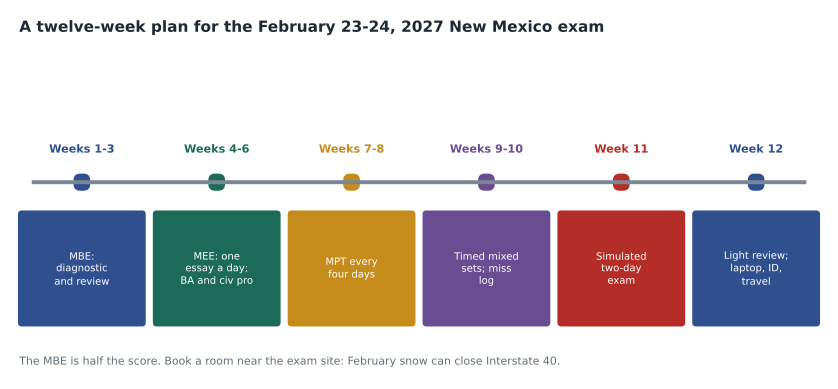
Paloma's plan ran twelve weeks, from the end of November to the exam. Weeks one through three focused on the MBE: a full diagnostic, then subject review in the order of her weakest scores, with fifty timed questions a day and a careful miss log. Weeks four through six moved the emphasis to the MEE, with one timed essay a day across the eight subjects still tested, and two a day on business associations and civil procedure, her weakest essay subjects. Weeks seven and eight added a full MPT every four days. Weeks nine and ten were mixed: a hundred MBE questions every other day, two essays a day, one MPT a week. Week eleven was a full two-day simulated exam on the real schedule. Week twelve was light review, rest and logistics.
The plan reflected her diagnostic. At 258 she was close, so she did not need to relearn everything. She needed three or four MBE scaled points and several written points, and she needed to protect her MPT strength. Marchetti also built in two rest days a week through January, when Paloma was clerking fifteen hours. 'Tired people do not learn,' Marchetti said. 'Rest is part of the plan, not a break from it.'
Part four: the exam-day plan
Paloma wrote her exam-day plan on a single page. Two weeks before: confirm the admission ticket, the exam location and the arrival time in the Board's instructions; complete every laptop software step; reread the list of permitted items. One week before: book the hotel near the exam site for the nights of February 22 and 23, because February snow can close Interstate 40 between Gallup and Albuquerque; pack identification, the admission ticket, the laptop and charger, earplugs if permitted, and lunch. The night before: no new material, a short walk, an early night.
On day one, the MEE morning: read each question's call first, spend about seven minutes outlining, about twenty writing and three checking; move on at thirty-one minutes no matter what. The MPT afternoon: read the task memo twice, spend about forty-five minutes reading and outlining and about forty-five writing; follow every format instruction. On day two, the MBE: about one minute and forty-five seconds per question, mark and return to hard questions, answer every question before time is called. Between sessions: eat, walk and do not discuss answers with other candidates.
| Time | Day one (Tuesday, February 23, 2027) | Day two (Wednesday, February 24, 2027) |
|---|---|---|
| Before the morning session | Arrive early with ticket, ID and laptop | Arrive early; no review of notes in the room |
| Morning | MEE: six essays, about thirty minutes each | MBE: 100 questions, three hours |
| Lunch | Eat, walk, do not discuss the essays | Eat, walk, do not discuss the questions |
| Afternoon | MPT: two tasks, ninety minutes each | MBE: 100 questions, three hours |
| Evening | Rest, light dinner, sleep | Done; the course comes next |
After the exam
The day after the exam, Paloma's plan had three items: register for the next New Mexico law course, check that her MPRE score and character and fitness file were complete, and send her clerkship supervisors a note thanking them. If she passes, she will sign the certificate of understanding, take the oath and enroll in Bridge the Gap within thirty days. If she does not, she will file for July 2027, the first New Mexico NextGen exam, and switch to NextGen materials the week results arrive.
Marchetti closed the session the way she closes every jurisdiction course. 'You know what the exam tests, you know what New Mexico requires beyond the exam, and you know the law your clients will bring you. Pass the exam, take the course and then go do the work.'
Common mistakes
MistakeA spouse can never sell real property alone during marriage.
InsteadA spouse may deal alone with his or her own separate real property not held jointly; joinder is required for community real property and jointly held separate property.
MistakeA joint tenancy deed makes a house community property regardless of where the money came from.
InsteadJoint title creates a presumption of community; tracing and evidence of intent can rebut it or support reimbursement.
MistakeTort Claims Act notice can wait until the client decides whether to sue.
InsteadWritten notice is due within ninety days of the occurrence; the deadline does not wait for the client's decision.
MistakeThe last week before the exam is for learning new material.
InsteadThe final week is for light review, rest and logistics; new material rarely sticks under stress.
Summary and key terms
- Practice questions should be answered under time and checked against the precise rule, as with joinder of separate real property.
- Classification problems start with the presumption of community property and then address tracing, transmutation and intent.
- Quasi-community property from another state is divided as community in a New Mexico divorce when both spouses are domiciled here.
- Tort Claims Act problems require the right waiver, ninety-day notice to the right official, a two-year filing period and the section 41-4-19 limits.
- A twelve-week plan should follow the UBE weights and the candidate's diagnostic, with rest built in.
- The exam-day plan covers logistics, timing for each component and the steps after the exam, including the New Mexico law course.
- 0
- IRAC
- 1
- presumption of community property
- 2
- tracing
- 3
- quasi-community property
- 4
- ninety-day notice
- 5
- damages cap
- 6
- study plan
- 7
- exam-day plan
Practice problems
Work each problem on paper first, then reveal the answer to check.
Why was the vacant lot mortgage in the Varela problem void?
Show answer
The lot was community real property, and Tobias signed the mortgage alone in violation of section 40-3-13.
When was Rosalind's Tort Claims Act notice due?
Show answer
November 18, 2026, ninety days after the August 20 accident.
What is the maximum Rosalind can recover from the county on the stated damages?
Show answer
620,000 dollars: 220,000 in medical expenses and 400,000 in other damages.
How should a candidate budget time on each MEE question?
Show answer
About seven minutes to outline, twenty to write and three to check.
Lesson quiz · 5 questions
Score 60% or more to complete this lesson.
Create a free account to save your progress, take quizzes and earn a certificate.