
BAR-232 · Lesson 3 of 12 · 20 min
Character and fitness and the MPRE
▶ Video coming soon A video version of this lesson is on the way.
Paloma's application had two items she worried about. In 2021 she had been cited in Santa Fe for driving with an expired registration; she paid the fine the next week. In 2023, during her second year of law school, a credit card balance of about 1,900 dollars went to a collection agency after she lost a part-time job. She paid it in full in 2024, and it still appeared on the credit report she printed for the application. 'Do I explain the collection account, or just let the report speak for itself?' she asked Marchetti.
'You explain it,' Marchetti said. 'The Board will see it anyway. What they want to know is whether you are honest about it, whether you understand what happened and whether it is behind you. A short, accurate explanation shows all three. Silence shows none of them.'
This lesson explains New Mexico's character and fitness standard, the conduct that prompts a closer look, the factors the Board weighs, how the process runs, and the MPRE requirement that sits alongside it.
The standard
Rule 15-103 NMRA requires every applicant to be of good moral character and physically and mentally fit to practice law. The rule states the purpose plainly: the investigation protects the public and the justice system. It also puts the burden where it belongs in any licensing scheme. The applicant must prove good character to the Board; the Board does not have to prove bad character.
The committee commentary to the rule describes what the Board is looking for in terms of the qualities a lawyer needs: the ability to reason and communicate, sound judgment, respect for the law and the rights of others, diligence and reliability, and the ability to meet deadlines and obligations. Everything in the investigation is a way of testing those qualities against the applicant's actual record.
Conduct that prompts further inquiry
The rule lists kinds of conduct that may lead the Board to look more closely. The list includes unlawful conduct, acts involving dishonesty, fraud, deceit or misrepresentation, violation of court orders, conduct suggesting that substance use or a mental health condition currently impairs the ability to practice, and false statements or omissions on the bar application itself. None of these items is an automatic bar. Each is a reason for the Board to ask questions and gather more information.
Two points deserve emphasis. First, the inquiry is about conduct and present ability, not diagnosis. An applicant who sought counseling or treatment and is practicing safely is not disqualified by having sought help, and candidates should not avoid treatment out of fear of the bar. Second, an omission on the application can become the most serious item in the file. A minor event honestly disclosed is usually routine. The same event discovered by the Board after the applicant left it off raises a question of candor, and candor goes to the heart of a lawyer's role.
The factors the Board weighs
When the record contains something that calls for a closer look, Rule 15-103 directs the Board to weigh a set of factors. They include the applicant's age at the time of the conduct, how recent the conduct was, how serious it was, the circumstances surrounding it, the cumulative effect of several incidents, evidence of rehabilitation, positive social contributions since the conduct, the applicant's candor in the admissions process, and the materiality of any omissions or misstatements.
Applied to Paloma's file, the factors point the same way. The registration citation is minor and five years old. The collection account came from a real financial setback, it was resolved in full, and she is disclosing it candidly with documentation. A short statement explaining the job loss, the payment and how she now manages her finances is all the Board is likely to need.
| Factor | What helps | What hurts |
|---|---|---|
| Age at the time | Conduct as a teenager or young student | Recent conduct as an adult professional |
| Recency | Several clean years since | Conduct during law school or after filing |
| Seriousness | Minor violations, civil matters resolved | Crimes of dishonesty, violence, fraud |
| Rehabilitation | Payment, treatment, restitution, steady record | Excuses, repeated incidents |
| Candor | Full disclosure with documents | Omissions, minimizing, inconsistent accounts |
Serious crimes
Rule 15-103 treats serious crimes differently. An applicant who has been convicted of a serious crime must show by clear and convincing evidence that they have been rehabilitated and that they otherwise meet the character requirements. That is a higher standard than the ordinary burden, and it reflects the weight the rule gives to the most serious misconduct. It is still a path, not a bar: New Mexico does not make a felony conviction automatically disqualifying, unlike some states.
How the process runs
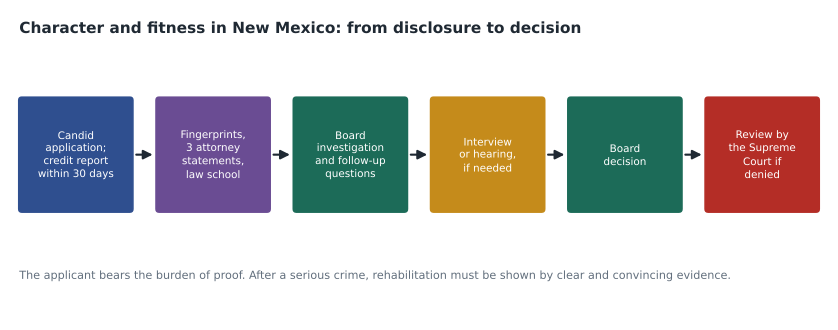
The investigation starts when the application is filed. The Board reviews the application and credit report, runs the fingerprint checks with the FBI and the State of New Mexico, reads the three attorney statements and the law school's response, and contacts employers, courts and other sources as needed. Many applicants hear nothing at all until they are cleared. Others receive a letter asking for more information or documents, and a smaller number are asked to meet with a Board member or appear for a hearing.
If the Board proposes to deny a license on character and fitness grounds, the rules give the applicant a hearing and, after the Board's decision, the right to seek review in the Supreme Court. The applicant remains under the continuing duty to update the application throughout, including during any appeal. Applicants facing a contested hearing often hire a lawyer who handles bar admission matters, which is a sensible investment when a career is at stake.
The certificate of understanding
Before a license is issued, Rule 15-103 also requires each applicant to sign a certificate stating that they have read and understand the New Mexico Rules of Professional Conduct, the rules governing discipline, the State Bar's Creed of Professionalism and the statutes and court rules that govern attorneys in New Mexico. The certificate is a formality only for someone who signs without reading. It is the Court's way of saying that new lawyers are expected to know the rules from the day they are licensed.
The MPRE requirement
Every applicant must also pass the Multistate Professional Responsibility Examination with a scaled score of at least 80. The MPRE is a separate two-hour, sixty-question multiple-choice exam written by NCBE and offered several times a year at testing centers. It tests the ABA Model Rules of Professional Conduct, the ABA Model Code of Judicial Conduct and generally accepted principles of lawyer regulation, not the New Mexico version of the rules. Scores run from 50 to 150, and New Mexico's 80 sits in the middle of the range of state requirements: Mississippi accepts 75, many states require 85 and California requires 86.
Timing is the part candidates most often get wrong, and here the sources do not line up neatly. NCBE's October 2026 summary of New Mexico requirements says there is no time limit on when the MPRE score must be earned. A 2024 version of Rule 15-103 ties the MPRE to the bar result, requiring the score within one year of notice of passing the exam or, for a transferred score, of the UBE administration. A bar review company's summary describes a window of five years before the first application or one year after passing. The safe course is simple: take the MPRE in law school or soon after, and ask the Board in writing to confirm that your score is within the current rule.
Worked problem
Checking an MPRE plan
Paloma's friend Quentin will sit for the February 2027 New Mexico exam. He has not taken the MPRE. He plans to take it in August 2027 if he passes the bar.
Show solution
- New Mexico requires a scaled score of 80 before a license issues.
- If he passes in February 2027, a score earned within one year after notice of passing satisfies even the strictest reading of the rule, so an August 2027 sitting would be in time.
- But waiting carries real risk. If he scores below 80 in August, he must retake in a later window, and his license is delayed until he passes.
- The better plan is to take the MPRE in March 2027, right after the bar exam, leaving a second chance in August.
Answer: Quentin's plan can work, but taking the MPRE in March 2027 gives him a margin for a retake.
Preparing the MPRE efficiently
Most candidates prepare for the MPRE in two to four weeks of part-time study. The exam rewards knowing the Model Rules' structure and the handful of distinctions that generate most questions: conflicts of interest and consent, confidentiality and its exceptions, fees and trust accounts, duties to the court, advertising and solicitation, and judicial conduct. Practice questions matter more than outlines, because MPRE questions often turn on a single word such as 'must', 'may' or 'subject to discipline'.
New Mexico candidates should keep one thing straight. The MPRE tests the ABA Model Rules. The New Mexico Rules of Professional Conduct, found in Rule Set 16 NMRA, follow the Model Rules closely but have their own numbering and some state-specific provisions, such as the requirement in Rule 16-104(C) to tell clients in writing if a lawyer does not carry professional liability insurance. Answer MPRE questions under the Model Rules, and learn the New Mexico differences for practice and for the required New Mexico law course.
Common mistakes
MistakeA felony conviction automatically bars admission in New Mexico.
InsteadNew Mexico requires clear and convincing evidence of rehabilitation after a serious crime, but conviction is not an automatic bar.
MistakeIt is safer to leave a resolved collection account off the application.
InsteadOmissions raise candor problems. Disclose it, explain it briefly and attach proof that it was resolved.
MistakeHaving received mental health treatment will keep me from being licensed.
InsteadThe inquiry is about conduct and present ability to practice, not about seeking help.
MistakeThe MPRE tests the New Mexico Rules of Professional Conduct.
InsteadThe MPRE tests the ABA Model Rules and Model Code of Judicial Conduct. The New Mexico rules are in Rule Set 16 NMRA.
Writing a disclosure statement
Most New Mexico applicants with something in their past end up writing a short explanation for the Board. Marchetti teaches a four-part structure. First, state the facts plainly: what happened, when, where, and how it was resolved, with case numbers or account numbers if there are any. Second, take responsibility without excuses. Third, describe what changed afterward, whether that means a budget, completed counseling, repaid restitution or a long clean record. Fourth, attach documents: the court disposition, the payoff letter or the dismissal order.
Paloma's statement about the collection account ran three short paragraphs. She explained that she lost a weekend job at a restaurant in Albuquerque in the spring of 2023, missed four payments on a card with a balance of about 1,900 dollars, and ignored the creditor's letters for longer than she should have. She paid the account in full in March 2024, attached the agency's letter confirming a zero balance, and described the monthly budget she has kept since. Marchetti read it twice and changed one word. 'Good,' she said. 'It is honest, it is short and it shows you learned something.'
Things candidates forget to disclose
Every year applicants run into trouble over items they did not think counted. The usual list includes traffic citations other than parking tickets, juvenile matters that the application asks about, academic discipline in college or law school, civil lawsuits in which the applicant was a party, past due child support, terminations or resignations in lieu of termination, and arrests that never led to charges. The rule of thumb is to answer the question the form actually asks, read broadly. If an item might be covered, disclose it with a sentence of explanation. Over-disclosure costs a few minutes; under-disclosure can cost a license.
Law school records deserve special mention. The Board receives a response from the applicant's law school, and many schools report academic or conduct matters that the student may have forgotten. An applicant who disclosed a law school matter on the school's own application, or who was disciplined in school, should make sure the bar application tells the same story.
Mental health and substance use questions
Like most states in recent years, New Mexico focuses its inquiry on conduct and on whether a condition currently impairs the ability to practice, rather than on diagnosis or treatment history. An applicant who has sought help for anxiety, depression or substance use and is functioning well has done exactly what a responsible professional should do. Where past conduct, such as a driving offense involving alcohol, raises a question, the Board looks at what the applicant has done since. The State Bar's lawyer assistance program is available to lawyers and law students, and using it is a sign of judgment, not a mark against the applicant.
When to get help
Most applicants never need a lawyer for character and fitness. But an applicant with a serious criminal record, a pattern of financial problems, prior discipline in another profession, or a past omission on a school application should consider consulting a lawyer who handles bar admission matters before filing. The cost of an hour of advice is small compared with the cost of a contested hearing or a year's delay.
Summary and key terms
- Rule 15-103 requires good moral character and fitness, and the applicant bears the burden of proof.
- Unlawful conduct, dishonesty, violation of court orders and false statements on the application prompt further inquiry, not automatic denial.
- The Board weighs age, recency, seriousness, rehabilitation, candor and materiality of omissions.
- After a serious crime the applicant must prove rehabilitation by clear and convincing evidence.
- Each applicant signs a certificate of understanding covering the Rules of Professional Conduct, the disciplinary rules and the Creed of Professionalism.
- New Mexico requires an MPRE scaled score of 80; confirm the timing window with the Board because summaries differ.
- 0
- good moral character
- 1
- burden of proof
- 2
- candor
- 3
- rehabilitation
- 4
- certificate of understanding
- 5
- Creed of Professionalism
- 6
- MPRE
- 7
- scaled score
Practice problems
Work each problem on paper first, then reveal the answer to check.
Who bears the burden of proof in New Mexico character and fitness review?
Show answer
The applicant.
What standard applies after a conviction for a serious crime?
Show answer
The applicant must show rehabilitation by clear and convincing evidence.
What MPRE score does New Mexico require?
Show answer
A scaled score of 80.
What does the certificate of understanding cover?
Show answer
The Rules of Professional Conduct, the disciplinary rules, the Creed of Professionalism and the laws and rules governing attorneys.
Lesson quiz · 5 questions
Score 60% or more to complete this lesson.
Create a free account to save your progress, take quizzes and earn a certificate.