
BAR-229 · Lesson 9 of 12 · 22 min
Nevada torts: comparative negligence, damages limits and claims against government
▶ Video coming soon A video version of this lesson is on the way.
Two injury files landed on Maribel's desk in the same week. In the first, a delivery driver had slipped on an icy ramp at a Washoe County maintenance yard and broken his wrist. In the second, a retired teacher from Carson City claimed that a surgeon in Reno had operated on the wrong knee. Chris Haddad handed her both and asked one question about each. 'For the county case, what is the most we can recover? For the surgeon case, when does the clock run out and what do we have to file with the complaint?'
Both answers are in Nevada statutes, and both are the kind of thing a new Nevada lawyer must know cold. This lesson covers Nevada's comparative negligence rule and its version of several liability, the waiver of sovereign immunity and the damages cap for claims against government, the special rules for medical malpractice, punitive damages, dram shop and social host liability, and wrongful death.
Modified comparative negligence
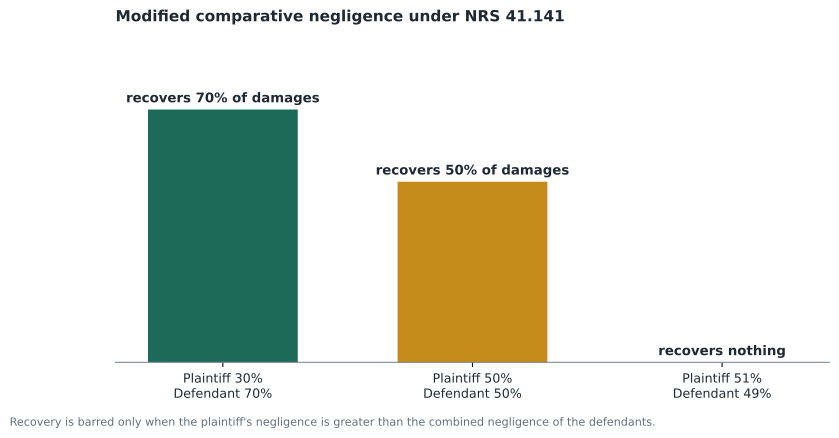
Nevada uses a modified comparative negligence system. Under NRS 41.141, a plaintiff's comparative negligence does not bar recovery if it was not greater than the negligence or gross negligence of the parties against whom recovery is sought. In other words, a plaintiff who is 50 percent at fault can still recover, reduced by that percentage, but a plaintiff who is 51 percent at fault recovers nothing. When there are several defendants, the plaintiff's negligence is compared with the combined negligence of all of them.
Juries are instructed accordingly. They return a general verdict for the plaintiff's total damages and a special verdict stating the percentage of negligence attributable to each party. The court then reduces the award by the plaintiff's percentage. If a defendant has settled, the jury is not told about the settlement, and the settlement amount is deducted from the plaintiff's net recovery.
Several liability and its exceptions
When a plaintiff recovers against two or more defendants in a negligence case, NRS 41.141 makes each defendant severally liable only for that defendant's percentage of fault. The plaintiff bears the risk that one defendant cannot pay. But the statute keeps joint and several liability in several situations: actions based on strict liability; intentional torts; the emission, disposal or spillage of toxic or hazardous substances; concerted acts of the defendants; and injuries caused by a product manufactured, distributed, sold or used in Nevada. The concerted-acts exception does not cover negligent acts of health care providers working together on a patient. Spotting whether a claim falls into one of these exceptions changes who must pay what.
Worked problem
Apportioning a three-party collision in Henderson
A pedestrian is struck in a crosswalk by a car whose driver was speeding; the car had been pushed into the crosswalk by a second car that rear-ended it. The jury finds damages of 300,000 dollars and assigns fault: pedestrian 20 percent, first driver 30 percent, second driver 50 percent. The second driver is uninsured and has no assets. How much can the pedestrian collect from the first driver?
Show solution
- Bar check: the pedestrian's 20 percent is not greater than the defendants' combined 80 percent, so recovery is allowed.
- Reduce for the plaintiff's fault: 300,000 less 20 percent is 240,000 dollars recoverable in total.
- Several liability: this is a negligence claim with no exception (no strict liability, intentional tort, toxic substance, concerted action or product), so each defendant pays only its own share.
- The first driver's share is 30 percent of 300,000, or 90,000 dollars.
Answer: The pedestrian can collect 90,000 dollars from the first driver. The second driver's 150,000-dollar share is uncollectible, and under several liability that loss falls on the plaintiff.
Claims against the state and local governments
Nevada has waived sovereign immunity, but with conditions. NRS 41.031 waives the immunity of the state and its political subdivisions and consents to liability under the same rules applied to natural persons and corporations, subject to listed exceptions. Suits against the state are brought in the county where the cause arose or in Carson City. The waiver does not extend to Eleventh Amendment immunity in federal court.
The main exception is discretionary-function immunity under NRS 41.032. No action may be brought based on an act or omission in the good-faith execution of a statute or regulation that has not been held invalid, or based on the exercise or failure to exercise a discretionary function or duty, whether or not the discretion is abused. The classic line separates policy-level decisions, such as whether to build a road or how to allocate a budget, which are immune, from operational negligence, such as failing to salt a ramp the agency has decided to maintain, which usually is not. Nevada courts apply a test modeled on the federal discretionary-function doctrine, asking whether the decision involved an element of judgment or choice and whether that judgment was grounded in social, economic or political policy.
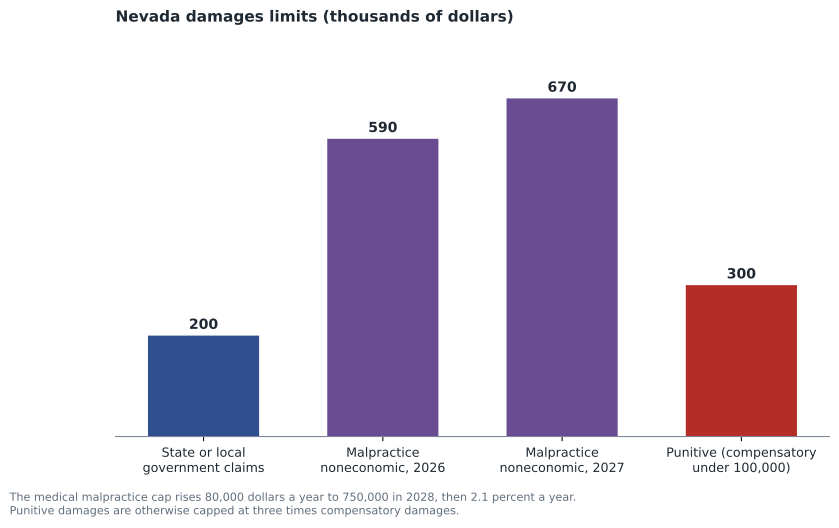
Recovery is capped. Under NRS 41.035, an award for damages in a tort action against the state, a political subdivision or their officers and employees may not exceed 200,000 dollars to any claimant, exclusive of interest computed from the date of judgment, and may not include exemplary or punitive damages. The cap applies per claimant, which matters in cases with several injured people.
There is also a claim-filing provision. Under NRS 41.036, tort claims against the state must be filed with the Attorney General, and claims against a political subdivision with its governing body, within two years after the cause of action accrues. Filing the administrative claim is not a condition precedent to suing, but it is part of good practice, and the general two-year limitations period for injury claims still applies to the lawsuit itself.
Medical malpractice
Professional negligence claims against health care providers follow chapter 41A. Professional negligence means a provider's failure to use the reasonable care, skill or knowledge ordinarily used by similarly trained and experienced providers under similar circumstances (NRS 41A.015).
Three procedural rules shape every case. First, the expert affidavit: under NRS 41A.071, a court must dismiss, without prejudice, a professional negligence action filed without an affidavit that supports the allegations, is made by a medical expert who practices or has practiced in a substantially similar area, identifies each provider alleged to be negligent, and sets out the specific negligent acts separately for each defendant. Second, the limitations period: under NRS 41A.097, for injuries on or after October 1, 2023, the action must be filed within three years after the injury or two years after the plaintiff discovers or reasonably should have discovered it, whichever comes first, with tolling while a provider conceals a relevant act, error or omission. For earlier injuries, the periods were three years and one year. Third, several liability: each defendant is liable only for its own percentage of negligence, for both economic and noneconomic damages (NRS 41A.045).
Nevada also creates a rebuttable presumption of negligence, without the need for expert testimony, in a short list of obvious cases (NRS 41A.100): a foreign substance other than medication or a prosthetic device left in the body after surgery; an explosion or fire originating in a substance used in treatment; an unintended burn from heat, radiation or chemicals; an injury to a part of the body not involved in or near the treatment; and surgery on the wrong patient or the wrong body part. The presumption does not apply if the plaintiff files an expert affidavit or designates an expert to prove the breach.
Noneconomic damages are capped. NRS 41A.035, as amended by Assembly Bill 404 in 2023, raised the long-standing 350,000-dollar cap in steps of 80,000 dollars each January 1: 430,000 dollars in 2024, 510,000 in 2025, 590,000 in 2026, 670,000 in 2027 and 750,000 in 2028. From January 1, 2029, the cap increases 2.1 percent a year. The cap applies to the action as a whole, not to each defendant, and economic damages such as medical expenses and lost earnings are not capped.
| Rule | Medical malpractice in Nevada |
|---|---|
| Expert affidavit | Required with the complaint or the case is dismissed without prejudice (NRS 41A.071) |
| Limitations | 3 years from injury or 2 years from discovery, whichever is first, for injuries on or after October 1, 2023 (NRS 41A.097) |
| Liability | Several only (NRS 41A.045) |
| Presumption of negligence | Five listed situations, such as wrong-site surgery (NRS 41A.100) |
| Noneconomic damages cap | 590,000 dollars in 2026; 670,000 in 2027; 750,000 in 2028 (NRS 41A.035) |
Punitive damages
Punitive damages in Nevada are governed by NRS 42.005. In an action for breach of an obligation not arising from contract, a plaintiff may recover punitive damages by proving by clear and convincing evidence that the defendant has been guilty of oppression, fraud or malice, express or implied. The award may not exceed three times the compensatory damages if compensatory damages are 100,000 dollars or more, or 300,000 dollars if compensatory damages are less than 100,000 dollars. The caps do not apply to claims against a manufacturer, distributor or seller of a defective product; an insurer acting in bad faith regarding its coverage obligations; violators of housing discrimination laws that allow higher awards; defendants responsible for harm from toxic, radioactive or hazardous materials; or defendants liable for defamation.
The procedure is bifurcated. The jury first decides whether punitive damages should be assessed. If it says yes, a separate proceeding before the same jury determines the amount, and the jury is not told about the caps. Evidence of the defendant's financial condition is not admissible until the amount phase.
Alcohol: dram shop and social host liability
Nevada largely rejects dram shop liability. Under NRS 41.1305, a person who serves or furnishes alcohol to someone 21 or older is not liable for damages caused by that person's consumption. The rule is different for underage drinkers. A person who knowingly serves or furnishes alcohol to someone under 21, or knowingly allows an underage person to drink on premises or in a vehicle the person controls, is liable for damages caused by the underage person's consumption, including attorney fees and costs and, where warranted, punitive damages. Licensed sellers and servers and their employees acting in the course of business are excluded from this underage-drinking liability, and their acts may not be used to prove proximate cause or negligence per se. In a state where the casino and hospitality industry is central to the economy, this statute appears in many cases.
Wrongful death
Under NRS 41.085, when a person's death is caused by the wrongful act or neglect of another, the decedent's heirs and the personal representative may each bring an action. The heirs may recover damages for their grief or sorrow, loss of probable support, companionship, society, comfort and consortium, and for the decedent's pain, suffering or disfigurement. The personal representative may recover the decedent's special damages, such as medical and funeral expenses, and any penalties, including punitive damages, that the decedent could have recovered, but not the decedent's pain and suffering, which belongs to the heirs' claim.
Worked problem
Answering Chris Haddad's two questions
The delivery driver slipped on an unsalted ramp at a county maintenance yard. The teacher was operated on at the wrong knee by a Reno surgeon on March 3, 2026. What is the most the driver can recover from the county, and when does the teacher's claim expire and what must be filed with it?
Show solution
- Driver: the county is a political subdivision. Failing to salt a ramp it maintains is operational, not a policy choice, so discretionary-function immunity under NRS 41.032 likely does not apply.
- Cap: NRS 41.035 limits recovery to 200,000 dollars per claimant, with no punitive damages; comparative fault under NRS 41.141 may reduce the award.
- Teacher: the injury occurred after October 1, 2023, so the claim must be filed within three years of injury or two years of discovery, whichever is first. She knew immediately, so the deadline is March 3, 2028.
- Filing: wrong-site surgery triggers the NRS 41A.100 presumption, but if the firm files an expert affidavit under NRS 41A.071, the presumption does not apply. Most lawyers file the affidavit anyway to avoid dismissal if the presumption is contested.
Answer: The driver can recover at most 200,000 dollars from the county. The teacher's claim must be filed by March 3, 2028; filing a supporting expert affidavit is the safer course, and noneconomic damages will be capped at the amount in effect under NRS 41A.035.
Common mistakes
MistakeA plaintiff who is 50 percent at fault recovers nothing in Nevada.
InsteadRecovery is barred only if the plaintiff's negligence is greater than the defendants' combined negligence; at 50 percent the plaintiff recovers half.
MistakeEvery co-defendant in Nevada is jointly and severally liable.
InsteadNegligence defendants are severally liable under NRS 41.141, with exceptions for strict liability, intentional torts, toxic substances, concerted acts and products.
MistakePunitive damages are available against a Nevada county.
InsteadNRS 41.035 bars punitive damages against the state and political subdivisions and caps damages at 200,000 dollars per claimant.
MistakeA casino that serves a visibly drunk adult patron is liable to people the patron later injures.
InsteadNRS 41.1305 bars liability for serving adults 21 or older; liability for underage drinking does not extend to licensed servers acting in the course of business.
Summary and key terms
- NRS 41.141 bars a plaintiff only when the plaintiff's negligence is greater than the defendants' combined negligence; defendants are severally liable with listed exceptions.
- Nevada waives sovereign immunity (NRS 41.031) subject to discretionary-function immunity (NRS 41.032) and a 200,000-dollar per-claimant cap with no punitive damages (NRS 41.035).
- Medical malpractice requires an expert affidavit, has a three-year or two-year limitations period, imposes several liability and caps noneconomic damages at 590,000 dollars in 2026 rising to 750,000 in 2028.
- Punitive damages require clear and convincing proof of oppression, fraud or malice and are capped at three times compensatory damages or 300,000 dollars, with exceptions.
- NRS 41.1305 rejects dram shop liability for adults but imposes liability for knowingly furnishing alcohol to underage persons, except for licensed servers in the course of business.
- Heirs and personal representatives each have wrongful death claims under NRS 41.085, with different recoverable damages.
- 0
- modified comparative negligence
- 1
- several liability
- 2
- discretionary-function immunity
- 3
- damages cap
- 4
- expert affidavit
- 5
- noneconomic damages
- 6
- punitive damages
- 7
- social host liability
- 8
- wrongful death
Practice problems
Work each problem on paper first, then reveal the answer to check.
Under NRS 41.141, may a plaintiff who is 45 percent at fault recover?
Show answer
Yes, reduced by 45 percent, because the plaintiff's negligence is not greater than the defendants'.
What is the damages cap for a tort claim against a Nevada county?
Show answer
200,000 dollars per claimant, exclusive of post-judgment interest, with no punitive damages.
What is the Nevada noneconomic damages cap in a medical malpractice action in 2027?
Show answer
670,000 dollars.
What must a plaintiff prove to recover punitive damages in Nevada?
Show answer
Oppression, fraud or malice, by clear and convincing evidence.
Lesson quiz · 5 questions
Score 60% or more to complete this lesson.
Create a free account to save your progress, take quizzes and earn a certificate.