
BAR-229 · Lesson 4 of 12 · 22 min
The Nevada Plan: structure, scoring and the Foundational Law Exam
▶ Video coming soon A video version of this lesson is on the way.
Maribel's July 2026 exam had been a single, compensatory test. Her MBE score had been decent, her essays uneven and her performance tests strong, and the combined result had landed just below the line. 'Under the old system I would retake everything,' she told Marchetti. 'Under the new one, I take a multiple-choice exam that covers the same seven subjects I just studied for the MBE, and a performance exam that is basically the part I was best at. That sounds better. Why does it make me nervous?'
'Because you cannot lean on your strengths any more,' Marchetti said. 'Each part has to be passed by itself. The good news is that you already know what both parts look like. The work now is to make sure neither is a weak spot.'
This lesson explains how the Nevada Plan is structured and scored, then focuses on its doctrinal component, the Foundational Law Exam: what it covers, how it is delivered, when it is given, how it is scored and how to prepare.
A conjunctive licensing system
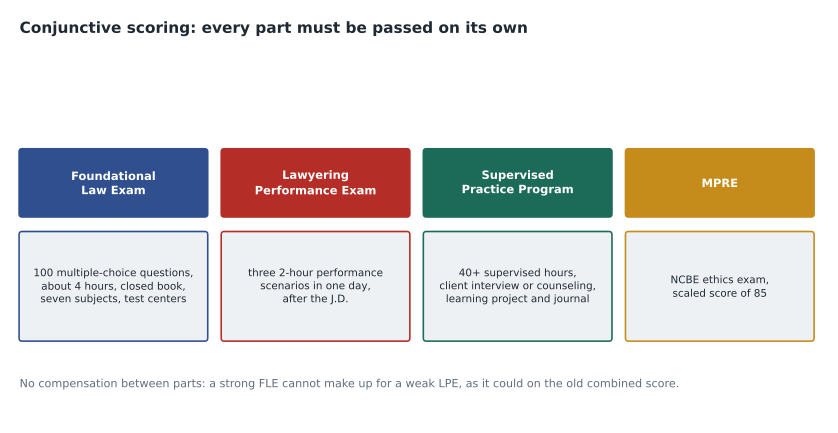
Testing experts describe two broad ways to combine several measurements. In a compensatory system, the parts are added into a total, and a high score on one part can offset a low score on another. Nevada's legacy exam worked that way, as do the UBE and most state exams. In a conjunctive system, each part has its own passing standard, and a candidate must meet every one. The Nevada Plan is conjunctive. One of the Plan's designers put the point directly when the first results came out: strength in one area will no longer compensate for weakness in another.
A conjunctive design has consequences for preparation. A candidate cannot plan to 'win' on the performance exam and 'survive' on doctrine. On the other hand, each part can be studied for with a narrower focus, scheduled when the candidate is ready, and retaken without repeating the parts already passed. For many candidates, especially working graduates, that flexibility matters more than anything else.
What the Foundational Law Exam is
The Foundational Law Exam, or FLE, is a closed-book, computer-based exam of 100 multiple-choice questions, taking about four hours. It covers seven subjects: federal civil procedure, constitutional law, contracts, criminal law and procedure, evidence, real property and torts. Those are the same seven subjects that the MBE covered, which is not a coincidence: they are the core of the first-year curriculum and the doctrinal foundation every new lawyer needs.
The FLE is not the MBE, however. It is written by Nevada's own drafting team, which was co-chaired by two well-known legal education scholars, Joan Howarth and Deborah Jones Merritt, and it is designed to test general principles that every law school covers rather than the fine points that commercial courses drill. The chair of Nevada's Board of Bar Examiners described the content as built around roughly twenty general principles per subject, all within what ABA-approved law schools already teach. The exam is meant to be passable by a diligent student who has done the coursework, without an expensive bar review course, though many candidates will still want structured review.
| Feature | Foundational Law Exam |
|---|---|
| Questions | 100 multiple-choice |
| Time | About four hours |
| Materials | Closed book |
| Delivery | Computer-based, at testing centers in and outside Nevada |
| Subjects | Federal civil procedure, constitutional law, contracts, criminal law and procedure, evidence, real property, torts |
| Eligibility | 42 credits at an ABA-accredited law school, or functional equivalency approval |
| Frequency | Four testing windows a year from 2027 |
| Fee | 150 dollars (non-attorneys) or 325 dollars (attorneys) |
When it is given
The first FLE was given in May 2026. It was offered to students in the class of 2027 who had completed the required credits and to out-of-state attorneys. Further windows followed in October and December 2026. From 2027, the State Bar lists four windows a year: February 18-19, May 27-28, August 19-20 and October 28-29, 2027. Each window spans two days, and candidates schedule a seat at a testing center within it. Registration closes about three months before each window, with a late period after that.
The schedule lets students take the FLE when the material is freshest. A student who finishes first-year courses in May can sit the FLE in the summer or fall of the second year, before the doctrine fades. A student who would rather wait until after the third year, or a graduate like Maribel, can take it then. There is no requirement to take the FLE before the LPE or in any particular sequence.
How it is scored
The FLE is scored on a scale set by the Board, and a candidate either passes or does not. Bar review providers report the passing scaled score as 75; candidates should confirm the current standard on the State Bar's FLE page before the exam. Raw scores are converted to the scale so that the standard means the same thing from one window to the next, even though the particular questions differ. As on the MBE, a small number of questions on any form may be pretest items that do not count, and candidates cannot tell which they are, so every question deserves full effort.
The first administration produced a pass rate of 76 percent, as the State Bar of Nevada reported in July 2026. Because the takers were mostly second- and third-year students and some out-of-state lawyers, and because the FLE tests only doctrine, that figure cannot be compared directly with the 56 percent pass rate on Nevada's legacy exam in February 2026, which included many repeat takers and a combined score.
What the questions look like
FLE questions present a short set of facts and ask for the best answer among several options. Some ask for the most likely outcome, some for the strongest argument, some for the correct rule. Because the exam tests general principles, the hardest questions are not about obscure exceptions; they are about applying a familiar rule correctly to facts that look slightly different from the textbook version. A torts question, for example, may turn on whether a duty exists at all before any question of breach. A civil procedure question may turn on whether a federal court has subject-matter jurisdiction before personal jurisdiction is reached.
Worked problem
Working an original FLE-style question
A homeowner hires a contractor to replace a roof for 18,000 dollars, payable on completion. The contractor finishes everything except installing the final row of ridge caps, which would cost 400 dollars to complete, and then refuses to return. The homeowner refuses to pay anything. The contractor sues for the contract price. What is the most likely result?
Show solution
- Identify the subject and issue: contracts, and whether the contractor substantially performed.
- Recall the rule: a party who has substantially performed may recover the contract price less the cost to complete or the damages caused by the minor breach; a material breach would excuse the other party.
- Apply it: the omitted work costs 400 dollars on an 18,000-dollar contract and does not defeat the purpose of the roof replacement. That is a minor breach.
- Eliminate wrong answers: an answer saying the contractor recovers nothing treats the breach as material; an answer awarding the full 18,000 dollars ignores the homeowner's damages.
Answer: The contractor most likely recovers the contract price less the cost of completing the ridge caps, about 17,600 dollars.
Preparing for the FLE
Because the FLE covers general principles in the core subjects, the best preparation looks like good first-year exam preparation, with more practice questions. Marchetti suggested a three-part approach for the group's Nevada members.
First, build or refresh a short outline for each subject, organized around the main principles rather than every case. For torts, that means duty, breach, causation and damages for negligence; the intentional torts and their defenses; strict liability; products liability; and defamation and privacy basics. For evidence, it means relevance, character evidence, impeachment, hearsay and its main exceptions, and privileges. Second, do timed multiple-choice sets regularly, starting with 20 to 30 questions and building toward full 100-question sessions of about four hours. Third, keep a 'miss log': for every question missed, write the rule that would have produced the right answer and why the chosen answer was tempting.
For Maribel, who had studied for the MBE through July, the task is mostly maintenance. She took a full diagnostic set in mid-November 2026 and scored well in contracts, torts and criminal law but missed more than she liked in real property future interests and in civil procedure joinder. Those became her targets for December, alongside her performance-test practice for the LPE.
Worked problem
A second original question: evidence
In a negligence trial arising from a collision in Henderson, the plaintiff calls a bystander who testifies that, seconds after the crash, another bystander shouted, "That red truck ran the light!" The defendant drives a red truck and objects on hearsay grounds. How should the court rule?
Show solution
- Identify the issue: the statement is offered to prove that the truck ran the light, so it is hearsay unless an exception applies.
- Look for an exception that does not depend on the declarant's availability: a present sense impression describes an event while or immediately after the declarant perceived it; an excited utterance relates to a startling event while the declarant is under the stress of excitement.
- Apply: the statement was made seconds after a crash and describes it. Both exceptions fit.
- Eliminate distractors: an answer that requires the declarant to testify, or that treats the statement as inadmissible character evidence, misreads the issue.
Answer: Overrule the objection. The statement is admissible as a present sense impression or an excited utterance.
| Day | FLE work (about 90 minutes) | Other Plan work |
|---|---|---|
| Monday | 33 mixed questions, timed, then review | SPP hours at the firm |
| Tuesday | Outline review: one weak subject | LPE: read one past performance test task |
| Wednesday | 33 mixed questions, timed, then review | SPP journal entry |
| Thursday | Miss log review and rule rewrite | LPE: write one task under time |
| Friday | Rest or light flashcards | Character and fitness file: one hour |
| Saturday | 100-question simulation every other week | LPE: full scenario every other week |
| Sunday | Off | Off |
The table shows a pattern that works for many working candidates: short, frequent doctrinal sessions, a weekly longer simulation, and a deliberate day off. Maribel adapted it to her firm schedule, moving the long sessions to Sunday afternoons and keeping Saturday free for her family in Elko twice a month.
Common traps on doctrinal multiple choice
A few patterns account for many wrong answers on exams like the FLE. The first is answering the question you expected instead of the one asked: a call asking for the defendant's best argument is not asking who wins. The second is choosing an answer that states a true rule that does not apply to these facts. The third is overlooking a threshold issue, such as whether a contract is within the statute of frauds before asking whether it was breached, or whether state action exists before asking whether a speech restriction is content-based. The fourth is reading too fast and missing a single word, such as a date, an age or the word 'not'. A miss log quickly shows which of these traps catches a particular candidate most often.
Test-day logistics
Because the FLE is delivered at testing centers, the logistics are those of any computer-based professional exam. Candidates schedule a seat after registration, bring the identification the vendor requires, arrive early for check-in, and store personal items in a locker. Closed book means nothing but what the center provides. Scheduled breaks, if any, follow the vendor's rules. Candidates approved for testing accommodations should confirm that the accommodations have been set up with the testing center before the day, not at the check-in desk.
Marchetti's practical advice: take one full practice set at the same time of day as your scheduled seat, in a quiet place, with only the materials you will have. Four hours of focused multiple-choice work is tiring in a way that 25-question sets are not.
How the FLE fits the rest of the Plan
The FLE and the LPE test different things. The FLE asks whether the candidate knows core rules and can apply them to short fact patterns. The LPE asks whether the candidate can do lawyering tasks with a file of facts and a library of law provided. Doctrine helps on the LPE, because a candidate who knows the general law reads the library faster, but the LPE gives the law needed for each task. The FLE gives nothing; it is closed book. For that reason, many candidates will take the FLE during law school and the LPE right after graduation, but candidates like Maribel, who are finishing after graduation, can take them in either order.
Common mistakes
MistakeThe FLE is just the MBE with a new name.
InsteadThe FLE covers the same seven subjects but is written by Nevada's own drafters around general principles, with 100 questions in about four hours.
MistakeI can bring a statute book or outline into the FLE.
InsteadThe FLE is closed book.
MistakeA strong LPE will make up for a weak FLE.
InsteadThe Nevada Plan is conjunctive: each component must be passed on its own.
MistakeThe FLE is given only in Las Vegas and Reno.
InsteadIt is delivered at testing centers both inside and outside Nevada.
Summary and key terms
- The Nevada Plan is a conjunctive system: each component has its own passing standard.
- The FLE has 100 closed-book multiple-choice questions in about four hours on seven core subjects.
- It is delivered at testing centers in and outside Nevada, four times a year from 2027.
- Bar review providers report a passing scaled score of 75; confirm the current standard with the State Bar.
- The first FLE, in May 2026, had a 76 percent pass rate.
- Preparation centers on general principles, timed practice sets and a miss log.
- 0
- conjunctive scoring
- 1
- compensatory scoring
- 2
- Foundational Law Exam
- 3
- scaled score
- 4
- pretest question
- 5
- miss log
Practice problems
Work each problem on paper first, then reveal the answer to check.
What does conjunctive scoring mean in the Nevada Plan?
Show answer
Each component must be passed on its own; no part can offset another.
How many questions are on the FLE, and how long does it take?
Show answer
100 multiple-choice questions in about four hours.
Name the seven FLE subjects.
Show answer
Federal civil procedure, constitutional law, contracts, criminal law and procedure, evidence, real property and torts.
When was the first FLE given, and what was its pass rate?
Show answer
May 2026; 76 percent.
Lesson quiz · 5 questions
Score 60% or more to complete this lesson.
Create a free account to save your progress, take quizzes and earn a certificate.