
BAR-229 · Lesson 11 of 12 · 20 min
No reciprocity: limited practice, pro hac vice and practice after admission
▶ Video coming soon A video version of this lesson is on the way.
Arrieta & Haddad's newest matter came from a Sacramento firm. A California client had been sued in Reno over a failed restaurant lease, and the client's long-time California lawyer, Meredith Huang, wanted to handle the trial. 'Can she just get admitted in Nevada?' the client asked. Begoña Arrieta explained that Meredith could not be admitted on motion, no matter how experienced she was, but that she could appear in this one case with the court's permission, alongside a Nevada lawyer. 'That Nevada lawyer would be me,' Arrieta said.
Maribel took notes. 'So even after twenty years in California, she would have to do the Nevada Plan to get a full license?' she asked afterward. 'The FLE and the LPE, yes,' Arrieta said. 'Not the supervised practice; she would qualify for the exemption. Nevada has always been like this.'
This lesson covers the routes into Nevada practice for lawyers licensed elsewhere, the limited forms of practice Nevada allows without full admission, and the duties of a newly admitted Nevada lawyer: the oath, State Bar membership, the mentoring program, continuing legal education and pro bono reporting.
No admission on motion, no transferred scores
Most states allow experienced lawyers from other states to be admitted on motion, without an exam, after a period of practice, and most accept transferred UBE scores. Nevada does neither. NCBE's summary of Nevada's rules lists no admission on motion and no attorneys' exam, and Nevada accepts neither UBE nor NextGen scores nor MBE scores transferred from other jurisdictions. Every lawyer who wants a full Nevada license, however experienced, completes the Nevada Plan.
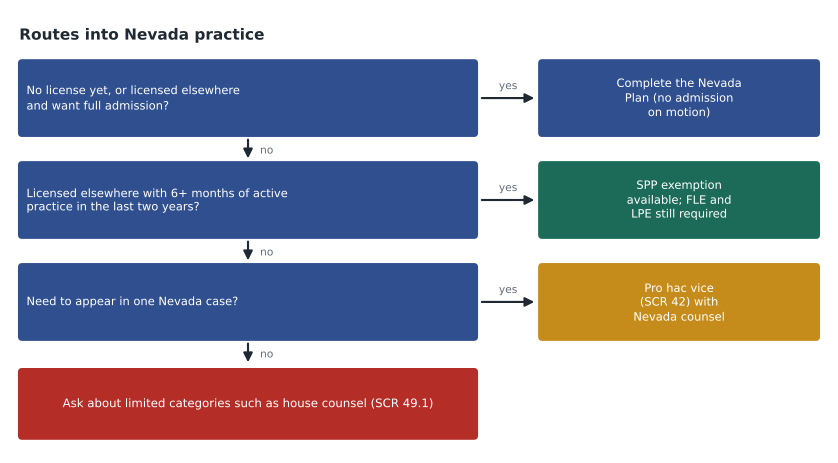
Nevada does give experienced lawyers some relief within the Plan. A lawyer who has had more than six continuous months of active, licensed practice in a United States jurisdiction within the last two years may request an exemption from the Supervised Practice Program. That lawyer still takes the Foundational Law Exam and the Lawyering Performance Exam, pays the attorney fees for each (325 and 500 dollars in the current cycle), takes the MPRE if the existing score is outside Nevada's window, and goes through character and fitness. For a busy lawyer, the Plan's structure has an advantage over the old two-and-a-half-day exam: the FLE can be taken at a testing center near home on a scheduled day, and the LPE is a single day.
Pro hac vice
A lawyer licensed elsewhere who needs to appear in a particular Nevada case can seek permission to appear pro hac vice under SCR 42. The out-of-state lawyer must associate with an active member of the State Bar of Nevada, who is responsible to the court for the case, and must apply for permission through the State Bar and the court in the manner the rule requires, including a fee and disclosures about the lawyer's admissions, discipline history and prior appearances. Courts retain discretion to deny or revoke permission, and the rule is designed for occasional appearances, not for building a regular Nevada practice. Nevada Rule 5.5 reinforces the point: an out-of-state lawyer may not establish an office or other systematic and continuous presence in Nevada or hold out as admitted to practice in Nevada.
The associated Nevada lawyer is not a figurehead. Local counsel must be prepared to participate in the case, sign filings as the rules require and appear when the court expects. Arrieta told Maribel that local counsel work is a common way for small Nevada firms to build relationships with firms in California, Arizona and Utah, but it carries real responsibility.
Transactional work: Rule 5.5A registration
Nevada is unusual in requiring out-of-state lawyers who handle Nevada work outside the courts to register. Under Nevada Rule 5.5A, a lawyer admitted in another jurisdiction who represents clients in Nevada in transactional or other non-litigation matters must register annually with the State Bar of Nevada and pay a 150-dollar fee by January 31. Failing to file can bring a fine of up to 500 dollars and other consequences. The rule lets Nevada know who is practicing in the state and subjects those lawyers to Nevada's disciplinary authority, while still permitting the cross-border transactional work that Nevada's economy, from mining and real estate to gaming and corporate formation, depends on.
Limited house counsel
In-house lawyers who move to Nevada to work for a single employer and who are licensed elsewhere may qualify for limited house counsel certification under SCR 49.1. The certification lets them advise their employer in Nevada without full admission, but not represent others or appear in Nevada courts beyond what the rule allows. The filing fee is 1,000 dollars. House counsel are subject to Nevada's rules of professional conduct and continuing legal education requirements.
| Route | Who it fits | Key limits |
|---|---|---|
| Nevada Plan | Anyone seeking full admission | FLE, LPE, SPP (exemption possible), MPRE 85, character and fitness |
| SPP exemption | Lawyers with 6+ continuous months of active practice in the last two years | Still must pass the FLE and LPE |
| Pro hac vice (SCR 42) | Out-of-state lawyer in one Nevada case | Must associate Nevada counsel; court discretion; no regular practice |
| Rule 5.5A registration | Out-of-state lawyer handling Nevada transactional matters | Annual registration and 150-dollar fee by January 31 |
| Limited house counsel (SCR 49.1) | In-house lawyer for one employer | Advises employer only; 1,000-dollar filing fee |
Worked problem
Advising Meredith Huang
Meredith Huang has practiced in California for twenty years. Her client was sued in Washoe County, and she wants to try the case. She also has a second client, a California company forming a Nevada subsidiary, for which she will draft documents but not appear in court. What does Nevada require for each matter, and what would it take for her to get a full Nevada license?
Show solution
- Litigation: she must seek pro hac vice permission under SCR 42, associated with a Nevada lawyer such as Begoña Arrieta, who remains responsible to the court.
- Transactional work: representing a client in a Nevada transactional matter triggers Rule 5.5A registration with the State Bar, with a 150-dollar fee due by January 31.
- Full license: Nevada has no admission on motion. She would pass the FLE and the LPE, request an SPP exemption based on her recent active practice, provide an MPRE score of 85 within Nevada's window (or retake it) and clear character and fitness.
Answer: Pro hac vice for the trial, Rule 5.5A registration for the subsidiary work, and the Nevada Plan, minus the SPP, if she wants a full license.
The oath and State Bar membership
After passing every component and clearing character and fitness, a candidate is recommended for admission and takes the attorney's oath prescribed by SCR 73. The Supreme Court publishes the names of successful applicants. From that point, the new lawyer is a member of the State Bar of Nevada, Nevada's mandatory, integrated bar. Membership brings annual dues, an annual registration that includes information such as trust account details, and the obligations described below.
Transitioning into Practice
New Nevada lawyers complete the State Bar's Transitioning into Practice program, known as TIP. It pairs a new lawyer with an experienced mentor and works through a structured plan of topics and activities during the first year or so of practice, covering subjects such as client relations, trust accounting, professionalism, courtroom practice and law office management. Under SCR 214 as it reads in 2026, newly admitted lawyers must complete TIP even though they are exempt from the regular CLE requirement during their first period of admission. The rule's text has been amended with effect from the end of 2027, so lawyers admitted around that time should check which version applies to them.
Continuing legal education
Under SCR 210, active Nevada lawyers must complete at least 13 hours of accredited continuing legal education each calendar year, by December 31. At least 2 of those hours must be exclusively in ethics and professional conduct, and at least 1 hour must be exclusively in substance abuse, addictive disorders or mental health issues that impair professional competence. Lawyers affirm their attendance by December 31, and an annual CLE fee is due January 1. Excess hours may be carried forward for up to two years, within limits: up to 20 general hours, up to 4 ethics hours and up to 2 substance abuse and mental health hours. Lawyers can earn limited general credit for uncompensated pro bono work through approved programs, at one credit hour for every three hours of service, up to four hours a year. Lawyers who supervise Supervised Practice Program candidates can also earn credit, up to four hours per cycle and twelve per year.
Newly admitted lawyers get a head start. Under SCR 214, a lawyer who passes the Nevada exam is exempt from the SCR 210 requirement for the rest of the calendar year of admission and the first full calendar year after it. A lawyer admitted in 2027 would therefore become subject to the annual requirement on January 1, 2029. The exemption does not cover TIP.
| Requirement | Rule | Amount |
|---|---|---|
| Total CLE each year | SCR 210 | 13 hours by December 31 |
| Ethics and professional conduct | SCR 210 | At least 2 of the 13 hours |
| Substance abuse, addictive disorders or mental health | SCR 210 | At least 1 of the 13 hours |
| New admittee exemption | SCR 214 | Rest of admission year plus the next full calendar year |
| Mentoring | SCR 214 and State Bar program | Transitioning into Practice |
| Pro bono reporting | Rule 6.1(b) | Annual form; 100-dollar fine for failing to file after notice |
Pro bono reporting and other annual duties
As discussed in Lesson 10, Nevada Rule 6.1 sets an aspirational goal of 20 hours of pro bono service a year and requires every lawyer to report annually, with a 100-dollar fine for failing to file the report after notice. Lawyers who hold client funds must maintain trust accounts that comply with Rule 1.15 and the State Bar's trust account requirements, and they report trust account information to the State Bar. Lawyers advertising their services file copies under Rule 7.2A. Each of these duties comes with a deadline, and missing them can lead to fines or administrative suspension.
A first-year checklist
Marchetti asked Maribel to write a one-page checklist for her first year after admission, so that the habits she was building for the Nevada Plan would carry into practice. Her draft had eight items. Take the oath and confirm State Bar membership and dues. Enroll in Transitioning into Practice and meet the assigned mentor in the first month. Set up a personal calendar entry for the December 31 CLE affirmation, even though the exemption covers the first period, so that the habit exists when the requirement starts. Learn the firm's trust account procedures and read Rule 1.15 and the State Bar's trust account guidance. File the annual pro bono report. Before helping with any firm advertising, reread Rules 7.2, 7.2A and 7.3. Keep a log of matters handled and courts appeared in, because years of active practice may matter later for admission elsewhere. And schedule a short check-in with Begoña Arrieta every quarter to review what went well and what did not.
Arrieta read the list and added a ninth item in pen: 'Ask questions before you sign anything.' Maribel taped it under the Nevada Plan calendar, which by then had most of its boxes checked or scheduled.
If you later want to practice elsewhere
The other side of Nevada's rules is that a Nevada license is not backed by a portable score. A Nevada lawyer who later wants to practice in another state will usually look to that state's admission on motion rules, which typically require a number of years of active practice, or take that state's exam. Whether a particular state treats completion of the Nevada Plan as passing a bar examination for motion purposes is that state's decision. Candidates who expect to move should check the rules of the states they have in mind, and should keep careful records of their Nevada practice, because years of active practice are often the key to admission on motion elsewhere.
Common mistakes
MistakeAn experienced out-of-state lawyer can be admitted in Nevada on motion.
InsteadNevada has no admission on motion. The lawyer completes the Nevada Plan, with a possible SPP exemption.
MistakeAn out-of-state lawyer can draft documents for Nevada transactions without telling anyone.
InsteadRule 5.5A requires annual registration with the State Bar and a 150-dollar fee.
MistakeNew Nevada lawyers have no obligations until their CLE exemption ends.
InsteadThey must complete the Transitioning into Practice program and meet other duties such as pro bono reporting and trust account rules.
MistakeNevada requires 15 CLE hours a year.
InsteadSCR 210 requires 13 hours, including 2 ethics hours and 1 hour on substance abuse, addictive disorders or mental health.
Summary and key terms
- Nevada offers no admission on motion and accepts no transferred UBE, NextGen or MBE scores.
- Experienced lawyers may request an SPP exemption but must pass the FLE and LPE and clear character and fitness.
- Out-of-state lawyers may appear in a single case pro hac vice under SCR 42 with Nevada counsel, register annually under Rule 5.5A for transactional work, or seek limited house counsel status under SCR 49.1.
- New lawyers take the SCR 73 oath, join the State Bar and complete the Transitioning into Practice program.
- SCR 210 requires 13 CLE hours a year, including 2 ethics and 1 substance abuse or mental health hour; SCR 214 exempts new admittees for the rest of the admission year and the next full year.
- Nevada licenses are not portable by score; moving later depends on other states' rules, often based on years of practice.
- 0
- admission on motion
- 1
- reciprocity
- 2
- pro hac vice
- 3
- local counsel
- 4
- Rule 5.5A registration
- 5
- limited house counsel
- 6
- Transitioning into Practice
- 7
- continuing legal education
Practice problems
Work each problem on paper first, then reveal the answer to check.
Can a lawyer with ten years in Utah be admitted in Nevada without any exam?
Show answer
No. Nevada has no admission on motion; the lawyer must pass the FLE and LPE, may request an SPP exemption and must clear character and fitness.
What does Rule 5.5A require?
Show answer
Annual registration with the State Bar, and a 150-dollar fee by January 31, for out-of-state lawyers handling Nevada transactional or other non-litigation matters.
How many CLE hours does a Nevada lawyer need each year?
Show answer
13, including 2 ethics hours and 1 hour on substance abuse, addictive disorders or mental health.
A lawyer is admitted in Nevada in April 2027. When does the annual CLE requirement start?
Show answer
January 1, 2029, after the exemption for the rest of 2027 and all of 2028.
Lesson quiz · 5 questions
Score 60% or more to complete this lesson.
Create a free account to save your progress, take quizzes and earn a certificate.