
BAR-229 · Lesson 8 of 12 · 19 min
Nevada community property, family law and wills
▶ Video coming soon A video version of this lesson is on the way.
The first client Maribel interviewed for her supervised practice hours was a Sparks warehouse supervisor named Graciela, who wanted a divorce after eleven years of marriage. Graciela owned a small house in Sparks that she had bought two years before the wedding, with a mortgage that she and her husband had paid down together ever since. Her husband had built a landscaping business during the marriage. He also had a retirement account from a job he held before they met, which kept growing. 'Everyone tells me Nevada splits everything fifty-fifty,' Graciela said. 'Is that true?'
Begoña Arrieta sat in, as the SPP rules require for client meetings, and let Maribel lead. Afterward she said: 'That question is half right. Nevada divides community property equally. The work is figuring out what is community and what is separate, and how to treat separate property that community money or effort has touched.'
Nevada is one of the community property states. This lesson covers how Nevada characterizes and manages marital property, how divorce works in Nevada, how property is divided and alimony awarded, and the Nevada rules on wills and the effect of death on community property.
Separate and community property
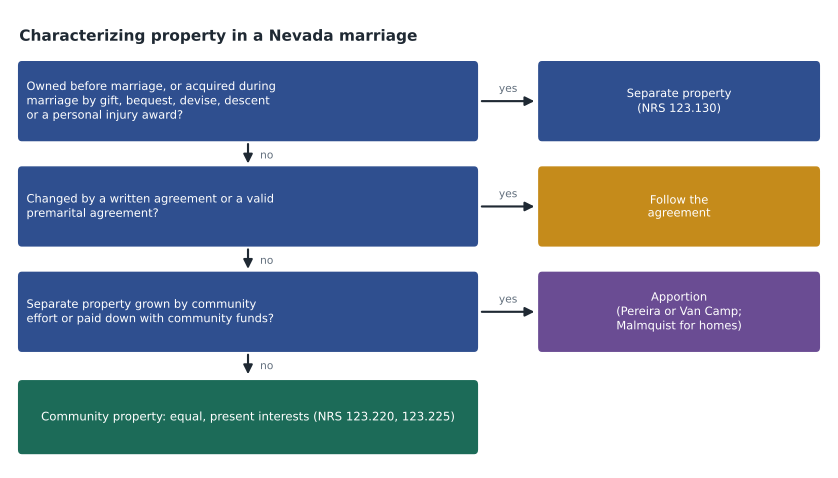
Nevada's statutes start with definitions. Under NRS 123.130, a spouse's separate property is all property owned before marriage and property acquired afterward by gift, bequest, devise, descent, or an award for personal injury damages, together with the rents, issues and profits of that property. Under NRS 123.220, all other property acquired after marriage by either spouse, or both, is community property, unless the spouses agree otherwise in writing, a decree of separate maintenance applies, one spouse has given the other written authority to treat earnings as separate under NRS 123.190, or another statutory exception applies.
Each spouse's interest in community property is a present, existing and equal interest (NRS 123.225). Neither spouse owns 'more' of community property because that spouse earned it. A paycheck earned by one spouse during the marriage belongs equally to both the moment it is earned.
Presumptions, tracing and transmutation
Property acquired during marriage is presumed to be community property, and a spouse claiming that a particular asset is separate must trace it to a separate source. Tracing is the everyday work of Nevada family lawyers: following money from a premarital account through deposits, withdrawals and purchases to show that an asset was bought with separate funds. Commingling separate and community funds in one account makes tracing harder and can result in the whole account being treated as community property if the separate contribution cannot be shown.
Spouses can change the character of property by agreement, a process called transmutation. Under NRS 123.125, a party seeking to show that community property became separate, or the reverse, must prove the transmutation by clear and convincing evidence. Marriage contracts and settlements must be in writing and executed and acknowledged like a deed (NRS 123.270), and recording rules apply when they affect real property. Premarital agreements are governed by chapter 123A, and an enforceable premarital agreement can displace the default community property rules.
A spouse may also record an inventory of separate property. Recording gives notice of the claimed separate character; failing to record does not make property community, but it can work against the owner in a dispute with a good-faith purchaser from the other spouse (NRS 123.140 to 123.160).
Separate property touched by community effort or money
The hardest characterization problems involve separate property that grows during the marriage because of community effort or community money. Nevada courts handle these through apportionment.
When a spouse's separate business grows during the marriage because of the spouse's work, the increase must be apportioned between the separate estate and the community. The Supreme Court of Nevada adopted that principle in Cord v. Neuhoff, 94 Nev. 21, 573 P.2d 1170 (1978), recognizing exceptions where the increase comes solely from natural enhancement or where the owner's effort was minimal and no value was assigned to it. Courts use one of two California methods. The Pereira approach allocates a fair return on the original separate investment to the separate estate and treats the rest of the growth as community property; it fits businesses where personal effort drove the growth. The Van Camp approach values the community's contribution as reasonable compensation for the spouse's services, less what the community already received, and treats the rest as separate; it fits businesses whose growth came mainly from the capital or market conditions. The Supreme Court later confirmed that one of these methods must be used for a separate property business.
For a home bought by one spouse before marriage and paid down with community funds, Nevada uses the method in Malmquist v. Malmquist, 792 P.2d 372 (Nev. 1990). The court adopted a modified version of California's Moore approach: it credits each estate with its principal reductions and down payment, allocates the outstanding loan balance according to the payments each source made, and divides appreciation proportionally. In simplified form, each estate receives its paydown plus a share of the appreciation proportional to its contribution to the purchase price.
Worked problem
Graciela's house under Malmquist (simplified)
Graciela bought the house for 200,000 dollars before marriage, paying 40,000 dollars down from her savings and borrowing 160,000. Before the wedding she paid 10,000 dollars of principal. During the marriage, community earnings paid 50,000 dollars of principal. At divorce the house is worth 350,000 dollars and the loan balance is 100,000. In this simplified example, assume the outstanding loan is allocated in proportion to the principal each estate paid. How might the equity be apportioned?
Show solution
- Appreciation: 350,000 minus the 200,000 purchase price is 150,000 dollars.
- Separate contributions: 40,000 down plus 10,000 paydown, 50,000 dollars. Community paydown: 50,000 dollars.
- Allocate the 100,000 loan balance: with equal paydowns, assume 50,000 to each estate. Each estate's share of the purchase price is then its paydown plus its loan share: separate 100,000, community 100,000.
- Appreciation share: each estate contributed half of the 200,000 price, so each receives 75,000 of appreciation.
- Equity: separate 50,000 + 75,000 = 125,000; community 50,000 + 75,000 = 125,000. Total equity is 250,000 dollars.
Answer: Graciela keeps about 125,000 dollars of equity as separate property, and the remaining 125,000 is community property to be divided equally. Real cases use the exact Malmquist allocation of the loan balance, which can change the numbers.
Management and control
During the marriage, either spouse may manage and control community property alone, with important limits in NRS 123.230. Neither spouse may give away community property without the other's express or implied consent. Neither may devise or bequeath more than one-half of the community property. Selling, conveying or encumbering community real property requires both spouses to join in the instrument, and buying community real property requires both as well. Selling or granting a security interest in community household goods requires both, except for purchase-money interests. And where both spouses run a community business, both must consent to acquiring or disposing of its assets; if only one spouse manages it, that spouse may act in the ordinary course alone. Each spouse may manage separate property without the other's consent (NRS 123.170).
Divorce in Nevada
Nevada is famous for quick divorces, and the reputation rests on the residence requirement. Under NRS 125.020, unless the cause of action arose in the county while both parties lived there, a divorce requires that one party has resided in Nevada for at least six weeks before filing. The complaint can be filed in the county where the cause accrued, where the defendant resides or may be found, where the plaintiff resides, where the parties last cohabited, or where the plaintiff has lived for six weeks. Residence is usually proved by a corroborating witness's affidavit (NRS 125.123).
The grounds are in NRS 125.010: insanity existing for two years before the action, with corroborating evidence; living separate and apart for one year without cohabitation; and incompatibility. In practice, almost every Nevada divorce is granted for incompatibility, which is Nevada's no-fault ground. Couples who agree on everything, have resolved custody and support, and have divided their property can use the summary divorce procedure by joint petition under NRS 125.181 and 125.182, with a residency corroboration affidavit.
| Issue | Nevada rule |
|---|---|
| Residence | One party resident at least six weeks before filing (NRS 125.020) |
| Grounds | Incompatibility; one year living apart; two years of insanity (NRS 125.010) |
| Agreed cases | Summary divorce by joint petition (NRS 125.181, 125.182) |
| Community property | Equal division to the extent practicable unless a compelling reason is found in writing (NRS 125.150) |
| Alimony | Lump sum or periodic, as just and equitable, considering statutory factors (NRS 125.150) |
| Omitted property | Postjudgment motion generally within three years of discovering fraud or mistake |
Property division and alimony
In a divorce, the court must, to the extent practicable, make an equal disposition of the community property. It may make an unequal disposition only if it finds a compelling reason and sets out its reasons in writing (NRS 125.150). The statute does not define a compelling reason, and Nevada courts read the phrase narrowly; financial misconduct such as wasting or hiding community assets is the classic example. Separate property is confirmed to its owner, although Nevada law allows a court in limited circumstances to set aside a spouse's separate property for the support of the other spouse or the children.
Alimony may be awarded as a lump sum or in periodic payments, as appears just and equitable. The statute lists factors including each spouse's financial condition, the nature and value of their property, the duration of the marriage, each spouse's income, earning capacity, age and health, the standard of living during the marriage, career prospects, education and training, contributions as a homemaker, and the award of property in the divorce. Courts may also award attorney fees. A spouse who discovers after the decree that community property was left out can move to divide it, generally within three years of discovering the fraud or mistake.
Wills and the effect of death
Nevada recognizes three forms of will. Any person of sound mind over the age of 18 may make a will (NRS 133.020). An attested will must be in writing, signed by the testator or by someone in the testator's presence at the testator's direction, and attested by at least two competent witnesses who sign in the testator's presence (NRS 133.040); witnesses may sign a self-proving declaration or affidavit (NRS 133.050). A holographic will is valid without witnesses if the signature, date and material provisions are in the testator's own handwriting (NRS 133.090). Nevada also authorizes electronic wills, which must be in an electronic record with the testator's date and electronic signature and must include an authentication characteristic of the testator, an electronic notary's signature and seal, or the electronic signatures of two or more attesting witnesses (NRS 133.085).
Several Nevada rules protect family members. A will made before marriage is revoked as to a surviving spouse, who takes an intestate share, unless an exception applies (NRS 133.110). Divorce or annulment revokes provisions for the former spouse in a will made before the decree, unless a court-approved agreement or order provides otherwise (NRS 133.115). A child born after the will is made and not provided for takes an intestate share unless the will shows the omission was intended or the child was provided for outside the will (NRS 133.160). And when a descendant beneficiary dies before the testator leaving descendants, Nevada's anti-lapse rule passes the gift to those descendants by representation (NRS 133.200).
At death, community property splits in two. Under NRS 123.250, the surviving spouse owns an undivided one-half of the community property as separate property. The decedent's half passes by will or, without a will, to the surviving spouse, and only the decedent's half is subject to probate administration. Spouses may also hold property as community property with right of survivorship, which passes entirely to the survivor without probate.
Common mistakes
MistakeEverything acquired during a Nevada marriage is divided equally.
InsteadOnly community property is divided equally, and an unequal division is allowed for a compelling reason stated in writing. Separate property, including gifts and inheritances, stays with its owner.
MistakeA premarital house stays entirely separate even if community money paid the mortgage.
InsteadNevada apportions the equity under Malmquist v. Malmquist, giving the community a share for its principal payments and the related appreciation.
MistakeOne spouse can sell community real estate alone.
InsteadBoth spouses must join in selling, conveying or encumbering community real property (NRS 123.230).
MistakeA holographic will needs two witnesses.
InsteadA Nevada holographic will needs no witnesses if the signature, date and material provisions are in the testator's handwriting (NRS 133.090).
Summary and key terms
- Separate property is property owned before marriage or acquired by gift, inheritance or a personal injury award; other property acquired during marriage is community property with equal, present interests.
- Transmutation must be proved by clear and convincing evidence; marriage contracts must be written and acknowledged.
- Growth of a separate business from community effort is apportioned under Pereira or Van Camp; premarital homes paid down with community funds are apportioned under Malmquist.
- Either spouse may manage community property, but gifts, wills beyond one-half and real property transactions have statutory limits.
- Divorce requires six weeks of residence; incompatibility is the usual ground; community property is divided equally unless a compelling reason is stated in writing.
- Nevada recognizes attested, holographic and electronic wills; at death the survivor keeps half the community property and only the decedent's half is probated.
- 0
- community property
- 1
- separate property
- 2
- transmutation
- 3
- tracing
- 4
- Pereira approach
- 5
- Van Camp approach
- 6
- incompatibility
- 7
- holographic will
- 8
- community property with right of survivorship
Practice problems
Work each problem on paper first, then reveal the answer to check.
Is an inheritance received during marriage community or separate property in Nevada?
Show answer
Separate property under NRS 123.130.
What residence does a Nevada divorce require?
Show answer
At least six weeks of residence in Nevada by one party before filing, unless the cause arose while both lived in the county.
When may a Nevada court divide community property unequally?
Show answer
Only if it finds a compelling reason and states the reasons in writing.
What happens to community property when a spouse dies?
Show answer
The survivor keeps one-half as separate property; the decedent's half passes by will or intestacy and is the only part probated.
Lesson quiz · 5 questions
Score 60% or more to complete this lesson.
Create a free account to save your progress, take quizzes and earn a certificate.