
BAR-228 · Lesson 4 of 12 · 19 min
The Nebraska bar exam: format, scoring and the 270 passing score
▶ Video coming soon A video version of this lesson is on the way.
Jace's study schedule was taped to the wall of his apartment in Kearney, a grid of colored boxes running from mid-November to the February exam. Marchetti looked at a photo of it during their session and asked a single question: 'Why do the essays get as much time as the MBE?'
Jace hesitated. 'Because the essays feel harder?' Marchetti shook her head. 'Feel is not a plan. The MBE is half your score. Let us start with how the exam is actually built and scored, and then fix the grid.' This lesson explains the format of the February 2027 Nebraska exam, how the three parts are weighted and scaled, what 270 means, and the rules that govern the testing room.
The exam Nebraska gives through February 2027
Under section 3-117(A) of the admission rules, an applicant who sits before July 2027 must pass the Uniform Bar Examination: the Multistate Essay Examination, the Multistate Performance Test and the Multistate Bar Examination, combined into a single score earned at one sitting. Nebraska does not let candidates bank a passing component from one administration and retake only the others. Everything must come together in the same two days.
Section 3-117(C) describes the schedule. The UBE is given on consecutive days twice a year, on dates the Commission sets to match NCBE's national dates. Day one is the written day: the MEE and the MPT, about three hours each. Day two is the MBE, about six hours. The February 2027 exam falls on Tuesday, February 23 and Wednesday, February 24, in Lincoln.
The three components
The MBE is 200 multiple-choice questions, 100 in the morning and 100 in the afternoon. Of the 200, 175 are scored and 25 are unscored pretest questions mixed among the rest, and candidates cannot tell which is which. The MBE covers seven subjects: civil procedure, constitutional law, contracts (including sales under Article 2 of the Uniform Commercial Code), criminal law and procedure, evidence, real property and torts.
The MEE is six essay questions, each with a suggested 30 minutes. Starting with the July 2026 exam, NCBE narrowed the MEE to business associations (agency and partnership, corporations and limited liability companies) plus the seven MBE subjects. Four subjects that used to appear on the MEE, namely conflict of laws, family law, trusts and estates, and secured transactions, were removed so that the essay's coverage lines up with NCBE's NextGen exam. Family law and trusts and estates may still appear as the subject of an MPT task, where the task's library supplies the law.
The MPT is two 90-minute tasks. Each task gives the candidate a file of facts, such as interview notes, letters and documents, and a library of legal authorities, which may be fictional. The candidate must produce a lawyering document: an objective memo, a persuasive brief, a client letter, a demand letter, a contract provision or a similar piece of work. The MPT tests whether the candidate can find the controlling law in the library, apply it to the facts and write in the format the supervising attorney requested.
How the parts are weighted
Section 3-117(C) sets the weighting by rule: the MBE counts for 50 percent of the total, the MEE for 30 percent and the MPT for 20 percent. These are the standard UBE weights used in every UBE jurisdiction, which is what makes a UBE score portable.
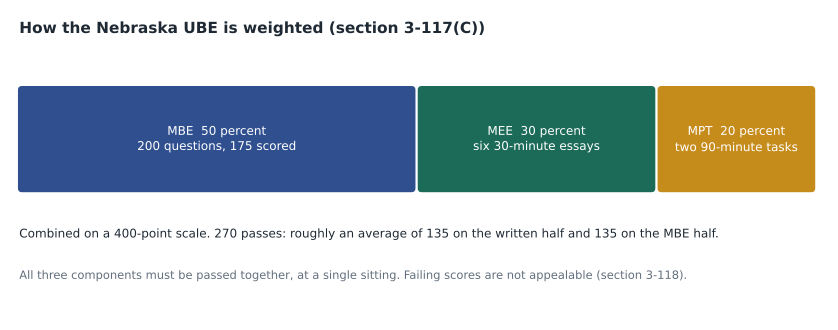
The weights answer Marchetti's question about the study grid. Half the score comes from the MBE. The MEE is worth 30 percent, spread over six questions, so each essay is worth about 5 percent of the total. Each MPT task is worth about 10 percent, making a single performance test worth twice a single essay. Candidates who neglect the MPT because it requires no memorization are giving up a fifth of their score.
| Component | Share of score | Approximate value of one item |
|---|---|---|
| MBE (175 scored questions) | 50 percent | About 0.29 percent per scored question |
| MEE (6 essays) | 30 percent | About 5 percent per essay |
| MPT (2 tasks) | 20 percent | About 10 percent per task |
Scaling and the 400-point scale
The UBE is reported on a 400-point scale. The MBE score is scaled by NCBE through a statistical process called equating, which adjusts for small differences in difficulty between test forms so that a given scaled score represents the same level of performance from one administration to the next. The written components are graded by the jurisdiction, and the raw written scores are then scaled to the MBE: in effect, the written scores are placed on the same distribution as the MBE scores of the same group of candidates. The scaled MBE score and the scaled written score are combined using the 50, 30 and 20 percent weights.
A useful way to think about the 270 line is that it corresponds roughly to an average of 135 on each half of the exam, written and multiple choice. Because of scaling, a candidate cannot convert a raw MBE percentage or a raw essay grade into a final score with any precision, and should not try. What matters is relative performance: the scaled written score depends on how a candidate's essays compare with others' in the same administration.
The 270 passing score
The Nebraska Supreme Court sets the passing score at 270 by rule. That is a middle position among UBE jurisdictions: some require 260, many require 266, and a few require 270 or higher. Because UBE scores are portable, the passing line matters in both directions. A candidate who earns 270 in Nebraska has a portable score that will also satisfy jurisdictions with lower passing scores, subject to their own time limits and requirements. Nebraska does not add a Nebraska-specific requirement on top of the UBE for exam applicants.
Worked problem
Reading a score report
Jace's study partner, Callie, sat in July 2026 and received a scaled MBE score of 141 and a total UBE score of 266. She asks Jace whether she should challenge her essay grades because she was close.
Show solution
- Her total of 266 is below Nebraska's 270 passing score.
- Under section 3-118, as amended in February 2026, a failing UBE or NextGen score is not appealable in Nebraska.
- She may inspect her answers within 10 days, subject to NCBE security procedures, which can help her see where she lost points; MBE papers are not available for review.
- Her 141 MBE suggests her written score was below the 135 average needed, so her retake plan should emphasize essays and the MPT.
- February 2027 is Nebraska's last legacy UBE. If she filed by the October 15, 2026 deadline, she can retake the familiar format; if not, her next chance is the NextGen exam in July 2027.
Answer: She cannot appeal the score; she should review her papers, rebalance toward the written portion and retake as soon as the calendar allows.
After a failure
Section 3-118 governs applicants who fail. As amended by the Court on February 18, 2026, it provides that a failing UBE or NextGen score is not appealable. A failing applicant may inspect his or her exam papers within 10 days, subject to NCBE's security procedures, but MBE papers are not retained for that purpose. Candidates who want to understand a close failure should use the inspection window promptly. A candidate may also request NCBE's MBE hand score service for a fee, which confirms that the answer sheet was scored correctly but almost never changes a result.
Rules of the testing room
Section 3-117 sets out detailed rules on exam integrity, and the penalties are severe. The Commission uses an identification system that keeps examinees anonymous through grading. Applicants may not bring or use unauthorized materials or devices, must answer from their own knowledge, may not copy or remove exam materials, and must treat proctors, officials and other candidates respectfully. Disruptions, including unpermitted electronic devices, are violations.
Applicants may not try to influence grading or identify themselves or their answers to Commission members or anyone else. Writing a personal note to the grader in an essay answer, for example, is a violation. The penalty for violating or attempting to violate these rules is an automatic failing grade on the entire exam, and the Commission may also bar the applicant from retaking the Nebraska exam. Proctors work under the Director of admissions, and they may not discuss the content of the exam with any applicant.
Marchetti put it simply for Jace: 'Leave your phone in the car. Do not write anything in an answer that identifies you. If something goes wrong in the room, tell a proctor, and do not try to fix it yourself.'
Rebuilding the study grid
With the weights in front of him, Jace rebuilt his schedule. About half of his remaining study hours went to MBE practice, mostly timed sets of mixed questions with careful review of every miss. About 30 percent went to MEE practice across business associations and the seven MBE subjects, writing full answers under time at least twice a week. The remaining 20 percent went to the MPT: at least six full 90-minute tasks before the exam, plus shorter drills on reading the task memo and outlining.
He dropped the outlines he had been making for conflict of laws and secured transactions. 'Those are gone from the MEE,' Marchetti confirmed. 'Do not let an old outline from an upper-class student talk you into studying for an exam that no longer exists.'
What Nebraska law has to do with it
Because Nebraska gives the UBE without a Nebraska component, the exam tests general principles of American law, the majority rules and the federal rules where federal law applies. Nebraska law appears on the exam only indirectly. Lesson 6 explains how to handle the gap between what the exam tests and the Nebraska law a new lawyer will use, and Lessons 7 through 10 cover the Nebraska law itself.
Common mistakes
MistakeA candidate can carry over a passing MBE score and retake only the essays.
InsteadNebraska requires a combined passing score on all three components at a single sitting.
MistakeThe essays deserve more study time than the MBE because they feel harder.
InsteadThe MBE is 50 percent of the score; the MEE is 30 percent and the MPT 20 percent.
MistakeConflict of laws and secured transactions still appear on the MEE.
InsteadNCBE removed conflict of laws, family law, trusts and estates and secured transactions from the MEE starting July 2026.
MistakeA close failing score can be appealed.
InsteadUnder section 3-118 a failing UBE or NextGen score is not appealable; papers may be inspected within 10 days.
How MEE answers are graded
MEE graders work from NCBE's grading materials, which identify the issues in each question and the analysis expected for each. Points come from spotting the issues, stating the governing rule accurately and applying it to the specific facts, then reaching a conclusion. Graders read quickly and grade relatively, comparing answers within the same administration. Clear headings for each issue, short paragraphs and conclusions that answer the question asked make an answer easy to reward. An answer that discusses the law at length without using the facts in the question earns little credit, however accurate the law.
The call of the question deserves the most attention. Each MEE question ends with one or more specific questions, and graders award points for answering them. A candidate who writes a general essay about the subject without addressing each numbered call loses points even for correct statements of law.
How MPT answers are graded
The MPT rewards following instructions. The task memo from the supervising attorney says what document to write, for whom and in what form, and sometimes what not to include. Graders look for correct use of the library's authorities, organization that fits the assigned format, and attention to the facts in the file, including facts that cut against the client. Because the library may contain fictional cases and statutes, candidates must use the law as the library states it, even if it differs from the rule they learned in law school.
How MBE questions are built
MBE questions are designed so that the wrong answers are attractive. A typical question has one correct answer and three distractors, each of which states a real rule that does not fit these facts, misapplies a rule, or reaches the right result for the wrong reason. Practicing with explanations, and studying why each wrong answer is wrong, builds the pattern recognition that improves MBE scores more than rereading outlines. Marchetti asked Jace to keep a log of every miss with a one-line note on why the chosen answer was wrong, and to review the log every Sunday.
Testing accommodations and the laptop
Candidates who typed in law school should type on the exam if they can, because typing is faster and graders read typed answers more easily. Lesson 2 described Nebraska's laptop registration, waiver and fee. Candidates who handwrite should practice writing full essays by hand under time in the last month, because handwriting six essays in three hours is a physical task as much as an intellectual one.
Summary and key terms
- Through February 2027, Nebraska gives the UBE: MEE and MPT on day one, MBE on day two, in Lincoln.
- All components must be passed by a combined score at one sitting.
- The weights are MBE 50 percent, MEE 30 percent and MPT 20 percent; the passing score is 270 on the 400-point scale.
- The MBE has 200 questions (175 scored); the MEE has six 30-minute essays; the MPT has two 90-minute tasks.
- From July 2026 the MEE covers business associations and the seven MBE subjects only.
- Failing scores are not appealable; papers may be inspected within 10 days.
- Exam integrity violations bring an automatic failing grade and may bar future attempts.
- 0
- Uniform Bar Examination
- 1
- Multistate Bar Examination
- 2
- Multistate Essay Examination
- 3
- Multistate Performance Test
- 4
- scaled score
- 5
- equating
- 6
- passing score
Practice problems
Work each problem on paper first, then reveal the answer to check.
What are the UBE weights in Nebraska?
Show answer
MBE 50 percent, MEE 30 percent, MPT 20 percent.
What is Nebraska's UBE passing score?
Show answer
270 on the 400-point scale.
Which four subjects left the MEE in July 2026?
Show answer
Conflict of laws, family law, trusts and estates, and secured transactions.
Can a Nebraska candidate appeal a failing score?
Show answer
No; under section 3-118 failing scores are not appealable, though papers may be inspected within 10 days.
Lesson quiz · 5 questions
Score 60% or more to complete this lesson.
Create a free account to save your progress, take quizzes and earn a certificate.