
BAR-228 · Lesson 10 of 12 · 19 min
Nebraska Rules of Professional Conduct
▶ Video coming soon A video version of this lesson is on the way.
In mid-November, Sato & Brekke interviewed a lawyer who wanted to move from a Grand Island firm. Over lunch, Miriam Sato mentioned that the Grand Island firm represented the trucking company in the Gibbon pickup crash, and that the candidate had worked on that file for several months. 'We could screen him,' Jace offered afterward, remembering the MPRE outline. 'Put up a wall, keep him off the file.' Sato shook her head. 'Not in Nebraska. Look at Rule 1.10.'
Jace brought the exchange to Marchetti, who used it to open a session on the Nebraska Rules of Professional Conduct. 'The MPRE tests the ABA Model Rules,' she said. 'Nebraska adopted the Model Rules framework, but it kept some older versions and wrote some rules of its own. A Nebraska lawyer who practices from the MPRE outline will get several things wrong.' This lesson covers the most important differences.
Where the rules live
The Nebraska Supreme Court adopts the Nebraska Rules of Professional Conduct as Chapter 3, Article 5 of its rules. Each rule has a section number built from its Model Rule number: Rule 1.6 is section 3-501.6, Rule 1.10 is section 3-501.10 and Rule 8.4 is section 3-508.4. The Nebraska rules follow the Model Rules' structure and much of their text, with comments, so the MPRE outline is a sound starting point. The differences below are the ones that matter most for a new lawyer.
Imputation without screening for lateral lawyers
Under Nebraska's section 3-501.10(a), when any lawyer in a firm would be prohibited from a representation under Rule 1.7 or Rule 1.9 if practicing alone, no lawyer in the firm may undertake it, unless the prohibition rests on a personal interest of the disqualified lawyer that does not present a significant risk of materially limiting the representation by the rest of the firm. The affected client can waive the imputed conflict on the conditions in Rule 1.7.
What Nebraska's rule does not contain is the screening provision the ABA added to Model Rule 1.10(a)(2) in 2009. Under the Model Rule, a firm can avoid imputation of a lateral lawyer's former-client conflict by timely screening the lawyer, giving written notice to the former client and certifying compliance. Nebraska's text offers no screening mechanism for lateral private lawyers. Comment 5 to Nebraska's rule describes the test for a departing lawyer's conflicts without any screening option. If a lawyer moving to a Nebraska firm is personally disqualified because of a former client's matter, the whole new firm is disqualified unless the former client consents.
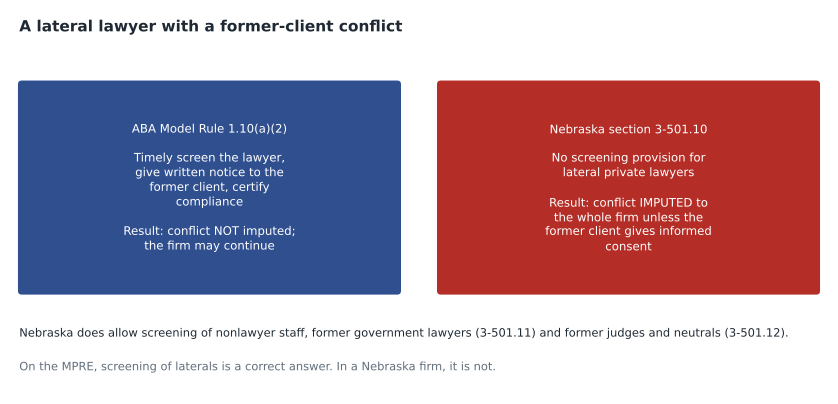
Nebraska does recognize screening in other settings. Section 3-501.9 and the comments to section 3-501.10 address screening of nonlawyer support staff who move between firms. Former government lawyers may be screened under section 3-501.11, and former judges, arbitrators, mediators and other neutrals may be screened under section 3-501.12. The gap is specific to private lawyers moving between firms, which is exactly the situation Sato & Brekke faced.
Applied to the interview, the rule was decisive. The candidate had worked substantially on the trucking company's defense in the same matter. Under Rule 1.9 he could not represent the farmer against his former client, and under Nebraska's Rule 1.10 that conflict would be imputed to everyone at Sato & Brekke. Hiring him would force the firm to withdraw from the farmer's case unless the trucking company consented, which it had every reason not to do.
Confidentiality exceptions
Model Rule 1.6(b) lists seven situations in which a lawyer may reveal confidential information, including to prevent the client from committing a crime or fraud that is reasonably certain to cause substantial financial injury to another when the client used the lawyer's services, and to detect conflicts when lawyers change firms. Nebraska's section 3-501.6(b) is different. It permits disclosure to the extent reasonably necessary to prevent the client from committing a crime or to prevent reasonably certain death or substantial bodily harm; to secure legal advice about the lawyer's own compliance with the Rules; to establish a claim or defense in a controversy between lawyer and client, or to respond to allegations about the lawyer's representation; and to comply with other law or a court order.
| Situation | ABA Model Rule 1.6(b) | Nebraska section 3-501.6(b) |
|---|---|---|
| Prevent reasonably certain death or substantial bodily harm | Permitted | Permitted |
| Prevent the client from committing a crime | Only crimes or frauds causing substantial financial injury, where the lawyer's services were used | Permitted for any crime the client intends to commit |
| Prevent, mitigate or rectify financial fraud using the lawyer's services | Permitted (paragraphs (b)(2) and (b)(3)) | No separate exception |
| Obtain ethics advice | Permitted | Permitted |
| Lawyer-client disputes and defense of the lawyer | Permitted | Permitted |
| Comply with other law or a court order | Permitted | Permitted |
| Detect conflicts when changing firms | Permitted (paragraph (b)(7)) | No separate exception |
The pattern is worth remembering. Nebraska's crime exception is broader than the Model Rule's, because it is not limited to financial crimes or to crimes that use the lawyer's services, but Nebraska has no stand-alone exceptions for rectifying past financial fraud or for conflict-checking information. Disclosure under section 3-501.6(b) is permissive. Other rules, such as the duty of candor to the tribunal in Rule 3.3 and the rule against assisting a client's crime or fraud, may require more, and a lawyer whose services would further a client's fraud must withdraw.
Limited-scope representation and help for self-represented litigants
Like the Model Rule, Nebraska's section 3-501.2 allows a lawyer to limit the scope of a representation if the limitation is reasonable and the client gives informed consent. Nebraska then adds detailed procedures that the Model Rule does not contain. A lawyer may prepare pleadings and other documents for a self-represented litigant to file, but each document must carry the words Prepared By with the lawyer's name, business address and bar number. Drafting the document is not an appearance, and the litigant signs as pro se.
A lawyer may also enter a Limited Appearance for an otherwise unrepresented party, with the client's written consent after consultation, and the appearance must clearly define the scope of the limited representation. Within 10 days after completing the limited representation, the lawyer must file a Certificate of Completion of Limited Representation and serve copies on the client and opposing counsel or party; that filing operates as a withdrawal without court approval. Nebraska's pleading rules cross-reference these provisions. Limited scope does not reduce the duty of competence for the work the lawyer does undertake.
These provisions matter in a rural practice. A family in the Sandhills may be able to afford help drafting a parenting plan but not full representation in a contested custody case. Nebraska's rule gives a lawyer a defined way to provide that help.
Financial assistance to clients
Section 3-501.8(e) prohibits a lawyer from providing financial assistance to a client in connection with pending or contemplated litigation, with two exceptions: a lawyer may advance court costs and litigation expenses, with repayment contingent on the outcome, and a lawyer representing an indigent client may pay those costs and expenses. In 2020 the ABA added a third exception to Model Rule 1.8(e), allowing a lawyer representing an indigent client pro bono to give modest gifts for basic living expenses such as food, rent or medicine. Nebraska's text does not include that humanitarian exception.
For a Nebraska lawyer, the practical rule is strict. A lawyer handling a car-crash case may advance filing fees, deposition costs and expert fees, but may not pay the client's rent or utility bills while the case is pending, however sympathetic the circumstances. A lawyer who wants to help should direct the client to community resources rather than providing money.
Fees
Section 3-501.5(c) follows the Model Rule on contingent fees. A contingent fee agreement must be in a writing signed by the client and must state the method of calculation, including the percentages that apply in the event of settlement, trial or appeal, the expenses to be deducted from the recovery, whether expenses are deducted before or after the fee is calculated, and any expenses the client must pay whether or not the client prevails. At the end of the matter, the lawyer must give the client a written statement of the outcome showing the remittance to the client and how it was determined.
Fee division between lawyers in different firms under section 3-501.5(e) is allowed only if the division is in proportion to the services each lawyer performs or each assumes joint responsibility for the representation, the client agrees to the arrangement, including the share each lawyer will receive, and the agreement is confirmed in writing, and the total fee is reasonable. The Nebraska comments explain that joint responsibility means the same financial and ethical responsibility as partners.
Safekeeping property
Section 3-501.15 requires a lawyer to hold client and third-party funds separately from the lawyer's own property, in a separate account maintained in the state where the lawyer's office is located, and to keep complete records of the account for five years after the representation ends. Advance fees and expenses go into the trust account and may be withdrawn only as earned or incurred. When the lawyer and another person both claim an interest in funds, the disputed portion stays in trust until the dispute is resolved, and the undisputed portion is distributed promptly. The rules on mandatory membership assessments, discussed in Lesson 1, also fund the regulation of trust account records.
Discipline and advice
Lawyer discipline in Nebraska is a Supreme Court function, carried out through the Counsel for Discipline, who investigates grievances and prosecutes formal charges, with the Supreme Court deciding the sanction. Nebraska lawyers who need guidance on an ethics question can consult the opinions of the Nebraska Lawyers' Advisory Committee, which the Court publishes on its website, and the Nebraska Lawyers Assistance Program offers confidential help with substance use and mental health concerns.
Worked problem
Three questions from the firm
In one week Jace is asked: (1) whether Sato & Brekke can hire the Grand Island lawyer and screen him from the pickup case; (2) whether the firm can pay two months of a struggling client's rent while her injury case is pending; and (3) whether he can draft a parenting plan for a self-represented father without appearing in the case.
Show solution
- Hiring: the lawyer is personally disqualified under Rule 1.9. Nebraska's section 3-501.10 has no lateral screening option, so his conflict would be imputed to the firm unless the trucking company consents.
- Rent: section 3-501.8(e) allows advancing litigation costs but not living expenses, and Nebraska has no humanitarian exception, so the firm may not pay the rent.
- Parenting plan: section 3-501.2 allows the drafting, but the document must show Prepared By with Jace's name, business address and bar number once he is admitted, and the father signs as pro se.
- Until he is admitted, Jace may not give legal advice to the father himself; a supervising lawyer at the firm must provide the service.
Answer: No screening, no rent and yes to limited-scope drafting with the Nebraska disclosure, done by an admitted lawyer.
Marchetti closed the session with a reminder. 'On the MPRE in March or August, screening of laterals is a correct answer. In Kearney, it is not. Keep the two straight, and when in doubt, read the Nebraska text, not the outline.'
Common mistakes
MistakeA Nebraska firm can screen a lateral lawyer to avoid imputing a former-client conflict.
InsteadNebraska section 3-501.10 has no lateral screening provision; the conflict is imputed unless the former client consents.
MistakeNebraska follows the 2020 ABA humanitarian exception for gifts to indigent clients.
InsteadNebraska section 3-501.8(e) allows only advances or payment of litigation costs and expenses.
MistakeA lawyer who ghostwrites a pleading for a self-represented party need not disclose it.
InsteadNebraska section 3-501.2 requires a Prepared By notation with the lawyer's name, address and bar number.
MistakeNebraska's confidentiality exceptions match the Model Rule exactly.
InsteadNebraska permits disclosure to prevent any client crime but has no separate financial-fraud rectification or conflict-checking exceptions.
Reading the Nebraska text
Because Nebraska numbers its rules from the Model Rules, a lawyer can move quickly between the two. The safe habit is to read the Nebraska section and its comments whenever a question turns on precise wording. The differences in this lesson are the ones most likely to matter in a first year of practice, but they are not the only ones, and the Court amends its rules from time to time. The Court's website publishes both the current rules and the orders amending them.
Summary and key terms
- The Nebraska Rules of Professional Conduct are Chapter 3, Article 5 of the Supreme Court Rules, numbered from the Model Rules (Rule 1.10 is section 3-501.10).
- Nebraska does not allow screening of lateral private lawyers to avoid imputed former-client conflicts.
- Section 3-501.6(b) permits disclosure to prevent any client crime but lacks the Model Rule's financial-fraud and conflict-checking exceptions.
- Section 3-501.2 adds Prepared By disclosure for ghostwritten documents, limited appearances and a certificate of completion within 10 days.
- Section 3-501.8(e) has no humanitarian exception for gifts to indigent clients.
- Contingent fees require a signed writing and a written closing statement; fee division requires client agreement confirmed in writing.
- Trust funds must be kept separate, with records kept five years; discipline runs through the Counsel for Discipline and the Supreme Court.
- 0
- imputation
- 1
- screening
- 2
- lateral lawyer
- 3
- permissive disclosure
- 4
- limited-scope representation
- 5
- limited appearance
- 6
- financial assistance
- 7
- trust account
Practice problems
Work each problem on paper first, then reveal the answer to check.
Can a Nebraska firm avoid imputing a lateral lawyer's former-client conflict by screening?
Show answer
No; Nebraska section 3-501.10 has no lateral screening provision.
What must appear on a document a Nebraska lawyer drafts for a self-represented litigant?
Show answer
Prepared By with the lawyer's name, business address and bar number.
What may a Nebraska lawyer pay on behalf of a litigation client?
Show answer
Court costs and litigation expenses (advanced, or paid for an indigent client), but not living expenses.
Within how many days must a lawyer file a certificate of completion after a limited appearance ends?
Show answer
Within 10 days.
Lesson quiz · 5 questions
Score 60% or more to complete this lesson.
Create a free account to save your progress, take quizzes and earn a certificate.