
BAR-228 · Lesson 2 of 12 · 19 min
Eligibility, education, deadlines and fees
▶ Video coming soon A video version of this lesson is on the way.
Jace had filed his application on October 6, 2026, nine days before the deadline, and he was proud of it. Then a law school friend called in a panic. She had planned to file 'sometime in October' for the February exam and had just learned that Nebraska had no late filing period. 'Is that true?' Jace asked Marchetti at their next session. 'She thought there was always a late window with a penalty.'
'There used to be one,' Marchetti said. 'There is not anymore. Nebraska closed the late window in 2025. If she has not filed by October 15, she will not be sitting in February.' This lesson walks through who is eligible, how and when to file, what it costs, and the practical details that trip candidates up.
The education requirement
Nebraska's education rule has one requirement and no alternatives. Under section 3-101(A) of the admission rules, an applicant must hold a J.D. or LL.B. from a law school that was approved by the American Bar Association at the time the applicant graduated. Section 3-113 makes this a minimum requirement for every applicant, and it directs the Director to reject any application that does not show the required degree. There is no route for graduates of state-accredited or unaccredited law schools, no law office study, and no path for graduates of foreign law schools, even those who later earn an American LL.M.
The phrase at the time of graduation matters in two directions. A graduate of a school that later lost ABA approval still qualifies if the school was approved when the graduate finished. A graduate of a school that gained approval only after the graduate finished generally does not. Candidates in unusual situations can ask the Commission for a waiver under section 3-121, but waivers go through the Commission to the Court, and the Court's decision on a waiver is final.
The degree and the filing date
The rules require the degree to be shown by the time of the exam, not by the time of filing. That matters most for July candidates. A student graduating in May must file for the July exam by March 1, months before graduation, and then document the degree before sitting. February candidates, like Jace, usually have their diplomas in hand when they file. Either way, the final transcript showing the degree conferred must reach the Director before the exam.
The filing windows
Nebraska sets opening dates as well as deadlines, and the Attorney Services Division does not accept applications outside the windows. An application is filed when the Director receives it with all required documents uploaded. An incomplete application is not filed, even if the candidate clicked submit before the deadline.
| Exam | Filing opens | Last day to file | Applications refused |
|---|---|---|---|
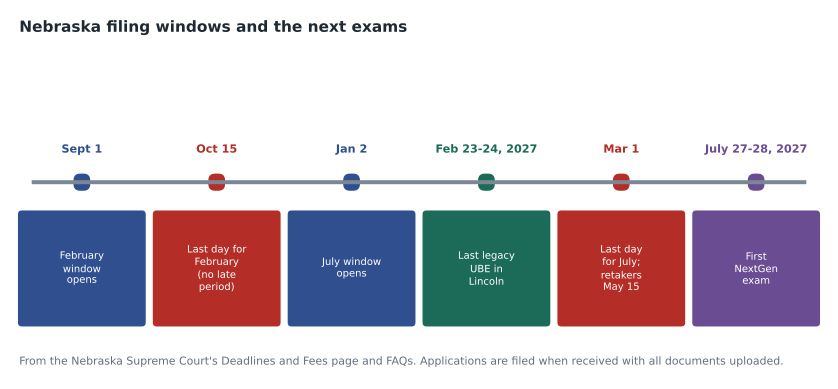
| February | September 1 | October 15 | October 16 and later |
| July | January 2 | March 1 | March 2 and later |
Under section 3-114(B), Nebraska has had no late application period since April 1, 2025. Before then, candidates could file late with an extra fee. Older advice from upper-class students or outdated websites may still mention a late window, which is exactly how Jace's friend got caught.
There is one extension built into the calendar for candidates who fail. An applicant who fails the February exam and applies for the next July exam has until May 15 to file, because February results come out after the regular March 1 deadline. An applicant who fails the July exam and applies for the next February exam has until October 15, the regular deadline.
Upcoming exam dates
The Court's admissions page lists the coming administrations: February 23 and 24, 2027; July 27 and 28, 2027; February 22 and 23, 2028; and July 25 and 26, 2028. The February 2027 exam is Nebraska's last administration of the current UBE. The July 2027 exam is Nebraska's first NextGen exam. All are given in Lincoln.
Fees
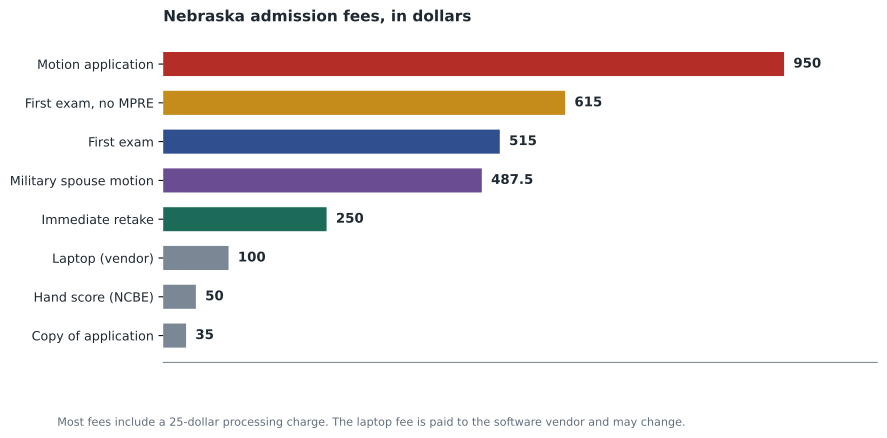
Nebraska's fees are set out in Appendix E of the admission rules and on the Court's Deadlines and Fees page. Fees are paid online; the Commission does not accept cash, personal checks or firm checks. Most fees include a 25-dollar payment processing charge.
| Fee | Amount |
|---|---|
| First-time exam application | 515 dollars |
| First-time exam application without a passing MPRE score | 615 dollars |
| Retake application for the immediately following exam (first retake only) | 250 dollars |
| Other retake applications | 515 dollars (615 dollars without a passing MPRE) |
| Laptop software fee (paid to the vendor; subject to change) | 100 dollars |
| MBE hand score request (paid to NCBE) | 50 dollars |
| Motion application (UBE, non-UBE or practice time) | 950 dollars |
| Motion application by a military spouse | 487.50 dollars |
| Copy of an application | 35 dollars |
The MPRE surcharge is worth noticing. A candidate who has not yet passed the MPRE may still apply to sit for the exam, but pays an extra 100 dollars. Candidates who take the MPRE early in law school avoid the surcharge and remove one source of stress. Jace took the MPRE in August 2025 and scored 94, so he paid 515 dollars.
Fingerprints and the online application
All applicants, whether by exam or motion, apply through the Nebraska Supreme Court's online attorney portal. Every applicant must also be fingerprinted under Neb. Rev. Stat. section 7-102(2), with a notarized authorization form. The fingerprints go to the Nebraska State Patrol and the FBI for criminal history checks. Candidates should schedule fingerprinting early; a delay in the background check can delay the character and fitness review even when everything else is in order.
After filing, applicants must keep their information current. Address changes go to the Commission in writing on its form; the Commission does not accept address changes by phone. A candidate who moves without updating the address risks missing a request for information, and section 3-119 and the related rules allow the Commission to withdraw an application administratively when an applicant fails to respond by a deadline it sets.
Laptops
Most candidates type their essays and performance tests. In Nebraska, laptop use is optional and requires registration with the exam software vendor, payment of the vendor's fee, a notarized liability waiver and approval by the Director. Applicants who miss the software registration deadline are assigned to handwrite. The laptop fee is paid to the vendor and is not refundable by the Commission.
'Register the laptop the day the instructions arrive,' Marchetti told Jace. 'Handwriting six essays and two performance tests is not a disaster, but it is not the exam you practiced for.'
Refunds and withdrawals
Nebraska's refund schedule depends on when the candidate withdraws. For the February exam, a request made between October 15 and December 1 receives a full refund minus fingerprinting costs; a request between December 2 and February 1 receives half. For the July exam, a request between March 1 and May 1 receives a full refund minus fingerprinting costs, and a request between May 2 and July 1 receives half. After those dates, any refund is a discretionary emergency refund at the Director's discretion. Motion applicants receive no refunds. Withdrawal must be made in writing by mail, email or fax.
The four-failure limit
Nebraska caps the number of attempts. Under section 3-114(I), an applicant who has failed a bar exam four times, in any jurisdiction or combination of jurisdictions, may not apply to sit for the Nebraska exam. The count includes failures elsewhere. A candidate who failed twice in another state and once in Nebraska has one Nebraska attempt left.
The limit is a reason to sit only when ready. Marchetti told Jace about a former student who sat four times in two years, each time with too little preparation, and then could not sit in Nebraska at all. 'Every attempt counts,' she said. 'A deferred exam costs a few months. A wasted attempt can cost a career in this state.'
Worked problem
Checking a friend's timeline
Jace's friend Ellery wants to sit for the February 2027 Nebraska exam. It is October 20, 2026. She has not filed. She has an MPRE score of 81 from March 2026. What are her options?
Show solution
- The February window closed on October 15. With no late period since April 1, 2025, Nebraska will not accept her February application.
- She can file for the July 2027 exam between January 2 and March 1, 2027.
- Her MPRE score of 81 is below Nebraska's 85, so she would pay 615 dollars instead of 515 unless she retakes the MPRE and passes before she applies.
- The July 2027 exam is Nebraska's first NextGen exam, so she should plan to study for the NextGen format (Lesson 5).
Answer: Ellery cannot sit in February 2027. She should retake the MPRE, file for July 2027 between January 2 and March 1, and prepare for NextGen.
A personal checklist
Marchetti gave Jace a checklist to share with the Tuesday group's newer members. Confirm the law school's ABA approval date. Open the online portal early and read every question. Schedule fingerprinting. Take the MPRE before filing if possible. File inside the window with every document uploaded, not just the form. Register the laptop as soon as instructions arrive. Calendar the refund dates in case plans change. And keep a copy of everything submitted, because the Commission charges for copies and because a candidate's later applications, including motion applications in other states, will be compared with this one.
Common mistakes
MistakeNebraska accepts late applications with a penalty fee.
InsteadSince April 1, 2025, Nebraska has no late filing period; applications after October 15 or March 1 are refused.
MistakeAn application is filed when the candidate clicks submit.
InsteadIt is filed when the Director receives it with all required documents uploaded.
MistakeA candidate without an MPRE score cannot apply for the exam.
InsteadThe candidate may apply but pays 615 dollars instead of 515 dollars and must pass the MPRE before admission.
MistakeOnly Nebraska failures count toward the attempt limit.
InsteadFailures in any jurisdiction count; four failures anywhere bar a Nebraska application.
What the online application asks for
The Nebraska application is long, and candidates who open it for the first time in the last week of the filing window are usually surprised. Beyond identifying information, it asks for every residence and every job over a period of years, education history, bar admissions and exam attempts in other jurisdictions, criminal and traffic history, civil litigation in which the applicant was a party, financial matters such as defaults and collections, and references who can speak to the applicant's character. Each answer may require supporting documents, and every document must be uploaded before the application counts as filed.
Marchetti's rule of thumb is to open the application on the day the window opens, September 1 for February or January 2 for July, and to spend the first week only gathering documents: court records, transcripts, addresses and dates of employment, and contact information for references. Most of the work is assembling facts the applicant has not thought about in years. A candidate who has moved often or held many part-time jobs should start even earlier, building the list from old tax returns, leases and pay records before the window opens.
Consistency with other applications
Nebraska's application will not be the last one a lawyer files. Admission on motion in another state, a federal court admission, a security clearance or a judicial application years later may ask the same questions, and the answers are often compared. A difference in dates or a matter disclosed in one place and omitted in another invites questions about candor. Keeping a complete copy of the Nebraska application is the simplest protection, and it costs nothing if the candidate saves it before submitting rather than requesting a copy later for a fee.
Changes after filing
The duty to keep the application accurate continues after filing. A new traffic citation, a change of address, a new job, a lawsuit or a change in financial circumstances should be reported promptly, with any supporting documents. The Commission evaluates the application as it stands at the time of its decision, and an applicant who lets a material change go unreported risks the same candor problem as an applicant who omitted it at the start. Jace reported his move within Kearney the week it happened, using the Commission's form, and added a note to his calendar to review the application for accuracy again in January.
Accommodations
Applicants with disabilities may request testing accommodations, such as extra time or a separate room, through the procedure the Attorney Services Division describes in its instructions. Requests generally require documentation from a qualified professional and must be made well before the exam so that the Commission can review them and arrange the room. A candidate who received accommodations in law school or on the MPRE should not assume they will carry over automatically; each jurisdiction reviews its own requests.
Summary and key terms
- Every applicant needs a J.D. or LL.B. from a law school ABA-approved at graduation; there are no alternative routes.
- File for February between September 1 and October 15, and for July between January 2 and March 1; there is no late window.
- After a failed February exam, the July retake application is due May 15.
- The first-time exam fee is 515 dollars, or 615 dollars without a passing MPRE; the immediate first retake is 250 dollars; motion applications are 950 dollars.
- All applicants are fingerprinted under Neb. Rev. Stat. section 7-102(2) and apply online.
- Laptop use requires vendor registration, a fee, a notarized waiver and Director approval.
- Four failures in any jurisdiction bar a Nebraska exam application.
- 0
- ABA-approved law school
- 1
- filing window
- 2
- late filing period
- 3
- MPRE surcharge
- 4
- fingerprint check
- 5
- refund schedule
- 6
- attempt limit
Practice problems
Work each problem on paper first, then reveal the answer to check.
What are the filing windows for the February and July Nebraska exams?
Show answer
February: September 1 to October 15. July: January 2 to March 1. No late filing.
How much does a first-time applicant pay with and without a passing MPRE score?
Show answer
515 dollars with a passing score; 615 dollars without.
A candidate failed the February exam. When is the July application due?
Show answer
May 15.
How many failures bar a Nebraska exam application?
Show answer
Four, in any jurisdiction or combination of jurisdictions.
Lesson quiz · 5 questions
Score 60% or more to complete this lesson.
Create a free account to save your progress, take quizzes and earn a certificate.