
BAR-228 · Lesson 3 of 12 · 20 min
Character and fitness and the MPRE
▶ Video coming soon A video version of this lesson is on the way.
Two questions on the Nebraska application had kept Jace up at night. When he was eighteen he got a speeding ticket on Highway 2 outside Broken Bow, forgot the court date during calving season and received a failure-to-appear notice before he paid the fine. And in 2022 a hospital bill from a riding accident went to a collection agency for several months before he paid it in 2023. 'Neither one is a big deal,' he told Marchetti. 'Do I really have to list them?'
'Yes,' she said, 'and the fact that you are asking means you already know the answer. In character and fitness, the thing that sinks applicants is almost never the old ticket. It is the answer that leaves the ticket out.' This lesson covers Nebraska's character and fitness standards and process, and the MPRE requirement every applicant must meet.
Why character and fitness review exists
The purpose of the review is to protect clients, courts and the public. A lawyer handles other people's money, keeps their secrets, meets deadlines that affect their lives and makes promises to courts. The Commission's task is to predict, from an applicant's past conduct, whether the applicant can be trusted with those duties. It is not a test of whether the applicant has ever made a mistake.
Nebraska frames the inquiry around essential eligibility requirements, listed in section 3-112 of the admission rules. They include honesty and candor, diligence and reliability, respect for the law and the rights of others, the ability to communicate clearly with clients, courts and others, sound judgment, the ability to meet deadlines and conduct oneself professionally, and the ability to manage one's own affairs and other people's in a way that would not endanger clients. Each item in an applicant's history is examined for what it says about these requirements.
The applicant bears the burden
Section 3-125 places the burden on the applicant to prove that he or she is qualified and has complied with the rules. The rules describe the practice of law as a privilege, not a right. In practice, that means a doubt about an applicant's history is resolved by the applicant producing evidence, such as court records, letters, explanations and proof of rehabilitation, not by the Commission proving unfitness.
Nebraska does not use NCBE's character and fitness investigation service, which some states use to gather records. Applicants file their character and fitness information directly with Nebraska through the Court's online application, and the Commission runs its own investigation under section 3-116, supported by the fingerprint check described in Lesson 2.
What the Commission considers
Section 3-116(H) lists factors the Commission weighs when it evaluates past conduct. They include the applicant's age at the time of the conduct, how recent it was, how reliable the information is, how serious the conduct was, the factors underlying it, its cumulative effect, evidence of rehabilitation, the applicant's positive social contributions since the conduct, the applicant's candor in the admission process, and the materiality of any omissions or misrepresentations.
| Factor | What helps the applicant |
|---|---|
| Age at the time | Conduct as a teenager or young adult usually weighs less than recent adult conduct |
| Recency | Several years of clean history since the event |
| Seriousness | Minor infractions rather than crimes of dishonesty or violence |
| Underlying factors | A clear explanation of circumstances, such as a family emergency or illness |
| Cumulative effect | An isolated event rather than a pattern |
| Rehabilitation | Treatment completed, debts repaid, restitution made, records cleared |
| Candor | Full, accurate disclosure, including matters the applicant thinks are trivial |
The factors explain Marchetti's advice. Jace's ticket and collection account were minor, years old, explained and resolved. On their own they raise little concern. A false or incomplete answer about them, on the other hand, goes straight to candor, which the Commission treats as a central requirement. An omission discovered through the fingerprint check or a credit report turns a small matter into a question about honesty.
Common areas of concern
Commissions across the country tend to look closely at the same categories, and Nebraska's application asks about them. They include criminal history, including charges that were dismissed or diverted; academic discipline or misconduct in law school or college; financial irresponsibility, such as unpaid debts, defaults on student loans or unpaid child support; neglect of professional or legal obligations; discipline in another profession or as a lawyer elsewhere; dishonesty in employment; and mental health or substance use conduct that has affected the applicant's ability to function. Questions about mental health in particular are generally framed around conduct and current functioning rather than diagnosis alone.
Applicants should gather records early. Court dispositions, police reports, letters from creditors showing payment, and law school records can take weeks to obtain. A clear, factual explanation supported by documents is far more persuasive than a long narrative without them.
Investigation and referral
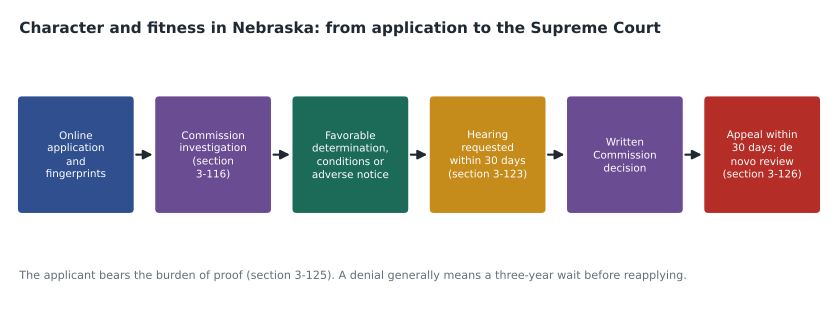
Under section 3-116, the Commission investigates each applicant and may ask for more information, interview the applicant or contact references. It may refer an applicant to the Nebraska Lawyers Assistance Program when conduct suggests a substance use or mental health issue that support could address. A referral is not a finding against the applicant; it can be the first step toward a path to admission.
The Commission may deny an applicant permission to sit for the exam on character grounds. An applicant denied for character and fitness generally must wait three years before reapplying, under section 3-116(B)(1), unless the order sets a different period. That waiting period is one reason to raise concerns early.
The early application option
Section 3-116(I) allows a student still in law school to file an early application for a character and fitness determination only. The early application is useful for a student with a significant history who wants to know, before investing in the full bar process, whether the Commission sees a barrier. It does not replace the regular application to sit for the exam, and the student will still have to file within the regular window and update the information.
Hearings and appeals
An applicant who receives an adverse decision is entitled to be heard. Under section 3-123, the applicant may request a hearing before the Commission within 30 days after notice of the adverse decision. The Rules of Evidence do not apply at the hearing, so the Commission may consider letters, records and testimony that a court might exclude. Applicants may be represented by counsel.
If the Commission rules against the applicant after the hearing, section 3-126 allows an appeal to the Nebraska Supreme Court within 30 days of the Commission's written decision. The Court may appoint a master to take evidence; otherwise it reviews the matter de novo on the record. De novo review means the Court reaches its own conclusion rather than deferring to the Commission's, although in practice the record the applicant built before the Commission is what the Court reviews.
Conditional admission
Not every concern ends in a choice between admission and denial. Under section 3-120, the Commission may recommend that an applicant be admitted subject to conditions, to protect the public while the applicant demonstrates continued rehabilitation. Conditions might include monitoring, treatment, reporting or financial management. A conditionally admitted lawyer must report violations, and a violation can lead to revocation of the conditional admission.
Worked problem
Answering a disclosure question
Jace's application asks whether he has ever been charged with, cited for or convicted of any offense other than minor traffic violations, and separately whether he has ever failed to appear in court. It also asks about any debts more than 90 days past due in the last ten years. How should he answer?
Show solution
- A speeding ticket by itself may fall within the minor traffic exception, but the failure to appear is asked about separately, so he must disclose the failure-to-appear notice and explain the underlying ticket.
- He should obtain the county court record showing the fine paid and the matter closed.
- The hospital bill was in collections for several months, so it is a past-due debt within ten years; he must disclose it.
- He should attach proof that the debt was paid in 2023 and give a short explanation of the accident and the billing mix-up.
- When unsure whether something must be listed, he should disclose it with an explanation rather than omit it.
Answer: Disclose both matters, briefly and factually, with documents showing they were resolved.
The MPRE requirement
Every Nebraska applicant must pass the Multistate Professional Responsibility Examination. Under section 3-117(B), the Court sets the passing score at 85 on the MPRE's scaled score range, and the MPRE may be taken at any location NCBE approves. A passing score is required before the Commission approves a candidate for admission. As Lesson 2 explained, an exam applicant may file before passing the MPRE but pays a higher fee.
The MPRE is a two-hour, 60-question multiple-choice exam, of which 50 questions are scored, given three times a year. It tests the ABA Model Rules of Professional Conduct, the ABA Model Code of Judicial Conduct and generally accepted principles of lawyer regulation, not Nebraska's own rules. Lesson 10 covers places where Nebraska's rules differ from the Model Rules, which matters for practice but not for the MPRE.
| Applicant | MPRE requirement in Nebraska |
|---|---|
| Exam applicant | A scaled score of 85 or higher, earned before the Commission approves admission |
| UBE or non-UBE score transfer applicant (section 3-119(A) or (B)) | A score of 85 or higher released within 5 years before applying |
| Practice-time applicant (section 3-119(C)) | The MPRE score required in the jurisdiction where licensed, regardless of when released |
| Military spouse applicant (section 3-119(D)) | Certification of familiarity with the Nebraska Rules of Professional Conduct; check the current rule for MPRE treatment |
Exam applicants should check the Commission's current guidance on how old an MPRE score may be when they apply. Jace's August 2025 score of 94 easily met the 85 standard and was recent, so he had nothing more to do.
MPRE strategy
Marchetti's advice on the MPRE was the same for every candidate: take it during law school, after or alongside the professional responsibility course, and get it out of the way before bar study begins. Candidates who postpone the MPRE until after the bar exam risk delaying admission even after passing. For candidates who must still take it, she recommends about three weeks of focused practice on the Model Rules, with special attention to conflicts of interest, confidentiality, client funds and the duties owed to courts.
Common mistakes
MistakeOld minor matters can be left off if they were resolved.
InsteadDisclose them with documents; omissions damage candor, which the Commission weighs heavily.
MistakeThe Commission must prove an applicant is unfit.
InsteadUnder section 3-125 the applicant bears the burden of proving qualification.
MistakeA referral to the Lawyers Assistance Program means denial.
InsteadA referral can be a path to admission, sometimes with conditions under section 3-120.
MistakeThe MPRE tests the Nebraska Rules of Professional Conduct.
InsteadIt tests the ABA Model Rules and related principles; Nebraska's variations matter for practice.
Writing the explanation
An explanation for a disclosure should be short, factual and complete. Marchetti suggests four sentences for most minor matters: what happened, when and where; how it was resolved, with the document that shows it; what the applicant learned or changed; and anything that has happened since that bears on it. Jace's explanation of the failure-to-appear notice followed that form. He wrote that he received a speeding ticket near Broken Bow in 2019 at age eighteen, missed the court date during calving season, received a failure-to-appear notice, paid the fine within weeks and has had no traffic or court matters since. He attached the county court record.
What the explanation should avoid is advocacy. Minimizing language, blaming others or arguing that a matter should not have been asked about reads as a lack of candor even when every fact is accurate. A candidate who believes a question is ambiguous should answer it in the broader way and explain, rather than choose the narrower reading and say nothing.
References and their letters
References matter more than many candidates expect. The Commission may contact them, and a reference who is surprised by a disclosure, or who barely knows the applicant, weakens the file. Candidates should choose references who know them well and in different settings, such as a supervising lawyer, a professor and someone from the candidate's community, and should tell each reference what the application discloses so that no one is caught off guard by a call. Jace chose Miriam Sato, a professor from his law school's legal clinic and the pastor of his family's church in Broken Bow, and told each of them about the ticket and the hospital bill before listing them.
Financial responsibility
Debt itself is not disqualifying. Most new lawyers carry large student loan balances, and the Commission is concerned with how an applicant manages obligations, not with the size of the balance. An applicant whose loans are in good standing or in an approved repayment plan, and who has resolved old collection accounts, presents no concern on that score. An applicant with defaulted loans, unpaid judgments or ignored collection notices should begin addressing them before filing, because current steps toward resolution are evidence of the reliability the Commission is looking for.
Summary and key terms
- Section 3-112 lists essential eligibility requirements such as honesty, diligence, judgment and respect for the law.
- The applicant bears the burden of proof (section 3-125); Nebraska runs its own investigation without NCBE's character service.
- The Commission weighs ten factors, including age, recency, seriousness, rehabilitation and candor (section 3-116(H)).
- A character denial generally means a three-year wait before reapplying.
- An adverse decision may be challenged at a Commission hearing requested within 30 days, then appealed to the Supreme Court within 30 days, reviewed de novo.
- Conditional admission is available under section 3-120.
- The MPRE passing score is 85; motion applicants using scores need an MPRE released within 5 years.
- 0
- essential eligibility requirements
- 1
- burden of proof
- 2
- candor
- 3
- rehabilitation
- 4
- conditional admission
- 5
- de novo review
- 6
- MPRE
Practice problems
Work each problem on paper first, then reveal the answer to check.
Who bears the burden in a Nebraska character and fitness review?
Show answer
The applicant, under section 3-125.
How long does an applicant have to request a Commission hearing after an adverse decision?
Show answer
30 days after notice, under section 3-123.
What standard does the Nebraska Supreme Court use on appeal?
Show answer
De novo review on the record, unless it appoints a master.
What MPRE score does Nebraska require?
Show answer
A scaled score of 85.
Lesson quiz · 5 questions
Score 60% or more to complete this lesson.
Create a free account to save your progress, take quizzes and earn a certificate.