
BAR-224 · Lesson 9 of 12 · 24 min
Minnesota family law, probate and the 2023 felony murder reform
▶ Video coming soon A video version of this lesson is on the way.
Ostby's firm does a steady business in divorces and estates, and by November Kirsten had drafted parts of both. One week she summarized a client's assets for a marital property worksheet; the next she helped prepare an inventory for a probate estate in Ramsey County. Then, on a Saturday, her Duluth high school friend called to ask what Kirsten thought of a news story about a man who had been resentenced under Minnesota's 2023 change to felony murder liability. Kirsten realized she was being asked about three different areas of Minnesota law in the same week.
'That is a fair picture of a general practice,' Marchetti said. 'Family, estates and a criminal question from a friend. The UBE tests all three in general form. Today we put the Minnesota versions next to the general rules, so you can see where they line up and where they do not.'
This lesson covers Minnesota dissolution and marital property, custody and parenting time, the Uniform Probate Code as Minnesota has adopted it, homestead and nonprobate transfers, and the 2023 change to accomplice liability for felony murder. On the MEE, general principles govern; this lesson covers the Minnesota rules a new lawyer uses in practice.
Dissolution of marriage
Minnesota calls divorce dissolution of marriage, and its statute is Minnesota Statutes chapter 518. Minnesota is a no-fault state. The sole ground for dissolution is an irretrievable breakdown of the marriage relationship. Fault, such as adultery or cruelty, is not a ground and generally does not affect the division of property, though conduct can matter in limited ways, such as when one spouse has dissipated marital assets.
To file, one of the parties must have resided in Minnesota for at least 180 days before the proceeding is commenced, or meet one of the other residence conditions in the statute. Consistent with Rule 3.01's approach for civil actions generally, family cases are commonly started by service of a summons and petition, and the family court rules add their own procedural requirements, such as early case management conferences and alternative dispute resolution.
Marital and nonmarital property
The central property question in a Minnesota dissolution is classification. Under Minnesota's statutory definition, marital property includes property acquired by either spouse during the marriage, and there is a presumption that property acquired during the marriage is marital, regardless of whose name is on the title. Nonmarital property is property acquired before the marriage, property acquired during the marriage by gift, bequest, devise or inheritance made to one spouse alone, property acquired in exchange for or as the increase in value of nonmarital property, property acquired after the valuation date, and property excluded by a valid antenuptial agreement.
The burden is on the spouse claiming that property is nonmarital to prove it, by a preponderance of the evidence, and to trace it. A spouse who received an inheritance during the marriage and deposited it into a joint account, then used the account for household expenses, may find that the inheritance has been commingled and can no longer be traced. Tracing is often the hardest factual work in a Minnesota property case.
Once property is classified, the court makes a just and equitable division of the marital property, considering statutory factors such as the length of the marriage, each spouse's age, health, income, employability and needs, and each spouse's contribution to the acquisition, preservation or appreciation of the property, including contributions as a homemaker. Minnesota courts often start from a roughly equal division, but the standard is fairness, not mathematical equality. Nonmarital property generally stays with its owner, but the statute allows a court to award part of one spouse's nonmarital property to the other, up to one-half, if the other spouse's resources or property are so inadequate as to work an unfair hardship.
| Item | Likely classification | Why |
|---|---|---|
| House bought during the marriage, titled to one spouse | Marital | Acquired during the marriage; title does not control |
| Retirement account contributions before the marriage | Nonmarital, if traced | Acquired before the marriage |
| Inheritance received by one spouse and kept in a separate account | Nonmarital | Inheritance to one spouse alone, traceable |
| Same inheritance spent on joint household expenses | Likely marital or lost | Commingled and no longer traceable |
| Increase in value of a premarital cabin | Nonmarital in part | Increase in value of nonmarital property, unless marital effort or funds contributed |
Custody and parenting time
Minnesota distinguishes legal custody, the right to make major decisions about the child's upbringing, such as education, health care and religious training, from physical custody, the routine daily care and control of the child and where the child lives. Either may be sole or joint.
The court decides custody based on the best interests of the child, using the factors in Minnesota Statutes section 518.17. The statute was substantially revised in 2015 and lists factors that include the child's physical, emotional, cultural, spiritual and other needs; any special medical, mental health or educational needs; the child's reasonable preference, if the child is mature enough; any domestic abuse; each parent's physical, mental and chemical health as it affects the child; the history and nature of each parent's participation in providing care; the willingness and ability of each parent to provide ongoing care; the effect on the child's well-being of changes to home, school and community; the effect of the proposed arrangements on the child's relationships with each parent and others; the benefit of maximizing parenting time with both parents; each parent's disposition to support the child's relationship with the other parent; and the parents' ability to cooperate.
The statute also addresses presumptions. On request of either party, there is a rebuttable presumption that joint legal custody is in the child's best interests. But where domestic abuse has occurred between the parents, there is a rebuttable presumption that joint legal or joint physical custody is not in the child's best interests. Minnesota's parenting time statute has long provided a rebuttable presumption that a parent is entitled to at least 25 percent of the parenting time. Family law in Minnesota has been the subject of frequent legislative proposals, so a practitioner should always read the current statute before advising a client.
Child support in Minnesota is calculated under chapter 518A using an income shares model, which combines both parents' incomes and allocates the basic support obligation in proportion to each parent's share, with adjustments for parenting time, health care and child care. Spousal maintenance, Minnesota's term for alimony, is governed by section 518.552 and depends on need and ability to pay, considering factors such as the length of the marriage and the standard of living established during it.
Probate: Minnesota's Uniform Probate Code
Minnesota adopted the Uniform Probate Code in the 1970s, and its probate law is found mainly in Minnesota Statutes chapter 524, with Minnesota modifications. That makes the MEE's general trusts and estates principles, which often follow the UPC, a good foundation for Minnesota practice, as long as the candidate watches for the Minnesota changes.
A valid will in Minnesota must be in writing, signed by the testator or by someone else in the testator's presence and at the testator's direction, and signed by at least two witnesses who witnessed the signing or the testator's acknowledgment of the signature or of the will. Minnesota does not generally recognize unwitnessed holographic wills made in Minnesota, though it will give effect to a will validly executed under the law of the place where it was made. A will can be made self-proved by the acknowledgment of the testator and affidavits of the witnesses, which simplifies probate.
When a person dies without a valid will, Minnesota's intestacy statute decides who inherits. The surviving spouse takes the entire estate if all of the decedent's descendants are also descendants of the spouse and the spouse has no other descendants. In blended families, the spouse takes a fixed amount plus a share of the balance, with the rest passing to the decedent's descendants. A surviving spouse is also protected against disinheritance by the elective share, which lets the spouse claim a percentage of the augmented estate that increases with the length of the marriage.
Homestead and nonprobate transfers
Minnesota gives special treatment to the homestead. If the decedent leaves a surviving spouse and no descendants, the homestead passes to the spouse. If there are descendants, the spouse receives a life estate in the homestead with the remainder to the descendants, though the statute gives the spouse an option to take an undivided one-half interest as a tenant in common instead of the life estate. The homestead rules apply even against the will in some circumstances, so a lawyer drafting a will for a married client who owns a home must take them into account.
Much property in Minnesota passes outside probate. Joint tenancy, payable-on-death accounts, beneficiary designations on retirement accounts and life insurance, and revocable trusts all avoid probate. Minnesota also authorizes transfer on death deeds under Minnesota Statutes section 507.071, which let an owner of real estate name a beneficiary who receives the property at the owner's death without probate, while the owner keeps full control during life. The deed must be recorded before the owner's death to be effective. Transfer on death deeds have become a common estate planning tool in Minnesota for clients whose main asset is a home or cabin.
Estates that do go through probate may proceed informally, before the probate registrar, when no one objects, or formally, before a judge, when there is a dispute or a need for court supervision. Small estates below a statutory value may be collected by affidavit without any probate proceeding.
Worked problem
A Ramsey County estate
A widow dies in St. Paul owning a house titled in her name, a checking account with a payable-on-death designation to her son, a retirement account naming her daughter as beneficiary, and a car. Her will, signed in front of two witnesses, leaves everything to her two children equally.
Show solution
- Nonprobate assets: the checking account passes to the son and the retirement account to the daughter by their designations, outside probate and outside the will.
- Homestead: there is no surviving spouse, so the special spousal homestead rules do not apply; the house passes under the will.
- Probate estate: the house and the car pass under the will to the two children equally.
- Procedure: if no one objects, the personal representative can seek informal probate before the registrar; a self-proved will makes that simpler.
Answer: The children share the house and car under the will, while the two accounts pass by designation. A lawyer should point out that the designations may make the overall division unequal, even though the will says equal shares.
The 2023 felony murder reform
The third topic is criminal law. Under the traditional felony murder rule, which the MBE tests in its general form, a person who commits or attempts a dangerous felony is guilty of murder if a death results, even without intent to kill. Combined with accomplice liability, the rule could make every participant in a felony guilty of murder, including a lookout or a driver who never expected violence.
Minnesota changed that in 2023. The legislature amended Minnesota's accomplice liability law to limit when a person who did not cause the death can be convicted as an accomplice to felony murder. For first-degree murder committed in the course of certain felonies, an accomplice who did not cause the death can be convicted only if the accomplice intentionally aided the person who caused the death and intended to cause a death. For second-degree felony murder, an accomplice who did not cause the death can be convicted only if the accomplice was a major participant in the underlying felony and acted with extreme indifference to human life. The change does not affect the liability of the person who actually caused the death.
The 2023 law also created a process for people already serving sentences for those offenses as accomplices to seek relief. Eligible people could file a preliminary application, with a deadline of October 1, 2024, and a court would decide whether there was a reasonable probability that the person was entitled to relief. If so, the person could petition to vacate the murder conviction and be resentenced on the remaining charges or the underlying felony. That is the process Kirsten's friend had read about.
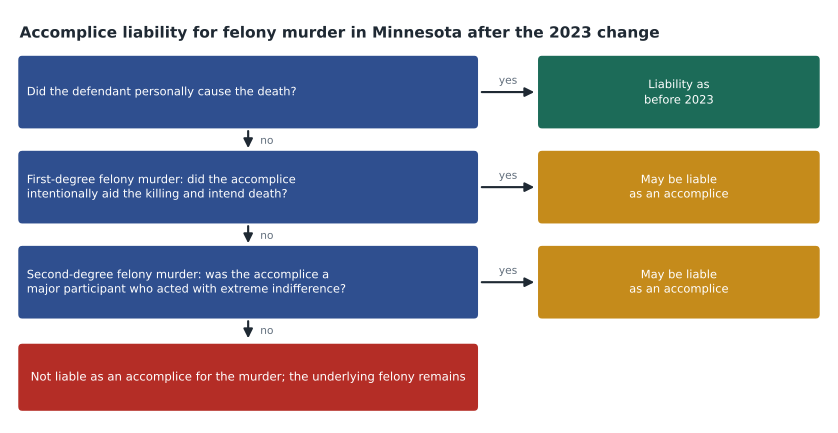
Minnesota's felony murder structure is itself distinctive. Minnesota's first-degree murder statute includes a killing committed with intent to cause death while committing or attempting certain serious felonies, so first-degree felony murder in Minnesota already requires intent to kill. Second-degree felony murder covers an unintentional killing while committing a felony offense, and Minnesota courts have limited the predicate felonies to those that are dangerous to human life, considered in the abstract or as actually committed. Minnesota also sentences under the Minnesota Sentencing Guidelines, which Minnesota pioneered in 1980 as one of the first guideline systems in the country.
Worked problem
Two accomplices after 2023
Ana and Ben agree to steal from a closed warehouse at night. Ana drives and waits in the car; she knows Ben has no weapon. Inside, Ben unexpectedly finds a security guard, struggles with him, and the guard dies of a head injury. Separately, Cal and Dev plan an armed robbery of a store; Cal brings a loaded gun and Dev, who knows about the gun, directs the robbery and blocks the door while Cal threatens the clerk, who is shot and killed.
Show solution
- Ben caused the death and faces liability for felony murder as before.
- Ana, under the 2023 law, can be convicted of second-degree felony murder as an accomplice only if she was a major participant in the burglary and acted with extreme indifference to human life. As a driver who believed no one was armed, she has a strong argument that she was neither.
- Cal caused the death and faces liability as before.
- Dev directed an armed robbery he knew involved a loaded gun and physically blocked the exit. A jury could find he was a major participant who acted with extreme indifference, so accomplice liability for second-degree felony murder remains possible.
Answer: The 2023 law separates Ana's situation from Dev's: it narrows accomplice liability for felony murder to participants whose role and mental state justify it.
On the MBE and MEE, the general felony murder rule and general accomplice liability principles still govern. A candidate who answers an MBE question about a getaway driver with Minnesota's 2023 rule will likely choose the wrong answer. That is another example of the two boxes.
Common mistakes
MistakeMinnesota requires proof of fault, such as adultery, to dissolve a marriage.
InsteadMinnesota is no-fault; the ground is irretrievable breakdown.
MistakeProperty titled in one spouse's name is that spouse's nonmarital property.
InsteadProperty acquired during the marriage is presumed marital regardless of title.
MistakeMinnesota recognizes handwritten wills without witnesses.
InsteadMinnesota generally requires two witnesses, though it honors wills valid where executed.
MistakeA transfer on death deed is effective if found in the owner's papers after death.
InsteadIt must be recorded before the owner's death.
MistakeAfter 2023, a Minnesota getaway driver is always guilty of felony murder if a death occurs.
InsteadFor second-degree felony murder, an accomplice who did not cause death must be a major participant who acted with extreme indifference.
Summary and key terms
- Minnesota dissolution is no-fault (irretrievable breakdown), with a 180-day residence requirement for one party.
- Property acquired during the marriage is presumed marital regardless of title; nonmarital property must be proved and traced; marital property is divided justly and equitably.
- Custody follows the best interests factors in section 518.17, with a presumption for joint legal custody on request and against joint custody where domestic abuse has occurred.
- Minnesota follows the Uniform Probate Code with modifications: two-witness wills, intestacy and elective share rules, and special homestead rules for surviving spouses.
- Transfer on death deeds under section 507.071 pass real estate outside probate if recorded before death.
- Since 2023, an accomplice who did not cause the death can be convicted of first-degree felony murder only with intent to aid and intent to kill, and of second-degree felony murder only as a major participant acting with extreme indifference.
- 0
- irretrievable breakdown
- 1
- marital property
- 2
- nonmarital property
- 3
- tracing
- 4
- legal custody
- 5
- physical custody
- 6
- elective share
- 7
- transfer on death deed
- 8
- major participant
Practice problems
Work each problem on paper first, then reveal the answer to check.
A spouse inherited 50,000 dollars during the marriage and kept it in a separate account in her name. Marital or nonmarital?
Show answer
Nonmarital, as an inheritance to one spouse that can be traced.
What are the formal requirements for a Minnesota will?
Show answer
A writing, signed by the testator (or by another at the testator's direction and in the testator's presence), and signed by two witnesses.
When must a Minnesota transfer on death deed be recorded?
Show answer
Before the owner's death.
Under the 2023 law, what must the state prove to convict an accomplice who did not cause the death of second-degree felony murder?
Show answer
That the accomplice was a major participant in the underlying felony and acted with extreme indifference to human life.
Lesson quiz · 5 questions
Score 60% or more to complete this lesson.
Create a free account to save your progress, take quizzes and earn a certificate.