
BAR-224 · Lesson 7 of 12 · 20 min
Minnesota courts and the Minnesota Rules of Civil Procedure
▶ Video coming soon A video version of this lesson is on the way.
In early November, Maren Ostby handed Kirsten a file with a sticky note on it. A prospective client had been rear-ended at a stoplight in Ramsey County. The other driver's insurer had made a low offer, and the client wanted to know whether the firm could 'get the case started' without filing anything in court yet, to put pressure on the insurer. Kirsten, who had spent the fall learning the Federal Rules of Civil Procedure for the MBE, assumed the answer was no. Under the federal rules, an action begins when the complaint is filed.
Ostby smiled when Kirsten said so. 'Not in Minnesota state court,' she said. 'Read Rule 3.01.' That evening Kirsten brought the file to Marchetti. 'This is the single most important Minnesota procedural rule for a new lawyer,' Marchetti said, 'and it is the opposite of what you are studying for the exam.'
This lesson explains the structure of the Minnesota courts, how a civil action is commenced in Minnesota, the one-year filing rule, Minnesota's notice pleading standard, discovery, the right to remove a judge, the special rule for punitive damages, expert evidence, and the basics of appeals. On the UBE, federal procedure governs; this lesson is about the Minnesota rules a new lawyer uses in state court.
The Minnesota court system
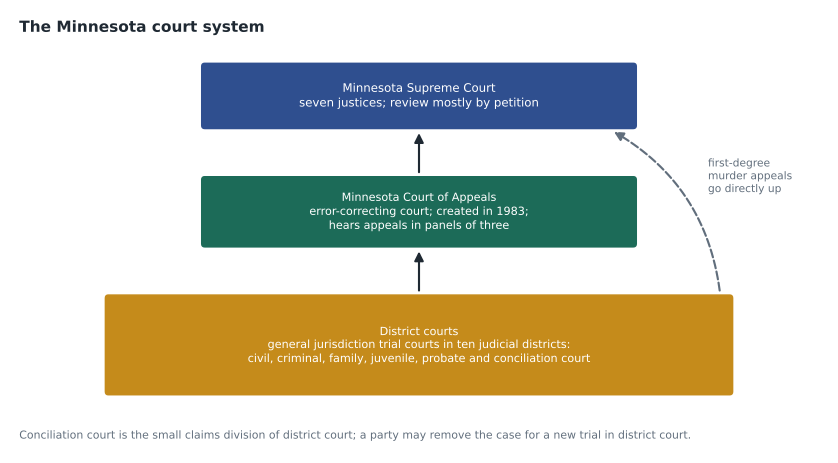
Minnesota has a three-level court system. The district courts are the trial courts of general jurisdiction. They hear civil cases of every size, criminal cases from petty misdemeanors to first-degree murder, family cases, juvenile cases, probate and guardianship matters, and housing cases. The state is divided into ten judicial districts, each covering one or more counties, and each county has a district court.
Within the district court, conciliation court serves as the small claims division. Conciliation court handles civil claims up to a statutory dollar limit, with simplified procedures and no requirement of a lawyer. A party who loses in conciliation court can remove the case to the district court for a new trial, which is one reason lawyers treat conciliation court as a first step rather than a final word.
The Minnesota Court of Appeals is the intermediate appellate court. It was created in 1983 to relieve the Supreme Court of a growing caseload, and it hears most appeals from the district courts as a matter of right. It sits in panels of three judges and is primarily an error-correcting court. The Minnesota Supreme Court, with seven justices, is the court of last resort. It reviews Court of Appeals decisions mostly by granting petitions for further review, decides cases of statewide importance, and hears appeals in first-degree murder cases directly from the district court.
Commencing an action: service, not filing
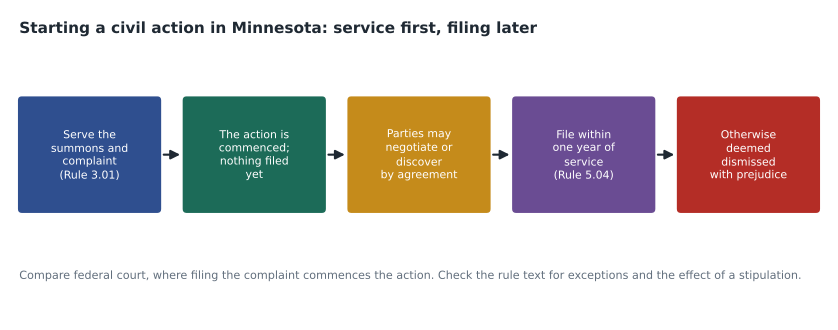
Under Federal Rule of Civil Procedure 3, a civil action is commenced by filing a complaint with the court. Minnesota's rule is different. Under Minnesota Rule of Civil Procedure 3.01, a civil action is commenced against a defendant when the summons is served on that defendant, along with the complaint, or delivered to the sheriff for service under the conditions the rule describes, or when service by publication begins. Filing with the court is not required to commence the action.
This is sometimes called hip-pocket service, because the plaintiff's lawyer can serve the summons and complaint and keep the case in the hip pocket, without filing, while the parties negotiate. The practice has deep roots in Minnesota, and it has real advantages. It lets parties exchange information and try to settle without court fees and without a public file. It also matters for statutes of limitations: because service commences the action, a plaintiff must complete service, not just filing, before the limitations period runs.
That last point is the trap for lawyers trained on the federal rules. A lawyer who files a complaint on the last day of the limitations period and assumes the action is commenced may find, in Minnesota state court, that it is not. The defendant must be served.
The one-year filing rule
Hip-pocket service once let cases sit unfiled for years. To address that, Minnesota amended its rules in 2013. Under Rule 5.04, an action that is not filed with the court within one year after it was commenced against any party is deemed dismissed with prejudice against all parties, unless the parties sign a stipulation to extend the filing period within that year. The rule gives the parties a year to work out the dispute privately and then forces the case into court or out of existence.
The consequences of missing the deadline are severe. A dismissal with prejudice ends the claim. A lawyer who serves a summons and then forgets to file within a year, or forgets to get a written stipulation extending the time, has lost the client's case. Most Minnesota firms calendar the one-year date the day service is completed.
Worked problem
Ostby's rear-end collision file
The client was rear-ended on a date within the limitations period. Ostby wants to start the action now to show the insurer the client is serious, but she hopes to settle without filing.
Show solution
- Commencement: under Rule 3.01, the action is commenced when the summons and complaint are served on the other driver. Nothing needs to be filed to commence it.
- Limitations: because service commences the action, completing service before the limitations period expires protects the claim.
- Calendar: the firm must file the action with the court within one year of service under Rule 5.04, unless the parties sign a written stipulation extending the time within that year.
- Consequence: if the firm misses the filing deadline without a stipulation, the action is deemed dismissed with prejudice.
Answer: Ostby can serve now, negotiate privately, and file only if settlement fails, as long as the firm files within one year of service or obtains a written stipulation.
Pleading: Minnesota kept notice pleading
In federal court, Bell Atlantic Corp. v. Twombly (2007) and Ashcroft v. Iqbal (2009) require a complaint to state enough facts to make a claim plausible, not merely conceivable. Many states adopted that standard for their own courts. Minnesota declined.
In Walsh v. U.S. Bank, N.A., decided in August 2014, the Minnesota Supreme Court held that the plausibility standard does not apply to Minnesota civil pleadings. Minnesota Rule of Civil Procedure 8.01 requires a short and plain statement of the claim showing that the pleader is entitled to relief. Under Minnesota's long-standing approach, a claim is sufficient against a motion to dismiss for failure to state a claim if it is possible, on any evidence that might be produced consistent with the pleader's theory, to grant the relief demanded. The Court reasoned that Minnesota's rule had its own history and interpretation and that a change of that kind should come through the rulemaking process, not a judicial decision.
The practical effect is that a complaint in Minnesota state court can survive a motion to dismiss with less factual detail than the same complaint would need in federal court. That can influence where a plaintiff's lawyer chooses to file, and it is a classic example of the two boxes from Lesson 6: on the MBE, Twombly and Iqbal govern; in Minnesota state court, Walsh governs.
Discovery and proportionality
Minnesota's discovery rules generally follow the federal model: interrogatories, requests for production, requests for admission, depositions and physical or mental examinations. The 2013 amendments that created the one-year filing rule also brought proportionality into Minnesota's discovery rules, so that discovery must be proportional to the needs of the case, considering factors such as the amount in controversy, the importance of the issues and the burden of the discovery. The amendments also introduced initial disclosures for many cases, requiring parties to share basic information without waiting for a formal request.
Minnesota's General Rules of Practice for the District Courts add further requirements, such as rules on motion practice, scheduling, and alternative dispute resolution. Most civil cases in Minnesota must consider ADR, such as mediation, and courts often order it. A new lawyer should read the General Rules alongside the Rules of Civil Procedure, because many day-to-day requirements, such as the timing of motion papers, are found there.
Removing a judge
Minnesota gives each side a right that surprises lawyers from federal practice. Under Minnesota Rule of Civil Procedure 63.03, a party may remove the assigned judge once, without showing cause, by serving and filing a notice to remove within the time the rule sets after the party receives notice of the assignment. A notice cannot be used against a judge who has already presided at a motion or other proceeding of which the party had notice. After the first removal, any further request requires an affirmative showing of prejudice. Minnesota's criminal rules contain a similar provision for criminal cases.
The right is a tool, and like any tool it can be misused. Lawyers who remove judges routinely may develop a reputation, and the timing rules are strict. But a new lawyer should know the right exists, because the deadline to exercise it runs quickly once a judge is assigned.
Punitive damages: a motion, not a pleading
Minnesota has a distinctive statutory rule for punitive damages. Under Minnesota Statutes section 549.191, a plaintiff may not seek punitive damages in the initial complaint. Instead, after the action is filed, the plaintiff must move to amend the pleadings to add a claim for punitive damages, and the motion must be supported by affidavits showing the factual basis for the claim. The court grants the motion only if it finds prima facie evidence in support of the claim. At trial, under section 549.20, punitive damages require clear and convincing evidence that the defendant's acts showed deliberate disregard for the rights or safety of others.
The two-step rule protects defendants from punitive damages claims added for leverage and gives the court an early look at whether the claim has support. For a plaintiff's lawyer, it means planning discovery to develop the evidence needed for the motion. For a new lawyer, it means never including a punitive damages demand in a Minnesota complaint.
| Issue | Federal court (tested on the UBE) | Minnesota state court (practice) |
|---|---|---|
| Commencement | Filing the complaint (FRCP 3) | Service of the summons (Minn. R. Civ. P. 3.01) |
| Filing deadline | Filing is the start | File within one year of commencement or the action is deemed dismissed with prejudice (Rule 5.04) |
| Pleading standard | Plausibility (Twombly, Iqbal) | Plain notice pleading (Rule 8.01; Walsh v. U.S. Bank, 2014) |
| Removing a judge | Only for cause | One removal without cause by timely notice (Rule 63.03) |
| Punitive damages | Pleaded in the complaint | Added only by motion to amend with a prima facie showing (Minn. Stat. 549.191) |
Expert evidence: Frye-Mack
On the MBE, expert testimony is governed by Federal Rule of Evidence 702 and the Daubert line of cases, under which the trial judge acts as a gatekeeper and assesses the reliability of the expert's methods. Minnesota did not adopt Daubert. Minnesota courts apply the Frye-Mack standard to novel scientific evidence: the underlying scientific theory must be generally accepted in the relevant scientific community, and the particular evidence must have foundational reliability. Minnesota Rule of Evidence 702 reflects that approach.
For a new litigator, the difference matters when the opposing expert relies on new or contested science. The question in Minnesota state court is general acceptance plus foundational reliability, not the Daubert factors. On the exam, Daubert governs.
Appeals
Appeals in civil cases go from the district court to the Court of Appeals under the Minnesota Rules of Civil Appellate Procedure. The deadline to appeal from a final judgment is generally 60 days, measured as the appellate rules specify, and certain orders are appealable before final judgment. Post-trial motions, such as a motion for a new trial, affect the timing. A new lawyer handling an appeal should read the appellate rules closely and calendar every deadline, because appellate deadlines are jurisdictional or close to it, and a missed deadline can end the appeal.
After the Court of Appeals decides, a party may petition the Supreme Court for further review. The Supreme Court grants review in a minority of cases, typically those that present important legal questions or conflicts. Most civil appeals end in the Court of Appeals.
Juries
Minnesota civil juries are typically smaller than twelve. The Minnesota Constitution allows the legislature to provide for verdicts by five-sixths of a jury after a set period of deliberation in civil cases, and Minnesota law does so. Criminal verdicts must be unanimous. A new lawyer preparing for a civil jury trial should check the current statute and rule on jury size and verdicts, because they affect jury selection strategy.
Common mistakes
MistakeA Minnesota civil action is commenced by filing the complaint.
InsteadUnder Rule 3.01, service of the summons commences the action.
MistakeA served but unfiled Minnesota action can stay unfiled indefinitely.
InsteadUnder Rule 5.04, it must be filed within one year or it is deemed dismissed with prejudice, absent a signed stipulation.
MistakeMinnesota state courts apply Twombly and Iqbal.
InsteadWalsh v. U.S. Bank (2014) kept notice pleading under Rule 8.01.
MistakeA Minnesota plaintiff can demand punitive damages in the complaint.
InsteadUnder section 549.191, punitive damages are added only by motion to amend with a prima facie showing.
MistakeMinnesota uses Daubert for expert evidence.
InsteadMinnesota applies Frye-Mack to novel scientific evidence.
Summary and key terms
- Minnesota has district courts in ten judicial districts, a Court of Appeals created in 1983, and a seven-justice Supreme Court that hears first-degree murder appeals directly.
- Under Rule 3.01, service of the summons commences a civil action; filing is not required to commence it.
- Under Rule 5.04, an action not filed within one year of commencement is deemed dismissed with prejudice unless the parties stipulate in writing to extend.
- Minnesota kept notice pleading under Rule 8.01 (Walsh v. U.S. Bank, 2014).
- A party may remove a judge once without cause by timely notice under Rule 63.03.
- Punitive damages are added only by motion under section 549.191 and require clear and convincing evidence of deliberate disregard under section 549.20.
- Minnesota applies Frye-Mack, not Daubert, to novel scientific evidence.
- 0
- hip-pocket service
- 1
- commencement
- 2
- one-year filing rule
- 3
- notice pleading
- 4
- notice to remove
- 5
- Frye-Mack standard
- 6
- conciliation court
Practice problems
Work each problem on paper first, then reveal the answer to check.
When is a Minnesota state court civil action commenced?
Show answer
When the summons is served on the defendant (or delivered to the sheriff or published as Rule 3.01 provides).
What happens if a served action is not filed within one year and there is no stipulation?
Show answer
It is deemed dismissed with prejudice under Rule 5.04.
A plaintiff's lawyer wants punitive damages in a Minnesota product case. What must she do?
Show answer
File without a punitive damages claim, then move to amend under section 549.191 with affidavits showing prima facie evidence.
Which standard governs novel scientific evidence in Minnesota state court?
Show answer
Frye-Mack: general acceptance plus foundational reliability.
Lesson quiz · 5 questions
Score 60% or more to complete this lesson.
Create a free account to save your progress, take quizzes and earn a certificate.