
BAR-224 · Lesson 10 of 12 · 22 min
Minnesota Rules of Professional Conduct
▶ Video coming soon A video version of this lesson is on the way.
In mid-November, a prospective client came to Ostby's office about a divorce and asked whether she could pay a flat fee up front so she would know her costs. Ostby agreed in principle and asked Kirsten to draft the fee agreement. Kirsten, fresh from her MPRE preparation, started with the Model Rules approach she had learned: an advance fee is held in trust and withdrawn as earned. Ostby stopped her. 'That is the default,' she said. 'But Minnesota has a specific rule about when a flat fee can be treated as earned on receipt. Look at Rule 1.5(b) before you draft.'
Kirsten told Marchetti about it that evening. 'The MPRE taught you the Model Rules,' Marchetti said. 'Minnesota's rules are built on them, and most of the time they match. The places where they do not match are exactly the places a new Minnesota lawyer gets into trouble, because she assumes the rule she studied is the rule that applies.'
This lesson explains how the Minnesota Rules of Professional Conduct relate to the ABA Model Rules, several Minnesota features a new lawyer should check, the trust account rules, and the Minnesota discipline system. On the MPRE, the Model Rules govern; in practice, the Minnesota rules do.
The Minnesota rules and the Model Rules
The Minnesota Supreme Court adopted the Minnesota Rules of Professional Conduct based on the ABA Model Rules, and it amends them from time to time, often following later ABA amendments but sometimes departing from them. The numbering follows the Model Rules, so Rule 1.7 on conflicts of interest and Rule 1.6 on confidentiality appear in the familiar places. Most of the text is the same or nearly the same. The comments, which in Minnesota are generally treated as guidance rather than binding rules, also follow the Model Rules in large part.
Because the overlap is so large, Kirsten's MPRE preparation is a solid foundation. What she needs is a list of the places to check. Marchetti's rule is that a new lawyer should never assume a Model Rule answer is the Minnesota answer on a question involving fees, trust accounts, confidentiality exceptions, financial assistance to clients, or harassment and discrimination, because those are areas where Minnesota has its own wording.
Advance fees and flat fees: Rule 1.5(b)
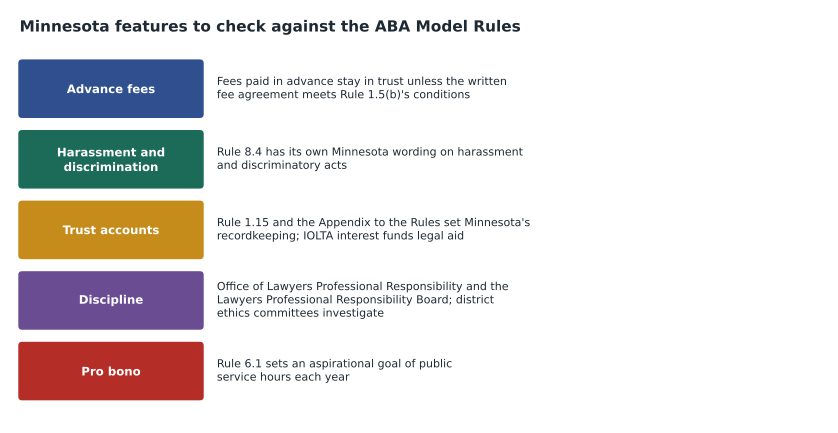
Rule 1.5 requires that fees be reasonable and that the basis or rate of the fee be communicated to the client. Minnesota's Rule 1.5(b) adds specific provisions on fees paid in advance. The general principle is that fees paid in advance of the services are held in a trust account until earned. A lawyer may treat an advance fee as the lawyer's property on receipt only if the fee agreement meets the rule's conditions, which include a written agreement signed by the client that explains the nature of the fee, that it will not be held in trust, and that the client may discharge the lawyer at any time and may be entitled to a refund of all or part of the fee if the agreed services are not completed. Minnesota also addresses availability fees, paid to secure a lawyer's availability rather than for specific services.
The details of the conditions matter, and a lawyer drafting a flat fee agreement in Minnesota should work from the current text of Rule 1.5(b) and its comments. The key lesson for a new lawyer is that a flat fee is not automatically the lawyer's money. Without a compliant written agreement, it belongs in trust until earned, and depositing it in the firm's operating account is a trust account violation.
Worked problem
Drafting Ostby's flat fee agreement
The divorce client will pay a flat fee for an uncontested dissolution. Ostby wants to deposit it in the firm's operating account.
Show solution
- Default: under Minnesota's Rule 1.5(b), a fee paid in advance is held in trust until earned unless the rule's conditions are met.
- Agreement: Kirsten drafts a written fee agreement, to be signed by the client, that describes the services, states that the fee will not be held in trust, and tells the client that she may discharge the firm at any time and may be entitled to a refund if the agreed services are not completed.
- Check: Kirsten compares the draft line by line against the current text of Rule 1.5(b) and its comments, and Ostby reviews it.
- Refunds: if the client ends the representation early, the firm must refund any unearned portion; a flat fee does not avoid the reasonableness requirement.
Answer: With a compliant written agreement, the firm may treat the flat fee as its property on receipt. Without one, the fee goes into trust.
Confidentiality: Rule 1.6
Minnesota's Rule 1.6 protects information relating to the representation of a client, as the Model Rule does, and then sets out exceptions permitting disclosure. Minnesota's list of exceptions is longer than the Model Rule's and is numbered differently. It includes disclosures the client consents to or that are impliedly authorized, disclosures to prevent reasonably certain death or substantial bodily harm, disclosures related to crimes and frauds in which the lawyer's services were used, disclosures to secure ethics advice, disclosures to establish a claim or defense in a controversy with the client, and disclosures to comply with other law or a court order, among others.
On the MPRE, the Model Rule's list governs. In practice, a Minnesota lawyer facing a confidentiality question should read Minnesota's Rule 1.6 itself, because an exception that exists under one rule may be worded differently, or may not exist, under the other. Confidentiality questions are rarely urgent in the abstract and often urgent in the moment, so a new lawyer should know where the rule is before the moment arrives.
Financial assistance to clients: Rule 1.8(e)
The Model Rule generally prohibits lawyers from providing financial assistance to clients in connection with pending or contemplated litigation, with exceptions for advancing court costs and litigation expenses and, since a 2020 amendment, for modest humanitarian gifts to indigent clients in some cases. Minnesota's Rule 1.8(e) has its own set of exceptions, which differ in their details. A plaintiff's lawyer in Minnesota who is asked by a struggling client for help with rent or medical bills during a lawsuit must check Minnesota's rule rather than relying on the Model Rule or on what lawyers do in another state.
Harassment and discrimination: Rule 8.4
Rule 8.4 defines professional misconduct. The Model Rule's paragraph (g), added in 2016, prohibits harassment and discrimination in conduct related to the practice of law. Minnesota's Rule 8.4 has its own provisions on these subjects, adopted separately and worded differently, addressing harassment of a person on the basis of protected characteristics in connection with a lawyer's professional activities and discriminatory acts prohibited by law that reflect adversely on fitness to practice. A Minnesota lawyer should read the Minnesota text, because the scope of the prohibition differs from the Model Rule's.
Trust accounts: Rule 1.15
Trust account violations are among the most common causes of serious discipline for lawyers, and Minnesota's rules on trust accounts are detailed. Rule 1.15 requires a lawyer to hold client and third-party funds separately from the lawyer's own funds, in a trust account, and to keep complete records. Minnesota supplements the rule with detailed recordkeeping requirements, set out in an appendix to the rules, which describe the books and records a lawyer must maintain, such as a check register, client subsidiary ledgers, and monthly reconciliations.
Most client funds that are nominal in amount or held for a short time go into a pooled interest-bearing account under Minnesota's IOLTA program, with the interest paid to fund legal services for low-income Minnesotans. Larger sums held for longer periods may go into separate interest-bearing accounts for the client's benefit. Banks that hold Minnesota lawyer trust accounts agree to report overdrafts to the Office of Lawyers Professional Responsibility, so a bounced trust account check often leads to an inquiry.
For a new lawyer, the practical rules are simple. Never deposit client funds in an operating account. Never pay firm expenses from the trust account. Never withdraw a fee before it is earned unless Rule 1.5(b)'s conditions for treating it as earned are met. Reconcile the trust account every month. And when in doubt, ask the firm's managing lawyer before moving money.
| Rule area | MPRE answer (Model Rules) | What to check in Minnesota |
|---|---|---|
| Advance flat fees | Held in trust until earned; refundable if unearned | Rule 1.5(b)'s written-agreement conditions for treating a fee as earned on receipt |
| Confidentiality exceptions | Model Rule 1.6(b) list | Minnesota Rule 1.6's longer, differently numbered list |
| Financial assistance in litigation | Model Rule 1.8(e), including the 2020 humanitarian exception | Minnesota Rule 1.8(e)'s own exceptions |
| Harassment and discrimination | Model Rule 8.4(g) | Minnesota Rule 8.4's own provisions |
| Trust account records | General recordkeeping duties | Minnesota's detailed appendix on books and records |
Pro bono: Rule 6.1
Rule 6.1 states that every lawyer has a professional responsibility to provide legal services to those unable to pay, and sets an aspirational goal of public service hours each year. The rule is not enforced through discipline. But Minnesota has a strong tradition of volunteer legal services, and many Minnesota firms expect new lawyers to take on pro bono matters through legal aid organizations and volunteer attorney programs. Pro bono work can also earn CLE credit in Minnesota in some circumstances, as Lesson 11 notes.
The Minnesota discipline system
Minnesota's lawyer discipline system is governed by the Rules on Lawyers Professional Responsibility, adopted by the Supreme Court. Its main parts are the Office of Lawyers Professional Responsibility, the Lawyers Professional Responsibility Board, district ethics committees, and the Supreme Court.
A complaint against a lawyer usually goes first to the Office of Lawyers Professional Responsibility, led by a Director appointed by the Supreme Court. Many complaints are referred to a district ethics committee, made up of local lawyers and public members, for investigation. The committee recommends a disposition to the Director. Minor violations may be resolved with a private admonition. More serious matters may lead to charges of unprofessional conduct, review by a panel of the Lawyers Professional Responsibility Board, and a petition for disciplinary action filed in the Supreme Court. The Court may appoint a referee to hear evidence and make findings. The Court then decides on public discipline, which can include a public reprimand, probation, suspension, or disbarment.
The Minnesota Client Security Board, a separate body, reimburses clients who lose money because of a Minnesota lawyer's dishonest conduct, such as theft from a trust account. It is funded by lawyers' annual registration fees. Its existence reflects the profession's collective responsibility for the dishonesty of individual lawyers.
Common first-year problems
Marchetti closed the session with the problems she sees most often in the files of new lawyers, drawn from her years of reading discipline decisions as a coach. The first is neglect: missing deadlines, failing to return calls, letting a file sit. The second is poor communication: not telling clients about settlement offers, adverse rulings or developments in their cases. The third is trust account mistakes, often from carelessness rather than dishonesty. The fourth is conflicts of interest that were never checked, such as representing a new client against a former client in a related matter. None of these requires knowledge of an obscure rule. All of them require systems: a calendar, a client communication habit, a monthly reconciliation and a conflicts check for every new matter.
Worked problem
A conflicts check at Ostby's firm
A new client wants the firm to sue a contractor for a defective deck. Kirsten runs the conflicts check and finds that Ostby represented the contractor two years ago in an unrelated collection matter that is now closed.
Show solution
- Current or former client: the contractor is a former client, so Rule 1.9, not Rule 1.7, governs.
- Same or substantially related matter: a defective deck claim is not the same as, or substantially related to, an unrelated collection matter, unless the firm learned confidential information in the earlier matter that would materially advance the new client's position.
- Confidential information: Kirsten asks Ostby whether she learned anything in the collection matter about the contractor's finances or practices that bears on the deck claim.
- Result: if not, the firm may take the new matter without the former client's consent, while continuing to protect the former client's confidential information.
Answer: The firm can likely take the case, but only after the conflicts check and a conversation about what was learned in the earlier matter.
Common mistakes
MistakeA flat fee is always the lawyer's property on receipt.
InsteadIn Minnesota, an advance fee is held in trust unless Rule 1.5(b)'s written-agreement conditions are met.
MistakeMinnesota's confidentiality exceptions are identical to the Model Rule's.
InsteadMinnesota's Rule 1.6 has a longer, differently numbered list of exceptions.
MistakeThe Minnesota State Bar Association disciplines lawyers.
InsteadThe Office of Lawyers Professional Responsibility, the Lawyers Professional Responsibility Board and the Supreme Court handle discipline.
MistakeA small trust account shortfall is fine if the lawyer repays it quickly.
InsteadCommingling and conversion are violations regardless of repayment; banks report trust account overdrafts.
MistakeRule 6.1's pro bono goal is enforced through discipline.
InsteadRule 6.1 is aspirational.
Summary and key terms
- The Minnesota Rules of Professional Conduct are based on the ABA Model Rules and follow their numbering, with Minnesota variations.
- Areas to check include advance and flat fees under Rule 1.5(b), confidentiality exceptions under Rule 1.6, financial assistance under Rule 1.8(e) and harassment and discrimination under Rule 8.4.
- Rule 1.15 and Minnesota's detailed recordkeeping appendix govern trust accounts; IOLTA interest funds legal services; banks report trust account overdrafts.
- Discipline runs through the Office of Lawyers Professional Responsibility, district ethics committees, the Lawyers Professional Responsibility Board and the Supreme Court.
- The Client Security Board reimburses clients for losses caused by lawyer dishonesty.
- Most first-year discipline problems come from neglect, poor communication, trust account errors and unchecked conflicts.
- 0
- Minnesota Rules of Professional Conduct
- 1
- advance fee
- 2
- flat fee
- 3
- IOLTA
- 4
- Office of Lawyers Professional Responsibility
- 5
- district ethics committee
- 6
- Client Security Board
Practice problems
Work each problem on paper first, then reveal the answer to check.
A client pays a 2,500-dollar flat fee for a will. There is no written agreement about trust. Where must the money go?
Show answer
Into the trust account, to be withdrawn as earned, because Rule 1.5(b)'s conditions are not met.
Which rules govern the MPRE, and which govern a Minnesota lawyer's conduct?
Show answer
The ABA Model Rules govern the MPRE; the Minnesota Rules of Professional Conduct govern Minnesota lawyers.
Who typically investigates a complaint against a Minnesota lawyer at first instance?
Show answer
A district ethics committee, on referral from the Office of Lawyers Professional Responsibility, or the Office itself.
What does the Client Security Board do?
Show answer
It reimburses clients who lose money because of a Minnesota lawyer's dishonest conduct.
Lesson quiz · 5 questions
Score 60% or more to complete this lesson.
Create a free account to save your progress, take quizzes and earn a certificate.