
BAR-224 · Lesson 12 of 12 · 22 min
Capstone: Minnesota practice questions and an exam-day plan
▶ Video coming soon A video version of this lesson is on the way.
By the last of their twelve sessions, Kirsten's practice scores had moved. Her written portion, graded against model answers, was running about 132, and her MBE practice sets pointed to about 136, a total of about 268 against the 260 she needed. Marchetti did not celebrate. 'Good,' she said. 'Now we protect it. The last weeks are about consistency, not new material. And today we do two things: a set of Minnesota practice questions to make sure the two boxes are still separate, and your exam-week plan.'
This capstone lesson has three parts. The first is a set of original practice questions on Minnesota admission and Minnesota law, with explanations. The second is a full fact-pattern problem answered in memo form, applying Minnesota law the way Kirsten would at the firm. The third is a twelve-week study plan and an exam-week plan for the February 23 and 24, 2027 Minnesota UBE.
Part one: Minnesota practice questions
These questions are original and written for this course. They test Minnesota rules covered in Lessons 1 through 11. Remember that on the UBE itself, general principles govern; these questions are about Minnesota.
Question 1. A 2026 graduate files her application for the February 2027 Minnesota exam on November 20, 2026. What is the consequence? Answer: She filed after the first filing deadline NCBE listed for February 2027, October 5, 2026, but before the late deadline of December 1, 2026. She may sit the exam but must pay the late filing fee.
Question 2. A candidate scores 127 on the MBE and 131 on the written portion of the Minnesota UBE. Does he pass? Answer: No. His total is 258, two points short of 260. The score is compensatory, but the total must reach 260.
Question 3. A candidate who fails the February 2027 Minnesota exam asks whether she can retake the same exam in Minnesota in July 2027. Answer: No. February 2027 is the last legacy UBE in Minnesota; the July 2027 Minnesota exam is NextGen.
Question 4. A plaintiff's lawyer serves a summons and complaint on a defendant in Minnesota state court on March 1, 2026, and the parties negotiate without filing. No stipulation is signed. On March 15, 2027, the lawyer files the action. What is the problem? Answer: Under Rule 5.04, an action not filed within one year after commencement is deemed dismissed with prejudice unless the parties sign a stipulation within that year. The action was commenced by service on March 1, 2026, so the filing deadline passed on March 1, 2027.
Question 5. In a negligence case against two defendants, the jury finds the plaintiff 35 percent at fault, defendant A 45 percent and defendant B 20 percent. What can the plaintiff recover from each? Answer: Minnesota compares the plaintiff with each defendant separately. The plaintiff's 35 percent is not greater than A's 45 percent, so she can recover from A; it is greater than B's 20 percent, so she cannot recover from B. Under section 604.02, A is not over 50 percent at fault, so A is severally liable for its own share, unless an exception applies. The interaction of the two statutes in that situation is a question a new lawyer should research carefully in the current case law.
Question 6. A pedestrian is injured on April 2 when a county snowplow backs into her in a parking lot next to the county courthouse. She contacts a lawyer on November 1. What is the most urgent issue? Answer: The notice deadline. Under section 466.05, written notice must be given to the county within 180 days after the injury is discovered. From April 2, that period has already run by November 1, unless an exception applies. The lawyer must investigate any basis for excusing late notice immediately.
Question 7. A client pays a lawyer a 3,000-dollar flat fee for an estate plan. The fee agreement is oral. The lawyer deposits the money in the firm's operating account. Has the lawyer violated the Minnesota rules? Answer: Very likely. Under Rule 1.5(b), a fee paid in advance is held in trust until earned unless a written agreement signed by the client meets the rule's conditions. An oral agreement does not.
Question 8. Under the 2023 Minnesota law, a lookout who did not know her companion was armed is charged as an accomplice to second-degree felony murder after the companion kills a store clerk during a robbery. What must the state prove? Answer: That the lookout was a major participant in the underlying felony and acted with extreme indifference to human life. On those facts, the state may have difficulty proving either.
Question 9. A Wisconsin lawyer with four years of full-time practice in Wisconsin, all within the last five years, applies for admission in Minnesota. Must he take the Minnesota exam? Answer: Not if he meets the requirements for admission without examination: active practice for at least three of the last five years, good standing, the MPRE requirement and character and fitness.
Question 10. A newly admitted Minnesota lawyer completes 50 CLE hours in her first period, including 3 ethics hours and 1 well-being hour, but no elimination of bias hours. Has she complied? Answer: No. Minnesota requires at least 2 elimination of bias hours within the 45. The extra hours do not substitute, and they do not carry over.
| Question | Minnesota rule tested | Lesson |
|---|---|---|
| 1 | Filing deadlines and late filing | 2 |
| 2 | Compensatory scoring and the 260 passing score | 4 |
| 3 | Last legacy UBE and NextGen in July 2027 | 5 |
| 4 | Commencement by service and the one-year filing rule | 7 |
| 5 | Defendant-by-defendant comparison and several liability | 8 |
| 6 | Municipal Tort Claims Act notice | 8 |
| 7 | Advance fees under Rule 1.5(b) | 10 |
| 8 | The 2023 felony murder reform | 9 |
| 9 | Admission without examination | 11 |
| 10 | CLE specialty credits and no carryover | 11 |
Part two: a full fact pattern
Marchetti's final exercise was a fact pattern built to run across several Minnesota topics. Kirsten wrote the memo in 45 minutes, as if for Ostby.
The facts. On August 10, 2026, Greta, a 70-year-old widow, was walking into the public library in a Minnesota city when she tripped on a raised section of sidewalk at the library entrance. The city had received two written complaints about the raised slab in the spring and had placed it on a repair list but had not repaired it. A city maintenance worker had also left a hose across the walk that morning. Greta was reading a text message as she walked. She broke her hip and incurred substantial medical bills. She died of unrelated causes on October 30, 2026, leaving a will, signed before two witnesses, that leaves everything to her two adult children. Her estate has a house, a bank account payable on death to her daughter, and her claim against the city. Her son visits the firm on November 16, 2026.
Worked problem
Memo: the estate's claim against the city
Ostby asks: (1) Is the claim viable, and what are the immediate deadlines? (2) How will fault be assessed? (3) How will any recovery be distributed?
Show solution
- Timely notice: under section 466.05, written notice must be given to the city within 180 days after the injury was discovered. The injury occurred August 10, 2026, so notice is due by early February 2027. The firm should send notice to the city council immediately, stating the time, place and circumstances and the amount sought if known.
- Standing and survival: Greta died of unrelated causes, so this is not a wrongful death claim. The personal injury claim may survive and be pursued by her personal representative, subject to Minnesota's survival statute, which limits the damages recoverable after death in some respects. The firm must open a probate estate, informally if no one objects, so that a personal representative can act, and must research the survival statute's limits on recovery.
- Immunity: the decision to place the slab on a repair list could be argued as discretionary if the city weighed budget and safety priorities in scheduling repairs; the city will raise the discretionary function exception. The hose left across the walk by a worker is operational conduct, not a policy decision. The snow and ice exception does not apply.
- Comparative fault: a jury may assign some fault to Greta for reading her phone. Under section 604.01, she can recover if her fault is not greater than the city's, with damages reduced by her share. If the contractor or another party were also involved, her fault would be compared with each defendant separately.
- Caps and damages: any recovery against the city is capped at 500,000 dollars per claimant, and punitive damages are not available.
- Distribution: any recovery belongs to the estate and passes under the will to the two children equally. The payable-on-death account passes to the daughter outside probate. The house passes under the will.
Answer: The claim is viable, with the strongest theory based on the worker's hose. The most urgent steps are notice to the city before the 180-day deadline and opening a probate estate so a personal representative can pursue the claim. Survival limits on damages need research.
Part three: the study plan
Marchetti's twelve-week plan for Kirsten ran from late November to the exam. It is written for the legacy UBE and is weighted toward writing, because that was where Kirsten's points were.
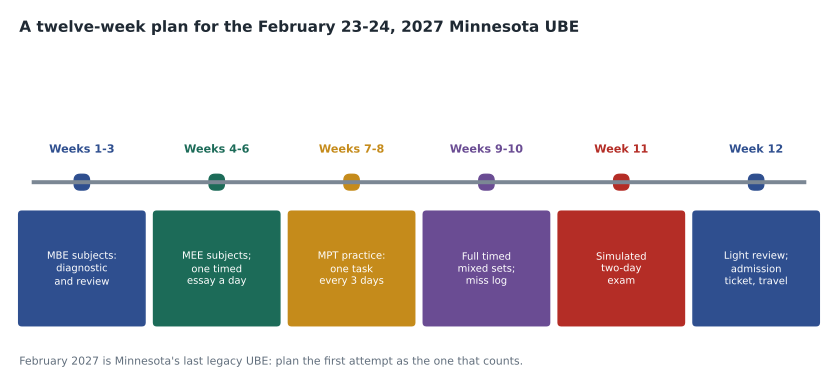
In weeks 1 to 3, Kirsten reviews the seven MBE subjects, starting with her weakest, and does 30 to 35 timed MBE questions a day with a miss log. In weeks 4 to 6, she reviews the six MEE-only subjects, business associations, conflict of laws, family law, secured transactions and trusts and estates, writing one timed essay a day and grading it against the model answer. In weeks 7 and 8, she adds one full MPT every third day, keeping the essays and MBE questions going. In weeks 9 and 10, she works mixed timed sets under exam conditions. In week 11, she sits a full simulated two-day exam. In week 12, she reviews lightly and handles logistics.
Kirsten reduces her hours at the firm in mid-January, so the heaviest weeks fall when she has the most time. Marchetti insisted on one full day off each week. 'Fatigue costs points,' she said. 'A rested candidate reads facts more accurately, and the bar exam is mostly about reading facts accurately.'
The exam-week plan
The exam days are Tuesday, February 23 and Wednesday, February 24, 2027. Marchetti plans the week backward from the reporting time on Tuesday morning.
| When | What to do |
|---|---|
| Thursday before | Reread the Board's exam instructions; confirm the test site, reporting time, identification rules and laptop software; check that the mock exam upload worked |
| Friday | Last full review day; stop new material by evening |
| Saturday | Light review of outlines and the miss log; pack: admission materials, identification, permitted items, medication, warm layers |
| Sunday | Rest; a walk; no practice tests |
| Monday | Travel to the test-site area if needed; drive the route at the actual reporting time; early night |
| Tuesday | MPT morning, MEE afternoon; eat lunch away from other candidates; do not discuss answers |
| Wednesday | MBE day; about 1.8 minutes a question; mark and move on |
| After | Update the Board about any change in the application; wait for results in the spring |
Two Minnesota-specific points belong on the list. The first is weather. Late February in Minnesota can bring heavy snow, ice and dangerous cold, and roads between Duluth and the Twin Cities can close. Kirsten plans to stay near the test site on Monday and Tuesday nights rather than drive in each morning, and to keep a winter kit in the car. The second is that February 2027 is the last legacy UBE in Minnesota. Marchetti does not want Kirsten thinking about it in the exam room, but she does want Kirsten to have prepared as if this attempt is the only legacy attempt available, because it is.
Worked problem
Kirsten's final checklist
In the last session, Marchetti asks Kirsten to read her checklist aloud.
Show solution
- Application filed September 28, 2026, before the October 5 first deadline: done.
- Character and fitness: full disclosure of the 2020 citation and the 2023 late account, with documents; court record supplied in October: done.
- MPRE 89, above Minnesota's 85: done.
- Study plan: twelve weeks, written-heavy, simulated exam in week eleven: on track.
- Laptop registered and software tested: done in December.
- Exam week: hotel near the test site for Monday and Tuesday nights; route checked; winter kit in the car.
Answer: Every track is either complete or scheduled. What remains is the work itself.
Exam-day habits that protect points
Marchetti's last advice was about the two days themselves. On the MPT, read the task memo first and follow its format instructions exactly. On the MEE, outline before writing and give every issue a heading, a rule, application and a conclusion. On the MBE, read the call of the question first, predict the answer before reading the options, and do not spend more than about two and a half minutes on any question; mark it and come back. Between sessions, do not discuss answers with other candidates. A candidate who hears that she missed an issue can lose the next session worrying about it.
And after the exam, Marchetti told Kirsten to do one more thing: update the Board if anything in her application changes while she waits for results. 'The exam ends Wednesday afternoon,' she said. 'Your duty of candor does not.'
Common mistakes
MistakeIn the last two weeks, a candidate should learn as many new rules as possible.
InsteadThe last weeks are for consistency, timed practice and rest, not new material.
MistakeA Minnesota rule is the right answer on the MEE if the candidate knows it.
InsteadMEE answers use general principles unless the question supplies a rule.
MistakeWeather is unlikely to matter in February.
InsteadMinnesota winter weather can close roads; stay near the test site.
MistakeA February 2027 candidate can count on a legacy retake in July 2027 in Minnesota.
InsteadJuly 2027 is NextGen in Minnesota.
MistakeThe duty to update the Board ends when the exam ends.
InsteadApplicants must keep their information current until admission.
Summary and key terms
- Original practice questions confirm the key Minnesota rules: deadlines, 260, the NextGen line, Rule 3.01 and 5.04, section 604.01 and 604.02, chapter 466 notice, Rule 1.5(b), the 2023 felony murder reform, admission without examination and CLE.
- A full fact pattern shows how Minnesota tort, municipal liability and probate rules work together in a real file.
- Kirsten's twelve-week plan is weighted toward writing, with timed MBE practice throughout and a simulated exam in week eleven.
- The exam-week plan works backward from Tuesday's reporting time and accounts for Minnesota winter weather.
- February 2027 is the last legacy UBE in Minnesota, so the first attempt should be prepared as the one that counts.
- 0
- miss log
- 1
- simulated exam
- 2
- call of the question
- 3
- survival claim
- 4
- exam-week plan
Practice problems
Work each problem on paper first, then reveal the answer to check.
A candidate scores 133 on the MBE. What written score does she need to reach 260?
Show answer
127.
An injury caused by a city employee occurs on June 1. When is notice due under section 466.05?
Show answer
Within 180 days after the injury is discovered, so by late November.
What is the most important thing to do in the week before the exam that is not studying?
Show answer
Reread the Board's instructions and confirm logistics: site, reporting time, identification, laptop software and travel.
Why should a February 2027 Minnesota candidate treat her first attempt as the one that counts?
Show answer
Because July 2027 is NextGen in Minnesota, so a retake would be a different exam.
Lesson quiz · 5 questions
Score 60% or more to complete this lesson.
Create a free account to save your progress, take quizzes and earn a certificate.