
BAR-220 · Lesson 6 of 12 · 18 min
What the exam tests and how Maine law appears
▶ Video coming soon A video version of this lesson is on the way.
Josie's first practice essay comes back from Marchetti with a single sentence circled in red. In an answer about a slip-and-fall at a store, Josie had written that the plaintiff's recovery would be barred if she was found equally at fault, because that is Maine law. 'True in Maine,' Marchetti writes in the margin, 'but the essay did not ask about Maine. It asked you to apply general principles. You spent four lines on a rule the graders were not looking for and skipped the comparative fault analysis they were.' Josie laughs when she reads it. 'I have been working at a Maine firm for three months,' she says. 'It is leaking into my answers.'
This lesson explains the difference between the general law tested on the Uniform Bar Examination and the Maine law a lawyer uses in practice. Keeping the two apart is one of the most useful habits a Maine applicant can build, especially one who already works in a Maine office.
The UBE tests general law
Every part of the legacy UBE is written by NCBE for use across many jurisdictions. The MBE tests generally accepted principles of law and the federal rules of civil procedure and evidence. The MEE asks examinees to apply generally accepted principles, and NCBE's grading materials are written that way. Where states are split, MEE questions usually either give the relevant rule or ask the examinee to discuss the competing approaches. The MPT supplies the law in its library. Nothing on the exam is drawn from Maine statutes or Maine cases.
Maine has no separate Maine law component. Some UBE jurisdictions require a state-specific course or test before admission; Maine's admission rules for examination applicants do not. The Maine law requirement that does exist arrives later and in a different form: Rule 11A requires lawyers admitted on motion to complete fifteen hours of continuing legal education on Maine practice and procedure, and new lawyers meet Maine's annual CLE requirement, described in Lesson 11. For the examination applicant, Maine law is not on the exam.
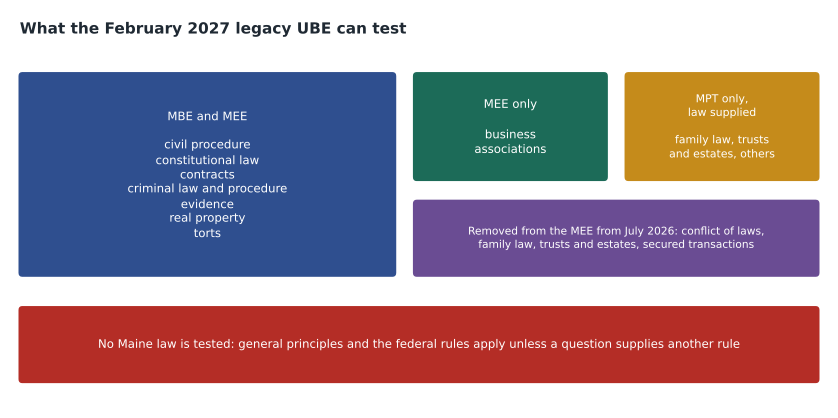
Where Maine law differs
A lawyer who works in Maine will notice differences between the general rules tested on the exam and the rules of Maine practice. Several appear in this course. Maine's civil procedure rules follow the federal model in structure but differ in timing and discovery: an answer is due within twenty days, discovery reaches matters relevant to the subject matter of the case, and there are no general initial disclosures. Maine tort law uses a modified comparative negligence rule under which a plaintiff found equally at fault recovers nothing, and the jury reduces damages by a dollar amount rather than a percentage. Maine's professional conduct rule on confidentiality protects confidences and secrets rather than all information relating to the representation.
On the exam, an examinee should ignore all of these unless the question raises them. An MBE question on the time to answer a complaint is a federal question, and the answer is the federal rule. An MEE torts question that asks about comparative fault calls for the general frameworks: pure comparative fault, modified comparative fault and, where relevant, contributory negligence. A professional responsibility issue on the MPT or in a NextGen skills question follows the ABA Model Rules unless the library says otherwise.
| Topic | What the exam tests | What Maine practice uses |
|---|---|---|
| Time to answer a complaint | Federal rule: generally 21 days after service | Maine rule: 20 days after service |
| Scope of discovery | Federal rule: relevant and proportional to the needs of the case | Maine rule: relevant to the subject matter, no general initial disclosures |
| Comparative fault | General frameworks, often with the rule supplied | Modified rule: a plaintiff equally at fault recovers nothing; reduction in dollars |
| Confidentiality | ABA Model Rule 1.6: all information relating to the representation | Maine Rule 1.6: confidences and secrets, with permissive exceptions |
| Limitation period for injury | Rarely tested; general principles | Generally six years for civil actions under 14 M.R.S. section 752 |
Reading the call of the question
The best protection against mixing the two is to read the call of the question carefully. MEE questions end with specific prompts, such as asking whether a party is liable, what claims a party may bring or whether a court should grant a motion. If the question says the events took place in a particular state and gives that state's rule, apply it. If it does not, apply the general rule and, where courts are split, say so briefly and apply the majority approach or the approach the facts suggest.
Marchetti teaches Josie a short drill. Before writing, she underlines every word in the question that tells her which law applies: a named jurisdiction, a reference to federal court, a quoted statute or the phrase applying general principles. If there is nothing, she writes the letters GP at the top of her scratch paper as a reminder that the answer should rest on general principles. 'You know a lot of Maine law now,' Marchetti says. 'That is good for your career and bad for your essays.'
Using a job wisely
Working while studying has costs and benefits. Josie's clerkship gives her real files and real clients, and the habits she builds at the firm, such as reading deadlines carefully and keeping clear notes, help with the MPT. But it also fills her mind with Maine rules that differ from the exam's rules. Marchetti recommends two practices.
First, keep a short page of differences. Each time Josie notices that a Maine rule differs from the general rule she is studying, she writes both on the page, with the exam version first. Reviewing the page once a week helps her see the general rule clearly and keeps the Maine rule from crowding it out.
Second, schedule study time away from the office. Josie studies MBE questions in the mornings before work and essays on weekends, so that the general rules come first in her day. She also spoke with Haskell, who agreed to cut her hours in January and February. Many Maine firms make similar arrangements for clerks preparing for the exam.
Worked problem
Separating Maine law from general law
An MEE question describes a customer who slips in a grocery store aisle on a spilled liquid. It says the jurisdiction follows modified comparative fault, under which a plaintiff may recover only if the plaintiff's fault is less than the defendant's, and asks what the customer can recover if the jury finds her 50 percent at fault and the store 50 percent at fault. What rule governs, and what is the answer?
Show solution
- Find the governing rule. The question supplies a modified comparative fault rule: the plaintiff's fault must be less than the defendant's.
- Apply it to the facts. At 50 percent each, the plaintiff's fault is not less than the store's.
- Reach the conclusion. Under the supplied rule, the customer recovers nothing.
- Avoid adding Maine law. The supplied rule happens to produce the same result as Maine's statute, but the answer should rest on the rule in the question, not on Maine.
Answer: The customer recovers nothing under the rule the question supplies. The examinee should apply that rule and need not mention Maine.
When Maine law does matter for the exam
There is one place where Maine law affects an applicant's exam preparation: the rules for the exam itself. Maine's filing windows, fees, passing score, accommodations and retake rules are all Maine law, and the earlier lessons in this course cover them. The applicant must know them to sit the exam, even though they are not tested on it.
Maine law also matters for what comes after the exam. A lawyer admitted on motion must take fifteen hours of continuing legal education on Maine practice and procedure under Rule 11A, and every new Maine lawyer will need Maine law from the first day of practice. Lessons 7 to 10 introduce the Maine courts, civil procedure, tort law, the Wabanaki Nations and Maine law, family law, probate and the Maine Rules of Professional Conduct, so that applicants can see what is ahead and so that working clerks can keep the Maine rules in their own compartment.
Common mistakes
MistakeThe Maine bar exam includes questions on Maine statutes.
InsteadThe UBE tests general principles and federal rules; Maine has no state component.
MistakeAn essay answer should cite the law of the state where the exam is given.
InsteadApply the rule the question supplies, or general principles if it supplies none.
MistakeMaine civil procedure is the same as federal procedure.
InsteadMaine follows the federal structure but differs on points such as the twenty-day answer period and the scope of discovery.
MistakeKnowing Maine practice rules helps on every exam question.
InsteadMaine rules can lead to wrong answers when the question calls for the general or federal rule.
Practice problems
Work each problem on paper first, then reveal the answer to check.
Does Maine require examination applicants to pass a Maine law test?
Show answer
No. Maine has no state law component for examination applicants.
An MBE question asks when a defendant in federal court must answer a complaint served personally. Which rule applies?
Show answer
The Federal Rules of Civil Procedure, which generally give 21 days after service.
How many hours of Maine practice and procedure CLE does Rule 11A require of motion applicants?
Show answer
Fifteen hours.
A sample page of differences
Josie's page of differences grows over the fall. Each line follows the same form: the topic, the exam rule and then the Maine rule. Time to answer: federal rule generally 21 days; Maine 20 days. Discovery scope: federal rule relevant and proportional; Maine relevant to the subject matter. Initial disclosures: required under the federal rule; Maine has no general requirement. Comparative fault: general frameworks or the rule given in the question; Maine bars a plaintiff equally at fault and reduces damages in dollars. Confidentiality: Model Rule covers all information relating to the representation; Maine covers confidences and secrets.
She keeps the page to one side of one sheet. When it threatens to grow longer, she asks whether each entry is likely to matter on the exam. Entries about Maine probate procedure or the Business and Consumer Docket, for example, will never come up on the UBE, so she moves them to a separate practice notebook. The page exists to protect exam answers from Maine rules that are close enough to the general rules to cause confusion.
How MEE graders treat jurisdiction-specific answers
MEE grading materials are written to reward answers that apply the general rule or the rule stated in the question. An answer that applies a particular state's minority rule without saying why usually loses credit, because it misses the analysis the graders were told to look for. An answer that notes a split and then applies the majority rule, or the rule the facts point to, usually earns full credit for that issue. The lesson for a Maine clerk is simple: if Maine follows a minority rule on some point, do not use it on an MEE answer unless the question invites it.
Graders also reward answers that are easy to follow. Headings that match the call of the question, a sentence stating each rule and a short paragraph applying that rule to the key facts are more effective than long discussions of every possible issue. Mentioning Maine law where it is not relevant does not usually cost points directly, but it costs time and can push out the analysis the graders are looking for.
The MPT library is the only law
The MPT has its own trap for practicing clerks. Each task supplies a library of cases and statutes, sometimes from an invented jurisdiction, and the examinee must use that law and only that law. A clerk who knows Maine's rule on a topic may be tempted to fill gaps in the library with Maine law. That is a mistake. If the library says the jurisdiction follows a rule different from Maine's, the answer must follow the library. If the library does not address a point, the answer should say so or reason from the authorities provided.
Josie practices this habit by reading each MPT library as though she has never practiced law anywhere. She marks each rule in the margin with the case or statute it comes from and uses only those rules in her answer. Her MPT scores improve once she stops reaching for outside law.
Using Maine experience on the MPT
Not everything from the office is a liability on the exam. The MPT tests skills that a clerk practices every day: reading a file carefully, separating relevant facts from irrelevant ones, writing for a specific reader and following instructions from a supervising lawyer. Josie notices that her practice at the firm drafting letters to clients and memos for Haskell makes the MPT task memos feel familiar. The skill transfers even when the law does not.
Marchetti puts it this way: 'Bring your judgment from the office. Leave your Maine rules there.'
Summary and key terms
- The UBE tests general principles and federal rules, and Maine has no state law component.
- Maine practice rules differ on points such as the answer period, discovery, comparative fault and confidentiality.
- Read the call of the question and apply any supplied rule or general principles.
- Working clerks should keep a page of differences with the exam rule listed first.
- Maine law matters for the exam process itself and for practice after admission.
- General principles
- The widely accepted rules of law that the UBE tests rather than the law of any one state.
- Call of the question
- The specific prompt at the end of an essay or performance test that tells the examinee what to answer.
- Modified comparative fault
- A rule reducing a plaintiff's damages by the plaintiff's share of fault and barring recovery past a threshold.
- Maine component
- A state-specific test or course some jurisdictions require; Maine has none for examination applicants.
Lesson quiz · 5 questions
Score 60% or more to complete this lesson.
Create a free account to save your progress, take quizzes and earn a certificate.