
BAR-220 · Lesson 2 of 12 · 18 min
Eligibility, education, filing windows and fees
▶ Video coming soon A video version of this lesson is on the way.
At their second session Josie brings a printout of the Bar Admission Rules with three sections highlighted in yellow: Rule 5, Rule 6 and Rule 10. 'I filed on November 2,' she says, 'and I paid 800 dollars. But a classmate who clerks in Portland says she can still file in January if she pays a late fee. Is that right?' Marchetti shakes her head. 'Not in Maine. Read Rule 5 again. The window closes on December 20, and the rule does not give a late period for exam applicants. Your classmate is thinking of another state.'
This lesson covers the threshold questions every Maine applicant must answer: whether the applicant's education qualifies, when the application must be filed, what it costs and what happens when an applicant needs accommodations or decides to withdraw. These rules are short, but they are applied strictly.
The education requirement
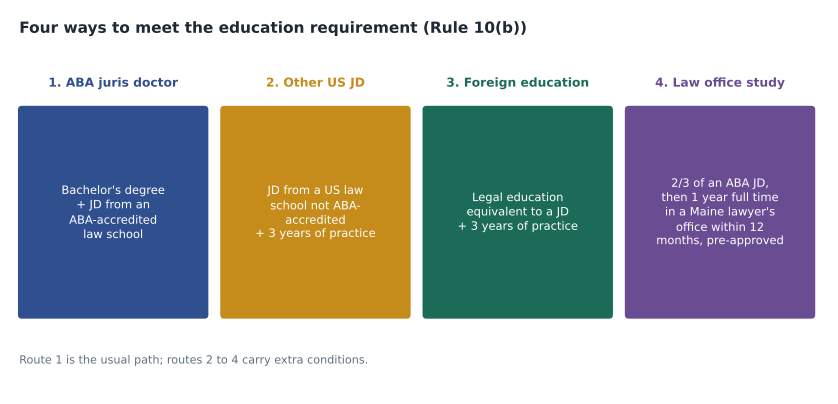
Rule 10(b) sets out the education requirement for admission by examination. An applicant qualifies in one of four ways. The first and most common is to hold a bachelor's degree, or its equivalent, and a juris doctor degree from a law school accredited by the American Bar Association. Almost every new graduate in Josie's study group meets this standard.
The second way is for a graduate of a law school in the United States that is not ABA-accredited. Such a graduate may qualify after practicing law for at least three years in a jurisdiction where the graduate is admitted. The third way covers graduates of law schools outside the United States: an applicant whose legal education is the equivalent of a juris doctor may qualify after at least three years of practice. NCBE's summary for Maine notes that foreign-educated applicants are eligible to sit, subject to these conditions.
The fourth way is the most unusual: law office study. Maine allows an applicant who has completed two-thirds of the requirements for a juris doctor at an ABA-accredited law school to finish preparing in the office of a Maine lawyer. The applicant must then study law full time for at least one year in the office of a member of the Maine bar, completed within a span of twelve months, under a plan approved in advance by the Board. The supervising lawyer certifies the study. Few applicants use this route, but it shows how Maine's rules preserve an older tradition of learning law in practice while still requiring most of a formal legal education.
An applicant who is unsure whether a degree or a period of practice qualifies should raise the question with the Board before the filing window closes, not after. The Board can ask for transcripts, a dean's certificate or evidence of practice, and gathering those papers takes time. The fee, as explained below, is not refunded if the applicant turns out to be ineligible.
The filing windows
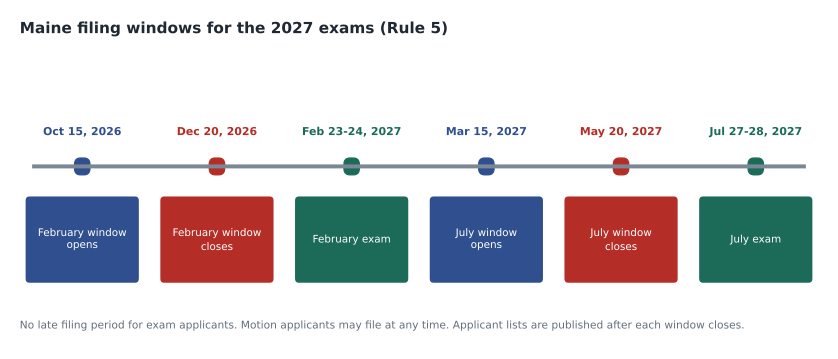
Rule 5 sets two filing windows each year. For the February exam, the application must be filed between October 15 and December 20 of the preceding year. For the July exam, the window runs from March 15 to May 20. These dates are firm. Applicants for admission on motion under Rule 11A are the one group that may file at any time, because they do not sit an exam.
Maine's windows are later and shorter than many states' deadlines. An applicant from a state with a single early deadline may assume that Maine works the same way and file far too early, before the window opens, or may hear about late filing periods elsewhere and assume Maine has one. Neither assumption is safe. A filing that arrives before the window opens may be returned, and a filing after the window closes will not be accepted for that exam.
The windows also connect to the character and fitness process. Under Rule 9, the Board publishes the names of applicants after each filing deadline, so that members of the bar and the public can come forward with information. That publication happens after May 20 and after December 20 each year. Applicants should expect their names to appear on that list.
Exam dates
Rule 10(c) fixes the exam dates by formula: the Uniform Bar Examination is given on the last Wednesday of February and July and on the Tuesday before it. For 2027, that means Tuesday, February 23 and Wednesday, February 24, and Tuesday, July 27 and Wednesday, July 28. An applicant can work out future dates from the formula, but should confirm them on the Board's announcements, which also give the location and reporting times.
Fees
Rule 6 sets the fees. An applicant who has never been admitted to practice anywhere, or who has been admitted for less than one year, pays 800 dollars to sit the exam. An applicant who has been admitted elsewhere for one year or more pays 900 dollars plus the fee NCBE charges for a character report. Admission on motion costs 1,000 dollars plus the NCBE fee. Admission by transferred score costs either 1,000 dollars or 900 dollars, depending on the applicant's prior admission, under the rule's schedule; a transfer applicant should read the current schedule before paying. The MPRE fee is paid separately to NCBE, and laptop software for the written portions may carry its own charge, which the Board's instructions explain.
Fees are nonrefundable. Rule 6 softens that rule in one way: an applicant who withdraws or does not sit may apply the fee as a credit toward one of the next four exams, subject to the Board's conditions. This matters in practice. An applicant who falls ill in January or whose job changes can preserve the fee by withdrawing properly and following the Board's instructions, rather than simply not appearing.
| Applicant | Fee under Rule 6 |
|---|---|
| Exam applicant never admitted, or admitted less than one year | 800 dollars |
| Exam applicant admitted elsewhere one year or more | 900 dollars plus the NCBE character report fee |
| Admission on motion (Rule 11A) | 1,000 dollars plus the NCBE character report fee |
| Transferred UBE score (Rule 11B) | 1,000 dollars or 900 dollars, depending on prior admission |
| Extension of time to be admitted on motion | 100 dollars for one six-month extension |
Accommodations
Rule 10(d) allows applicants with disabilities to request testing accommodations. The request must be made in writing with supporting documentation, and it should be filed with the application so the Board has time to review it and to arrange the testing room, extra time, breaks or equipment needed. An applicant who needs accommodations should not wait for the last days of the filing window, because the Board may need more documentation. Accommodations on the MPRE are requested separately through NCBE.
Attempts and retakes
Maine does not limit the number of times an applicant may sit the exam. Rule 10(f) provides that there is no limit on attempts. An applicant who fails can file again in the next window. There is one important connection to other routes, however. Under Rule 11A, an applicant who has failed the Maine bar exam within the past five years is not eligible for admission on motion. A lawyer who might later qualify on motion should weigh that rule before sitting the exam.
Worked problem
A late decision to sit
Theo, an invented applicant, graduated from an ABA-accredited law school in May 2026. On December 28, 2026 he decides he wants to sit the February 2027 Maine exam. What are his options?
Show solution
- Identify the window. The February 2027 window under Rule 5 ran from October 15 to December 20, 2026.
- Check for a late period. Rule 5 gives exam applicants no late filing period.
- Identify the next exam. The July 2027 exam falls on July 27 and 28, with a filing window from March 15 to May 20, 2027.
- Plan the fee and materials. As a never-admitted applicant he would pay 800 dollars and should prepare his character material before March.
Answer: Theo cannot sit in February 2027. He should prepare to file in the March 15 to May 20, 2027 window for the July exam.
Josie's checklist
By the end of the session Josie has a one-page checklist: education confirmed by a juris doctor from an ABA-accredited school and a bachelor's degree; filing window October 15 to December 20, filed November 2; fee of 800 dollars paid; no accommodations needed; MPRE score of 94 reported. She adds one line Marchetti suggests: 'If anything changes, write to the Board before the exam, not after.' Haskell, reading over her shoulder later that week, adds his own note: 'Keep a copy of everything you send them.'
Common mistakes
MistakeMaine has a late filing period for a higher fee.
InsteadRule 5 gives exam applicants fixed windows with no late period: October 15 to December 20 for February and March 15 to May 20 for July.
MistakeAny law degree qualifies.
InsteadA juris doctor from an ABA-accredited school qualifies directly; other degrees require three years of practice, and law office study has its own conditions.
MistakeAn unused fee is lost.
InsteadFees are nonrefundable, but the fee may be credited toward one of the next four exams under the Board's conditions.
MistakeFailing the Maine exam has no effect on other routes.
InsteadAn applicant who failed the Maine exam within five years is not eligible for admission on motion.
Practice problems
Work each problem on paper first, then reveal the answer to check.
When does the filing window for a July Maine exam open and close?
Show answer
It opens March 15 and closes May 20.
What fee does a never-admitted exam applicant pay?
Show answer
800 dollars.
Under the law office study route, how long must the applicant study in a Maine lawyer's office?
Show answer
At least one year of full-time study, completed within twelve months, after finishing two-thirds of an ABA juris doctor, under a plan approved in advance by the Board.
Reading Rule 5 closely
Rule 5 is short, and its brevity hides a few points worth noticing. The windows are defined by dates, not by business days, so a window that closes on a weekend still closes on that date. An application is filed when the Board receives it in the form the rule and the Board's instructions require, so an applicant who mails a paper form on the last day takes a real risk. And because the rule sets no late period, the Board has no fee schedule for late filings; there is simply no route into the exam once the window has closed.
Applicants coming from other states often carry assumptions that do not fit. Some states have one early deadline and a later deadline with a higher fee. Others open filing many months before the exam. Maine does neither. The best practice is to treat the opening date as the real target and to file within the first few weeks, leaving time to answer any questions the Board raises about education, prior admissions or the application itself.
When education raises a question
Most applicants never think about the education rule, because their juris doctor from an ABA-accredited school answers it. Three groups should think harder. The first is graduates of law schools that were not ABA-accredited when they graduated, who need three years of practice in a jurisdiction where they are admitted. The second is foreign-educated lawyers, who must show that their legal education is the equivalent of a juris doctor and that they have practiced for three years. The third is applicants interested in law office study, who must obtain the Board's approval before the year of office study begins, not after.
For each of these groups, the safest approach is to write to the Board early with the relevant documents and ask whether the education will qualify. The Board's answer before filing is far more useful than a denial after the fee is paid. An applicant should also confirm that the period of practice counts under the rule, because some kinds of work may not be treated as the practice of law.
Budgeting for the exam
Fees are only part of the cost. An applicant should also budget for the MPRE fee paid to NCBE, any laptop software charge, a commercial review course if the applicant uses one, travel to the exam site, a place to stay if the site is far from home and time away from work. For a working clerk, lost hours in the final weeks are often the largest cost. Josie's budget lists the 800-dollar fee she has already paid, two nights near the exam site and three weeks of reduced hours, which Haskell has agreed to.
Planning for the cost early also helps an applicant decide when to sit. An applicant who cannot reduce work hours before February may do better to file for July, when the timing may allow more study. The choice is personal, but it should be made with the whole cost in view, not just the fee.
Withdrawing the right way
Life does not always cooperate with exam dates. An applicant who falls ill, faces a family emergency or changes jobs after filing should read Rule 6 and the Board's instructions on withdrawal right away. A proper withdrawal preserves the option to apply the fee as a credit toward one of the next four exams. Simply failing to appear can make that harder. The applicant should withdraw in writing, keep a copy and confirm how the credit will be applied when the applicant files again.
Summary and key terms
- Rule 10(b) accepts an ABA juris doctor with a bachelor's degree, other degrees with three years of practice, or law office study after two-thirds of an ABA juris doctor.
- Rule 5 sets filing windows of October 15 to December 20 for February and March 15 to May 20 for July, with no late period.
- The exam is given on the last Wednesday of February and July and the Tuesday before.
- A never-admitted applicant pays 800 dollars; fees are nonrefundable but may be credited to one of the next four exams.
- There is no limit on attempts, but a failure within five years bars admission on motion.
- Filing window
- The fixed period in which an exam application must be filed under Rule 5.
- Law office study
- Maine's route allowing an applicant who has completed two-thirds of an ABA juris doctor to finish preparing in a Maine lawyer's office.
- Fee credit
- The Rule 6 option to apply an unused fee toward one of the next four exams.
- Testing accommodations
- Adjustments to exam conditions requested in writing under Rule 10(d).
Lesson quiz · 5 questions
Score 60% or more to complete this lesson.
Create a free account to save your progress, take quizzes and earn a certificate.