
BAR-220 · Lesson 1 of 12 · 18 min
Becoming a lawyer in Maine
▶ Video coming soon A video version of this lesson is on the way.
Josie Thibodeau joins Hollis Marchetti's study group in the fall of 2026 with a clear goal and a long drive. She grew up in Lewiston, in a Franco-American family where her grandmother still answers the phone in French, and she finished law school in Portland in May 2026. Over the summer she worked on a legal aid project helping tenants in Androscoggin County, and in September she started as a law clerk at Calvin Haskell's three-lawyer firm in Bangor. The firm handles probate estates, divorces, house closings, a few injury cases and, this fall, a claim against a town after one of its plow trucks backed into a client's parked car. She has decided to sit the February 2027 Maine bar exam, and Haskell wants her licensed by spring so she can take over the firm's probate court appearances.
'Maine is a small bar with a long memory,' Marchetti tells her at their first one-on-one session. 'There are a few thousand practicing lawyers, one law school and one supreme court that does almost everything. The rules are short and they are strict about dates. If you learn who does what and when each window opens and closes, the process is very manageable. The exam itself is the national Uniform Bar Examination, so most of your study time goes to general law, not to Maine law. Your job is to keep those two things separate.'
This lesson maps the whole path to a Maine law license: the bodies involved, the routes to admission, the order of the steps and the habits that keep an applicant out of trouble. Later lessons take each step in detail. The rules described here come from the Maine Bar Admission Rules as amended through March 2025, which the Maine Judicial Branch publishes, and from the jurisdiction information that the National Conference of Bar Examiners (NCBE) publishes for Maine.
Who does what
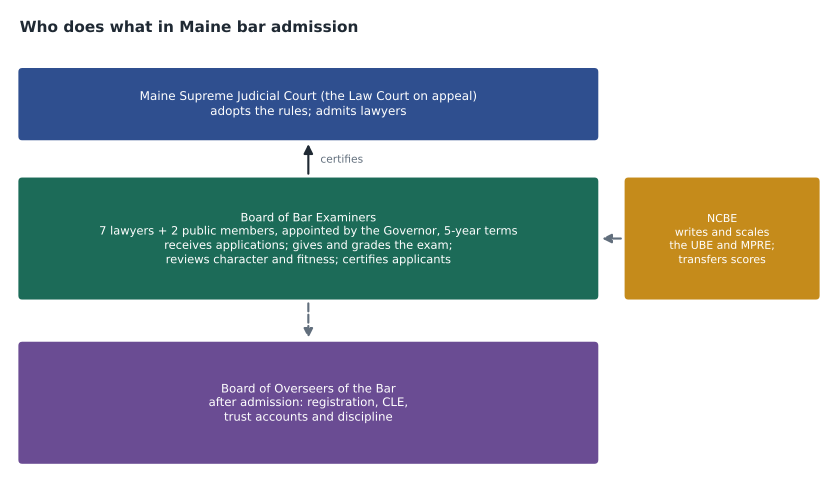
Three bodies matter most. The first is the Maine Supreme Judicial Court, the state's highest court. It adopts the Maine Bar Admission Rules and the Maine Bar Rules, and it is the court that admits lawyers to practice. When the court sits to decide appeals it is called the Law Court, a name that appears in every Maine case citation and that new lawyers learn quickly.
The second is the Maine Board of Bar Examiners. Under Rule 3 of the Bar Admission Rules, the Board has nine members: seven lawyers and two members of the public. The Governor appoints them, and the lawyer members are appointed on the recommendation of the Supreme Judicial Court. Members serve five-year terms. The Board receives applications, collects fees, administers the exam, grades the written answers, investigates character and fitness and, when an applicant has met every requirement, issues a certificate of qualification. The Board's mailing address is in Brunswick, and its own website carries the current forms, deadlines and announcements.
The third is the Board of Overseers of the Bar. It does not admit anyone, but it governs a Maine lawyer's life after admission: annual registration, continuing legal education, trust account rules and lawyer discipline. Applicants meet the Overseers twice before they are licensed. An out-of-state lawyer who seeks admission on motion must designate the Board of Overseers as agent for service of process, and every new lawyer registers with the Overseers soon after taking the oath.
NCBE is a fourth player, but only in a supporting role. It writes the Uniform Bar Examination and the Multistate Professional Responsibility Examination (MPRE), scales the scores, runs the score transfer service and offers character investigation services that many boards use. NCBE does not decide who is admitted in Maine. When an applicant reads something on NCBE's site that seems to conflict with Maine's own rules, the Maine rules and the Maine Board's announcements control.
The routes to a Maine license
Maine offers several routes to admission. Most new law graduates take the bar exam. Under Rule 10, an applicant for admission by examination must meet the education requirement, pass the Uniform Bar Examination given in Maine and satisfy the character and fitness requirement in Rule 9. Rule 11 adds the MPRE: a scaled score of at least 80, earned within fifteen years. Lesson 2 covers the education requirement in detail, including Maine's unusual law office study option.
A lawyer who already holds a Uniform Bar Examination score from another jurisdiction may seek admission by transferred score under Rule 11B. The score must meet Maine's current passing score and must have been earned within the past three years. An experienced lawyer licensed elsewhere may seek admission on motion under Rule 11A after practicing for at least three of the past five years. Both routes still require the MPRE and character and fitness review, and both are covered in Lesson 11.
There is no diploma privilege in Maine, so graduating from Maine's law school does not by itself admit anyone. There is also no Maine-specific component on the exam. Maine law matters to the new lawyer, but it is learned for practice and for the continuing legal education course described in Lesson 11, not tested on the exam.
| Route | Main rule | Core requirements | Who uses it |
|---|---|---|---|
| Admission by examination | Rule 10 | Education, UBE given in Maine, MPRE 80, character and fitness | Most new graduates |
| Transferred UBE score | Rule 11B | Score meeting Maine's current passing score, earned within three years, same education and MPRE | Recent examinees from other UBE jurisdictions |
| Admission on motion | Rule 11A | Active practice three of the past five years, ABA law degree, MPRE, good standing | Experienced lawyers licensed elsewhere |
| Temporary practice | Rule 11C | Employment with a public defense or legal services provider, up to two years | Lawyers serving low-income clients |
The order of the steps
For an examination applicant, the steps run in a fixed order. The applicant confirms eligibility, takes the MPRE, files the application and fee within the filing window, completes the character and fitness review, sits the exam, receives the result, is certified as qualified by the Board and is admitted by the court. After admission the new lawyer registers with the Board of Overseers and begins meeting continuing legal education duties.
Some steps can overlap. The MPRE can be taken before or after the bar exam, and many Maine applicants take it during law school. The character and fitness review runs while the applicant studies. The exam result and the character and fitness decision are separate, so an applicant can pass the exam and still wait for the character review to finish, or the reverse.
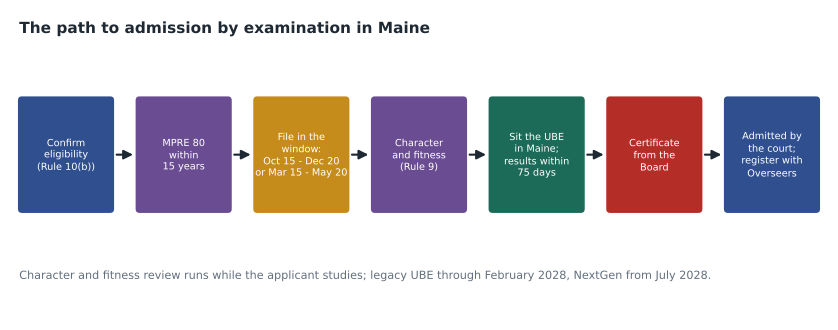
For Josie, the timeline looks like this. She took the MPRE in March 2026 and scored 94, well above the 80 Maine requires. The filing window for the February 2027 exam opened on October 15, 2026, and she filed on November 2, about seven weeks before the window closes on December 20. The exam itself falls on Tuesday, February 23 and Wednesday, February 24, 2027. Results come within seventy-five days of the exam under Rule 10(e). If she passes and her character review is complete, she can be admitted in the spring.
Worked problem
Planning backward from the exam
An applicant who graduated in May 2026 decides on November 1, 2026 to sit the February 2027 Maine exam. She has not yet taken the MPRE. What should her plan include?
Show solution
- Check the filing window. For the February exam, Rule 5 sets a window from October 15 to December 20, so she can still file, but she should not wait until the last week.
- Check the MPRE. Maine requires a scaled score of 80 within fifteen years. She can take the MPRE after the bar exam, but admission waits until she has the score.
- Gather the character and fitness material now, because the review starts when she files and the burden of proof is on her.
- Build a study schedule that covers the general law tested on the UBE, since Maine has no state component on the exam.
Answer: She should file well before December 20, register for the next available MPRE, assemble her character material and start a UBE study plan. Missing the window would push her to the July 2027 exam, whose filing window runs from March 15 to May 20, 2027.
Small-bar habits that help
Marchetti gives Josie three habits for the months ahead. The first is to keep a single source file. Every rule she relies on goes in with its citation and the date she last checked it: Rule 5 for filing windows, Rule 6 for fees, Rule 9 for character and fitness, Rule 10 for the exam, Rule 11 for the MPRE. When a rule changes, she updates the entry and notes what changed. Maine amends its rules from time to time, and the version in a study guide or a classmate's memory may be out of date.
The second habit is to read the Board's own announcements. The Board publishes the passing score, the exam location, laptop instructions and any changes to procedure. NCBE's jurisdiction pages summarize those facts, but the Board is the source. If the Board's website is slow or unavailable, Josie can call or write to the Board; she should not rely on a forum post.
The third habit is candor. Maine's character and fitness rule places the burden on the applicant, and Maine is a place where people know each other. A forgotten parking ticket or a college disciplinary note is rarely a problem when it is disclosed. The same fact, discovered after an applicant left it out, can delay admission for months. Lesson 3 explains the process and how to prepare a careful application.
'Write the deadlines on paper,' Marchetti says, 'and tape them somewhere you will see them every day. Then forget about them and study. The process rewards people who are organized early and calm later.'
What this course covers
The twelve lessons follow the path in order. Lessons 2 and 3 cover eligibility, education, filing windows, fees, character and fitness and the MPRE. Lessons 4 to 6 cover the exam: the legacy Uniform Bar Examination that Maine gives through February 2028, the NextGen exam that replaces it in July 2028 and what the exam does and does not test. Lessons 7 to 10 introduce the Maine law a new lawyer meets in the first year of practice: the courts and civil procedure, tort law and the Maine Tort Claims Act, the Wabanaki Nations and Maine law, and family law, probate and professional conduct. Lesson 11 covers score transfer, admission on motion and the duties that begin after admission. Lesson 12 is a capstone with practice questions and an exam-day plan.
Throughout the course, Josie's story shows how the rules work for one applicant. Her facts are invented, as are the facts in every example and practice question. None of the practice questions are released bar exam questions.
Common mistakes
MistakeGraduating from Maine's law school admits you to practice in Maine.
InsteadMaine has no diploma privilege. Graduates must pass the bar exam or qualify by another route.
MistakeNCBE decides who is admitted in Maine.
InsteadNCBE writes and scales the exams. The Board of Bar Examiners certifies applicants and the Supreme Judicial Court admits them.
MistakeThe Maine bar exam has a Maine law section.
InsteadMaine gives the Uniform Bar Examination with no Maine component.
MistakeThe Board of Overseers handles bar applications.
InsteadThe Board of Bar Examiners handles applications. The Board of Overseers governs registration, CLE and discipline after admission.
Practice problems
Work each problem on paper first, then reveal the answer to check.
Which body issues the certificate of qualification for a Maine applicant?
Show answer
The Maine Board of Bar Examiners, after the applicant has met every requirement.
How many members does the Board of Bar Examiners have, and how are they chosen?
Show answer
Nine: seven lawyers and two public members, appointed by the Governor, with the lawyer members appointed on the recommendation of the Supreme Judicial Court, for five-year terms.
What is the Law Court?
Show answer
The name used for the Maine Supreme Judicial Court when it sits to decide appeals.
A first look at the calendar
Before the session ends, Marchetti and Josie lay out the calendar for the rest of the process on a single sheet. October 15, 2026: the February window opens. November 2: Josie files. December 20: the window closes, and the Board publishes the list of applicants soon after. February 23 and 24, 2027: the exam. Early May 2027 at the latest: results, because Rule 10(e) requires them within seventy-five days. Spring 2027: the certificate of qualification, admission and registration with the Board of Overseers.
Marchetti adds a second column for what Josie controls. She controls her filing date, the completeness of her application, her MPRE score report and her study plan. She does not control how long the character review takes or when results are released. 'Spend your energy on the first column,' Marchetti says. 'The second column takes care of itself if the first one is done well.'
Josie also writes down who to call. For questions about her application, fees or the exam itself, she contacts the Board of Bar Examiners. For questions about her MPRE score report, she contacts NCBE. For questions about registration after admission, she will contact the Board of Overseers. Knowing which office handles which question saves days of waiting for an answer from the wrong place.
Summary and key terms
- The Maine Supreme Judicial Court adopts the admission rules and admits lawyers; it is called the Law Court when it decides appeals.
- The Board of Bar Examiners has seven lawyers and two public members appointed by the Governor for five-year terms.
- Most applicants are admitted by examination; others transfer a UBE score or seek admission on motion.
- Maine has no diploma privilege and no Maine component on the exam.
- The Board of Overseers of the Bar governs registration, CLE and discipline after admission.
- Law Court
- The Maine Supreme Judicial Court sitting as the court that decides appeals.
- Board of Bar Examiners
- The nine-member body that administers the Maine bar exam and certifies applicants as qualified.
- Board of Overseers of the Bar
- The body that governs registration, continuing legal education and discipline for Maine lawyers.
- Certificate of qualification
- The Board of Bar Examiners' certification that an applicant has met every requirement for admission.
Lesson quiz · 5 questions
Score 60% or more to complete this lesson.
Create a free account to save your progress, take quizzes and earn a certificate.