
BAR-220 · Lesson 5 of 12 · 18 min
Exam changes ahead: NextGen in July 2028
▶ Video coming soon A video version of this lesson is on the way.
Two members of Marchetti's study group, Marcus and Tessa, already know the NextGen bar exam well, and one Tuesday evening they describe it for the others. Marcus passed the first NextGen exam in July 2026; Tessa is sitting it in February 2027. Josie listens closely even though she is sitting the old exam. 'Maine switches in July 2028,' she says. 'If I pass in February, I never see it. But the lawyers I supervise someday will have taken it, and if something goes wrong in February I still have two more chances at the old exam before the change.'
This lesson explains Maine's move from the legacy Uniform Bar Examination to the NextGen bar exam: when it happens, what the new exam looks like, how it is scored and what Maine has not yet decided. It is written for applicants who may sit either exam and for those who will advise them.
Maine's timeline
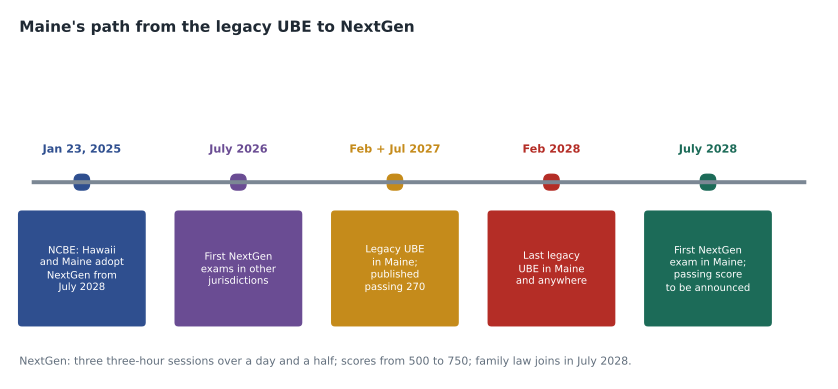
NCBE announced on January 23, 2025 that Hawaii and Maine would begin giving the NextGen bar exam in July 2028. NCBE's jurisdiction information for Maine shows the same plan: the last legacy UBE in Maine will be the February 2028 exam, and the first NextGen exam will be the July 2028 exam. February 2028 is also the last time NCBE plans to give the legacy UBE anywhere, so Maine is among the last jurisdictions to make the change rather than among the first.
That timing gives Maine applicants an unusual amount of runway. An applicant who sits in February 2027 and does not pass has two more legacy administrations before the change: July 2027 and February 2028. After that, every retake is on the NextGen format. An applicant who graduates in May 2027 can still sit two legacy exams. Students who entered law school in the fall of 2025 will graduate into the NextGen era.
What the NextGen exam looks like
The NextGen exam is a single integrated exam rather than three separately named parts. NCBE's design calls for three sessions of three hours each over a day and a half, with two sessions on the first day and one on the second. Each session contains about 40 multiple-choice questions, two integrated question sets and one performance task. The exam is computer-based and given in person at the jurisdiction's test site using NCBE's secure software on examinees' laptops.
The multiple-choice questions include standard single-answer questions and select-two questions, in which the examinee chooses two correct options from a longer list and can earn partial credit. Integrated question sets present one fact pattern followed by several questions that can mix multiple-choice and short written answers, and they may test more than one subject and skill at once. Performance tasks take the place of the MPT. They give the examinee a file and a library and ask for a written product; some are research tasks that test the ability to find and use authority inside a supplied library.
NCBE's scoring rules give select-one questions up to one point, select-two questions up to two points with partial credit, short written answers up to two points, drafting answers up to eight points and standard performance tasks up to twenty-four points. The three question types carry approximate weights of 49 percent for multiple choice, 21 percent for integrated question sets and 30 percent for performance tasks. Each session also includes some unscored pretest items.
| Feature | Legacy UBE (Maine through February 2028) | NextGen (Maine from July 2028) |
|---|---|---|
| Structure | MEE, MPT and MBE as separate parts | Three integrated sessions |
| Length | Two full days | A day and a half |
| Multiple choice | 200 single-answer questions | About 40 per session, including select-two |
| Written work | Six essays and two performance tests | Integrated question sets and three performance tasks |
| Delivery | Laptop or handwritten written portions | Computer-based with NCBE software |
| Score scale | 400 points; Maine has published 270 | 500 to 750; Maine score not yet announced |
What NextGen tests
Through February 2028, the NextGen exam tests foundational concepts and principles in eight subjects: business associations, civil procedure, constitutional law, contracts, criminal law, evidence, real property and torts. Beginning in July 2028, which is Maine's first NextGen exam, family law joins the list. Trusts and estates may appear in performance tasks and integrated sets with the needed law supplied. NCBE's content scope marks some topics as ones examinees must know from memory, while others may be tested with the law provided.
The exam also tests foundational lawyering skills, among them legal research, legal writing, issue spotting and analysis, investigation and evaluation, client counseling and advising, negotiation and dispute resolution, and client relationship and management. A short list of professional responsibility rules is tested within skills questions, so some ethics knowledge is needed on the bar exam itself, even though Maine continues to require the MPRE as a separate exam.
For a Maine applicant in July 2028, family law matters twice: once on the national exam, where it will be tested as general law, and again in Maine practice, where the family law of Title 19-A governs. Lesson 10 introduces that Maine law.
Scoring and Maine's passing score
The NextGen exam produces one scaled score on a range of 500 to 750. NCBE scores the multiple-choice items and jurisdiction graders score the written answers using NCBE's rubrics. The score is equated so that it means the same thing from one administration to the next, and it does not depend on how other examinees performed. NCBE has advised that legacy and NextGen scores should not be compared number to number.
As of November 2026, NCBE's information for Maine lists the NextGen passing score as to be announced. Several jurisdictions that adopted NextGen earlier chose 610, and others chose different numbers. Because Maine's rule leaves the passing score to the Board, Maine can set its NextGen score by announcement rather than by rule amendment. An applicant planning for July 2028 should watch for the Board's announcement and should not assume Maine will choose any particular number.
Score transfer will change too. NCBE has said that NextGen scores can be transferred among jurisdictions that accept them. Maine's transfer rule, described in Lesson 11, requires a transferred score to meet Maine's current passing score, so Maine will need to set a NextGen standard for incoming NextGen scores. Until the Board does so, an applicant hoping to bring a NextGen score into Maine should ask the Board directly.
Worked problem
Which exam will an applicant sit?
Three invented applicants want to sit in Maine. Ana graduates in May 2027. Ben graduates in May 2028. Cal sits in February 2028, does not pass and wants to retake as soon as possible. Which exam will each face?
Show solution
- Ana can sit the July 2027 or February 2028 exam, both legacy UBEs.
- Ben's first chance after graduation is July 2028, Maine's first NextGen exam.
- Cal's February 2028 exam is the last legacy UBE; his retake in July 2028 will be NextGen.
- For Cal, the content shift matters most: family law joins the foundational subjects and the format changes completely.
Answer: Ana sits a legacy exam, Ben sits NextGen and Cal must switch from the legacy format to NextGen for his retake.
Preparing during the transition
Marcus's advice for the group is practical. 'The law is mostly the same,' he says. 'Negligence is still negligence. What changes is how they ask. You need to be fast at reading a file and pulling out what matters, because every session has a performance task. And the select-two questions punish you for guessing on one of the two.' Tessa adds that the integrated sets feel like a client walking in with several problems at once.
For Josie, the lesson has a narrow practical point. She is sitting the legacy exam, so her study plan follows the MBE, MEE and MPT. But she keeps a page of notes on NextGen for one reason: if February does not go well, she will retake the legacy exam in July 2027, and she wants to be sure she never needs to switch formats midstream. Marchetti approves. 'Plan to pass the first time,' she says, 'and know your fallback.'
Common mistakes
MistakeMaine adopted NextGen in 2026 along with the first group of states.
InsteadMaine begins NextGen in July 2028, after its last legacy UBE in February 2028.
MistakeMaine's NextGen passing score is 610.
InsteadAs of November 2026, Maine's NextGen passing score has not been announced.
MistakeNextGen keeps the MEE and MPT as separate parts.
InsteadNextGen uses three integrated sessions with multiple-choice questions, integrated question sets and performance tasks.
MistakeLegacy and NextGen scores can be compared directly.
InsteadThey use different scales, and NCBE advises against direct comparison.
Practice problems
Work each problem on paper first, then reveal the answer to check.
When is Maine's first NextGen exam?
Show answer
July 2028.
What score range does NextGen use?
Show answer
500 to 750.
Which subject joins NextGen's foundational subjects in July 2028?
Show answer
Family law.
Why NCBE built a new exam
NCBE developed the NextGen exam after a multiyear study of what newly licensed lawyers actually do in their first years of practice. The study surveyed lawyers across the country and found that new lawyers rely heavily on skills such as research, writing, issue spotting and client counseling, and that they look up much of the detailed law they use rather than recalling it from memory. The NextGen design responds to those findings. It tests a narrower set of legal concepts that new lawyers should know without looking them up and gives more weight to skills applied to realistic tasks.
That design choice changes how an examinee should prepare. On the legacy MBE, detailed rule knowledge across seven subjects is rewarded directly. On NextGen, foundational concepts still matter, but more of the score comes from working with materials: reading a file, finding the relevant authority in a library and producing a useful written product under time pressure. An examinee who has practiced only memorization may find the performance tasks and integrated sets difficult.
What carries over
Much of what an examinee learns for the legacy exam carries over. The foundational subjects are largely the same, with business associations included and family law added in July 2028. The MPT is the closest legacy relative of the NextGen performance task, so an examinee who has become efficient at MPTs has a head start. The habits that help on MEE essays, such as stating the rule clearly before applying it, help on the short written answers in integrated question sets.
What does not carry over well is the rhythm of the legacy exam. A legacy examinee spends a full morning on essays and two full sessions on multiple choice. A NextGen examinee switches formats within each session, moving from multiple-choice items to an integrated set to a performance task. Practicing that switch under timed conditions is an important part of NextGen preparation.
Planning for an uncertain point
An applicant who expects to sit in July 2028 or later should watch for three announcements from the Board: Maine's NextGen passing score, any changes to the filing windows or procedures for computer-based testing and Maine's standard for accepting transferred NextGen scores. Until those announcements are made, the applicant should plan on the general NextGen format published by NCBE and on Maine's existing rules for everything else, such as the filing windows, fees and character and fitness review.
Law students in Maine have an additional reason to pay attention. Students who started law school in the fall of 2025 will graduate in May 2028, just before the change. If they sit in July 2028 they will take NextGen; if they somehow sat in February 2028, before graduating, they would not meet the education requirement. In practice, nearly all of them will be NextGen examinees, and their law school courses and bar preparation should reflect that.
Score transfer during the change
The change also affects lawyers who move between states. A lawyer who earns a legacy UBE score in 2027 may want to transfer it to another jurisdiction after that jurisdiction has switched to NextGen. NCBE has said that jurisdictions will set their own policies on accepting legacy scores after the change, and many have announced that they will continue to accept legacy scores for a period. A lawyer planning such a move should check the receiving jurisdiction's policy rather than assuming that the score will be accepted.
For incoming transfers to Maine, the rule remains Rule 11B: the score must meet Maine's current passing score and must have been earned within three years. A legacy score earned in 2027 can be transferred to Maine for three years after the exam at which it was earned, if it meets Maine's current passing score, subject to any change the Board announces. Lesson 11 covers transfers in detail.
Josie's fallback page
Josie's single page on NextGen ends with three lines. First, Maine's last legacy exam is February 2028, so she has two retakes on the legacy format if she needs them. Second, if she ever needs to sit NextGen, she will need to practice performance tasks and select-two questions. Third, the passing score for Maine's NextGen exam is not yet known. She files the page at the back of her binder and hopes never to read it again.
Summary and key terms
- NCBE announced on January 23, 2025 that Maine and Hawaii would adopt NextGen in July 2028.
- Maine's last legacy UBE is February 2028, also the last legacy UBE anywhere.
- NextGen has three three-hour sessions over a day and a half, each with about 40 multiple-choice questions, two integrated sets and a performance task.
- NextGen scores run from 500 to 750; Maine has not yet announced its NextGen passing score.
- Family law joins NextGen's foundational subjects in July 2028.
- NextGen bar exam
- NCBE's integrated, computer-based bar exam that replaces the legacy UBE.
- Integrated question set
- A NextGen item with one fact pattern and several questions that may mix formats and subjects.
- Select-two question
- A NextGen multiple-choice item in which the examinee chooses two correct options, with partial credit.
- Performance task
- A NextGen skills task that asks for a written product from a supplied file and library.
Lesson quiz · 5 questions
Score 60% or more to complete this lesson.
Create a free account to save your progress, take quizzes and earn a certificate.